The atomic bomb represents one of humanity’s most profound and terrifying scientific achievements, fundamentally altering the course of history and international relations since its first deployment in 1945. Understanding how atomic bomb works requires delving into the intricate physics of nuclear fission, the engineering marvels that harness this energy, and the devastating consequences that follow detonation. This comprehensive examination reveals how scientists transformed Einstein’s theoretical equation E=mc² into weapons of unprecedented destructive power, utilising uranium-235 and plutonium-239 to create chain reactions that release energy equivalent to thousands of tons of conventional explosives. From the gun-type assembly of Little Boy to the sophisticated implosion design of Fat Man, these weapons demonstrate both human ingenuity and the sobering responsibility that accompanies such knowledge. Can humanity ever truly control such power?
What you’ll learn: Discover the intricate science of nuclear fission, the engineering behind the first atomic bombs, their devastating effects, and the enduring legacy of the nuclear age. From Hiroshima and Nagasaki to the ongoing nuclear arms race, explore how this profound scientific achievement continues to shape our world.
Introduction to atomic bombs
What is an atomic bomb?
An atomic bomb, also known as a nuclear weapon, is a devastating explosive device that derives its destructive power from nuclear reactions—specifically nuclear fission. Unlike conventional explosives that rely on chemical reactions, atomic bombs harness the immense energy stored within atomic nuclei, making them exponentially more powerful than traditional weapons. The fundamental principle underlying nuclear weapon science involves the splitting of heavy atomic nuclei, which releases tremendous amounts of energy according to Einstein’s famous equation E=mc².
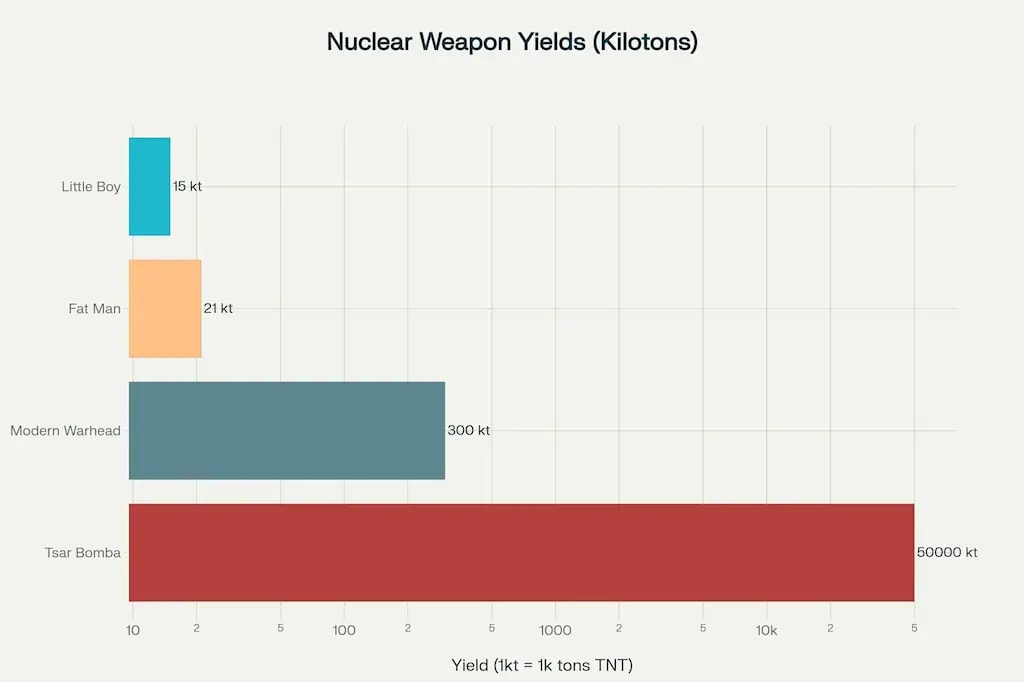
The destructive capability of these weapons is staggering. The bomb used on Hiroshima contained approximately 50 kg of uranium-235, yet packed the explosive power of 15,000 tons of TNT. This represents an energy density that far exceeds anything achievable through conventional means, demonstrating why nuclear weapons fundamentally changed warfare and international relations.
Brief history and origins
The development of atomic weapons traces back to the Manhattan Project, a massive scientific undertaking during World War II led by the United States in collaboration with the United Kingdom and Canada. Nuclear physicist J. Robert Oppenheimer directed the Los Alamos Laboratory that designed the bombs, whilst Major General Leslie Groves oversaw the entire programme. The project employed nearly 130,000 people at its peak and cost nearly US$2 billion, equivalent to about $27 billion in today’s money.
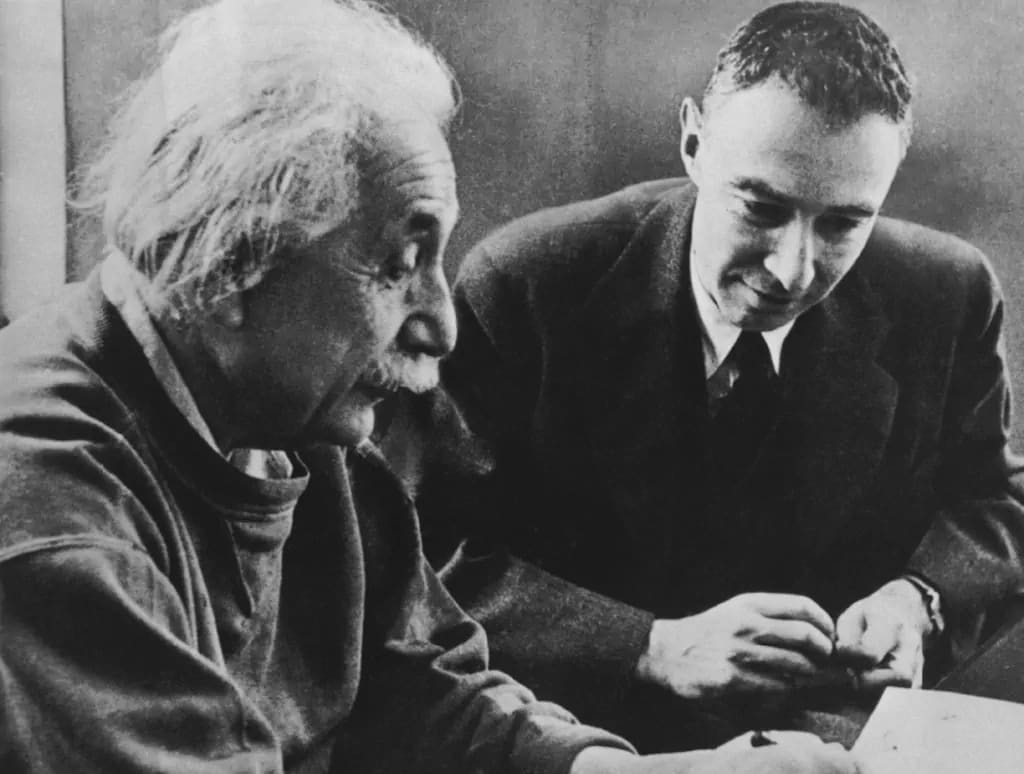
The Manhattan Project’s origins can be traced to British physicist Mark Oliphant’s crucial intervention in 1941. When Oliphant visited Washington, he discovered that British reports on uranium-235 fission potential were locked away unused. His subsequent meeting with Ernest Lawrence and Robert Oppenheimer at Berkeley reinvigorated the American atomic bomb project, demonstrating how international scientific collaboration accelerated nuclear weapons development.
The first successful test, codenamed Trinity, occurred on 16 July 1945 in New Mexico. This test validated the implosion design that would later be used in the Fat Man bomb dropped on Nagasaki. The project culminated in the deployment of two distinct weapon designs: Little Boy (uranium gun-type) over Hiroshima and Fat Man (plutonium implosion-type) over Nagasaki.
The science of nuclear fission
Understanding nuclear fission
Nuclear fission represents the fundamental scientific principle behind atomic bomb mechanics. Fission occurs when a heavy nucleus, such as uranium-235 or plutonium-239, absorbs a neutron, becomes unstable, and splits into two lighter nuclei. This process releases a tremendous amount of energy, typically around 200 million electron volts per fission event—millions of times more energy than chemical reactions.

The fission process becomes self-sustaining through what scientists call a chain reaction. When a uranium-235 atom absorbs a neutron and fissions, it releases three new neutrons along with significant binding energy. These newly released neutrons can then strike other uranium-235 nuclei, causing them to fission and release more neutrons, creating an exponentially growing reaction.
Key fissile materials
The isotopes uranium-235 and plutonium-239 were selected by atomic scientists because they readily undergo fission when struck by neutrons. These materials possess unique nuclear properties that make them suitable for weapons applications. Uranium-235, containing 92 protons and 143 neutrons, comprises only 0.7% of naturally occurring uranium. The remainder consists of uranium-238, which cannot sustain a chain reaction and must be separated through the complex process of uranium enrichment.
Plutonium-239 presents different advantages and challenges. It has the smallest critical mass of all common nuclear fuels—approximately 11 kg in a spherical, untampered configuration. Plutonium-239 is not naturally occurring but is produced in nuclear reactors when uranium-238 absorbs neutrons. This artificial production route made plutonium an attractive alternative when uranium-235 proved difficult to obtain in sufficient quantities.
Critical mass and chain reactions
Critical mass represents the minimum amount of fissile material required to sustain a nuclear chain reaction. This concept is crucial to understanding atomic bomb principles. When fissile material reaches critical mass, each fission event produces, on average, exactly one additional fission. Below this threshold (subcritical), the chain reaction dies out; above it (supercritical), the reaction grows exponentially.

The critical mass depends on several factors including the material’s density, shape, purity, and surrounding environment. For weapons applications, engineers manipulate these variables to achieve supercriticality rapidly. The presence of a neutron reflector or tamper can significantly reduce the required critical mass by bouncing escaping neutrons back into the fissile core.
Energy release mechanisms
The extraordinary energy release in nuclear fission stems from the conversion of a small amount of matter into energy, following Einstein’s mass-energy equivalence principle E=mc². When heavy nuclei split, the resulting fragments have slightly less total mass than the original nucleus. This “mass defect” converts directly into energy, producing the devastating power characteristic of nuclear weapons.
The fission of one atom of plutonium-239 generates 207.1 MeV of energy, equivalent to approximately 23 gigawatt hours per kilogram of material. However, not all fissile material in a weapon undergoes fission. In the Hiroshima bomb, only about 1 kg of the 64 kg uranium core actually fissioned, yet this small amount still produced a 15-kiloton explosion.
Types of atomic bombs
Gun-type assembly: the Little Boy design
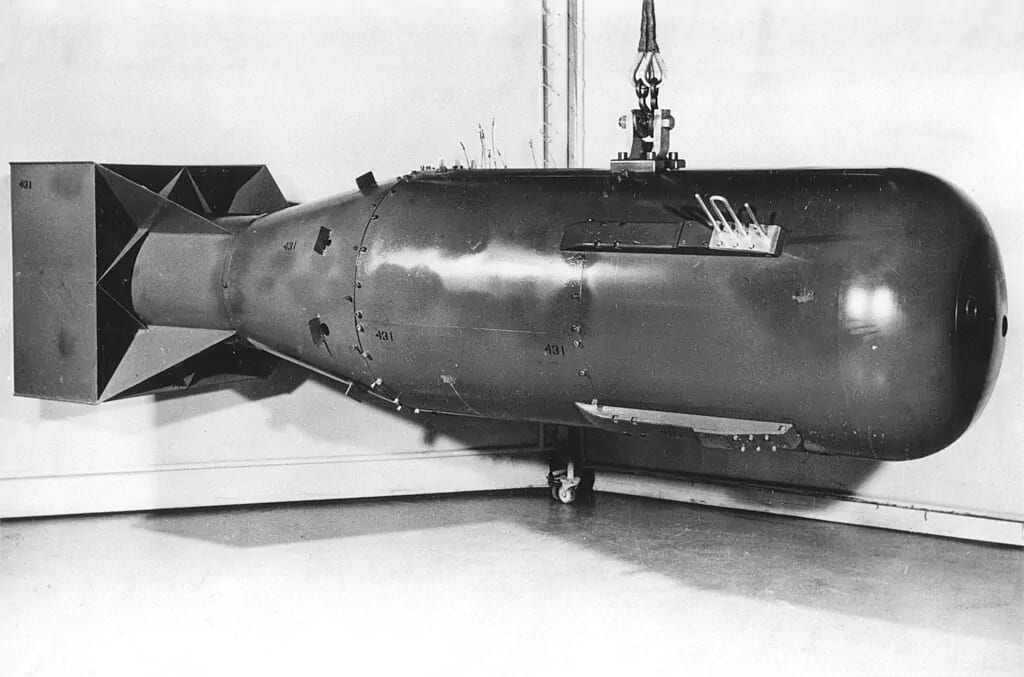
The gun-type fission weapon represents the simpler of the two primary atomic bomb designs. This mechanism assembles fissile material into a supercritical mass by literally shooting one subcritical piece into another, much like firing a bullet down a gun barrel. The Little Boy bomb dropped on Hiroshima exemplified this design, using highly enriched uranium-235 as its fissile material.
In the gun-type assembly, a hollow projectile of uranium-235 (the “bullet”) is fired through an artillery barrel into a solid cylinder of the same material (the “target”). The projectile is propelled by conventional explosives, and when it strikes the target, the combination of compression and increased mass pushes the uranium beyond critical mass, initiating the chain reaction.

This design was considered almost certain to work and was never tested prior to its use at Hiroshima. The confidence in the gun-type mechanism stemmed from its relative simplicity compared to the implosion design. However, the gun-type weapon is highly inefficient—the weapon used on Hiroshima contained 64 kilograms of uranium, but less than a kilogram underwent nuclear fission.
Implosion-type assembly: the Fat Man design
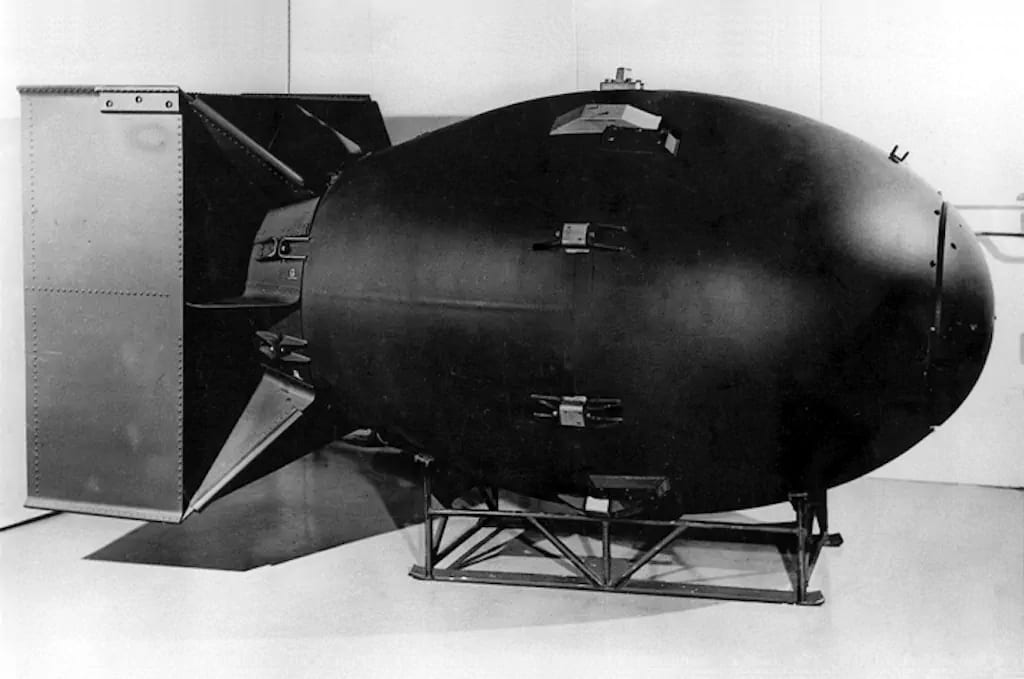
The implosion-type weapon represents a more sophisticated approach to achieving supercriticality. Fat Man, the bomb dropped on Nagasaki, demonstrated this design using plutonium-239 as its fissile material. The implosion method became necessary because plutonium’s high spontaneous fission rate made it unsuitable for gun-type weapons.
In an implosion bomb, a subcritical sphere of plutonium sits at the centre, surrounded by carefully shaped high-explosive charges. When these explosives detonate simultaneously, they create a precisely directed implosion that compresses the plutonium core to supercritical density. This compression increases the material’s density sufficiently to sustain a chain reaction whilst reducing the critical mass required.
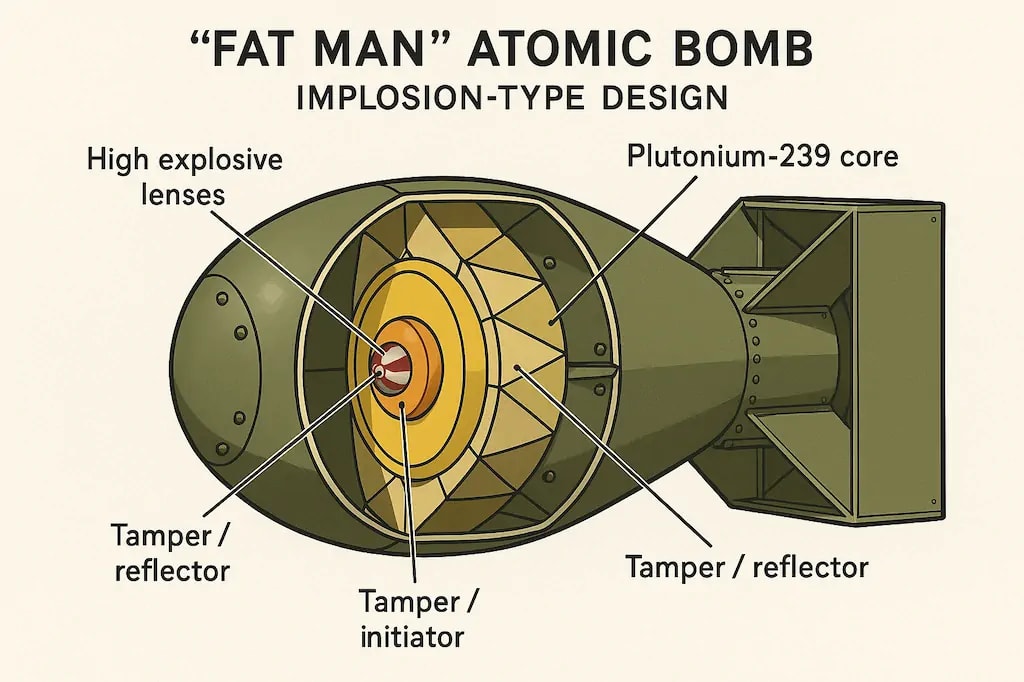
The implosion design required extraordinary precision in timing and explosive shaping. The high explosives must detonate within microseconds of each other to create a perfectly symmetrical compression wave. Any asymmetry would result in the plutonium being squeezed out sideways rather than compressed uniformly, preventing the achievement of supercriticality.
Thermonuclear weapons: beyond fission
Whilst this article focuses primarily on fission-based atomic bombs, understanding the distinction between atomic and hydrogen bombs is crucial for comprehensive knowledge. Thermonuclear weapons, also called hydrogen bombs, use nuclear fission to initiate nuclear fusion reactions. These weapons achieve much greater yields by combining light nuclei rather than splitting heavy ones.

Modern nuclear weapons work by combining chemical explosives, nuclear fission, and nuclear fusion. The fission stage creates the extreme temperatures and pressures necessary to ignite fusion in hydrogen isotopes like deuterium and tritium. This multi-stage process can produce explosions thousands of times more powerful than the original fission bombs.
The Soviet Union’s Tsar Bomba, detonated in 1961, demonstrated the terrifying potential of thermonuclear weapons. This three-stage bomb produced an explosion approximately 3,000 times more powerful than the Hiroshima bomb, illustrating how fusion technology exponentially increased destructive capability.
Components of an atomic bomb
The fissile core
The fissile core represents the heart of any atomic weapon, containing the uranium-235 or plutonium-239 that undergoes nuclear fission. In gun-type weapons like Little Boy, the fissile material is divided into two subcritical masses that are brought together during detonation. The hollow uranium “bullet” weighs approximately 25 kg, whilst the cylindrical “target” contains the remaining uranium.
Implosion-type weapons feature a solid sphere of plutonium-239, typically weighing around 6.2 kg and roughly the size of a softball before compression. The plutonium must be of extremely high purity, as the presence of plutonium-240 can cause premature detonation due to its high spontaneous fission rate. This purity requirement makes weapons-grade plutonium production technically challenging and closely monitored internationally.
High explosives and initiation systems
Conventional high explosives play crucial roles in both weapon types, though their functions differ significantly. In gun-type weapons, the explosives simply propel the uranium bullet down the barrel at high velocity. However, implosion weapons require precisely shaped explosive charges designed to create perfectly symmetrical compression waves.
The high explosives in Fat Man consisted of approximately 5,300 pounds of carefully shaped charges arranged around the plutonium core. These explosives, typically materials like HMX, RDX, or TATB, must detonate simultaneously within microseconds to achieve the required compression symmetry. The detonation system includes multiple detonators connected by an intricate wiring system that ensures precise timing.
Neutron initiators and reflectors
Neutron initiators provide the initial neutrons necessary to start the chain reaction at the optimal moment. In both Little Boy and Fat Man, polonium-beryllium initiators served this function. These devices consist of polonium (which emits alpha particles) separated from beryllium by a thin barrier. When the weapon’s compression or impact breaks this barrier, alpha particles strike the beryllium, producing neutrons that initiate fission.
Neutron reflectors, often called tampers, surround the fissile core to improve efficiency. These dense materials, such as natural uranium or tungsten carbide, serve dual purposes: reflecting escaping neutrons back into the core and providing inertial confinement to delay the weapon’s disassembly. By reflecting neutrons, tampers can reduce the critical mass required whilst increasing the weapon’s yield.
Casing and delivery systems
The weapon’s casing provides structural integrity and environmental protection whilst housing all internal components. Little Boy measured approximately 10 feet in length and 28 inches in diameter, weighing around 9,700 pounds. Fat Man was shorter but wider, measuring 10 feet 8 inches long and 60 inches in diameter, with a weight of 10,800 pounds.
Beyond the basic casing, delivery considerations significantly influence weapon design. Both Hiroshima and Nagasaki bombs were designed for aircraft delivery, requiring specific aerodynamic properties and fusing systems. The bombs incorporated barometric sensors to ensure detonation at optimal altitude for maximum destructive effect.
The detonation process
Initiation and assembly
The detonation process begins with the weapon’s initiation system, which varies between gun-type and implosion designs. In Little Boy, an electrical signal triggered conventional explosives that fired the uranium bullet down the barrel toward the target. The entire assembly process took only milliseconds, but this was sufficient time for the subcritical masses to combine and achieve supercriticality.
Fat Man’s initiation involved a more complex sequence. Electrical signals simultaneously triggered 32 detonation points around the plutonium sphere. The resulting implosion compressed the plutonium from softball size to tennis ball size in microseconds, increasing its density far beyond the critical threshold. At the moment of maximum compression, the polonium-beryllium initiator released neutrons into the supercritical plutonium.
Nuclear chain reaction development
Once neutrons enter the supercritical fissile material, the chain reaction begins exponentially growing. Each generation of fission events occurs in approximately 10 nanoseconds for fast fission. In a 20-kiloton weapon, about 80 generations of fission occur before the weapon disassembles itself. Remarkably, 99.9% of the weapon’s energy release occurs in the final 7 generations, taking only about 0.07 microseconds.
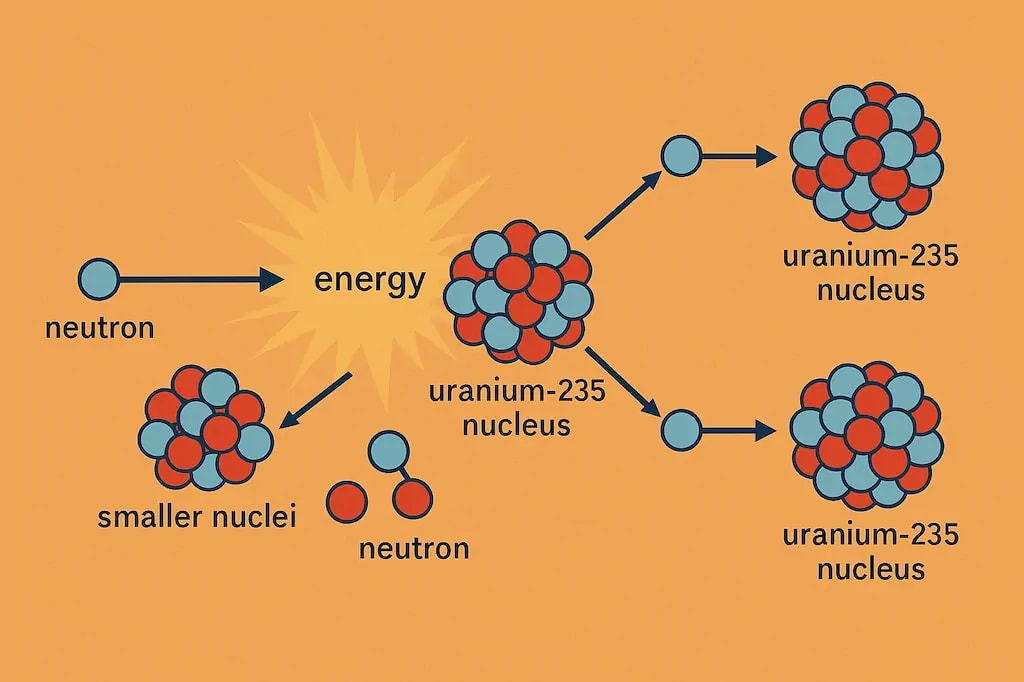
The neutron population grows exponentially: one neutron becomes three, then nine, then twenty-seven, and so forth. This geometric progression quickly produces trillions of fission events, each releasing millions of electron volts of energy. The cumulative energy release creates temperatures exceeding 100 million degrees Celsius—several times hotter than the sun’s core.
Formation of the fireball
The intense energy release rapidly heats the weapon materials and surrounding air, creating a brilliant fireball. Initially, this energy exists as high-energy X-rays that are absorbed by the surrounding air. The heated air becomes luminous plasma, radiating visible light, ultraviolet radiation, and infrared energy.
The fireball expands rapidly due to the enormous pressure created by the energy release. Ten seconds after a 1-megaton explosion, the fireball reaches a mile in diameter. During its early stages, the fireball is many times brighter than the sun even at distances of 50 miles. This thermal flash accounts for more than one-third of the weapon’s total energy output.
Mushroom cloud development
As the fireball rises due to buoyancy and convection, it begins forming the characteristic mushroom cloud. The hot gases and vaporised material from the explosion create a powerful updraft that draws in surrounding air and debris. This process creates the distinctive stem and cap structure associated with nuclear explosions.

The mushroom cloud serves as a vehicle for distributing radioactive fallout over vast areas. Particles of vaporised weapon materials, soil, and other debris become irradiated during the explosion and are carried aloft by the rising column of superheated air. Wind patterns then disperse this radioactive material across potentially enormous areas, creating long-term contamination zones.
Effects of an atomic bomb detonation
Blast wave and overpressure
The blast wave represents one of the most immediately destructive effects of nuclear detonation, carrying approximately half of the weapon’s total energy. As the rapidly expanding fireball pushes into surrounding air, it creates an abrupt jump in air pressure that propagates outward at thousands of miles per hour. This pressure wave, measured in pounds per square inch (psi) above normal atmospheric pressure, can obliterate structures and cause devastating injuries.
Normal air pressure measures about 15 psi, but nuclear blast waves can create overpressures exceeding 100 psi near ground zero. Even modest overpressures of 5 psi can collapse most residential buildings, whilst 10 psi destroys heavily reinforced concrete structures. The blast wave’s destructive radius depends on weapon yield, with larger weapons creating damaging overpressures at proportionally greater distances.
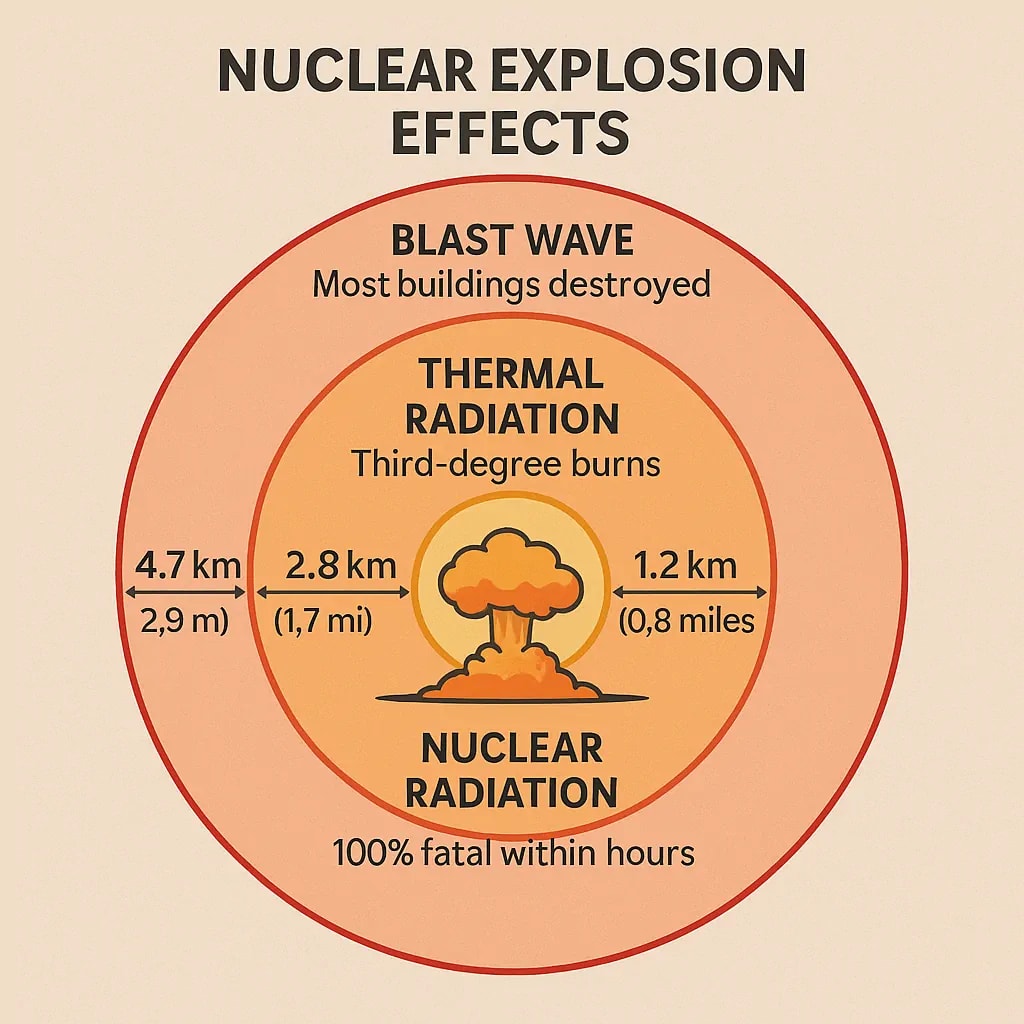
Recent studies using detailed three-dimensional urban terrain models have examined 10-kiloton detonations on cities like Washington D.C. and Los Angeles. These analyses demonstrate that blast effects vary significantly based on urban geography, with buildings providing both shelter and obstacles that can focus or deflect pressure waves.
Thermal radiation and flash burns
Thermal radiation accounts for 35 to 45% of a nuclear weapon’s energy release, creating intense heat capable of igniting fires and causing severe burns at enormous distances. The thermal flash consists of two distinct pulses: an initial ultraviolet burst lasting about a tenth of a second, followed by a more prolonged visible and infrared pulse carrying 99% of the thermal energy.
The intense heat can ignite fires and cause third-degree burns tens of miles from large thermonuclear explosions. This thermal energy travels at the speed of light, reaching targets almost instantaneously regardless of distance. Two-thirds of injured Hiroshima survivors showed evidence of flash burns caused by this thermal radiation.
The thermal effects create distinctive patterns of destruction and injury. Objects and people positioned between the explosion and potential targets can create “thermal shadows” where shielded areas remain unburned whilst exposed surfaces suffer severe damage. Weather conditions significantly influence thermal radiation effectiveness, with clear skies allowing maximum energy transmission whilst clouds or smoke can substantially reduce damage ranges.
Nuclear radiation and fallout
Nuclear radiation represents perhaps the most insidious effect of atomic weapons, causing both immediate and long-term health consequences. The initial radiation consists of gamma rays and neutrons released during the nuclear reactions themselves. This prompt radiation can cause acute radiation syndrome in those close enough to receive significant doses.
Radioactive fallout creates longer-term contamination as irradiated debris settles back to earth. The fallout consists of fission products and activated materials that continue emitting radiation for extended periods. Studies of Hiroshima and Nagasaki survivors have documented increased cancer rates, particularly leukaemia, which appeared 2-8 years after exposure and peaked 6-8 years post-bombing.
Within 20 to 30 days of the Hiroshima bombing, radiation exposure caused approximately 6,000 additional deaths among blast survivors. Long-term effects include increased incidence of various cancers, cataracts, and keloid scarring. The hibakusha (atomic bomb survivors) continue providing crucial data about radiation’s long-term health impacts.
Electromagnetic pulse effects
Nuclear explosions produce electromagnetic pulses (EMP) that can damage or destroy electronic systems over vast areas. The EMP results from gamma rays interacting with the atmosphere, creating rapidly changing electric and magnetic fields. High-altitude detonations can generate EMP effects across entire continents, potentially crippling electronic infrastructure.
The significance of EMP effects was first recognised during early nuclear testing. During the 1945 Trinity test, despite extensive shielding, many electronic records were lost due to electromagnetic interference. Modern society’s dependence on electronic systems makes EMP effects particularly concerning for contemporary nuclear warfare scenarios.
The characteristics of nuclear EMP depend on factors including detonation altitude, weapon yield, and the Earth’s magnetic field interactions. Military terminology distinguishes between high-altitude electromagnetic pulse (HEMP) devices designed specifically to maximise EMP effects and conventional nuclear weapons where EMP represents a secondary consequence.
Historical context and impact
Hiroshima and Nagasaki: unprecedented destruction
The atomic bombings of Hiroshima and Nagasaki on 6 and 9 August 1945 marked humanity’s first and only use of nuclear weapons in warfare. Little Boy, dropped on Hiroshima at 8:15 AM, contained the equivalent of 20,000 tons of TNT and claimed approximately 130,000 lives within seconds. Most victims were instantly vaporised or turned to radioactive dust, whilst tens of thousands more suffered devastating injuries.
The destruction was unprecedented in human history. In Hiroshima, 80% of the city centre was completely destroyed through shock and heat waves exceeding 6,000°C. Four square kilometres around ground zero were obliterated, whilst buildings up to 2 kilometres away collapsed from the blast effects. The rising mushroom cloud dispersed radioactive fallout across vast areas, creating long-term contamination.
Three days later, Fat Man devastated Nagasaki with equally terrible consequences. This plutonium implosion bomb proved even more efficient than Little Boy, demonstrating the rapid advancement in nuclear weapon technology. According to some reports, American planners had initially considered three nuclear strikes to ensure Japan’s complete surrender, but only possessed two operational weapons in August 1945.
The immediate death tolls were staggering, but the long-term consequences proved equally devastating. Estimates suggest up to 166,000 people died in Hiroshima and 80,000 in Nagasaki by the end of 1945. However, radiation-related deaths continued for decades, with approximately 5,000 names added annually to victim lists. Today, the total death toll approaches 450,000 people.
Cold War nuclear arms race
The atomic bombings triggered a global nuclear arms race that defined international relations for decades. The Soviet Union, aided by intelligence gathered from American nuclear secrets, successfully tested their own atomic device in August 1949, just four years after the American bombs. This development shattered America’s nuclear monopoly and initiated the Cold War’s nuclear competition.
Soviet nuclear development benefited from outstanding pre-war nuclear physics research and concentrated state resources. Under Stalin’s direct supervision, hundreds of research institutes, design bureaus, and production plants engaged in the atomic project. The centralised, state-controlled economy enabled rapid concentration of human, material, and financial resources for weapons development. Soviet intelligence also supplied valuable information about American atomic bomb designs.
As tensions escalated, both superpowers developed increasingly powerful thermonuclear weapons. The hydrogen bomb represented a quantum leap in destructive capability, using fission to initiate fusion reactions. Both nations built massive arsenals whilst developing delivery systems including strategic bombers, intercontinental ballistic missiles, and nuclear submarines.
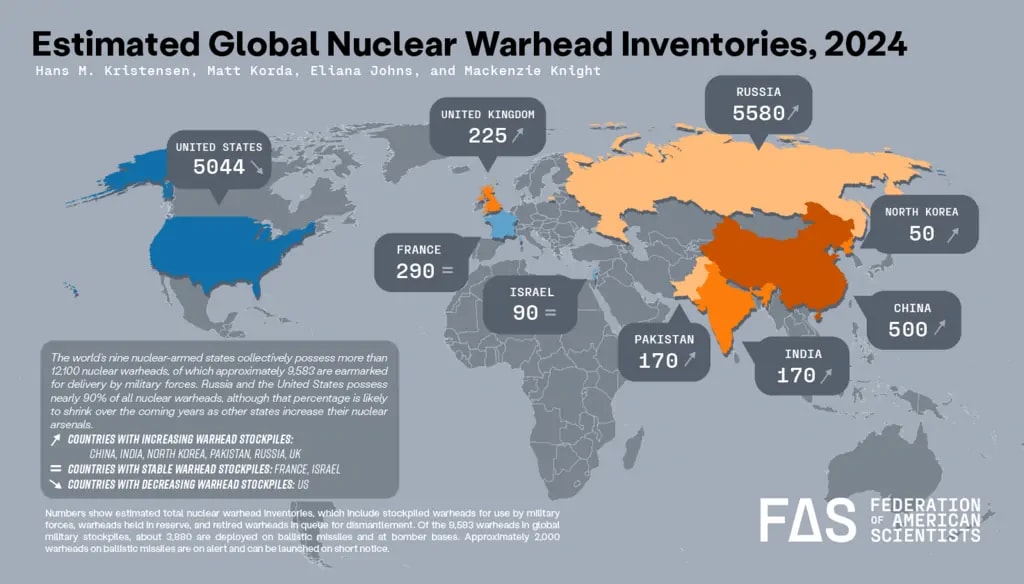
Other nations—the United Kingdom, France, China, and Israel—had acquired nuclear weapons by the late 1960s. This proliferation pattern continues today, with nine nations now possessing nuclear weapons. Recent developments include North Korea’s successful nuclear tests and ongoing concerns about Iran’s nuclear programme.
Nuclear proliferation and control efforts
The spread of nuclear weapons technology has prompted extensive international control efforts. The Nuclear Non-Proliferation Treaty (NPT), which entered force in 1970, represents the most significant attempt to limit nuclear weapon spread. With 189 state parties, the NPT is the most universal arms control treaty in history.
The NPT’s fundamental bargain involves non-nuclear weapon states agreeing not to acquire nuclear weapons in exchange for access to peaceful nuclear technology and commitments from nuclear weapon states to pursue disarmament. However, the treaty’s effectiveness faces ongoing challenges. Four nuclear-armed states remain outside the NPT (India, Pakistan, Israel, and North Korea), whilst disarmament progress among existing nuclear weapon states remains limited.
Nuclear proliferation concerns extend beyond state actors to terrorist organisations. The possibility of non-state actors acquiring nuclear materials or weapons represents one of the gravest contemporary security threats. Even a single nuclear detonation in a modern city would overwhelm existing disaster relief capabilities, whilst multiple detonations could trigger societal collapse.
Efforts to prevent nuclear terrorism include enhanced security for nuclear materials, international cooperation on nuclear forensics, and diplomatic initiatives to reduce global nuclear stockpiles. However, the fundamental knowledge of nuclear weapon construction cannot be “uninvented,” making continued vigilance essential.
Safety and ethical considerations
The devastating consequences of nuclear warfare
Nuclear weapons represent an existential threat to human civilisation, with consequences extending far beyond their immediate destructive effects. Modern nuclear arsenals contain thousands of weapons, many orders of magnitude more powerful than those used against Japan. The use of even a small fraction of existing nuclear weapons could trigger global climate disruption and threaten billions with starvation.
Climate scientists have identified the potential for “nuclear winter” following large-scale nuclear exchange. The detonation of hundreds or thousands of nuclear weapons would inject massive quantities of soot and debris into the atmosphere, blocking sunlight and disrupting global weather patterns. This could destroy agricultural systems worldwide, creating a global famine affecting regions far from any nuclear combat.
The medical consequences of nuclear warfare would overwhelm any conceivable response capability. Physicians and first responders cannot function effectively in radioactively contaminated areas. Even a single nuclear detonation in a major city would strain disaster relief resources beyond breaking point. A nuclear war would produce refugee crises orders of magnitude larger than any previously experienced.
Long-term environmental contamination would render vast areas uninhabitable for decades or centuries. The psychological trauma inflicted on survivors could fundamentally alter social structures and international relations. Studies of atomic bomb survivors demonstrate increased suicide risk among certain demographic groups, particularly those exposed at young ages.
Scientific responsibility and ethical frameworks
The development of nuclear weapons raises profound questions about scientific responsibility and the ethical application of knowledge. Many Manhattan Project scientists experienced moral conflicts about their work, particularly after witnessing the weapons’ devastating effects. Robert Oppenheimer famously quoted the Bhagavad Gita after the Trinity test: “Now I am become Death, the destroyer of worlds.”
Research into physics students’ ethical reasoning about atomic weapons reveals the complexity of moral judgements in scientific contexts. Students often struggle to apply ethical frameworks consistently when evaluating the development and use of nuclear weapons. This highlights the importance of incorporating ethical education into scientific curricula.
The dual-use nature of nuclear technology complicates ethical considerations. Nuclear reactors provide clean energy and medical isotopes whilst simultaneously producing materials suitable for weapons. This duality necessitates careful international oversight and robust safeguards to prevent military applications of civilian nuclear programmes.
Historical examples demonstrate both the potential for scientific knowledge to serve humanity and its capacity for devastating misuse. Nuclear technology has enabled medical treatments, space exploration, and clean energy generation. However, the same fundamental knowledge underpins weapons capable of ending human civilisation.
International disarmament efforts
Global disarmament efforts have achieved mixed results since the Cold War’s end. Total nuclear weapon numbers have declined from Cold War peaks, with current global stockpiles estimated at approximately 16,300 warheads. However, all nuclear weapon states continue modernising their arsenals, raising questions about genuine disarmament commitment.
The Treaty on the Prohibition of Nuclear Weapons, adopted in 2017, represents the latest attempt to accelerate disarmament. This treaty explicitly prohibits nuclear weapon development, testing, production, stockpiling, transfer, use, and threatened use. However, no nuclear weapon states have signed the treaty, limiting its immediate practical impact.
Regional initiatives, such as nuclear weapon-free zones, provide alternative approaches to nuclear risk reduction. Mongolia’s nuclear weapon-free status demonstrates how individual states can contribute to non-proliferation despite geopolitical constraints. Such initiatives require patient diplomacy and mutual understanding among competing powers.
The fundamental challenge remains that nuclear weapons knowledge cannot be eliminated. Once developed, the scientific principles underlying nuclear weapons become part of human knowledge. This reality necessitates continued international cooperation, robust verification mechanisms, and sustained political commitment to preventing both state and non-state nuclear proliferation.
Conclusion
The atomic bomb stands as perhaps the most consequential scientific achievement of the 20th century, fundamentally altering humanity’s relationship with both science and warfare. Understanding how atomic bomb works—from the intricate physics of nuclear fission to the devastating consequences of detonation—remains crucial for informed citizenship in our nuclear age. The nuclear weapon science, whilst elegant in its simplicity, produces effects of almost incomprehensible magnitude: splitting atoms to release energy that can obliterate entire cities and contaminate vast regions for generations.
The historical development from the Manhattan Project through today’s global nuclear arsenals demonstrates both human ingenuity and the sobering responsibility that accompanies such knowledge. The gun-type assembly of Little Boy and the implosion design of Fat Man represent early implementations of principles that now underpin thousands of far more powerful weapons worldwide. Yet these same nuclear technologies have also enabled beneficial applications in medicine, energy production, and scientific research, illustrating the dual-edged nature of scientific advancement.
Perhaps most critically, the effects of nuclear weapons extend far beyond their immediate blast, thermal, and radiation damage. The long-term consequences—from increased cancer rates among survivors to potential global climate disruption—underscore why nuclear weapons remain humanity’s gravest existential threat. As we face ongoing proliferation challenges and emerging security concerns, understanding these weapons’ fundamental principles becomes essential for evaluating policy decisions and supporting international efforts toward a safer world.
The atomic bomb’s legacy serves as a stark reminder that scientific knowledge, once discovered, cannot be undiscovered. This reality places special responsibility on scientists, policymakers, and citizens to ensure that nuclear technology serves humanity’s beneficial purposes whilst vigilantly preventing its destructive applications. Only through sustained international cooperation, robust safeguards, and unwavering commitment to peaceful uses of nuclear energy can we hope to navigate the complex challenges of our nuclear age.
FAQ: Frequently Asked Questions
Q: What’s the difference between atomic and hydrogen bombs?
A: Atomic bombs (fission bombs) derive their energy from splitting heavy atomic nuclei like uranium or plutonium. Hydrogen bombs (thermonuclear bombs) are much more powerful, using a fission reaction to create the extreme temperatures and pressures needed to ignite a fusion reaction between light nuclei like hydrogen isotopes.
Q: How much fissile material is needed for an atomic bomb?
A: The minimum amount of fissile material needed is called the critical mass. For uranium-235, it’s around 50 kg (for Little Boy), and for plutonium-239, it’s about 11 kg in a spherical configuration. However, efficient weapon designs use less due to factors like density and neutron reflectors.
Q: What are the immediate effects of a nuclear detonation?
A: The immediate effects include a devastating blast wave (about 50% of the energy), intense thermal radiation causing severe burns and fires (35-45% of energy), and initial nuclear radiation (gamma rays and neutrons). These are followed by radioactive fallout.
Q: What is the nuclear winter theory?
A: Nuclear winter is a hypothetical climatic effect that could follow a large-scale nuclear war. The detonation of many nuclear weapons would inject vast amounts of soot and dust into the atmosphere, blocking sunlight, causing a drastic drop in global temperatures, and disrupting agricultural systems, leading to widespread famine.