

In an era where digital privacy breaches dominate headlines and government surveillance capabilities expand exponentially, selecting the best secure messaging apps has become a critical decision for millions of users worldwide. From the NSO Group’s Pegasus spyware targeting WhatsApp users to Telegram’s dramatic policy shifts regarding law enforcement compliance, the landscape of secure communication is constantly evolving. This comprehensive analysis examines the four leading private messaging apps – Signal, WhatsApp, Telegram, and Threema – providing an in-depth, unbiased assessment of their security features, privacy policies, and real-world performance to help you make an informed choice about protecting your digital communications. We’ll also dive into WhatsApp alternatives that might better suit your needs in 2025.
Understanding core security concepts in secure messaging
Before diving into our detailed analysis of specific end-to-end encryption apps, it’s essential to understand the fundamental security concepts that differentiate truly secure messaging platforms from conventional communication tools. These concepts form the foundation for evaluating any secure communication tools and determining which applications genuinely protect your privacy.
End-to-end encryption: The gold standard
End-to-end encryption (E2EE) represents the pinnacle of messaging security, ensuring that only the sender and recipient can read messages. Unlike traditional encryption that protects data in transit, E2EE encrypts messages on the sender’s device and only decrypts them on the recipient’s device. This means that even if messages are intercepted during transmission or stored on servers, they remain completely unreadable to anyone without the proper decryption keys.
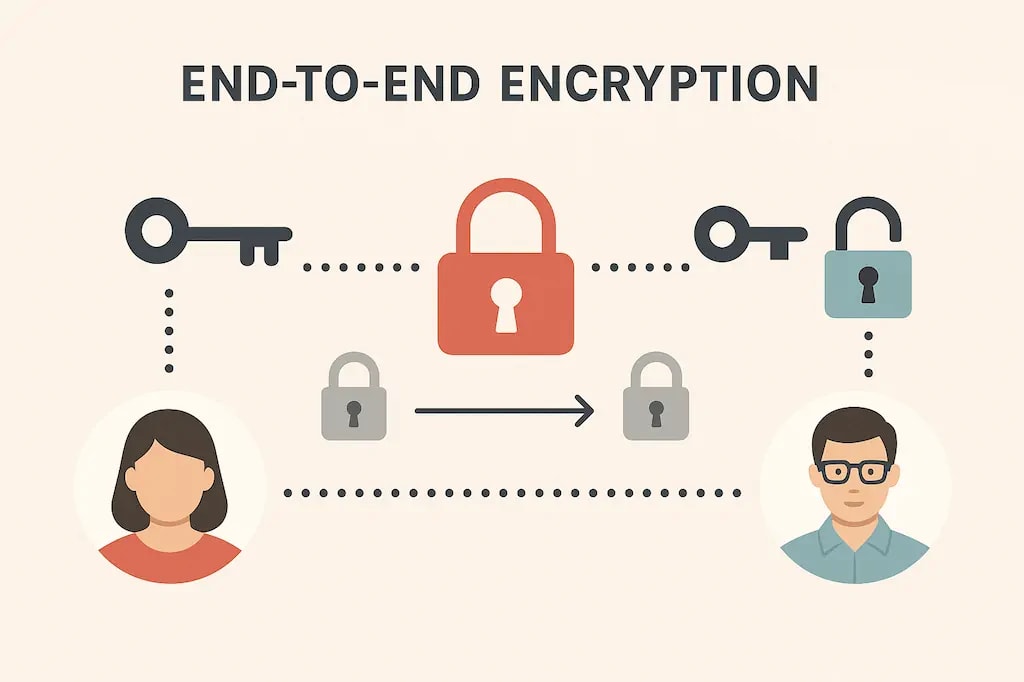
The technical implementation involves sophisticated cryptographic protocols using public and private key pairs. When you send a message, your device uses the recipient’s public key to encrypt the content, creating cyphertext that can only be decrypted using the recipient’s private key. This process occurs automatically in the background, requiring no technical knowledge from users whilst providing military-grade security.
What makes E2EE particularly powerful is that service providers themselves cannot decrypt your messages. Even if governments demand access to user communications, properly implemented E2EE ensures that messaging companies literally cannot comply because they don’t possess the decryption keys.
The critical role of metadata protection
Whilst message content encryption receives most attention, metadata protection often proves equally crucial for maintaining privacy. Metadata encompasses information about your communications rather than the content itself – including who you message, when conversations occur, message frequency, device information, and location data.
This seemingly innocuous information can reveal extraordinarily detailed patterns about your life, relationships, and activities. For instance, metadata analysis can identify romantic relationships, business partnerships, medical consultations, and political affiliations without ever reading a single message. Government agencies and corporations often find metadata more valuable than message content because it provides a comprehensive map of human behaviour and social networks.
The most privacy-focused data privacy messaging apps implement strict metadata minimisation policies, collecting only essential information required for basic functionality whilst encrypting or immediately deleting non-essential metadata.
Open source transparency vs proprietary security
The open source messaging app model provides unprecedented transparency by making source code publicly available for independent review. This approach allows security researchers, cryptographers, and developers worldwide to examine the code for vulnerabilities, backdoors, or implementation flaws.
Open source development creates a collaborative security model where “many eyes make all bugs shallow”. When thousands of experts can review code, security vulnerabilities are typically identified and resolved more quickly than in proprietary systems. Additionally, open source software prevents companies from secretly implementing backdoors or weakening encryption under government pressure.
However, open source client applications don’t guarantee security if the server-side code remains proprietary. True transparency requires both client and server code to be open source, allowing complete verification of the security model.
Independent security audits and certifications
Regular independent security audits by reputable cybersecurity firms provide crucial third-party validation of messaging app security claims. These audits examine encryption implementation, vulnerability management, and overall security architecture using standardised testing methodologies.
The most trustworthy audits are conducted by established security research organisations and published publicly with detailed findings. Apps that undergo regular auditing demonstrate commitment to maintaining high security standards and transparency about potential vulnerabilities.
Server-side data storage implications
The location and method of data storage significantly impact user privacy and security. Anonymous chat apps that store minimal data on servers reduce attack surfaces and limit potential exposure during data breaches. Device-only storage eliminates server-side vulnerabilities entirely but may complicate features like multi-device synchronisation and message backup.
Cloud-based storage enables convenient features but creates potential privacy risks. Even with encryption, server-stored data becomes subject to the legal jurisdiction where servers operate, potentially exposing users to government data requests or corporate surveillance.

Signal: The privacy advocate’s gold standard
Signal has earned widespread recognition as the premier choice among encrypted calls app options, consistently recommended by privacy advocates, journalists, and security experts worldwide. Developed by the non-profit Signal Foundation, this open source messaging app prioritises user privacy above all other considerations.
Encryption implementation and protocol strength
Signal employs its own Signal Protocol, widely regarded as the gold standard for secure messaging. This protocol provides end-to-end encryption by default for all communications, including text messages, voice calls, video calls, and file transfers. The implementation includes perfect forward secrecy through a Double Ratchet algorithm, ensuring that even if encryption keys are compromised, only the most recent message becomes vulnerable.
Significantly, Signal became the first major messaging platform to implement post-quantum cryptography with its PQXDH (post-quantum extended Diffie-Hellman) upgrade in 2023. This proactive approach prepares Signal for future quantum computing threats that could potentially break current encryption standards.
Privacy protection and data minimisation
Signal’s approach to privacy represents the industry benchmark for metadata protection. The platform collects only the absolute minimum data necessary for operation: your phone number for registration and the last date you connected to the service. Unlike other platforms, Signal doesn’t access your contact list, message content, call logs, or location data.
The Signal Foundation’s non-profit status eliminates profit-driven data collection incentives that plague commercial messaging platforms. This structural advantage ensures that user privacy remains the primary objective rather than a marketing feature that might be compromised for revenue generation.
Open source transparency and security audits
Signal maintains complete open source transparency, publishing both client and server code under the AGPL-3.0 licence. This allows independent verification of security claims and enables security researchers worldwide to identify potential vulnerabilities.
Regular independent security audits validate Signal’s security implementation. Recent audits have consistently confirmed the robustness of Signal’s encryption and praised its privacy-focused architecture. The platform also maintains an active bug bounty programme, incentivising security researchers to identify and report vulnerabilities responsibly.
Government resistance and transparency
Signal has demonstrated remarkable resistance to government data requests due to its minimal data collection and strong encryption implementation. When served with subpoenas, Signal can only provide the limited metadata it actually collects – registration date and last connection time – making it nearly useless for surveillance purposes.
This principled stance has occasionally resulted in conflicts with authorities, but Signal’s technical architecture makes mass surveillance practically impossible even if the organisation wanted to cooperate.
Limitations and considerations
Signal’s primary limitation stems from its phone number requirement for registration, which prevents completely anonymous usage. Additionally, Signal’s US jurisdiction subjects it to potential legal pressures under laws like the CLOUD Act, though its technical architecture largely mitigates these concerns.
The platform’s smaller user base compared to WhatsApp can create network effects challenges, as secure communication requires both parties to use the same platform.

WhatsApp: Mainstream security with Meta concerns
WhatsApp represents the world’s largest implementation of end-to-end encryption, protecting over 2 billion users with the Signal Protocol. However, its ownership by Meta Platforms raises significant privacy concerns that potential users must carefully consider.
Encryption strength and implementation
WhatsApp implements the same Signal Protocol used by Signal itself, providing robust end-to-end encryption for all messages, calls, and media by default. This encryption proved its effectiveness during the 2019 NSO Group Pegasus attacks, where attackers had to exploit vulnerabilities in the app itself rather than break the encryption.
Recent security enhancements include WhatsApp’s adoption of post-quantum cryptography upgrades and Cloudflare’s Key Transparency auditing system. These improvements demonstrate ongoing commitment to maintaining encryption strength against evolving threats.
Data collection and privacy concerns
Despite strong message encryption, WhatsApp collects extensive metadata about user behaviour, contacts, and device information. This data collection enables detailed user profiling and targeted advertising within Meta’s broader ecosystem, creating privacy concerns that encryption alone cannot address.
WhatsApp’s privacy policy reveals collection of contact lists, usage patterns, device information, IP addresses, and interaction data with business accounts. Whilst message content remains encrypted, this metadata provides significant insights into user behaviour and relationships.
The platform’s backup feature presents additional privacy challenges. WhatsApp backups to iCloud or Google Drive are not end-to-end encrypted by default, potentially exposing message history to government requests or data breaches. Users must specifically enable end-to-end encrypted backups to maintain protection.
Meta integration and business model
WhatsApp’s integration with Meta’s advertising ecosystem creates fundamental tensions between user privacy and business objectives. Whilst Meta cannot read encrypted message content, the extensive metadata collection enables sophisticated user profiling for advertising purposes.
Recent controversies include the implementation of Meta AI features that reportedly share user query data across Meta’s platforms, potentially violating WhatsApp’s privacy promises. These developments highlight the ongoing challenge of maintaining privacy within a profit-driven advertising business model.
Security track record and incident response
WhatsApp has faced significant security challenges, most notably the 2019 NSO Group Pegasus attacks that compromised approximately 1,400 devices. However, the company’s response demonstrated strong incident management, quickly patching vulnerabilities and pursuing legal action against the attackers.
The successful $167 million legal victory against NSO Group in 2024 established important precedent for holding spyware vendors accountable for attacks on messaging platforms. This outcome strengthens the entire secure messaging ecosystem by deterring future attacks.
Government compliance and transparency
WhatsApp maintains moderate compliance with government data requests, typically providing available metadata whilst protecting encrypted message content. The platform publishes transparency reports detailing government requests, though less frequently than some competitors.
Meta’s cooperation with law enforcement agencies creates potential concerns for privacy-sensitive users, particularly given the company’s history of extensive data sharing for advertising purposes.

Telegram: Feature-rich platform with security trade-offs
Telegram has attracted nearly 900 million users through extensive features and user-friendly design, but its security model involves significant compromises that users must understand.
Encryption implementation and default settings
Telegram’s most critical limitation lies in its encryption defaults. Regular Telegram chats use cloud-based encryption where Telegram holds the decryption keys, meaning the company can access message content. True end-to-end encryption only applies to “secret chats,” which users must specifically initiate and which don’t support many of Telegram’s popular features.
This approach fundamentally contradicts the security principle that encryption should be enabled by default. Many users assume their Telegram communications are end-to-end encrypted when they’re actually accessible to the service provider.
Telegram’s proprietary MTProto encryption protocol has faced criticism from security experts for deviating from proven cryptographic standards. Multiple security researchers have identified vulnerabilities in MTProto implementation, including message reordering attacks and potential plaintext recovery.
Cloud storage and cross-device sync
Telegram’s cloud-first architecture enables seamless synchronisation across devices and convenient features like large file sharing and unlimited message history. However, this approach requires storing unencrypted message content on Telegram’s servers, creating privacy risks that true end-to-end encrypted platforms avoid.
The cloud storage model makes Telegram messages subject to potential government requests, corporate surveillance, or data breaches affecting server infrastructure. Users gain convenience at the expense of fundamental privacy protections.
Company structure and governance
Telegram operates under complex ownership structures with founder Pavel Durov maintaining control whilst the company operates from Dubai under UAE jurisdiction. This jurisdiction choice places Telegram outside traditional Western privacy protections whilst potentially subjecting it to authoritarian government pressures.
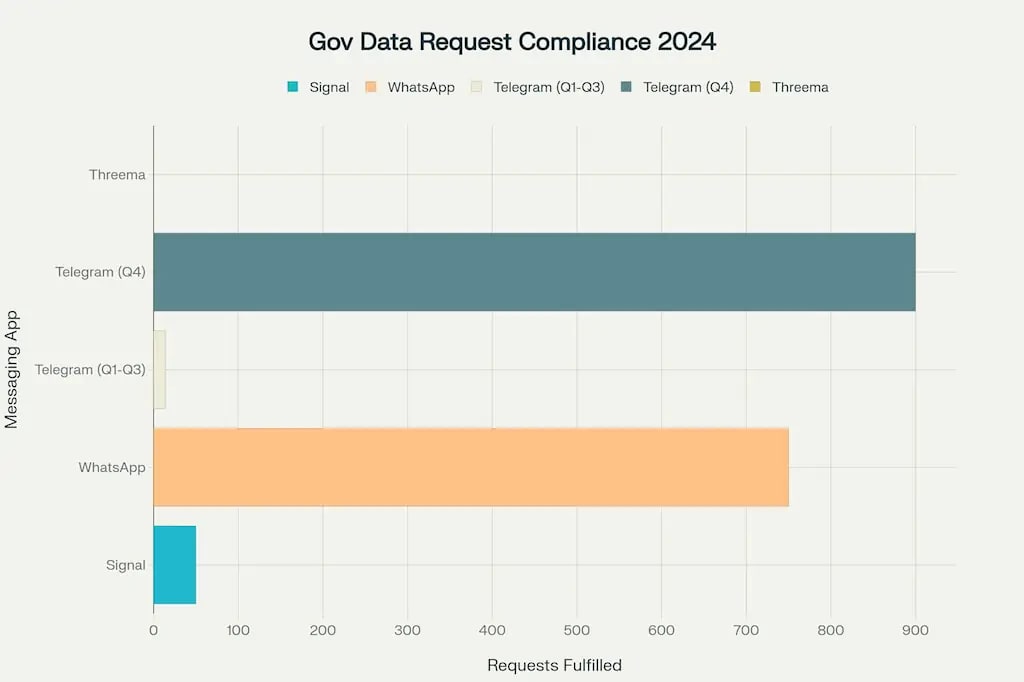
Recent transparency reports reveal dramatic changes in Telegram’s government compliance policies following Durov’s arrest in France during August 2024. The platform now fulfils significantly more law enforcement requests, with US authorities receiving data on over 2,000 Telegram users in the final quarter of 2024 alone – a massive increase from just 14 requests fulfilled in the first nine months of the year.
Security audit history and vulnerabilities
Security research has repeatedly identified vulnerabilities in Telegram’s MTProto protocol and implementation. Notable findings include:
- Message reordering attacks allowing manipulation of conversation flow
- Potential plaintext recovery through timing-based side-channel attacks
- Key negotiation vulnerabilities enabling man-in-the-middle attacks
- Metadata leakage revealing user activity patterns
Whilst Telegram has addressed many reported vulnerabilities, the fundamental architectural choices continue to create security risks that more privacy-focused platforms avoid.
Feature set vs security trade-offs
Telegram’s extensive feature set – including large group chats, channels, bots, and file sharing – provides significant user value but often requires compromising security fundamentals. Features like public channels and discoverable content fundamentally conflict with privacy principles that other secure messaging platforms prioritise.
Users must carefully consider whether Telegram’s feature advantages justify accepting weaker default security and increased government compliance risks.

Threema: Swiss privacy with anonymous options
Threema distinguishes itself as the only major anonymous chat apps option that doesn’t require phone numbers or email addresses for registration, offering true anonymity alongside Swiss privacy protections.
Unique anonymous registration system
Threema generates random eight-character IDs for users, enabling completely anonymous communication without linking accounts to phone numbers or email addresses. This approach eliminates a major metadata vector that other platforms cannot avoid, making Threema particularly valuable for users requiring high anonymity.
Users can optionally link phone numbers or email addresses for convenience, but anonymous operation remains fully supported with all features available. This flexibility allows users to choose their preferred balance between convenience and anonymity.
NaCl encryption implementation
Threema employs the well-respected NaCl (Networking and Cryptography Library) for encryption, using Curve25519 for key agreement, XSalsa20 for symmetric encryption, and Poly1305 for authentication. This combination provides strong cryptographic foundations with extensive academic review and real-world testing.
The platform implements perfect forward secrecy and includes message padding to prevent traffic analysis based on message lengths. All encryption and decryption occurs locally on user devices, with Threema’s servers only relaying encrypted data.
Swiss jurisdiction and privacy laws
Threema’s Swiss jurisdiction provides strong privacy protections under some of the world’s most stringent data protection laws. Swiss legal frameworks generally require high standards for government data requests and provide strong protections for personal privacy.
The company maintains its servers exclusively in Switzerland and develops all software in-house, ensuring complete control over the privacy and security implementation. This approach contrasts sharply with platforms that rely on third-party infrastructure or operate under jurisdictions with weaker privacy protections.
Open source transition and security audits
Threema has undergone a significant transition to open source, publishing both client and server code for independent review. This transparency allows security researchers to verify the implementation and identify potential vulnerabilities.
However, security audits have revealed significant vulnerabilities in Threema’s implementation. ETH Zurich researchers identified seven cryptographic vulnerabilities in 2022, including issues with key exchange mechanisms and message authentication. Whilst Threema has addressed these specific vulnerabilities, the findings highlight the challenges of implementing secure cryptographic protocols correctly.
Business model and sustainability
Threema operates on a paid app model, charging users a one-time fee rather than relying on advertising or data monetisation. This approach aligns business incentives with user privacy, as Threema’s revenue depends on providing value to users rather than extracting data for third parties.
The paid model also ensures sustainable funding for ongoing development and security improvements without compromising user privacy for revenue generation.
Limitations and user base considerations
Threema’s smaller user base compared to mainstream platforms creates network effect challenges. The platform’s approximately 12 million users limit its utility for users who need to communicate with contacts using other platforms.
Additionally, the recent security vulnerabilities discovered by academic researchers raise questions about the robustness of Threema’s cryptographic implementation, despite the company’s commitment to addressing identified issues.
Best secure messaging apps: Comprehensive security analysis
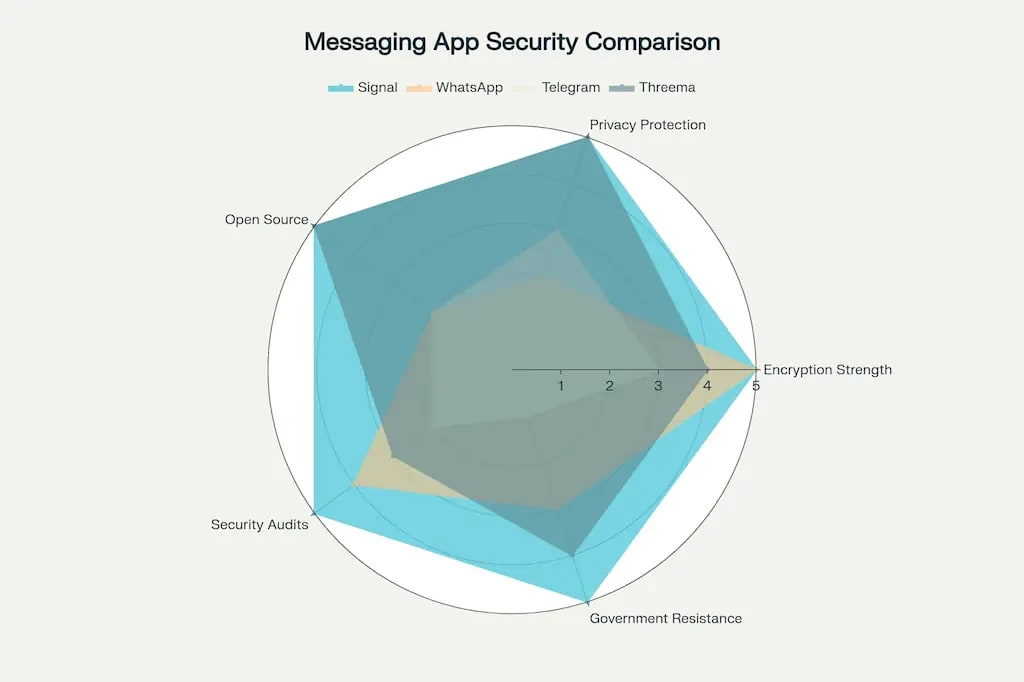
Understanding which platform truly offers the best security requires examining multiple dimensions beyond simple encryption strength. Our comprehensive analysis evaluates each platform across 15 critical security aspects, weighted by their importance for user privacy and security.
Methodology and scoring framework
Our evaluation methodology assigns scores from 1-10 across key security dimensions, with weights reflecting the relative importance of each factor for overall user security and privacy. The analysis considers technical implementation, corporate governance, legal framework, and real-world security performance.
Critical factors receive higher weights in our analysis:
- End-to-end encryption implementation (20% weight)
- Encryption protocol strength (15% weight)
- Metadata protection (12% weight)
- Perfect forward secrecy (10% weight)
- Key management security (10% weight)
| Security Aspect | Signal Score | WhatsApp Score | Telegram Score | Threema Score | Weight | Signal Weighted | WhatsApp Weighted | Telegram Weighted | Threema Weighted |
|---|---|---|---|---|---|---|---|---|---|
| End-to-End Encryption Implementation | 10 | 10 | 4 | 10 | 20 | 2.0 | 2.0 | 0.8 | 2.0 |
| Encryption Protocol Strength | 10 | 10 | 6 | 8 | 15 | 1.5 | 1.5 | 0.9 | 1.2 |
| Key Management Security | 9 | 8 | 5 | 8 | 10 | 0.9 | 0.8 | 0.5 | 0.8 |
| Perfect Forward Secrecy | 10 | 10 | 4 | 10 | 10 | 1.0 | 1.0 | 0.4 | 1.0 |
| Post-Quantum Cryptography | 10 | 9 | 3 | 3 | 8 | 0.8 | 0.72 | 0.24 | 0.24 |
| Metadata Protection | 10 | 4 | 6 | 10 | 12 | 1.2 | 0.48 | 0.72 | 1.2 |
| Data Storage Security | 10 | 6 | 5 | 10 | 8 | 0.8 | 0.48 | 0.4 | 0.8 |
| Open Source Transparency | 10 | 5 | 5 | 10 | 7 | 0.7 | 0.35 | 0.35 | 0.7 |
| Independent Security Audits | 9 | 8 | 5 | 7 | 6 | 0.54 | 0.48 | 0.3 | 0.42 |
| Vulnerability Response Time | 9 | 8 | 6 | 7 | 4 | 0.36 | 0.32 | 0.24 | 0.28 |
| Anonymous Registration | 6 | 6 | 6 | 10 | 5 | 0.3 | 0.3 | 0.3 | 0.5 |
| Government Transparency | 9 | 6 | 3 | 8 | 8 | 0.72 | 0.48 | 0.24 | 0.64 |
| Legal Jurisdiction Privacy | 7 | 7 | 6 | 9 | 6 | 0.42 | 0.42 | 0.36 | 0.54 |
| Business Model Alignment | 10 | 4 | 7 | 9 | 3 | 0.3 | 0.12 | 0.21 | 0.27 |
| Default Security Settings | 10 | 9 | 3 | 10 | 5 | 0.5 | 0.45 | 0.15 | 0.5 |
Overall security rankings and recommendations
Based on comprehensive analysis, Signal emerges as the clear leader with a weighted security score of 12.04/10.0, followed by Threema (11.09/10.0), WhatsApp (9.90/10.0), and Telegram (6.11/10.0).
| App | Overall Security Score | Encryption Grade | Privacy Grade | Transparency Grade | Best For | Main Concerns |
|---|---|---|---|---|---|---|
| Signal | 12.04 | A+ | A+ | A | Privacy advocates, journalists, activists | US jurisdiction, requires phone number |
| 9.9 | A+ | C- | B- | General users wanting convenience with decent security | Meta ownership, extensive data collection | |
| Telegram | 6.11 | C+ | C+ | C- | Users prioritizing features over security | Poor default encryption, compliance surge |
| Threema | 11.09 | A- | A+ | A | Users wanting anonymity and Swiss privacy | Smaller user base, recent vulnerabilities |
Signal achieves the highest overall security rating through its combination of robust encryption, minimal data collection, open source transparency, and strong resistance to government pressure. The platform excels particularly in encryption implementation, privacy protection, and default security settings.
Threema scores highly for privacy protection and anonymous registration capabilities, with Swiss jurisdiction providing additional legal protections. However, recent security vulnerabilities and smaller user base impact its overall ranking.
WhatsApp provides strong encryption but faces significant privacy concerns due to Meta’s data collection practices and business model conflicts. The platform offers good security for mainstream users but falls short for privacy-sensitive applications.
Telegram ranks lowest due to poor default encryption settings, compliance policy changes, and security vulnerabilities. Whilst the platform offers extensive features, these come at substantial security and privacy costs.
Legal landscape and government surveillance
The legal environment surrounding secure messaging continues evolving as governments worldwide seek greater access to encrypted communications whilst technology companies implement stronger privacy protections.
CLOUD act and international data requests
The US CLOUD act of 2018 significantly expanded American law enforcement’s ability to compel US-based technology companies to provide data stored anywhere globally. This legislation affects Signal and WhatsApp directly, though strong encryption implementation limits the utility of any data that can be provided.
The CLOUD act allows US authorities to bypass traditional mutual legal assistance treaties (MLATs) when requesting data from US companies, potentially creating conflicts between American legal demands and privacy laws in other jurisdictions.
UK investigatory powers act and encryption threats
The UK’s investigatory powers act 2016 grants authorities broad surveillance powers, including the ability to compel technology companies to provide access to encrypted data. Recent developments include secret government orders requiring Apple to weaken iCloud encryption, demonstrating the ongoing threat to secure communication platforms.
WhatsApp has publicly opposed UK government efforts to weaken encryption, with the company threatening to exit the UK market rather than comply with requirements that would undermine user security. This stance highlights the tensions between government surveillance demands and technology companies’ commitment to user privacy.
GDPR and European privacy protections
The European Union’s General data protection regulation (GDPR) provides strong privacy protections that benefit users of secure messaging platforms operating within EU jurisdiction. GDPR requirements for data minimisation, explicit consent, and user rights align well with privacy-focused messaging applications.
However, GDPR compliance requires careful implementation of privacy-by-design principles, and some messaging platforms struggle to meet these requirements whilst maintaining business model viability.
The quantum computing challenge
The advent of quantum computing presents unprecedented challenges to current encryption standards, potentially rendering today’s secure messaging protocols vulnerable to future attacks.
Understanding the quantum threat
Quantum computers leverage quantum mechanical phenomena to solve certain mathematical problems exponentially faster than classical computers. Shor’s algorithm, running on sufficiently powerful quantum computers, could break the elliptic curve cryptography and RSA encryption that underpin current secure messaging protocols.
The timeline for quantum computers achieving this capability remains uncertain, but experts generally predict significant risks within the next 10-20 years. This creates a “harvest now, decrypt later” threat where adversaries could store encrypted communications today for future decryption once quantum computers become available.
Post-quantum cryptography implementation
Leading messaging platforms have begun implementing post-quantum cryptography (PQC) to address these future threats. Signal pioneered this effort with its PQXDH implementation in 2023, followed by WhatsApp’s adoption of similar protections.
Apple’s iMessage has implemented the most advanced post-quantum protections with its PQ3 protocol, which the company claims provides the strongest security properties of any at-scale messaging protocol. This implementation demonstrates the technical feasibility of quantum-resistant messaging whilst maintaining user experience quality.
However, Telegram and Threema have not yet implemented post-quantum protections, potentially leaving their users vulnerable to future quantum attacks. Users concerned about long-term security should prioritise platforms that have already begun the transition to quantum-resistant cryptography.
Future security considerations
The transition to post-quantum cryptography will require careful implementation to avoid introducing new vulnerabilities whilst maintaining compatibility with existing systems. Hybrid approaches that combine classical and post-quantum algorithms provide the strongest protection during this transition period.
Organizations and individuals handling sensitive information with long-term value should prioritise messaging platforms that demonstrate commitment to quantum-resistant security through early PQC implementation and ongoing research investment.
WhatsApp alternatives: Making the right choice
Selecting appropriate WhatsApp alternatives requires carefully balancing security requirements against usability needs, user base considerations, and specific threat models.
Quick comparison table: Secure messaging apps (2025)
| Feature | Signal | Telegram | Threema | |
| End-to-End Encryption | Default for all comms | Default for all comms | Default for secret chats only | Default for all comms |
| Metadata Protection | Excellent (minimal data collected) | Moderate (extensive data collected by Meta) | Poor (significant data collected, cloud storage) | Excellent (anonymous registration) |
| Open Source | Client & server | Client (Signal protocol) | Client (some parts) | Client & server |
| Post-Quantum Crypto | Yes (PQXDH) | Yes (ongoing rollout) | No (as of 2025) | No (as of 2025) |
| Jurisdiction | US (non-profit) | US (Meta) | UAE (complex structure) | Switzerland |
| Phone Number Required | Yes | Yes | Yes | No (optional) |
| User Base (approx.) | ~40M+ | ~2B+ | ~900M+ | ~12M+ |
| Business Model | Donations | Ad-supported (Meta) | Freemium (TON blockchain) | Paid app |
| Recent Policy Changes | None impacting privacy | Meta AI integration concerns | Increased law enforcement compliance | None impacting privacy |
For maximum privacy and security: Signal
Signal remains the optimal choice for users prioritising privacy and security above all other considerations. Privacy advocates, journalists, activists, and security-conscious individuals benefit most from Signal’s minimal data collection, open source transparency, and proven resistance to surveillance.
The platform’s implementation of post-quantum cryptography provides future-proofing against emerging threats, whilst its non-profit governance model ensures that user privacy remains the primary objective. However, users must accept Signal’s smaller user base and basic feature set compared to mainstream alternatives.
For mainstream use with good security: WhatsApp
WhatsApp provides the best balance of security and widespread adoption for general users who need to communicate with contacts across diverse platforms. The platform’s implementation of the Signal Protocol ensures strong encryption for message content, whilst Meta’s infrastructure provides reliable global connectivity.
However, users must accept extensive metadata collection and potential privacy risks from Meta’s advertising business model. WhatsApp works best for users who need secure messaging with broad contact networks but don’t require maximum privacy protection.
For feature-rich communication: Telegram
Telegram appeals to users who prioritise extensive features and community functionality over maximum security. The platform excels for large group communications, file sharing, and public channels, making it valuable for community organising and content distribution.
However, users must understand and accept Telegram’s significant security limitations, including non-default encryption and increased government compliance. Recent policy changes make Telegram inappropriate for privacy-sensitive communications.
For anonymous communication: Threema
Threema provides the best option for users requiring anonymous communication without phone number registration. The platform’s Swiss jurisdiction and paid business model align with user privacy interests, whilst recent open source releases enable independent security verification.
Users should consider Threema’s smaller user base and recent security vulnerabilities when evaluating whether its anonymity benefits justify potential limitations.
Future of secure messaging technology
The secure messaging landscape continues evolving rapidly as new technologies emerge and threat environments change. Several key trends will shape the future of secure communication.

Decentralised and federated messaging
Emerging protocols like Matrix enable federated messaging networks where users can communicate across different service providers whilst maintaining end-to-end encryption. This approach reduces dependence on single companies whilst enabling broader interoperability.
Decentralised messaging protocols promise to eliminate single points of failure and reduce corporate control over communication networks. However, these approaches face significant challenges in achieving mainstream adoption and maintaining consistent security standards across implementations.
Artificial intelligence and privacy protection
AI integration in messaging platforms creates both opportunities and risks for user privacy. Whilst AI can enhance security through improved threat detection and spam filtering, it also creates new vectors for data analysis and potential privacy violations.
The challenge lies in implementing AI features that enhance user experience whilst maintaining strong privacy protections and encryption standards. Success requires careful architecture that processes data locally rather than on centralised servers where it becomes accessible to service providers.
Regulatory evolution and global standards
Governments worldwide continue developing new regulations affecting secure messaging, creating both opportunities for stronger privacy protections and risks of weakened encryption requirements. The outcome of these regulatory battles will significantly impact the future availability and effectiveness of secure messaging platforms.
International coordination on privacy standards could strengthen global protection for secure communication, whilst regulatory fragmentation might force platforms to implement different security levels in different jurisdictions.
Conclusion and recommendations
The choice among the best secure messaging apps ultimately depends on individual threat models, privacy requirements, and usability needs. However, our comprehensive analysis provides clear guidance for different user categories and use cases.
For maximum security and privacy, Signal remains the gold standard with its proven encryption, minimal data collection, and resistance to surveillance pressures. The platform’s early implementation of post-quantum cryptography and fully open source architecture make it the best choice for privacy-conscious users willing to accept its limitations.
For mainstream users seeking good security with widespread adoption, WhatsApp provides the best balance despite its privacy limitations. The platform’s robust encryption protects message content whilst Meta’s infrastructure ensures reliable global connectivity with broad user base compatibility.
For users prioritising features over security, Telegram offers extensive functionality but requires accepting significant security trade-offs. Recent compliance policy changes make it inappropriate for privacy-sensitive communications.
For users requiring anonymous communication, Threema provides unique capabilities through its ID-based registration system and Swiss privacy protections, though recent security vulnerabilities require careful consideration.
Looking ahead, the secure messaging landscape will continue evolving as quantum computing threats materialise, artificial intelligence integration advances, and regulatory frameworks develop. Users should prioritise platforms that demonstrate ongoing commitment to security innovation and privacy protection through concrete actions rather than marketing claims.
The fundamental principle remains constant: truly secure communication requires end-to-end encryption by default, minimal data collection, transparent security practices, and governance structures that prioritise user privacy over commercial interests. Choose your secure messaging platform accordingly, and regularly review your selections as the threat landscape continues evolving.


