Nelson Mandela stands as one of the most extraordinary figures of the 20th century, a man whose journey from a humble rural village to a stark prison cell and ultimately to the presidential palace exemplifies the triumph of human dignity over systemic oppression. This comprehensive guide explores everything you need to know about Nelson Mandela, from his early life in the Eastern Cape to his global legacy that continues to inspire millions worldwide. As South Africa’s first democratically elected president and a Nobel Peace Prize laureate, Mandela’s story is one of unwavering resilience, profound sacrifice, and the steadfast belief that reconciliation could heal even the deepest wounds of a nation profoundly divided by apartheid.
Table of contents
The early years: Roots of a revolutionary spirit
Every great journey begins with a first step, and for Nelson Mandela, that step was rooted deep in the rich soil of the Eastern Cape. To truly understand the titan he became, we must first look at the crucible of his early life, where the seeds of a revolutionary were sown.
Birth and childhood in Mvezo: The “troublemaker” is born
Nelson Rolihlahla Mandela was born on 18 July 1918 in the tiny village of Mvezo, nestled on the banks of the Mbashe River in South Africa’s Eastern Cape Province. His birth name, Rolihlahla, is deeply significant in the Xhosa language, directly translating to “pulling the branch of a tree” or, more tellingly, “troublemaker”. A prescient moniker, indeed, for a man who would spend his life upsetting the oppressive status quo.
Born into the Madiba clan of the Thembu tribe, Mandela’s heritage was inextricably linked to African royalty. His father, Gadla Henry Mphakanyiswa, served as a chief and counsellor to the Thembu king, while his mother, Nosekeni Fanny, hailed from the Mpemvu clan. This aristocratic lineage would later imbue Mandela with natural leadership qualities and a deep, innate understanding of traditional African governance structures.
However, the family’s fortunes shifted dramatically when Mandela was still an infant. His father lost his chieftainship following a dispute with the local white magistrate, forcing the family to relocate to the even smaller, more rural village of Qunu. This early experience of injustice and the arbitrary use of power by colonial authorities undoubtedly planted the initial seeds of Mandela’s later political awakening and his lifelong commitment to dismantling such inequities.
Education and formative influences: A mind awakens
Mandela’s educational journey commenced at a local mission school in Qunu, a journey that began with a curious colonial custom. It was here that his teacher, Miss Mdingane, bestowed upon him the English name “Nelson” in keeping with the practice of assigning Christian names to African children. This seemingly innocuous act was, in fact, a reflection of the colonial education system’s broader attempt to assimilate African children into European cultural norms, a subtle yet pervasive form of cultural imposition that Mandela would later resist.

Following his father’s passing when Mandela was twelve years old, he became a ward of Jongintaba Dalindyebo, the regent of the Thembu people. At the esteemed Great Place in Mqhekezweni, Mandela was exposed to the intricate workings of traditional African democracy, where decisions were forged through consensus and every voice, regardless of stature, was heard. This profoundly shaped his later understanding of democratic governance and his enduring commitment to inclusive leadership.
Mandela’s formal education progressed through Clarkebury Boarding Institute and subsequently at Healdtown, a prestigious Methodist institution. These schools provided him with a Western-style education while crucially maintaining his deep connection to African traditions and values. It was during this period that he began to hone his exceptional oratorical skills and cultivate his deep, almost insatiable, appreciation for learning. This foundational period laid the groundwork for his future as a powerful communicator and intellectual leader.
University years and political awakening: The spark of defiance
In 1939, Mandela enrolled at the University of Fort Hare, at the time the sole institution of higher learning specifically for black South Africans. Often heralded as the “Oxford of Africa,” Fort Hare was a melting pot where Mandela first encountered brilliant minds who would become lifelong friends and political allies, including the formidable Oliver Tambo and Robert Sobukwe. It was a period of intense intellectual ferment and burgeoning political consciousness.
However, Mandela’s university career was abruptly cut short when he was expelled in 1940 for his participation in a student boycott, a protest sparked by grievances over poor food quality and inadequate representation. This act of defiance, though seemingly minor, marked his first significant political protest and unequivocally demonstrated his early willingness to challenge authority when he perceived it to be unjust. It was a clear precursor to the monumental battles he would later wage.
The fight against apartheid: From lawyer to revolutionary leader
Mandela’s journey from an aspiring lawyer to an international revolutionary is inextricably linked to the brutal reality of apartheid. To truly grasp the magnitude of his struggle, one must first comprehend the systemic injustice he dedicated his life to dismantling.
Understanding the apartheid system: Institutionalized injustice
To truly comprehend the monumental struggle Mandela undertook, one must first confront the abhorrent system he fought against. Apartheid, meaning “separateness” in Afrikaans, was a legal framework of institutionalized racial segregation that was chillingly formalized by the National Party government in 1948. However, the insidious roots of racial discrimination in South Africa stretched back centuries, firmly embedded in the colonial period.
The apartheid laws meticulously classified South Africans into four rigid racial categories: White, Black, Coloured, and Indian. These classifications dictated every facet of life – where people could live, work, attend school, and even whom they could marry. The entire system was meticulously designed to perpetuate white minority rule while simultaneously ensuring a constant supply of cheap black labour for the booming mining and agricultural industries.
Black South Africans, who shockingly constituted 80% of the population, were cruelly relegated to impoverished “homelands” or Bantustans, effectively becoming foreigners in their own ancestral land. They were compelled to carry passes (derisively dubbed “dompas”) at all times and faced immediate imprisonment if found in white areas without proper documentation. This system was not just discriminatory; it was a deliberate, dehumanizing attempt to erase identity and enforce absolute subjugation.
Joining the African National Congress (ANC): A call to action
After his expulsion from Fort Hare, Mandela, a young man brimming with intellect and indignation, moved to Johannesburg in 1941, where he worked as a mine security guard and later as an articled clerk at a law firm. The vibrant, yet brutally segregated, city exposed him to the harsh, daily realities of racial segregation and the pervasive humiliations faced by black South Africans. It was a stark awakening to the systemic injustices that demanded a response.
In 1944, drawn by an unshakeable sense of duty, Mandela joined the African National Congress (ANC), a liberation movement founded in 1912 with the singular aim of fighting for the rights of black South Africans. It was within the ranks of the ANC that he, alongside visionary figures like Oliver Tambo and Walter Sisulu, co-founded the ANC Youth League, which advocated for more radical action against apartheid. This younger faction passionately advocated for more radical and direct action against apartheid, pushing for a more assertive stance than the ANC’s earlier, often more moderate, approach.
The Youth League’s ambitious Programme of Action, which the ANC formally adopted in 1949, boldly called for boycotts, strikes, and civil disobedience as potent tools of resistance. This marked a significant and pivotal shift from the ANC’s previous reliance on petitions and negotiations, signaling a new, more confrontational era in the anti-apartheid movement.
The defiance campaign of 1952: Non-violent confrontation
Mandela’s ascent to prominence within the ANC perfectly coincided with the launch of the Defiance Campaign in 1952, a groundbreaking mass civil disobedience movement designed to directly challenge discriminatory apartheid laws. As National Volunteer-in-Chief, Mandela played an absolutely crucial role in meticulously organizing and bravely leading this campaign alongside the esteemed Indian Congress leader Yusuf Cachalia.
The campaign commenced on 26 June 1952, with volunteers across the nation deliberately and peacefully breaking apartheid laws – entering whites-only areas, purposefully using segregated facilities, and resolutely refusing to carry passes. The protests were overwhelmingly peaceful, a testament to the movement’s discipline, but the government’s response was anything but. They unleashed harsh repression, arresting over 8,000 protesters by the campaign’s conclusion.
While the Defiance Campaign did not achieve its immediate legislative goals, it undeniably and significantly raised international awareness of the brutal reality of apartheid and firmly established Mandela as a prominent, unyielding leader in the burgeoning liberation movement. The campaign also powerfully demonstrated the efficacy and moral force of non-violent resistance, serving as a profound inspiration for similar movements worldwide, including the pivotal American civil rights movement. It showed the world that courage could wear many faces, not just that of the armed combatant.
The shift to armed struggle: Umkhonto we Sizwe
By the late 1950s, a sobering realization began to dawn: non-violent resistance alone, as powerful as it was, would likely not be enough to dismantle the entrenched and brutal system of apartheid. The tragic 1960 Sharpeville Massacre, where police opened fire on peaceful protesters, killing 69 innocent people, marked an irreversible turning point in the liberation struggle. The government’s subsequent banning of the ANC and other liberation movements left activists with agonizingly few options.
In 1961, with a heavy heart but firm resolve, Mandela co-founded Umkhonto we Sizwe (MK), meaning “Spear of the Nation,” which became the armed wing of the ANC. The decision to take up arms was not made lightly, nor was it a first choice. As Mandela later explained with profound clarity, “We had no choice but to resort to violence and sabotage after the government showed it was not prepared to listen to our peaceful protests”. It was a strategic, reluctant embrace of force in the face of unrelenting state violence.
MK’s initial strategy judiciously focused on sabotage rather than outright guerrilla warfare, meticulously targeting government installations, power plants, and transportation networks while scrupulously avoiding civilian casualties. During this perilous period, Mandela travelled secretly to other African countries, seeking both military training and crucial support for the armed struggle. This measured approach aimed to disrupt the system, not indiscriminately harm people.
Imprisonment: 27 years of unyielding struggle and resilience
The long, dark years of imprisonment could have broken any lesser man. Yet, for Nelson Mandela, Robben Island became not a tomb, but a crucible, forging an even more resolute spirit.
Arrest and the Rivonia trial: “I am prepared to die”
On 5 August 1962, the long arm of the apartheid state finally caught up with Mandela. He was arrested near Howick in KwaZulu-Natal, apprehended while returning from a clandestine meeting vital to the anti-apartheid movement. Initially, he received a five-year sentence for illegally leaving the country and inciting workers to strike. However, his fate took a far graver turn when police subsequently raided the ANC’s secret headquarters at Liliesleaf Farm in Rivonia, a Johannesburg suburb, uncovering a trove of documents that implicated him further.
The Rivonia Trial, which commenced in October 1963, ascended into one of the most significant political trials in the annals of South African history. Mandela and nine of his co-accused faced charges of sabotage and conspiracy to overthrow the state – crimes that, under the harsh apartheid laws, carried the ultimate penalty: death. The world watched, horrified yet captivated.
The trial’s most indelible moment arrived on 20 April 1964, when Mandela delivered his now-legendary “I Am Prepared to Die” speech from the dock. In this profoundly powerful address, he articulated his unwavering political beliefs with chilling clarity and explained the agonizing necessity that had driven him to embrace armed struggle:
“I have cherished the ideal of a democratic and free society in which all persons live together in harmony and with equal opportunities. It is an ideal which I hope to live for and to achieve. But if need be, it is an ideal for which I am prepared to die”.
On 12 June 1964, a collective gasp of relief, quickly followed by renewed outrage, swept across the globe. Mandela and seven of his co-accused were sentenced to life imprisonment, narrowly escaping the death penalty due in large part to immense international pressure and the masterful arguments of their dedicated defence team. Their journey to the infamous Robben Island had begun.
Life on Robben Island: The university of adversity
From 1964 to 1982, eighteen grueling years of his life, Mandela was incarcerated on Robben Island, a windswept, desolate piece of land situated seven kilometres off the coast of Cape Town in Table Bay. The island, with its notoriously harsh conditions and extreme isolation, was deliberately chosen by the apartheid regime to systematically break the spirit of political prisoners. They clearly underestimated the spirit of Nelson Mandela.
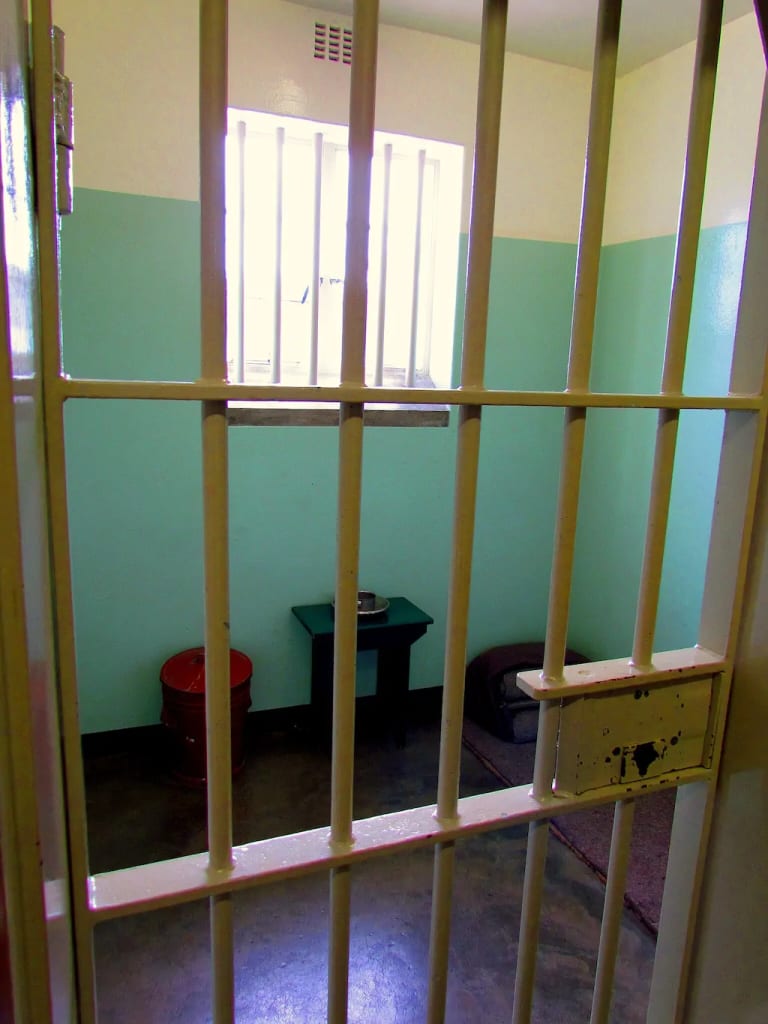
Life on Robben Island was brutally harsh, a constant test of endurance. Prisoners were forced to sleep on thin straw mats laid directly on cold concrete floors, subsisted on meager rations of mealie porridge and watery soup, and were compelled to perform back-breaking hard labour in the glaring lime quarry. The blinding white limestone and fine, insidious dust from the quarry permanently damaged Mandela’s eyesight, a debilitating condition that would affect him for the remainder of his life.
Yet, remarkably, despite these soul-crushing conditions, Mandela and his fellow political prisoners transformed Robben Island into what they defiantly dubbed “Mandela University”. They ingeniously conducted secret classes, clandestinely shared knowledge, and engaged in fervent political discussions that were instrumental in maintaining their spirits and meticulously preparing them for their eventual, hopeful release.
Mandela’s inherent leadership qualities shone brightly, even within the confines of prison. He tirelessly mediated disputes between prisoners, skilfully negotiated with warders for incremental improvements in conditions, and meticulously maintained a disciplined daily routine that rigorously included exercise, study, and profound reflection. His unwavering dignity and unyielding refusal to be broken by the system gradually, almost imperceptibly, earned him a grudging respect, even from some of his jailers.

International pressure and the free Mandela campaign: A global cry for justice
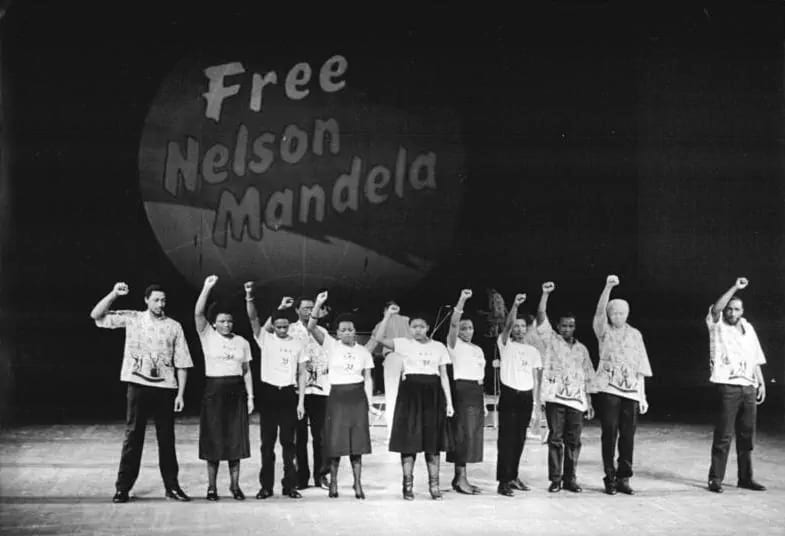
As the years of his unjust incarceration stretched into decades, Mandela’s imprisonment evolved into a powerful, undeniable symbol of apartheid‘s deep-seated injustice. The international community, stirred by the sheer moral outrage, launched widespread campaigns demanding his immediate release, with “Free Nelson Mandela” becoming an iconic rallying cry for anti-apartheid movement activists across the globe.
The campaign gained unstoppable momentum throughout the 1980s, manifesting in increasingly stringent sanctions imposed on South Africa and exhilarating concerts held worldwide in Mandela’s honour. The monumental 1988 Mandela 70th Birthday Concert at Wembley Stadium, watched by an astonishing 600 million people globally, brought unprecedented international attention to his dire plight and the ongoing struggle.
By the late 1980s, the apartheid government found itself besieged, facing increasing pressure from multiple, converging fronts: crippling international sanctions, escalating domestic unrest, and the dramatically shifting geopolitical landscape following the end of the Cold War. The release of Nelson Mandela became not merely a hope, but an inevitable necessity. The walls of injustice were crumbling.
Release and transition to democracy: The dawn of a new era
The moment Nelson Mandela walked free from prison was more than just a release; it was the symbolic unlatching of the gates for an entire nation. The culmination of decades of struggle, it marked the beginning of South Africa’s painstaking yet triumphant march towards true democracy in Africa.
The historic release: Freedom’s first steps
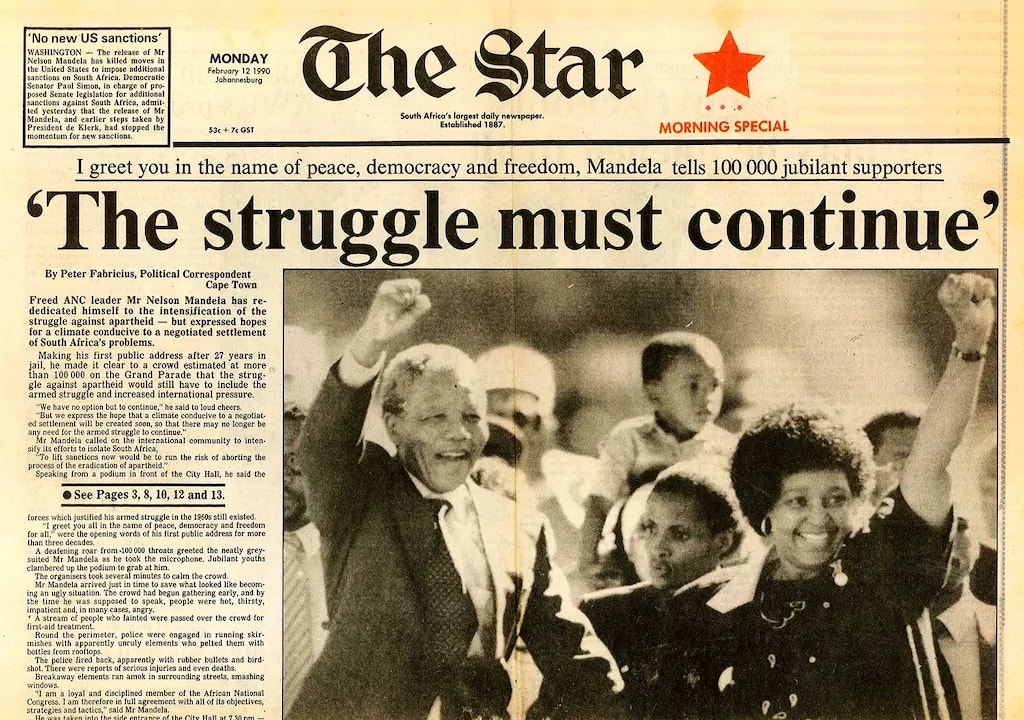
On 11 February 1990, a date forever etched in South African history, after an arduous 27 years in prison, Nelson Mandela walked free from Victor Verster Prison near Cape Town. The electrifying moment was broadcast live and watched by millions worldwide, marking the definitive beginning of South Africa’s arduous yet ultimately triumphant transition to democracy.
President F.W. de Klerk’s monumental decision to release Mandela and unban the ANC was driven by a complex interplay of both pragmatic and moral considerations. The oppressive apartheid system was, by this point, economically unsustainable and morally indefensible. The government, facing internal and external pressure, finally recognized that a negotiated settlement was infinitely preferable to the looming catastrophe of civil war.
Mandela’s first words as a free man, delivered with characteristic grace and power from the balcony of Cape Town City Hall, powerfully demonstrated his unwavering commitment to reconciliation while maintaining his resolute call for justice: “I stand before you not as a prophet but as a humble servant of you, the people. Your tireless and heroic sacrifices have made it possible for me to be here today”. It was a speech that set the tone for the challenging years ahead.
Negotiations and the Nobel Peace Prize: Forging a future
The period from 1990 to 1994 was characterized by intense, often fraught, negotiations between the outgoing apartheid government and the various liberation movements. Mandela’s role as the primary negotiator for the ANC was absolutely crucial; he had to deftly balance the soaring expectations of his eager supporters with the cold, hard practical realities of achieving a peaceful, stable transition. It was a tightrope walk of immense historical significance.
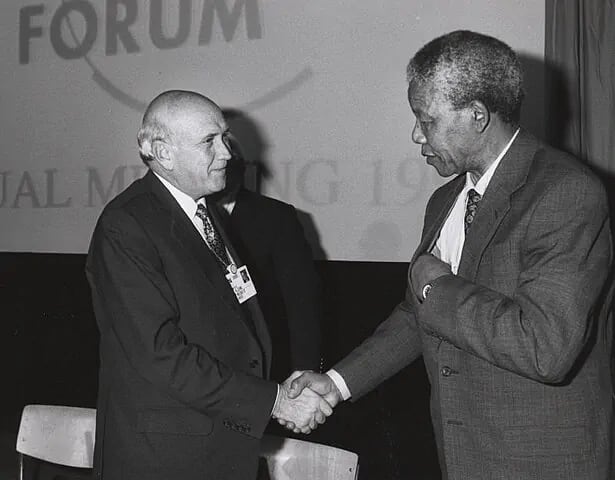
In a landmark recognition of their extraordinary efforts, Nelson Mandela and F.W. de Klerk were jointly awarded the Nobel Peace Prize in 1993 for their tireless work in dismantling apartheid and laying the essential foundations for a democratic South Africa. The prestigious award recognized their shared, if sometimes conflicted, commitment to achieving fundamental change through negotiation rather than continued violence. It was a powerful global endorsement of their collaborative, albeit difficult, path.
However, the negotiations were far from smooth sailing. Waves of political violence erupted across the country, threatening to derail the entire fragile process. The horrific assassination of prominent ANC leader Chris Hani in April 1993 brought the country to the terrifying brink of civil war. In that darkest hour, Mandela’s televised address, a poignant and powerful call for calm, demonstrated his profound moral authority and was instrumental in preventing the volatile situation from spiralling uncontrollably. It was a moment where his leadership truly saved the nation.
Presidency: Building a new South Africa from the ashes
With the weight of a nation on his shoulders, President Mandela embarked on the monumental task of rebuilding, focusing on unity and healing in a land scarred by decades of apartheid. His presidency became a beacon of reconciliation for the world.
The 1994 election and inauguration: A nation reborn
On 27 April 1994, a date forever etched in South African history, the nation held its first truly democratic elections, with people of all races queuing together to vote. The ANC swept to victory, securing 62.6% of the vote, and on 10 May 1994, Nelson Mandela was inaugurated as South Africa’s first democratically elected president. It was an extraordinary moment, a triumph of the human spirit.
Nelson Mandela delivering his inauguration speech as South Africa’s first democratically elected president in 1994.
At 77 years young, Mandela became the world’s oldest first-time president, a role he famously never actively sought but accepted as his solemn duty to the nation. His powerful inauguration speech encapsulated the profound significance of the moment, promising a new dawn: “Never, never, and never again shall it be that this beautiful land will again experience the oppression of one by another”. These words resonated globally, a promise of freedom and equality.
The government of national unity: Forging bonds of trust
Mandela’s presidency was uniquely characterized by his deep-seated commitment to reconciliation and the arduous, yet vital, process of nation-building. He established a Government of National Unity that audaciously included former enemies, even appointing F.W. de Klerk as Deputy President and retaining many civil servants from the very apartheid era.
This profoundly inclusive approach, while controversial among some ardent ANC supporters who yearned for more immediate and radical change, was, for Mandela, an absolute necessity for the country’s fragile stability and its future prosperity. His guiding philosophy was famously summarized in one of his most profound Mandela quotes: “If you want to make peace with your enemy, you have to work with your enemy. Then he becomes your partner”. It was a philosophy of pragmatic forgiveness.
The Truth and Reconciliation Commission (TRC): Unearthing the past for a better future
One of Mandela’s most defining and significant initiatives during his presidency was the establishment of the Truth and Reconciliation Commission (TRC) in 1995, an institution brilliantly chaired by the revered Archbishop Desmond Tutu. The TRC was meticulously tasked with investigating the horrific human rights violations committed during the apartheid era, providing a vital, cathartic platform for victims to bravely tell their stories and for perpetrators to seek amnesty in exchange for full disclosure.
The commission’s controversial approach of granting amnesty in exchange for full disclosure of past crimes, rather than pursuing retributive justice, directly reflected Mandela’s deeply held belief that truth and reconciliation were paramount to genuine healing and future progress, far more crucial than mere retribution. As he eloquently explained, in another of his resonant Mandela quotes: “We chose to forgive rather than to demand retribution, to move forward rather than to remain prisoner of our past”. This nuanced approach, though debated, was a cornerstone of his vision for a united South Africa.
Challenges and achievements: The road ahead
Mandela’s presidency faced a daunting array of challenges that threatened to overwhelm the nascent democracy. These included persistently high crime rates, deeply entrenched economic inequality, and the devastating, burgeoning HIV/AIDS pandemic. Critics, understandably, argued that his government was perhaps too singularly focused on political reconciliation at the perceived expense of much-needed radical economic transformation, leaving many of apartheid‘s structural economic inequalities largely intact.
However, Mandela’s achievements during his single term were undeniably monumental and transformative. He masterfully oversaw the peaceful transition to a full democracy, meticulously established robust democratic institutions, and tirelessly worked to create a new constitution that unequivocally enshrined human rights and equality for all citizens. Perhaps most importantly, he demonstrated to a sceptical world that former enemies could, indeed, work together for the common good.
Post-presidency and global elder statesmanship: A continued mission
Even after stepping down from the highest office, Nelson Mandela’s influence only seemed to grow. He transitioned into a role as a global elder statesman, his moral authority continuing to inspire and guide.
Retirement from politics: A precedent for democracy
True to his word and an exceptional demonstration of democratic principle, Mandela served only one term as president, gracefully stepping down in 1999 at the age of 80. His voluntary relinquishment of power, a rare act in many parts of the world, set an incredibly important precedent for African leaders and powerfully demonstrated his unwavering commitment to democratic principles and the peaceful transfer of power.
In his much-deserved retirement, Mandela, far from retreating, continued his tireless advocacy work through the indispensable Nelson Mandela Foundation, now focusing his considerable energies on critical areas like education, healthcare, and vital rural development initiatives. He also courageously became a prominent and outspoken advocate in the global fight against HIV/AIDS, openly speaking about the disease after his son Makgatho tragically died from AIDS-related complications in 2005. This deeply personal tragedy fueled his public health advocacy, showing his commitment extended beyond political liberation to the health and well-being of his people.
The Mandela legacy in action: A shepherd of humanity
Mandela’s post-presidency years solidified his role as a truly global elder statesman. He actively mediated international conflicts, passionately championed children’s rights, and relentlessly continued to speak out against injustice wherever he encountered it. His profound moral authority transcended national boundaries, cementing his position as one of the most respected and revered figures in world politics.
His approach to leadership, even in retirement, continued to emphasize unity over division. As he famously articulated in one of his most illustrative Mandela quotes: “A leader is like a shepherd. He stays behind the flock, letting the most nimble go out ahead, whereupon the others follow, not realizing that all along they are being directed from behind”. This humble yet profound insight captures his quiet strength and strategic wisdom.
Nelson Mandela International Day: A living, global legacy
Nelson Mandela International Day isn’t just a date on the calendar; it’s a living, breathing testament to the power of individual action and a global call to service, embodying the spirit of his famous “67 minutes campaign.”
The birth of Mandela Day: “It is in your hands now”
In November 2009, the United Nations General Assembly officially declared 18 July – Mandela’s birthday – as Nelson Mandela International Day. This significant day was established to honour his monumental contributions to peace, profound reconciliation, and universal human rights. It was a global acknowledgement of a truly singular figure in South African history and beyond.
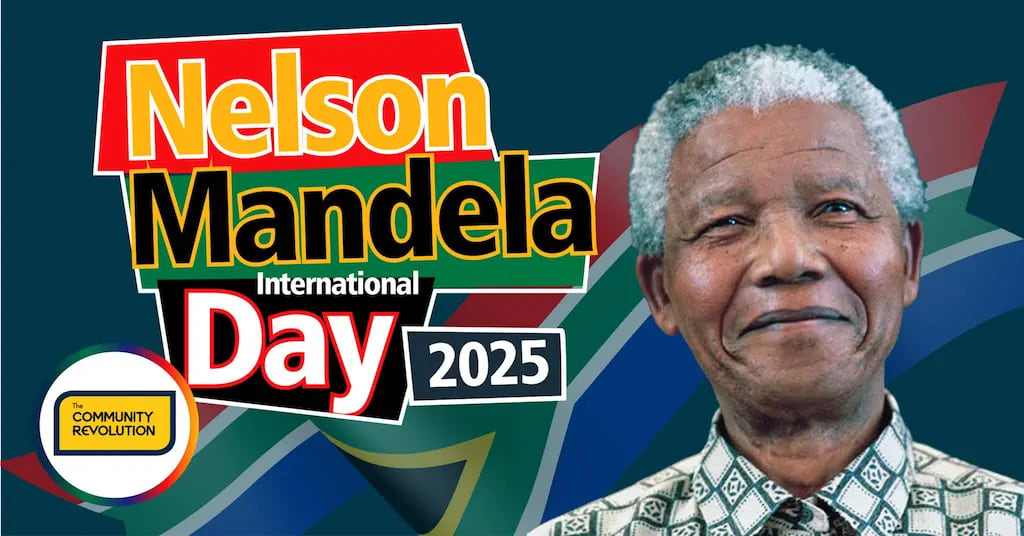
The very concept of Mandela Day was directly inspired by Mandela’s own empowering words: “It is in your hands now”. The day serves as an annual call to action, urging people worldwide to dedicate 67 minutes of their valuable time to community service – precisely one minute for each year of Mandela’s incredible public service and sacrifice. It’s a tangible way for ordinary individuals to embody his extraordinary spirit.
The 67 minutes campaign: A small act, a big impact
The 67 minutes campaign is a simple yet powerful invitation, encouraging people everywhere to make a tangible difference in their local communities through acts of service, no matter how seemingly small. Activities on this day range widely, from feeding the homeless and meticulously cleaning up neglected neighbourhoods to mentoring eager young people and visiting the elderly.
The campaign beautifully reflects another of Mandela’s deeply held beliefs, captured in one of his most inspiring Mandela quotes: “what counts in life is not the mere fact that we have lived. It is what difference we have made to the lives of others that will determine the significance of the life we lead”. It’s a profound reminder that legacy is built through service, not just through positions of power.
Global impact and observance: A ripple effect of good
Mandela Day has transcended its origins to become a truly global phenomenon, with millions of people participating in diverse community service activities worldwide. The day serves as a poignant annual reminder that each individual, regardless of their circumstances, possesses the inherent power to ignite positive change, powerfully embodying Mandela’s philosophy that, as another of his famous Mandela quotes suggests, “there is no passion to be found playing small – in settling for a life that is less than the one you are capable of living”. It’s a call to embrace our full potential for good.
Philosophy and key works: The wisdom of Madiba
Beyond his actions, Nelson Mandela left behind a profound philosophical legacy, encapsulated in his powerful autobiography, a testament to his intellect and unwavering spirit. His “Long Walk to Freedom” reveals the very soul of the man.
Long walk to freedom: The definitive Mandela autobiography
Mandela’s autobiography, “Long Walk to Freedom,” published in 1994, stands as the definitive, indispensable account of his extraordinary life and unwavering struggle. What many may not realize is that a significant portion of this monumental book was meticulously written in secret during his agonizing imprisonment on Robben Island, with precious manuscripts painstakingly hidden in cocoa tins and bravely buried in the prison garden.
This powerful Mandela autobiography chronicles his remarkable evolution from a driven young lawyer to a formidable revolutionary leader, and finally, to a statesman utterly committed to profound reconciliation. It offers invaluable, raw insights into his developing philosophy and the crucible of experiences that relentlessly shaped his unique worldview. If you want to truly understand the man, this book is where you start your Long Walk to Freedom with him.
Core philosophical principles: A beacon for humanity
Mandela’s philosophy, forged in the fires of adversity and refined through decades of struggle, was built upon several foundational principles that remain profoundly relevant today:
- Non-racialism: He believed in a non-racial society where people would be judged not by the colour of their skin but by the content of their character. This was a radical departure from the ingrained hatred of apartheid laws.
- Democracy: His understanding of democracy was shaped by traditional African concepts of consensus and consultation, where every voice was heard. It was a democracy rooted in communal well-being, a stark contrast to the imposed colonial systems.
- Reconciliation: He believed that reconciliation was essential for healing and progress, famously stating: “As I walked out the door toward the gate that would lead to my freedom, I knew if I didn’t leave my bitterness and hatred behind, I’d still be in prison”. This personal philosophy transcended political rhetoric.
- Ubuntu: This African philosophy, which emphasises our interconnectedness as human beings, was central to his approach to leadership and governance. It informed his every decision, driving him towards a shared humanity.
Memorable quotes and their significance: Words that echo
Nelson Mandela’s powerful words continue to inspire, challenge, and uplift people across every corner of the globe. His Mandela speech moments are immortalised in these powerful phrases. Some of his most impactful Mandela quotes include:
- “Education is the most powerful weapon which you can use to change the world” – This profound statement reflects his unwavering belief in the transformative and liberating power of Mandela education, a force capable of dismantling prejudice and fostering progress.
- “No one is born hating another person because of the colour of his skin, or his background, or his religion. People must learn to hate, and if they can learn to hate, they can be taught to love” – This deeply insightful quote demonstrates his nuanced understanding of the learned nature of prejudice and, crucially, the inherent human capacity for empathy and compassion. It’s a powerful message for racial reconciliation today.
- “It always seems impossible until it’s done” – This encapsulates his indomitable spirit and pragmatic approach to seemingly insurmountable challenges, a rallying cry for persistent effort.
These are not merely words; they are calls to action, guiding principles for those seeking to make a difference in the world.
Death and global mourning: A world united in grief
When the news broke of Nelson Mandela’s passing, the world collectively paused. It was a moment of profound sadness, but also an overwhelming outpouring of tributes for a life lived with extraordinary purpose, truly a turning point in South African history and global consciousness.
The final years: A gradual sunset
In his twilight years, Nelson Mandela’s health began its inevitable decline. He was hospitalised several times for respiratory infections and other age-related ailments. Despite his failing health, he remained a profoundly revered figure, with world leaders and ordinary citizens alike seeking his wisdom, his blessing, and simply, his presence. His very existence continued to be a beacon.
Passing of an icon: A world weeps
On 5 December 2013, the news that the world had braced for, yet still dreaded, finally arrived. Nelson Mandela passed away at his home in Johannesburg at the age of 95. South African President Jacob Zuma, with a heavy heart, announced his death to a grieving nation, declaring: “Our nation has lost its greatest son”.
The news of Mandela’s passing triggered an unprecedented, global outpouring of grief and heartfelt tributes from around the world. World leaders, renowned celebrities, and countless ordinary citizens from every corner of the earth paid their deepest respects to a man who had, quite literally, touched millions of lives through his unwavering struggle against apartheid and his tireless work for peace and reconciliation. It was a rare moment of unified global emotion.
State funeral and global tribute: A farewell to Madiba
Mandela’s state funeral, a solemn yet celebratory occasion, was held on 15 December 2013 in his ancestral home of Qunu, bringing his extraordinary journey full circle. The deeply moving service was attended by an astonishing array of world leaders, including then-US President Barack Obama, who delivered a powerful eulogy describing Mandela as “a man who took history in his hands and bent the arc of the moral universe toward justice”.
The funeral itself was preceded by a massive memorial service at FNB Stadium in Johannesburg, attended by over 90,000 people, a sea of humanity united in remembrance. The ten-day period of official mourning across South Africa, and indeed, around the world, powerfully demonstrated the profound, undeniable global impact of Mandela’s life and enduring legacy. It was a testament to the fact that his fight against apartheid had resonated with people of all backgrounds.
Legacy and continuing influence: Mandela’s echoes in 2024
Nelson Mandela’s journey didn’t end with his passing. His principles continue to resonate, offering a blueprint for addressing some of the most pressing contemporary issues in 2024, from democracy challenges to the ongoing pursuit of racial reconciliation.
The Mandela effect on global politics: A blueprint for peace
Nelson Mandela’s profound legacy extends far beyond the geographical borders of South Africa. His groundbreaking approach to leadership, one that vehemently emphasized profound reconciliation over vindictive revenge, has profoundly influenced peace processes and post-conflict resolutions worldwide. His unique model of moral leadership, characterized by integrity, empathy, and an unwavering commitment to justice, has inspired countless activists and leaders across the globe, providing a powerful beacon in challenging times. In an era fraught with democracy challenges, his example of peaceful transition and collaboration offers invaluable lessons.
Challenges to the legacy: The unfinished work
However, like any monumental figure, Mandela’s legacy is not without its thoughtful critics and complex debates. Some argue, with valid points, that his singular emphasis on political reconciliation, while crucial for peace, inadvertently came at the expense of a more radical economic transformation, leaving many of apartheid‘s deeply entrenched economic inequalities distressingly intact. Young South Africans, in particular, often question whether his conciliatory approach was perhaps too accommodating, leading to persistent socio-economic disparities.
These criticisms reflect the inherent, intricate challenges of transitional justice and the undeniable difficulty of achieving both profound political liberation and sweeping economic transformation simultaneously. However, they also serve to demonstrate the ongoing, vital relevance of Mandela’s extraordinary example and the continued, pressing need for his cherished values of tolerance, forgiveness, and unwavering perseverance in the face of ongoing injustice. The pursuit of true racial reconciliation is a continuous journey.
The enduring relevance of Mandela’s message in 2024: A guiding light
In an era of increasing global polarization, escalating division, and pervasive online vitriol, Mandela’s timeless message of profound reconciliation and inherent human dignity remains profoundly, undeniably relevant, perhaps even more so now than ever before. His extraordinary example powerfully demonstrates that even the most deeply entrenched, seemingly intractable conflicts can indeed be resolved through patient, persistent dialogue and courageous compromise, offering a vital lesson for navigating current democracy challenges around the world.
As humanity grapples with complex contemporary issues such as the existential threat of climate change, widening economic inequality, and persistent global conflicts, Mandela’s philosophy of ubuntu – the beautiful and profound concept of our inherent interconnectedness as human beings – offers a powerful, much-needed ethical framework for holistically addressing these daunting challenges. It reminds us that our shared humanity is our greatest strength, a message that truly resonates in the ongoing quest for racial reconciliation and global unity.
Conclusion: The immortal legacy of Nelson Mandela
Nelson Mandela’s life story is ultimately one of unparalleled triumph over adversity, of unyielding hope over the deepest despair, and of transformative love over corrosive hate. From his humble beginnings in a rural village in the Xhosa tribe to his emergence as a global icon of peace and profound reconciliation, Mandela unequivocally demonstrated that one person, through sheer will and moral courage, can indeed change the world.
His legacy resides not merely in the political transformation of South Africa, monumental as that was, but in the extraordinary example he set for all of humanity. He showed us that it is profoundly possible to emerge from 27 years of brutal imprisonment without succumbing to bitterness, to find the strength to forgive one’s most ardent enemies, and to courageously build a future founded on shared humanity rather than perpetuating past grievances.
The core principles that steadfastly guided Mandela – justice, equality, profound reconciliation, and the spirit of ubuntu – remain as vitally relevant today as they were during the darkest days of apartheid. His life serves as a constant, powerful reminder that “there is no easy walk to freedom anywhere, and many of us will have to pass through the valley of the shadow of death again and again before we reach the mountaintop of our desires”. This powerful Mandela quote resonates with universal truth.
As we continue to face contemporary challenges of inequality, division, and injustice in our own societies and across the globe, Mandela’s incandescent example continues to light the way forward. His immortal words echo through time, a guiding star for those who seek genuine liberty: “For to be free is not merely to cast off one’s chains, but to live in a way that respects and enhances the freedom of others”.
In remembering Nelson Mandela, we honour not just a man, but a profound, enduring idea – the transformative idea that human beings possess the boundless capacity to transcend their circumstances, that former enemies can indeed become trusted partners, and that the long, often winding, arc of history, though arduous, ultimately bends with unwavering certainty toward justice. This, I believe, is the true, immeasurable measure of Mandela’s greatness, and the profound reason why his legacy will endure, inspiring generations to come.
Join the conversation!
What does Nelson Mandela’s legacy mean to you in today’s world? How do you think his principles of reconciliation and justice can be applied to the challenges we face in 2025 and beyond? Share your thoughts and engage in the discussion below.