

The world knows Mohandas Karamchand Gandhi as the Mahatma Gandhi, the “Great Soul” who led India to independence through non-violent resistance and became a global icon of peace and moral leadership. His image graces currency notes, countless statues stand in his honour from London to Ghana, and his philosophy inspired civil rights leaders from Martin Luther King Jr. to Nelson Mandela. But behind this sanitised narrative lies a far more complex and troubling figure: one whose early racist views, problematic treatment of women, controversial sexual practices, and rigid authoritarianism paint a starkly different picture from the saint-like figure we’ve been taught to revere.
This isn’t about tearing down a hero; it’s about understanding the complete human being. The hidden side of Gandhi reveals contradictions that are both fascinating and deeply uncomfortable, challenging us to grapple with the reality that even our most revered leaders are capable of profound moral failures alongside their greatest triumphs.
The author acknowledges that this examination of Gandhi’s controversial aspects draws from extensive historical research and documented sources. The goal is not to diminish Gandhi’s contributions to Indian independence and global non-violence movements, but to present a more complete and historically accurate portrait of this complex figure.
Timeline of Gandhi’s controversial views and actions (1893–1948)

| Year | Event | Controversy |
|---|---|---|
| 1893 | Arrival in South Africa | Early racist views expressed about Black Africans |
| 1894 | Letter to Natal Parliament | Called Indians ‘little better than savages or Natives’ |
| 1904 | Letter to Johannesburg health officer | Demanded withdrawal of ‘Kaffirs’ from Indian areas |
| 1906 | Takes vow of brahmacharya | Imposed celibacy on wife Kasturba without consent |
| 1915 | Return to India | Defended caste system, opposed complete abolition |
| 1920 | Anti-industrialisation views | God forbid India should take to industrialisation |
| 1932 | Fast against separate electorates | Opposed Ambedkar’s efforts for Dalit rights |
| 1935 | Meeting with Margaret Sanger | Opposed contraception, called users ‘prostitutes’ |
| 1939 | Letter to Hitler | Addressed Hitler as ‘Dear friend’ |
| 1940 | Brahmacharya experiments begin | Slept naked with young women including grandniece |
| 1944 | Kasturba’s death | Allegedly prevented her from taking penicillin |
| 1946 | Experiments with Manu Gandhi | 77-year-old sleeping naked with 18-year-old grandniece |
| 1948 | Assassination by Godse | Killed by Hindu nationalist for being ‘too pro-Muslim’ |
The South African years: Early racism and colonial complicity
Gandhi’s transformation from racist lawyer to global icon began in the most unlikely way, through his own prejudices. When the 24-year-old barrister arrived in South Africa in 1893, he brought with him not enlightenment, but the racial hierarchies of his time, amplified by his own sense of Indian superiority.
The uncomfortable truth about Gandhi’s early views
The historical record is unambiguous: Gandhi held deeply racist views about Black Africans for a significant portion of his time in South Africa. In 1893, he wrote to the Natal parliament complaining that “a general belief seems to prevail in the Colony that the Indians are a little better, if at all, than savages or the Natives of Africa”. Rather than challenging this racist hierarchy, Gandhi sought to elevate Indians within it.
His 1904 letter to a Johannesburg health officer is even more damning: “About the mixing of the Kaffirs with the Indians, I must confess I feel most strongly”. He demanded that Black Africans be withdrawn from areas where Indians lived, arguing for racial segregation that would benefit his own community at the expense of others.
The young Gandhi wasn’t fighting racism, he was trying to secure a better position within it. He emphasised the shared “Indo-Aryan” heritage between Indians and Europeans, arguing this warranted better treatment than that afforded to Black Africans. During the Boer War, he even formed an Indian Ambulance Corps to serve alongside British forces, hoping to prove Indian loyalty and worthiness.
The evolution and its limits
Historians like Ramachandra Guha acknowledge that Gandhi “outgrew his racism quite decisively” by his thirties. However, this evolution was neither complete nor swift. Patrick French called Gandhi’s disregard for Africans “the black hole at the center of his sanctifying mythology”, while recent scholarship suggests his racist opinions persisted longer than previously acknowledged.
The transformation narrative, whilst partially true, cannot erase the fact that Gandhi spent his formative political years advocating for racial segregation and describing Black Africans as “uncivilised” and “savage”. This legacy continues to haunt his reputation, leading to statue removals in Ghana and protests under the hashtag #GandhiMustFall.

Caste, Ambedkar, and the Poona pact (1932): Representation vs. reform
Perhaps no aspect of Gandhi’s hidden side is more politically charged in modern India than his complicated relationship with the caste system. While popular mythology portrays him as a crusader against caste discrimination, the reality reveals a man whose reforms were limited, paternalistic, and ultimately insufficient for those who suffered most under caste oppression.
The Gandhi-Ambedkar conflict
The philosophical battle between Gandhi and Dr. B.R. Ambedkar, the Dalit leader who would become the architect of India’s Constitution, exposes the fundamental limitations of Gandhi’s approach to caste. When the British awarded separate electorates to Dalits in 1932, Gandhi’s response was not celebration but a fast unto death in protest.
Gandhi’s opposition wasn’t born from a desire for Dalit empowerment but from his fear that separate electorates would “destroy Hinduism” by creating divisions within the Hindu fold. His strategic concerns were clear: if Muslims already had separate electorates, and now Dalits did too, the political power of caste Hindu leadership would be significantly diminished.
Ambedkar was forced into the Poona pact under the threat of Gandhi’s death—a moral blackmail that secured reservations for Dalits but abandoned the more radical separate electorates that could have provided genuine political autonomy. As Ambedkar himself noted, Gandhi’s approach was fundamentally flawed: even with reserved seats, upper castes would still determine which Dalit candidates succeeded.
The varna ideal vs. caste reality
Gandhi’s position on caste was not opposition but reform. As controversial writer Arundhati Roy argues, “the greatest misconception is that Gandhi fought against the caste system. This is not true. He always said that it was the most genius point of the entire Hindu civilisation”.
Gandhi believed in the varna system—the theoretical four-fold division of society—arguing that “the callings of a Brahmin and a scavenger are equal, and their due performance carries equal merit before God”. This romantic view ignored the brutal realities of caste discrimination and hereditary occupational bondage that trapped millions in poverty and social exclusion.
Ambedkar’s response was devastating: “If the Mahatma believes, as he does, in everyone following his or her ancestral calling, then most certainly he is advocating the Caste System”. Gandhi’s vision would have kept Shudras as a servile class and integrated Dalits into the Shudra varna rather than eliminating caste hierarchies altogether.
Brahmacharya “experiments”: Power, intimacy, and dissent
Of all Gandhi’s hidden practices, none are more disturbing than his so-called “experiments” in celibacy, a euphemism for sleeping naked with young women, including his grandniece, ostensibly to test his spiritual purity.
The mechanics of “spiritual testing”
After taking a vow of brahmacharya (celibacy) in 1906, Gandhi developed increasingly elaborate justifications for his intimate contact with women. His “experiments” began innocuously but evolved into explicit sexual behaviour disguised as spiritual discipline.
Sushila Nayar, his personal physician and secretary’s sister, slept and bathed with Gandhi from girlhood. When questioned, Gandhi explained: “While she is bathing I keep my eyes tightly shut. I do not know whether she bathes naked or with her underwear on. I can tell from the sound that she uses soap”.
But the most controversial experiment involved his grandniece Manu Gandhi. In December 1946, the 77-year-old Gandhi told the 18-year-old: “We both may be killed by the Muslims, and must put our purity to the ultimate test, so that we know that we are offering the purest of sacrifices, and we should now both start sleeping naked”.
The redefinition of celibacy
Gandhi essentially redefined brahmacharya to accommodate his personal practices. He described a true brahmachari as “one who never has any lustful intention… who is capable of lying naked with naked women, however beautiful, without being in any manner whatsoever sexually excited”.
This self-serving definition allowed him to claim spiritual superiority whilst engaging in behaviour that would be considered inappropriate by any conventional standard. When staff members resigned in protest and family members objected, Gandhi treated their concerns as further proof of the experiment’s necessity: “If I don’t let Manu sleep with me, though I regard it as essential that she should, wouldn’t that be a sign of weakness in me?”.
Crucially, Sushila Nayar later revealed that the “brahmacharya experiment” terminology was developed only after people began questioning Gandhi’s behaviour. “In the early days, there was no question of calling this a brahmacharya experiment,” she admitted. Like many powerful men, Gandhi made up the rules as he went along.
Views on women: Misogyny disguised as protection
Gandhi’s treatment of women extended far beyond his sexual experiments to encompass a worldview that was deeply misogynistic and harmful to women’s rights and safety. His views on menstruation, contraception, and sexual violence reveal a man whose supposed progressiveness masked profound prejudices.
Blaming the victims
Gandhi believed women were responsible for their own sexual assault—a viewpoint that would be considered abhorrent today. When harassment occurred in his South African ashram, his solution was to cut the hair of his female followers, as if their appearance, rather than male behaviour, was the problem.
His belief that rape victims lost their value as human beings was even more devastating. Gandhi argued that fathers could be justified in killing daughters who had been sexually abused to preserve family and community honour. This victim-blaming mentality has had lasting consequences, with its echoes still found in contemporary India’s treatment of sexual violence survivors.
The war against contraception
Gandhi’s opposition to birth control was absolutist and harmful. During his 1935 meeting with birth control pioneer Margaret Sanger, he rejected contraceptives entirely, arguing they would lead to “frightful results” and turn people into “mental and moral wrecks”.
He labelled women who used contraceptives as “prostitutes” and argued that the solution to unwanted pregnancies was male self-control, not female autonomy. This position ignored the reality of women’s lives and their need for reproductive control, condemning them to endless childbearing or dangerous attempts at family limitation.
Bizarre beliefs about female biology
Perhaps most telling were Gandhi’s views on menstruation, which he saw as “a manifestation of the distortion of a woman’s soul by her sexuality”. This pathologisation of normal female biology revealed the extent to which his supposedly spiritual worldview was infected by misogyny.
Gandhi believed women shouldn’t menstruate at all—a view so disconnected from biological reality that it verged on the delusional. His attempt to impose his sexual hang-ups on women’s natural functions demonstrates the authoritarian streak that ran through much of his supposedly liberating philosophy.
Economic philosophy: Anti-industrial romanticism
Gandhi’s economic philosophy, whilst influential, may have hindered India’s development through its romantic opposition to industrialisation and modern technology. His famous declaration—”God forbid that India should ever take to industrialisation after the manner of the west”—reflected a worldview that privileged spiritual purity over material progress.
The spinning wheel myth
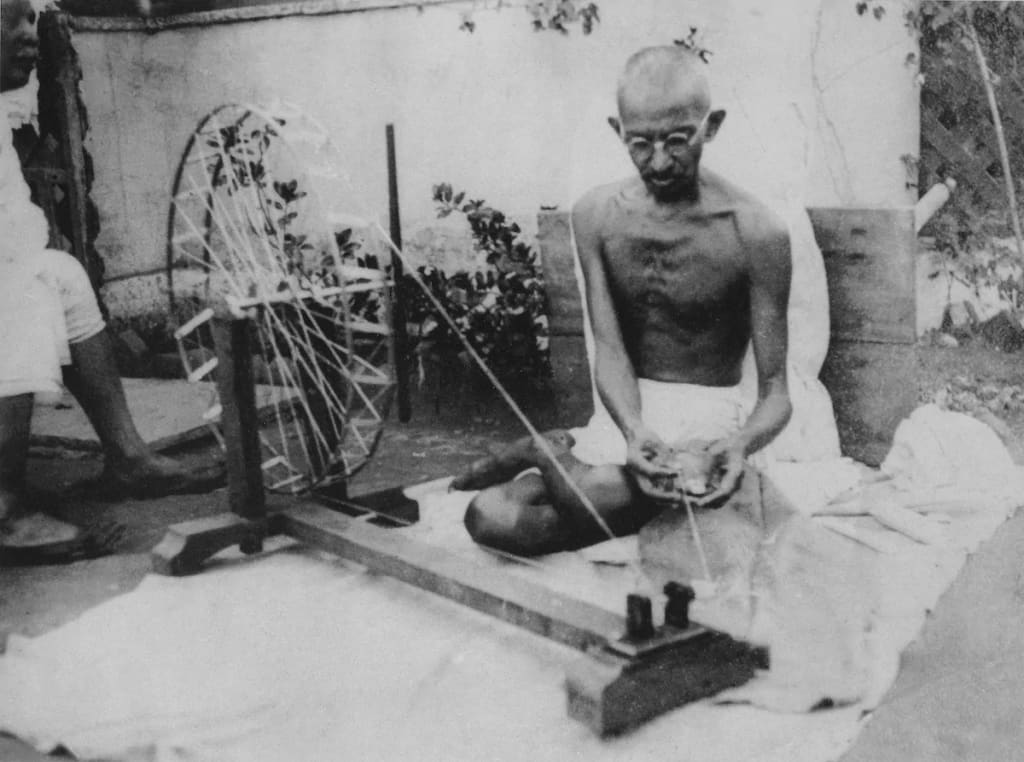
The charkha (spinning wheel) became both symbol and trap in Gandhi’s economic thinking. Whilst hand-spinning provided some employment during the independence struggle, it could never address the massive scale of India’s poverty and unemployment.
Even sympathetic economists recognised the limitations. Nobel laureate Amartya Sen demonstrated in 1957 that the government-promoted ambar charkha (improved spinning wheel) actually destroyed value rather than creating it, leading to inflation and impeding capital accumulation.
Rabindranath Tagore, Gandhi’s Nobel Prize-winning contemporary, questioned whether poverty could be tackled with “mechanical and ritualistic spinning on a primitive wheel”. The obsession with village self-sufficiency, whilst morally appealing, ignored the realities of economic interdependence and the benefits of specialisation.
The development trap
Gandhi’s economic philosophy, influenced by Victorian critics like John Ruskin and Thomas Carlyle, was built on moral concerns rather than economic logic. His vision of self-reliant village communities may have inadvertently strengthened feudalism and impeded the modernisation that India desperately needed.
The contradiction in Gandhi’s thinking was stark. He accepted some modern technology (like the Singer sewing machine) whilst rejecting others, but offered no coherent principle for distinguishing between helpful and harmful innovations. This arbitrary approach left his followers without clear guidance for navigating the modern world.
The Hitler letters (1939, 1940): ‘Dear friend’ and wartime judgment
Gandhi’s correspondence with Adolf Hitler reveals a political naivety that bordered on the dangerous. His 1939 and 1940 letters, whilst motivated by his commitment to non-violence, demonstrated a fundamental misunderstanding of the nature of evil and the limits of moral persuasion.
“Dear friend” and the failure of moral equivalence
Gandhi’s decision to address Hitler as “Dear Friend” reflects his belief that he had “no enemies”, a worldview that, whilst spiritually admirable, proved politically catastrophic. His 1940 letter to the British people urging them to “lay down arms and accept whatever fate Hitler decided” would have meant surrendering Europe to Nazi rule.
The correspondence reveals Gandhi’s dangerous assumption that moral force could overcome any opponent. His advice to Jews to practice satyagraha against the Nazis showed a profound misunderstanding of genocidal ideology and the limits of non-violent resistance against those who recognise no moral constraints.
The complexity of wartime positions
Gandhi’s position wasn’t simply pacifist, it was strategically confused. Whilst opposing British participation in World War II without Indian consent, he simultaneously offered Hitler the fruits of British defeat. This wasn’t principled non-violence but a form of indirect collaboration with fascism.
Churchill’s dismissal of Gandhi as someone who “offered to mediate Britain’s surrender to Hitler” wasn’t entirely unfair. Gandhi’s description of Hitler as “not a bad man” in May 1940—the very month Churchill became Prime Minister—revealed a moral blindness that could have had catastrophic consequences for civilisation itself.
Letter to Adolf Hitler, 1939
As AT WARDHA,
C.P.,
INDIA,
July 23, 1939DEAR FRIEND,
Friends have been urging me to write to you for the sake of humanity. But I have resisted their request, because of the feeling that any letter from me would be an impertinence. Something tells me that I must not calculate and that I must make my appeal for whatever it may be worth. It is quite clear that you are today the one person in the world who can prevent a war which may reduce humanity to the savage state. Must you pay that price for an object however worthy it may appear to you to be? Will you listen to the appeal of one who has deliberately shunned the method of war not without considerable success? Anyway I anticipate your forgiveness, if I have erred in writing to you.
I remain,
Your sincere friend,
HERR HITLER
BERLIN GERMANY
Letter to Adolf Hitler, 1940
WARDHA,
December 24, 1940
DEAR FRIEND,
That I address you as a friend is no formality. I own no foes. My business in life has been for the past 33 years to enlist the friendship of the whole of humanity by befriending mankind, irrespective of race, colour or creed. I hope you will have the time and desire to know how a good portion of humanity who have been living under the influence of that doctrine of universal friendship view your action. We have no doubt about your bravery or devotion to your fatherland, nor do we believe that you are the monster described by your opponents. But your own writings and pronouncements and those of your friends and admirers leave no room for doubt that many of your acts are monstrous and unbecoming of human dignity, especially in the estimation of men like me who believe in universal friendliness. Such are your humiliation of Czechoslovakia, the rape of Poland and the swallowing of Denmark. I am aware that your view of life regards such spoliations as virtuous acts. But we have been taught from childhood to regard them as acts degrading humanity. Hence we cannot possibly wish success to your arms. But ours is a unique position. We resist British Imperialism no less than Nazism. If there is a difference, it is in degree. One-fifth of the human race has been brought under the British heel by means that will not bear scrutiny. Our resistance to it does not mean harm to the British people. We seek to convert them, not to defeat them on the battle-field. Ours is an unarmed revolt against the British rule. But whether we convert them or not, we are determined to make their rule impossible by non-violent non-co-operation. It is a method in its nature indefensible. It is based on the knowledge that no spoliator can compass his end without a certain degree of co-operation, willing or compulsory, of the victim. Our rulers may have our land and bodies but not our souls. They can have the former only by complete destruction of every Indian-man, woman and child. That all may not rise to that degree of heroism and that a fair amount of frightfulness can bend the back of revolt is true but the argument would be beside the point. For, if a fair number of men and women be found in India who would be prepared without any ill will against the spoliators to lay down their lives rather than bend the knee to them, they would have shown the way to freedom from the tyranny of violence. I ask you to believe me when I say that you will find an unexpected number of such men and women in India. They have been having that training for the past 20 years. We have been trying for the past half a century to throw off the British rule. The movement of independence has been never so strong as now. The most powerful political organization, I mean the Indian National Congress, is trying to achieve this end. We have attained a very fair measure of success through nonviolent effort. We were groping for the right means to combat the most organized violence in the world which the British power represents. You have challenged it. It remains to be seen which is the better organized, the German or the British. We know what the British heel means for us and the non-European races of the world. But we would never wish to end the British rule with German aid. We have found in non-violence a force which, if organized, can without doubt match itself against a combination of all the most violent forces in the world. In nonviolent technique, as I have said, there is no such thing as defeat. It is all ‘do or die’ without killing or hurting. It can be used practically without money and obviously without the aid of science of destruction which you have brought to such perfection. It is a marvel to me that you do not see that it is nobody’s monopoly. If not the British, some other power will certainly improve upon your method and beat you with your own weapon. You are leaving no legacy to your people of which they would feel proud. They cannot take pride in a recital of cruel deed, however skilfully planned. I, therefore, appeal to you in the name of humanity to stop the war. You will lose nothing by referring all the matters of dispute between you and Great Britain to an international tribunal of your joint choice. If you attain success in the war, it will not prove that you were in the right. It will only prove that your power of destruction was greater. Whereas an award by an impartial tribunal will show as far as it is humanly possible which party was in the right. You know that not long ago I made an appeal to every Briton to accept my method of non-violent resistance. I did it because the British know me as a friend though a rebel. I am a stranger to you and your people. I have not the courage to make you the appeal I made to every Briton. Not that it would not apply to you with the same force as to the British. But my present proposal is much simple because much more practical and familiar. During this season when the hearts of the peoples of Europe yearn for peace, we have suspended even our own peaceful struggle. Is it too much to ask you to make an effort for peace during a time which may mean nothing to you personally but which must mean much to the millions of Europeans whose dumb cry for peace I hear, for my ears are attuned to hearing the dumb millions? I had intended to address a joint appeal to you and Signor Mussolini, whom I had the privilege of meeting when I was in Rome during my visit to England as a delegate to the Round Table Conference. I hope that he will take this as addressed to him also with the necessary changes.
I am,
Your sincere friend,
M.K. GANDHI
The authoritarian streak: Control and punishment
Behind Gandhi’s gentle public image lay an authoritarian personality that demanded absolute obedience and imposed harsh punishments for minor infractions. His treatment of family members, ashram residents, and followers revealed a man who brooked no dissent from his rigid moral code.
Petty tyranny in daily life
Gandhi’s authoritarianism manifested in trivial yet telling ways. When his son rounded off the time by a single minute, Gandhi flew into a rage and delivered a lengthy sermon about lying. When a Dalit girl arrived late to prayer because she was combing her hair, he cut off her hair as punishment—without her consent.
His treatment of his wife Kasturba was particularly harsh. Gandhi himself wrote about dragging her to their gate and threatening to throw her out during an argument, describing how “tears were running down her cheeks in torrents”. His later comment that “the wife, with her matchless powers of endurance, has always been the victor” cannot disguise the emotional abuse inherent in such behaviour.
The imposition of values
Gandhi’s decision to impose celibacy on Kasturba without her consent exemplifies his authoritarian approach to personal relationships. His description of her as having a “dull cow-like expression” reveals the contempt that often lay behind his public pronouncements about partnership and equality.
The broader pattern is clear: Gandhi expected others to conform to his moral vision regardless of their own wishes or well-being. This authoritarianism, dressed up as spiritual discipline, created a culture of fear and submission around him that contradicts the image of the gentle sage.

The assassination and its aftermath
Gandhi’s death at the hands of Hindu nationalist Nathuram Godse was both tragic and revealing. Godse’s motivation—that Gandhi was “too pro-Muslim” and had betrayed Hindus during Partition—exposed the dangerous tensions that Gandhi’s complex political positions had created.
The final irony
Gandhi died as he had lived in his final years—caught between competing demands and satisfying none completely. Hindu nationalists saw him as a traitor to their cause, whilst Muslims questioned his commitment to their rights. His vision of a united India had collapsed into the bloodbath of Partition.
The execution of Godse and his co-conspirator Narayan Apte came despite pleas for clemency from Gandhi’s own sons—a final testament to his belief in non-violence that his killers could never understand. Yet the fact that a movement inspired by Gandhi’s own selective reading of Hindu tradition produced his assassin reveals the contradictions inherent in his complex legacy.
The humour and humanity: Redeeming complexities
For all his flaws, Gandhi retained a sense of humour and human warmth that complicated any simple judgment of his character. His witty correspondence with Churchill, his declaration that he had “no enemies,” and his ability to laugh at himself provided glimpses of a more appealing personality beneath the rigid moral framework.
Gandhi’s letter to Churchill after the latter’s harsh criticisms demonstrated his capacity for gracious response to attack. His starting letters to Hitler with “My dear friend” reflected not naivety alone but a genuine belief in the possibility of human transformation—however misguided that belief proved to be.
Statues, protests, and #GandhiMustFall: A global reckoning
The controversies surrounding Gandhi’s legacy have led to modern protests and the removal of his statues across the world. The #GandhiMustFall movement, inspired by South Africa’s Rhodes Must Fall campaign, brought renewed attention to his early racist views.
Key instances include:
- Ghana (2016): Students and faculty at the University of Ghana successfully petitioned for the removal of a Gandhi statue, citing his derogatory comments about Black Africans during his time in South Africa.
- Malawi (2018): A court injunction halted the planned installation of a Gandhi statue in Blantyre after activists and lawyers argued against honoring a figure with a history of racism.
This global reckoning highlights the enduring impact of Gandhi’s early prejudices and the demand for a more complete and honest acknowledgment of historical figures’ complexities.
Conclusion: Wrestling with a complex legacy
What do we do with a hero who has such a profound hidden side? Gandhi’s story forces us to confront the reality that great historical figures are not saints but complex human beings capable of both inspiration and repulsion, often simultaneously.
The hidden side of Gandhi doesn’t negate his achievements—his role in India’s independence, his development of non-violent resistance as a political tool, and his influence on civil rights movements worldwide remain significant. But neither can these achievements excuse his racism, misogyny, authoritarianism, and sexual impropriety.
Perhaps the most troubling aspect of Gandhi’s legacy is how it has been sanitised and mythologised, turning a flawed human being into an untouchable saint. This process has made it difficult to learn from both his successes and his failures, creating a false idol rather than a complex historical figure from whom we might draw more nuanced lessons.
Gandhi’s contradictions mirror those of his age and, in many ways, our own. His combination of progressive political vision and regressive social attitudes, his genuine spiritual seeking and profound personal failings, his commitment to truth and capacity for self-deception—all reflect the complexity of human nature and the difficulty of moral leadership.
The hidden side of Gandhi ultimately serves as a reminder that heroes are made, not born, and that the process of heroic myth-making often obscures the very human struggles that make historical figures both relatable and instructive. In confronting Gandhi’s full complexity, we neither diminish his contributions nor excuse his failures—we simply see him as he was: a man whose extraordinary impact on history was achieved despite, and perhaps partly because of, his profound human limitations.
The question isn’t whether Gandhi was good or evil—it’s whether we can learn from the entirety of his story, darkness and light together, to build a more honest and effective approach to social change. In the end, perhaps that’s the most valuable lesson his hidden side can teach us: that moral leadership is not about perfection, but about the ongoing struggle to align our highest aspirations with our all-too-human realities.
The author acknowledges that this examination of Gandhi’s controversial aspects draws from extensive historical research and documented sources. The goal is not to diminish Gandhi’s contributions to Indian independence and global non-violence movements, but to present a more complete and historically accurate portrait of this complex figure.
FAQ: Frequently Asked Questions
Q: Did Gandhi write to Hitler?
A: Yes—two letters, in 1939 (intercepted by British authorities) and 1940 (published in Harijan), beginning “My dear friend,” urging non-violence and restraint during World War II.
Q: What were Gandhi’s letters to Hitler?
A: Mohandas Karamchand Gandhi wrote two letters to Adolf Hitler, in 1939 and 1940, addressing him as “Dear friend”. These letters are a source of ongoing controversy because they urged the Nazi leader to avoid war through non-violent means. While Gandhi’s intent was to promote peace, critics view the letters as a demonstration of his political naivety and a dangerous misunderstanding of the nature of Hitler’s genocidal regime.
Q: Why was Gandhi’s statue removed in Ghana?
A: Following a campaign highlighting his South Africa-era racist statements, the University of Ghana removed his statue in 2016 after sustained faculty and student petitions.
Q: What was the Poona Pact (1932)?
A: An agreement between Ambedkar and Gandhi replacing separate electorates for Dalits with reserved seats in joint electorates after Gandhi’s fast; critics argue it limited Dalit political autonomy.
Q: What were Gandhi’s “brahmacharya experiments”?
A: A series of practices, especially in the 1940s, in which Gandhi shared beds and sometimes slept naked with young women, rationalized as tests of celibacy; they provoked resignations and enduring criticism over consent and power.
Q: Did Gandhi oppose contraception?
A: Yes; in a 1935 dialogue with Margaret Sanger, he rejected contraceptives, emphasizing male self-restraint and warning of moral harm—positions criticized by women’s rights advocates and historians.
