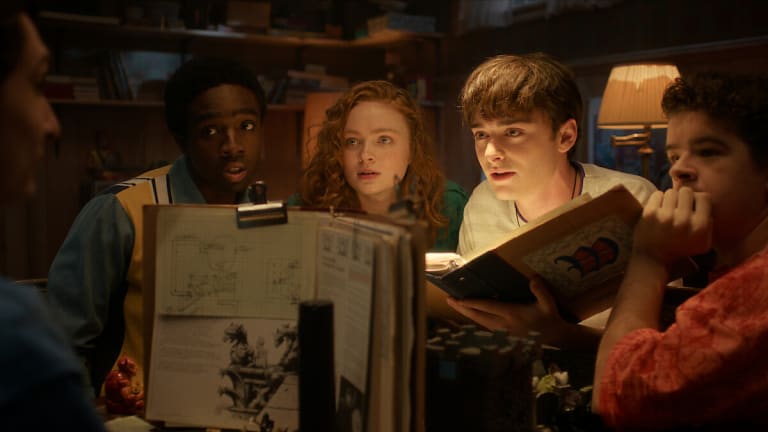
Tales from the Loop art inspiration begins with a simple yet profound question: what happens when the otherworldly bleeds into the everyday? Swedish artist Simon Stålenhag answered this question through his haunting digital paintings, creating an alternate reality where massive robots rust in Swedish forests and children play beneath the shadows of abandoned spacecraft. When Amazon Prime Video transformed these static images into the television series Tales from the Loop in 2020, they didn’t just adapt an art book. They excavated the emotional archaeology of a generation caught between analog childhood and digital futures. This Amazon Prime hidden gem represents something increasingly rare in our hyperconnected age: a meditation on technology’s soul, wrapped in the gossamer threads of Nordic melancholy.
The series stands as a testament to the power of visual storytelling, where every frame carries the weight of Stålenhag’s painterly vision. Yet beneath its melancholic beauty lies a masterclass in adaptation. How do you transform the stillness of painted moments into the rhythm of television? The answer, as it turns out, lies not in explanation but in atmosphere, not in action but in the spaces between heartbeats where wonder lives.
For viewers searching for underrated Amazon shows 2025 or art-inspired television that breaks from conventional streaming fare, Tales from the Loop offers something genuinely different. It’s a series that rewards patience, contemplation, and a willingness to sit with ambiguity in ways that feel increasingly radical in our age of instant gratification.

The artist behind the vision: Simon Stålenhag’s digital canvas
Simon Stålenhag paintings emerged from the suburbs of Stockholm like signals from an alternate timeline. Born in 1984, Stålenhag grew up in Märsta, a rural Swedish area that would later become the spiritual homeland of his artistic universe. His early years were marked by two seemingly contradictory influences: the naturalistic watercolours of Swedish wildlife artist Lars Jonsson and the conceptual art of science fiction luminaries Ralph McQuarrie and Syd Mead. This collision of pastoral realism and speculative design would prove prophetic.
The genesis of Stålenhag’s artwork reads like a love letter to creative procrastination. Working at a gaming company by day, he began posting images to Facebook and other platforms as a creative outlet, attempting to capture “all the weird personal stuff” he couldn’t explore in his professional work. What started as weekend sketches evolved into something far more resonant: a vision of childhood filtered through the lens of technological anxiety.
Stålenhag’s technique represents a masterclass in digital painting that rivals traditional media. Working primarily in Photoshop, he builds each image through careful layering, starting with photographic references from his extensive archive of over 45,000 images captured during walks around his native landscape. His process involves painting over photographs to create compositions that feel both hyperreal and dreamlike, employing texture overlays and careful brushwork that gives his digital art a distinctly painterly quality.

The artist’s retro-futuristic aesthetic stems from a deeply personal place. As Stålenhag explained in interviews, his work attempts to create art for his “12-year-old self”. Pieces that would make his younger self think, “This feels like it’s meant for adults, but I want to see it anyway”. This philosophy infuses every canvas with a sense of forbidden knowledge, the thrilling vertigo of glimpsing adult mysteries through adolescent eyes.
Stålenhag’s paintings operate on a principle of deliberate ambiguity. Unlike traditional science fiction, which often feels compelled to explain its technological marvels, his work presents them as facts of life. As mundane as telephone poles or as common as tractors. A massive cargo vessel hovers above a suburban street while two figures barely acknowledge its presence. Children walk past towering robots with the casual indifference of commuters passing street lamps. This studied normalisation of the extraordinary creates a cognitive dissonance that lies at the heart of the work’s emotional power.
What makes Stålenhag’s approach particularly compelling for those interested in analog technology in media is his deliberate choice to set his retrofuturistic visions in the 1980s and 1990s. The technology in his paintings feels both advanced and outdated simultaneously, creating a temporal paradox that speaks to our complicated relationship with progress. His robots don’t gleam with digital perfection. They rust, corrode, and decay like any other abandoned infrastructure.
From canvas to screen: the genesis of Amazon’s Tales from the Loop
The transformation of Simon Stålenhag artwork into the Tales from the Loop Amazon Prime series began with a fateful phone call. Director Mark Romanek, fresh from his work on projects like Never Let Me Go, received a recommendation from filmmaker Matt Reeves about a script based on “these paintings by this guy, Simon Stålenhag”. Romanek’s response was immediate: “I know those paintings. Those paintings are amazing.”
What followed was a collaboration between Romanek, showrunner Nathaniel Halpern, and cinematographer Jeff Cronenweth that would set new standards for visual storytelling in television. The challenge was considerable: how do you animate the static poetry of Stålenhag’s images without losing their essential mystery?
Halpern’s approach proved inspired. Rather than attempting to directly adapt specific paintings, he used them as emotional touchstones, creating stories that could exist within Stålenhag’s universe whilst maintaining their painterly stillness. The decision to relocate the action from Sweden to the fictional town of Mercer, Ohio, was both practical and thematic. The flat topography of Winnipeg (where the series was actually filmed) provided the perfect visual analogue to Stålenhag’s Swedish landscapes.

The adaptation process involved what Romanek described as “building that world” rather than simply bringing paintings to life. The creative team would extrapolate from Stålenhag’s aesthetic references, creating interior spaces and narrative elements that felt consistent with his vision whilst serving the needs of television storytelling. When uncertain about a particular choice, they would consult Stålenhag directly, using him as “a final helper to get us out of a jam”.
The series structure deliberately echoes the anthology nature of Stålenhag’s art books. Each episode functions as a standalone story whilst contributing to a larger tapestry, much like individual paintings in a gallery exhibition. This approach allowed the creators to maintain the mysterious, disconnected quality of the source material whilst building a coherent television narrative.
For those familiar with other sci-fi tv shows 2025, Tales from the Loop stands apart in its refusal to prioritize action or plot twists. Instead, it embraces the contemplative qualities that make Stålenhag’s paintings so arresting. The show trusts viewers to find meaning in silence, to read emotion in landscape, to understand that sometimes the most profound science fiction asks questions rather than providing answers.
Tales from the Loop: episode-painting-element connections
| Episode | Episode Theme | Corresponding Stålenhag Painting | Key Visual Element |
|---|---|---|---|
| Episode 1: Loop | Time Travel Sphere | Eclipse Chamber | Massive Time Displacement Orb |
| Episode 2: Transpose | Body Swapping | Body-Switch Pods | Metallic Transfer Pods |
| Episode 3: Stasis | Time Freezing | Time Machinery | Temporal Suspension Equipment |
| Episode 4: Echo Sphere | Future Echoes | Echo Sphere | Life-Echo Detector |
| Episode 5: Control | Robot Control | Robot Controllers | Robot Control Gloves |
| Episode 6: Parallel | Reality Shifting | Portal Tech | Dimension-Shift Vehicles |
| Episode 7: Enemies | Security Robots | Security Bots | Abandoned Law Enforcement |
| Episode 8: Home | Loop Facility | Loop Infrastructure | Underground Installation |
The cinematography of wonder: Jeff Cronenweth’s visual translation
The visual style of Tales from the Loop represents perhaps the most successful art to television adaptation in recent memory. Cinematographer Jeff Cronenweth, known for his collaborations with David Fincher, faced the unique challenge of translating Stålenhag’s painterly aesthetic into moving images.
Cronenweth’s approach involved studying not just Stålenhag’s work but its antecedents. The cinematographer and his team revisited films by Ingmar Bergman, Andrei Tarkovsky, and Krzysztof Kieślowski. Hardly typical reference points for American science fiction television. This European art cinema influence infused the series with a contemplative pace and visual grammar that prioritised mood over momentum.
The technical specifications were equally considered. Shooting on Panavision’s Millennium DXL2 cameras with large-format sensors, Cronenweth employed shallow depth of field as a “storytelling tool” to isolate characters and create the soft, painterly focus that characterises Stålenhag’s work. The choice of Panaspeed and Primo 70 lenses further enhanced this effect, creating what Cronenweth described as the “soft look” that allows science fictional elements to “blend with the subtleties of the photography”.
Colour grading proved equally crucial. Working with Light Iron colourist Ian Vertovec, Cronenweth developed what they called a “natural colour palette” that avoided the traditional blue-heavy aesthetic of science fiction. Instead, they emphasised earth tones and the “perpetual magic hour” quality of Stålenhag’s paintings. The approach pulled blues toward cyan and greens toward yellow, creating a more film-like, less electronic appearance.
Perhaps most importantly, Cronenweth understood that Tales from the Loop’s visual style needed to serve character over spectacle. As he explained, “if we were too heavy-handed with the visuals, you would lose some of the humanity”. The science fictional elements had to “blend with the subtleties of the photography” to maintain what he called a “false sense of everyday life”.
The filming locations in Manitoba, Canada, particularly around Winnipeg and Morden, provided the perfect canvas for this approach. The flat, expansive landscapes, the long horizontal lines, the sense of space and isolation, all echoed the Swedish countryside that inspired Stålenhag’s original works. When viewers watch the series, they’re seeing a careful reconstruction of a very specific emotional geography.
Episode by episode: when paintings become stories
The direct connection between specific paintings and Tales from the Loop episodes reveals the depth of the adaptation process. Each episode draws not just inspiration but emotional DNA from Stålenhag’s visual narratives, transforming static moments into temporal experiences.
“Loop” introduces viewers to the central mystery: a massive underground particle accelerator that generates impossible technology and even more impossible situations. The episode’s visual language establishes the series’ approach immediately. Massive structures loom in the background while the foreground focuses on intimate human moments. This is science fiction where the spectacular serves the personal.
“Transpose” takes its body-swapping premise from Stålenhag’s paintings of paired technological devices. However, the series uses this concept to explore themes of identity and belonging that resonate far beyond its science fictional premise. Two boys discover they can switch bodies using mysterious Loop technology, but the real revelation concerns their different socioeconomic backgrounds and the invisible barriers that separate them. The episode transforms a high-concept premise into an examination of privilege, empathy, and the masks we wear in daily life.
“Stasis” presents perhaps the series’ most emotionally devastating hour. A young woman discovers a device that can freeze time, allowing her to steal moments with her boyfriend without the world moving forward. The technology comes from Stålenhag’s recurring motif of strange objects found in rural settings. Objects whose purpose remains mysterious but whose effects prove profound. When the device eventually fails, the episode delivers a gut-punch meditation on grief, stolen time, and the impossibility of holding onto perfect moments.
“Echo Sphere” perhaps provides the clearest example of this translation. The episode’s central artifact, a massive metal sphere that reveals one’s remaining lifespan through echoes, appears directly in Stålenhag’s paintings. But the television adaptation transforms this mysterious object into a meditation on mortality and the relationship between grandfather and grandson. The sphere becomes not just a science fictional device but a metaphor for the echoes that ripple through generations. The episode asks difficult questions about legacy, memory, and what we leave behind.
“Control” explores motherhood through the lens of technological malfunction. A robot “child” begins malfunctioning, forcing its adoptive mother to confront questions about what makes something alive and worthy of love. The episode draws from Stålenhag’s paintings of abandoned robots and automated children, transforming these images into a surprisingly tender examination of maternal bonds and the nature of consciousness.
“Parallel” draws from paintings depicting reality-shifting technology. In Stålenhag’s universe, everyday objects (tractors, cars, household appliances) can become gateways between dimensions. The episode uses this concept to examine loneliness and connection, as a security guard named Gaddis finds himself in an alternate reality where a different version of his life plays out. The parallel universe isn’t wildly different from his own. It’s just slightly better, slightly happier, slightly more fulfilled. The episode transforms a science fiction trope into an examination of regret and the lives we didn’t live.

“Enemies” features two boys who discover a robot buried on an island. The machine becomes a test of their friendship and moral development. Stålenhag’s paintings often feature children interacting with dormant or damaged technology, and this episode captures the sense of discovery and danger that permeates those images.
“Home” closes the season with a devastating temporal loop. Directed by Jodie Foster, the episode follows a young woman who experiences her entire life in repeated cycles, always returning to the same moment. The episode synthesizes all of the series’ themes: time, memory, technology, love, loss. It’s a fitting conclusion to a season that treated science fiction as a vehicle for emotional exploration rather than spectacular entertainment.
Each Tales from the Loop episode painting connection operates on multiple levels simultaneously. The visual elements provide the science fictional framework, but the emotional resonance comes from Stålenhag’s deeper themes: childhood wonder confronting adult disappointment, technology’s promise curdling into abandonment, the way extraordinary circumstances illuminate ordinary human truths.
Why Tales from the Loop remains Amazon’s beautiful hidden gem
In an era dominated by prestige television’s baroque complexity and superhero spectacle’s bombastic excess, Tales from the Loop feels like a transmission from an alternative timeline where thoughtfulness triumphed over sensation. Yet this very quality (its commitment to contemplation over action) likely explains why it remains relatively unknown compared to more aggressive offerings in Amazon’s catalogue.
The series melancholic atmosphere operates as both its greatest strength and its commercial liability. Critics and audiences consistently praise its visual splendour and emotional depth whilst acknowledging its deliberately glacial pace. This is television that demands engagement rather than consumption, requiring viewers to fill in narrative gaps and sit with ambiguity in ways that streaming algorithms actively discourage.
Tales from the Loop’s reception reveals a fascinating cultural divide. Professional critics largely embraced its meditative approach and visual sophistication, with many comparing it favourably to classic science fiction anthologies like The Twilight Zone. Audience reactions proved more mixed, with some viewers finding its philosophical approach deeply moving whilst others struggled with its lack of traditional narrative resolution.

The series represents what might be called “pandemic television”. Programming perfectly suited to a moment of enforced reflection and isolation. Its themes of disconnection, technological anxiety, and the search for human meaning in an increasingly mediated world proved remarkably prescient for 2020 audiences. Yet its contemplative pace and existential weight made it challenging viewing for those seeking escapist entertainment.
For viewers searching for best hidden gem tv series or amazon prime hidden shows worth watching, Tales from the Loop offers a viewing experience unlike anything else on the platform. It’s not comfort food television. It’s art that requires active participation, emotional investment, and a willingness to accept that not every mystery needs solving.
Perhaps most significantly, Tales from the Loop demonstrates television’s potential as a medium for fine art adaptation. Unlike comic book adaptations, which typically focus on plot and character dynamics, Stålenhag’s series proves that mood and atmosphere can sustain narrative engagement. It’s a lesson that mainstream television has largely ignored, preferring the safety of familiar formulas to the risk of genuine artistic experimentation.
The show’s influence on subsequent melancholic sci-fi productions remains visible in series that prioritize atmosphere and emotional truth over spectacle. While it may never achieve the viewership numbers of more conventional offerings, its impact on how television can adapt visual art continues to resonate with creators willing to trust their audience’s intelligence and patience.
The broader universe: exploring Stålenhag’s extended canon
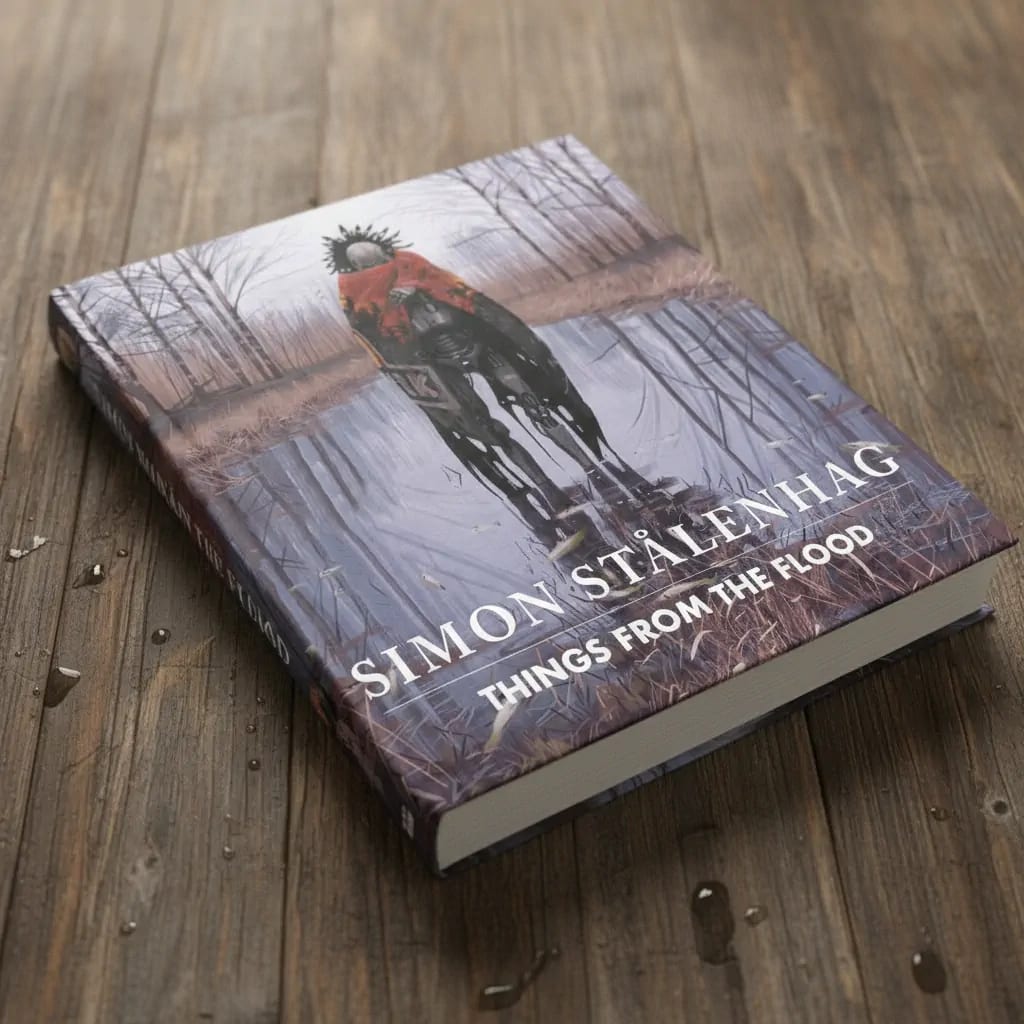
Simon Stålenhag’s books extend far beyond the original Tales from the Loop, creating an interconnected universe of technological melancholy that spans decades and continents. Things from the Flood (2016), the direct sequel to Tales from the Loop, advances the timeline into the 1990s, exploring the aftermath of the Loop’s decommissioning and the literal flooding of the surrounding area.
Things from the Flood shifts the focus from children to teenagers, examining how the Loop’s legacy shapes adolescent coming-of-age in a world where extraordinary technology has become mundane debris. The emotional register darkens accordingly, trading childhood wonder for teenage alienation and the growing awareness that adult promises of technological progress often yield environmental and social devastation. Where Tales from the Loop maintained a sense of possibility and magic, Things from the Flood confronts the consequences of abandoned dreams.
The Electric State (2017) represents Stålenhag’s most ambitious narrative expansion, relocating the action to an alternate 1990s America devastated by technological addiction and virtual reality escapism. The story follows teenager Michelle and her robot companion Skip across a wasteland littered with the remains of battle drones and consumer electronics. A meditation on technology’s capacity to isolate rather than connect. The book feels eerily prescient given our current struggles with social media addiction and digital disconnection.

The forthcoming Netflix adaptation of The Electric State, directed by the Russo Brothers and starring Millie Bobby Brown, suggests that Stålenhag’s visual universe is finally receiving the broader cultural recognition it deserves. Yet this mainstream success also raises questions about whether the essential melancholy and ambiguity of his work can survive Hollywood’s preference for resolution and spectacle. The challenge will be maintaining Stålenhag’s refusal to explain his technology or provide easy answers while satisfying audience expectations for narrative closure.
The Labyrinth (2021), Stålenhag’s most recent work, ventures into more explicitly post-apocalyptic territory whilst maintaining the artist’s signature blend of technological decay and human resilience. The book demonstrates Stålenhag’s continued evolution as both visual artist and storyteller, suggesting that his creative universe still has unexplored territories to map. The Labyrinth pushes further into mystery and abstraction, trusting readers to find their own meaning in images that grow increasingly surreal and dreamlike.
Each of these books expands on the core themes established in Tales from the Loop: the relationship between humans and the technology we create, the way progress leaves ruins in its wake, the persistence of childhood wonder in increasingly cynical worlds. They also demonstrate Stålenhag’s growth as a visual storyteller, with each successive book pushing his technical skills and narrative ambitions further.
The cultural impact and artistic legacy
The influence of Simon Stålenhag’s artwork extends far beyond its direct adaptations, inspiring a generation of digital artists to explore the intersection of nostalgia and technology. His technique of combining photographic realism with speculative elements has become a template for contemporary concept art, whilst his thematic preoccupations with technological anxiety and childhood memory resonate with artists grappling with our current digital moment.
Tales from the Loop’s visual style has similarly influenced television production, demonstrating that audiences will engage with challenging, art-house approaches to genre material when executed with sufficient skill and conviction. The series proves that television can function as a legitimate medium for fine art adaptation, opening possibilities for future projects that prioritise atmosphere and emotion over traditional narrative mechanics.
The cultural significance of Stålenhag’s work lies partly in its timing. Created during the early decades of the 21st century, his paintings capture a generation’s complicated relationship with technological progress. The simultaneous wonder and anxiety that characterises our digital age. His images of abandoned robots and derelict machinery speak to contemporary fears about artificial intelligence and automation whilst maintaining a fundamentally humanistic perspective.
In the realm of digital art and concept design, Stålenhag’s influence appears in countless works that attempt to balance the mundane and the spectacular, the nostalgic and the futuristic. Young artists cite his work as formative in their development, particularly his demonstration that digital painting can achieve the emotional depth and textural richness traditionally associated with oil and canvas.
For the emerging field of art-inspired television, Tales from the Loop stands as both proof of concept and cautionary tale. It demonstrates that direct adaptation of visual art can work beautifully when creators respect the source material’s essence rather than simply mining it for imagery. Yet its limited mainstream success also suggests that such adaptations face significant commercial challenges in an entertainment landscape that increasingly favors the familiar over the adventurous.
Perhaps most importantly, both Stålenhag’s paintings and their television adaptation demonstrate art’s capacity to process collective trauma through individual stories. The Loop universe provides a framework for examining how extraordinary circumstances reveal fundamental human truths. How crisis strips away pretense to expose the essential connections that sustain us through uncertainty.
A viewing guide: how to experience Tales from the Loop
For viewers new to the series, approaching Tales from the Loop requires a slight adjustment of expectations. This isn’t television designed for binge-watching or casual background viewing. It demands attention, patience, and a willingness to sit with ambiguity.
Start with “Echo Sphere” (episode 4). While not the series premiere, it offers perhaps the most accessible entry point, balancing the show’s philosophical ambitions with a clear emotional through-line. The relationship between grandfather and grandson provides an anchor while the titular artifact introduces the series’ approach to science fiction as metaphor rather than spectacle.
Return to “Loop” (episode 1) after experiencing the series’ rhythms. The pilot’s deliberate pacing and withholding of information makes more sense once you understand the show’s priorities. It’s not withholding exposition to be difficult. It’s asking you to experience the world as its characters do: with wonder, confusion, and gradual understanding.
Watch “Parallel” (episode 6) for a masterclass in what the series does best. The episode takes a high-concept premise (parallel universes) and uses it to examine the most human of emotions: regret, loneliness, the pain of paths not taken. It’s science fiction in the mode of Stanislaw Lem or Ursula K. Le Guin, using the impossible to illuminate the possible.
Conclude with “Home” (episode 8). Jodie Foster’s direction brings the season to a devastating close, synthesizing all the show’s themes into a temporal loop that feels both science fictional and achingly human. It’s the kind of finale that lingers long after the credits roll, asking questions that have no easy answers.
Between episodes, take time to seek out Stålenhag’s original paintings. Understanding the visual source material enriches the viewing experience, revealing how the series expands static images into moving narratives without losing their essential poetry.
Conclusion: the enduring power of painted dreams
Tales from the Loop art inspiration ultimately transcends its immediate sources, creating something genuinely new from the marriage of visual art and narrative television. The series succeeds not by explaining Stålenhag’s mysteries but by inhabiting them, demonstrating that the most powerful science fiction operates through suggestion rather than exposition.
In our current moment of technological anxiety and social fragmentation, both Stålenhag’s paintings and their television adaptation offer something increasingly rare: a vision of the future that acknowledges its darkness whilst maintaining fundamental faith in human resilience. The Loop universe suggests that even when our technological ambitions fail (when our robots rust and our machines fall silent) the essential human capacity for connection and wonder remains intact.
Amazon’s hidden gem may not have achieved the cultural penetration of more aggressive entertainment offerings, but its influence operates on a deeper level. Like the best art, it changes how we see the world around us, encouraging us to find beauty in decay and meaning in melancholy. In transforming Stålenhag’s painted dreams into moving pictures, Tales from the Loop proves that television, at its best, can function as both mass entertainment and fine art. A reminder that in our rush toward digital futures, we need not abandon the analog soul.
The paintings that inspired Tales from the Loop continue to haunt viewers long after the final credits fade, like echoes reverberating through that mysterious sphere at the heart of Stålenhag’s universe. They remind us that the most profound transformations happen not in the presence of extraordinary technology but in those quiet moments when we recognise our shared humanity reflected in another’s eyes. Perhaps that’s the real magic of the Loop: not the ability to manipulate time or space, but the capacity to help us see ourselves more clearly through the lens of someone else’s beautiful, melancholic dream.
For anyone searching for tales from the loop review analysis or wondering whether this simon stalenhag paintings tv adaptation deserves their time, the answer is simple. If you’re willing to slow down, to sit with mystery, to find meaning in silence and beauty in decay, Tales from the Loop offers rewards unlike anything else in contemporary television. It’s not for everyone. But for those it speaks to, it speaks with uncommon depth and lingering power.
Sources and further reading
For those interested in exploring the world of Tales from the Loop and Simon Stålenhag’s broader artistic universe more deeply, the following resources provide valuable context and insight:
- The American Society of Cinematographers: “Tales From the Loop: Strange Machines” features an in-depth interview with director Mark Romanek and cinematographer Jeff Cronenweth discussing their approach to visual storytelling, filming techniques in Manitoba, camera choices, lens selections, and how they translated Stålenhag’s painterly aesthetic to moving images.
- Forbes: Interview with showrunner Nathaniel Halpern confirming the creative process behind the adaptation, specifically how each episode was conceived from a particular painting by Stålenhag and the emotional foundation each image provided for narrative expansion.
- Simon Stålenhag’s official website: The artist’s own site features galleries of his work organized by project, providing the most direct access to the paintings that inspired the series. Essential viewing for understanding the source material.
- Dive deeper into Simon Stålenhag’s mesmerizing worlds:
- The Electric State: Experience the haunting beauty that inspired Netflix’s upcoming film starring Millie Bobby Brown. This dystopian masterpiece blends Stålenhag’s signature retro-futuristic art with a gripping road trip narrative through a world where technology and humanity collide.
→ Get your copy: https://theurb.co/4mCMcsx - Tales from the Loop: Own the original art book that started it all! This is where the Amazon Prime series found its soul. Every page reveals the mysterious Swedish countryside where impossible machines reshape reality and childhood wonder meets existential dread.
→ Discover the source material: https://theurb.co/489e4ku - The Labyrinth: Step into Stålenhag’s latest vision of alternative history, where massive underground installations hide beneath pastoral Swedish landscapes. Perfect for fans who crave more of that distinctive blend of melancholy and wonder.
→ Explore the newest world: https://theurb.co/4nt2l53 - Things from the Flood: The darker sequel to Tales from the Loop takes us into the 1990s, where the magic is fading and reality becomes more brutal. Essential reading for understanding the complete emotional journey of Stålenhag’s universe.
→ Continue the story: https://theurb.co/4mFTax2
- The Electric State: Experience the haunting beauty that inspired Netflix’s upcoming film starring Millie Bobby Brown. This dystopian masterpiece blends Stålenhag’s signature retro-futuristic art with a gripping road trip narrative through a world where technology and humanity collide.
Supporting independent journalism: When you purchase these books through our Amazon links above, you pay exactly the same price as you would anywhere else, there’s no additional cost to you. However, we receive a small commission (typically around 4.5% for books) that goes directly toward supporting our independent journalism and content creation. These commissions are incredibly valuable to us and help keep our publication running, allowing us to continue bringing you in-depth coverage of science fiction, art, and pop culture. Your support through these affiliate purchases makes a real difference in our ability to maintain editorial independence and produce quality content.