

The Five Guys history and success story reads like the perfect recipe for American entrepreneurial triumph—a tale of a desperate father, five ambitious sons, and a $70,000 college fund that would eventually cook up one of the world’s most beloved burger empires. In an industry dominated by flashy advertising campaigns and aggressive promotional warfare, the premium burger chain Five Guys achieved something extraordinary: they built a global franchise worth billions without spending a single penny on traditional marketing. Their secret ingredient wasn’t found in their hand-cut chips or never-frozen beef patties—it was a revolutionary understanding that in the restaurant business, the product is the promotion. By 2024, Five Guys operated nearly 1,900 locations worldwide and reported over $680 million revenue in Europe alone, with a new refinancing deal to power even greater international expansion. The fresh sizzle of a Five Guys burger has captured hearts from Arlington to Zurich. But do you know why millions swear by their made-to-order fries—while rivals rely on freezer trucks? If you’ve ever queued for your custom burger in London’s Covent Garden, you know the hype is real. This is the fresh ingredients restaurant that redefined the global fast-casual market.
The desperate dad’s $70,000 wager: Five Guys’ humble beginnings
The Five Guys origin story begins in 1986 with what Jerry Murrell himself describes as an act of “desperation disguised as wisdom”. After watching his two eldest sons, Jim and Matt, show decidedly lukewarm enthusiasm for higher education, Jerry faced a pivotal parental moment. Instead of pushing them into university lectures they’d probably skip, he presented them with an ultimatum that would reshape the fast-casual dining landscape forever: “Start a business or go to college”.
The business route won decisively. Jerry and his wife Janie took their sons’ $70,000 college fund—a substantial sum in 1986—and invested it in a small burger joint in Arlington, Virginia’s Westmont Shopping Centre. The location wasn’t exactly prime real estate; it was tucked away in what Jerry diplomatically calls “an unremarkable corner of a run-down shopping centre”. But this wasn’t accidental—it was strategic. As Jerry explained years later, “We liked that it was tucked back and hard to get to. We knew that if we could survive and grow there, then we might really have something”.
The name “Five Guys” wasn’t the result of extensive market research or branding consultancy—it was simply Jerry plus his four sons at the time: Jim, Matt, Chad, and Ben. When a fifth son, Tyler, arrived two years later, Jerry cheekily redefined the brand as representing just his sons, effectively writing himself out of the company name but not the company’s future.

Those early days weren’t without their challenges. Employees pilfered from the till, the brothers constantly bickered over business decisions, and their first foray into coffee service was, in Jerry’s words, “absolutely terrible—the young kids working for us knew nothing about coffee”. But once each son found their niche within the business, the Five Guys success story truly began to simmer.
The 15-year refinement period: Perfecting the formula before franchising
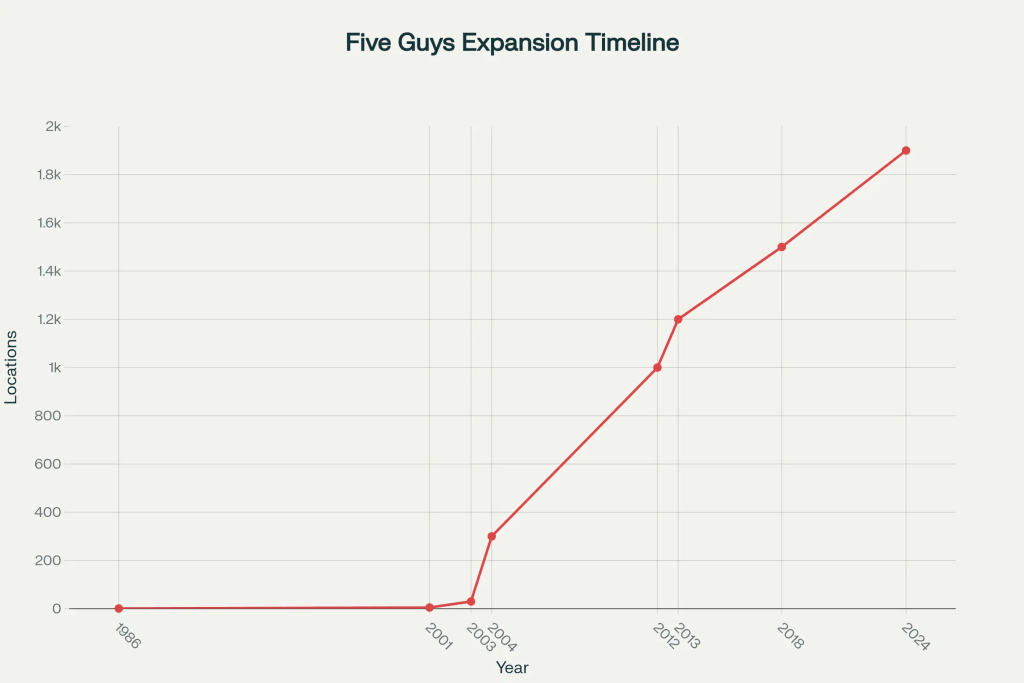
What sets the Five Guys business model apart from virtually every other restaurant chain is their extraordinary patience. From 1986 to 2003, Five Guys operated just five locations around the Washington D.C. metro area. This wasn’t due to lack of ambition or capital constraints—it was a deliberate strategy to perfect every aspect of their operation before unleashing it upon the world.
During these 15 years, the Murrell family obsessively refined their processes. They tested 16 different mayonnaise varieties before selecting their signature condiment. They established relationships with potato suppliers north of the 42nd parallel because those potatoes “grow more slowly and are more solid”. They developed their hand-formed burger technique, perfected their peanut oil frying process, and created what Jerry calls their “infalível” (infallible) business model.
This methodical approach flew in the face of typical American business expansion models. Most successful restaurant concepts begin franchising within a few years of proving their initial concept. Five Guys spent nearly two decades—an entire generation—honing their craft. As family business expert Jerry Murrell notes, “We all started dreaming then”, but they dreamed while testing, adjusting, and perfecting.
The result of this patient refinement was a business model so robust that when Five Guys finally began franchising in 2003, they sold franchise rights for over 300 locations within just 18 months. This wasn’t luck—it was the inevitable outcome of spending 15 years working out every possible operational issue.
The anti-fast food revolution: Five Guys’ unconventional business model
The Five Guys marketing strategy begins with a radical premise: reject everything that defines traditional fast food. Where McDonald’s and Burger King built empires on speed, convenience, and rock-bottom prices, Five Guys built theirs on quality, transparency, and what they call “fast-casual” dining. This approach solidified its position as a leading premium burger chain.
No freezers, no compromises
Perhaps the most striking aspect of Five Guys’ operations is what you won’t find in their kitchens: freezers. Every Five Guys location operates with coolers only, ensuring that every ingredient—from beef patties to potato chips—is fresh, never frozen. This isn’t merely a marketing gimmick; it’s an operational philosophy that permeates every aspect of their business model, cementing its status as a fresh ingredients restaurant.
“There are no freezers in Five Guys locations, just coolers” reads like a simple statement, but it represents a massive operational challenge. Fresh ingredients require sophisticated supply chain management, more frequent deliveries, higher storage costs, and significantly more skilled food preparation. But this commitment to freshness creates what food industry analysts call the “Five Guys difference”—a taste profile that simply cannot be replicated with frozen ingredients.
Made-to-order excellence
In an industry obsessed with speed metrics and drive-through times, Five Guys deliberately rejected the drive-through model entirely. Every burger is cooked only after it’s ordered, every order is customised to the customer’s specifications, and speed takes a backseat to quality. They even posted signs reading: “If you’re in a hurry, there are a lot of really good hamburger places within a short distance from here”.
This seemingly customer-unfriendly approach actually became a competitive advantage. In a world of pre-made, heat-lamp burgers, Five Guys offered something revolutionary: food prepared exactly as you wanted it, exactly when you wanted it.

Open kitchen transparency
Five Guys pioneered the open kitchen concept in fast-casual dining, allowing customers to watch their food being prepared. This transparency serves multiple strategic purposes: it builds trust, demonstrates freshness, and creates entertainment during the waiting period. As one industry analyst notes, “Five Guys takes transparency seriously. The open kitchen layout allows customers to see their food being prepared, creating a sense of trust and authenticity”.
This transparency extends beyond kitchen operations to ingredient sourcing, nutritional information, and even supply chain details. Every Five Guys location displays information about where their potatoes and beef originate, creating what marketing experts call “radical transparency”. Honestly, Five Guys’ no-nonsense approach is refreshing in a world of gimmicks.
The genius marketing strategy: When product becomes promotion
The most revolutionary aspect of the Five Guys success story isn’t their food—it’s their complete rejection of traditional marketing. In an industry that spends billions on advertising, Five Guys achieved global expansion without buying a single television commercial, radio spot, or digital advertisement, showcasing their word-of-mouth marketing success.
The zero-advertising philosophy
“We don’t do any marketing” sounds like hyperbole, but Five Guys CEO John Eckbert means it literally. When asked about Facebook advertising or pandemic-era digital marketing, Eckbert explains: “All those dials are gone and off the table, so it does focus you on the things that you can do, which is making great burgers and fries, hiring people who are passionate about it”.
This isn’t just cost-saving—it’s strategic brand positioning. By refusing to advertise, Five Guys signals to customers that every penny goes into product quality rather than promotional spending. As Jerry Murrell puts it: “We put all our money into the food. That’s why the décor is so simple—red and white tiles. We don’t spend our money on décor. Or on guys in chicken suits. But we’ll go overboard on food”. This contributes significantly to their reputation as a premium burger chain.
Word-of-mouth as marketing strategy
Five Guys built their empire on the radical premise that satisfied customers are the best marketers. “Treat that person right, he’ll walk out the door and sell for you” became their unofficial marketing manifesto. This word-of-mouth strategy proved incredibly effective because it created what marketers call “earned trust”—recommendations from friends and family carry infinitely more weight than paid advertisements. This is the essence of word-of-mouth marketing success.
The strategy worked spectacularly. Five Guys growth accelerated precisely because customers became voluntary brand ambassadors. Social media amplified this effect, with customers posting photos of their “Five Guys Fridays” and custom burger creations, creating what marketing experts term “user-generated content at scale”.
The peanut strategy: Distraction marketing
One of Five Guys’ most discussed marketing elements is their complimentary peanuts—and the strategy behind them is more clever than it initially appears. According to a former Five Guys employee, “The peanuts are to distract the customers so that they won’t stare at us” during the longer cooking process required for made-to-order food.
But the peanuts serve multiple strategic purposes beyond distraction. They act as a subtle warning system for customers with peanut allergies (since Five Guys cooks everything in peanut oil), they create a memorable dining experience, and they provide what hospitality experts call “perceived value”—free food that costs the company relatively little but creates significant customer goodwill.
The explosive expansion era: From 5 to 1,900 locations
When Five Guys finally began franchising in 2003, their expansion was nothing short of phenomenal. They sold franchise rights for over 300 locations within 18 months, transforming from a regional Washington D.C. curiosity into a national phenomenon virtually overnight, contributing to their fast-casual market growth.
Domestic domination
By 2011, Five Guys was officially recognised as “the fastest-growing restaurant chain in the U.S.” with a staggering 32.8% increase in sales. Their revenue jumped from $950 million in 2011 to over $1.5 billion by 2019, representing sustained double-digit growth that made industry analysts take notice.
The numbers tell the story of unprecedented expansion:
- 2003: Begin franchising with 30 locations
- 2004: 300+ locations across multiple states
- 2012: 1,000th location milestone
- 2018: 1,500+ locations nationwide
- 2024: Nearly 1,900 locations worldwide
International conquest: Five Guys global expansion
Five Guys international expansion began in 2013 with their first UK location in London’s Covent Garden. The UK market proved extraordinarily receptive—so much so that Five Guys international expansion accelerated beyond even optimistic projections. As Five Guys COO Sam Chamberlain noted: “The demand from international consumers has been overwhelming, and we are applying resources to meet this demand”. This is a prime example of their global fast-casual market penetration.
The international numbers are staggering:
- UK: 170+ locations (as of 2023)
- Europe: $680 million revenue in 2023 (up from $565 million in 2022). By 2024, Five Guys reported over $680 million revenue in Europe alone, with a new refinancing deal to power even greater international expansion.
- Global presence: 19 countries across North America, Europe, Middle East, and Asia-Pacific
Average unit volumes in international markets run “5-7 times that of domestic locations”, suggesting that Five Guys’ premium positioning resonates even more strongly in international markets where American casual dining concepts often command premium pricing.
Five Guys vs. the competition: How premium positioning wins
In an industry dominated by McDonald’s ($43 billion revenue) and other fast-food giants, Five Guys’ $2 billion revenue might seem modest. But their competitive positioning tells a different story—they’re not competing on volume, they’re competing on value perception and customer loyalty. This highlights their strategy as a premium burger chain.
Premium positioning strategy
Unlike McDonald’s value-menu approach, Five Guys competitive advantage lies in premium positioning. Their burgers cost $10-$12 compared to McDonald’s $2-$4 offerings, but this price differential is strategic. Five Guys targets customers who visit twice yearly and view the meal as a “treat,” while McDonald’s customers visit 8+ times annually for convenient, affordable meals.
This positioning creates what economists call “price insensitivity”—customers who choose Five Guys aren’t primarily motivated by cost considerations. They’re paying for fresh ingredients, customisation options, and a premium experience that mass-market competitors simply cannot replicate at scale. This further solidifies their position as a premium burger chain.
Market share dynamics in the fast-casual market
While Five Guys holds just 6.6% of the fast-casual market compared to major players, their growth trajectory suggests different strategic priorities. They’re capturing the premium segment of the burger market—customers willing to pay significantly more for perceived quality improvements.
Here’s a comparison of market share among some prominent burger chains:
| Chain | Market Share (Approx.) | Key Strategy |
| Whataburger | 42% | Regional dominance |
| In-N-Out | 26% | West Coast concentration, cult following |
| Five Guys | 12% | National/International presence, premium quality |
| Shake Shack | 33% growth rate | Premium positioning, urban focus |
Five Guys’ strategy focuses on sustainable growth rather than market share maximisation—an approach that generates higher per-unit profitability and stronger brand loyalty, demonstrating its effectiveness in the fast-casual market growth.
The secret ingredients: What makes Five Guys different
Customisation as competitive moat
Five Guys offers over 250,000 possible topping combinations with 15 free toppings—a level of customisation that larger competitors cannot economically replicate. This customisation creates what business strategists call a “switching cost”—once customers become accustomed to their perfect Five Guys burger combination, competing options seem limited by comparison.
Supply chain as strategic advantage
Five Guys maintains unprecedented control over their international supply chain, shipping napkins, cups, and packaging materials from the United States to ensure consistency. While this seems economically questionable, their buying power makes it cost-effective: “We spend $7.5 million a year on napkins here in the US, so our buying power is tremendous. When shipping a full ocean container, it costs a few dollars per case of napkins, so actually it is cheaper than going locally”.
Family business advantage
Unlike publicly-traded competitors pressured by quarterly earnings, Five Guys remains family-owned, allowing long-term strategic thinking. All five Murrell sons remain actively involved: Matt oversees operations, Jim handles franchisee selection, Chad manages training, Ben runs IT, and Tyler operates their bakery network.
This family involvement creates what business analysts call “institutional knowledge retention”—the founding vision remains undiluted by corporate bureaucracy or shareholder pressure.
Lessons from the Five Guys phenomenon
The patience principle
Perhaps the most counterintuitive lesson from the Five Guys history and success is the value of patience. Their 15-year refinement period seems excessive by modern business standards, but it created an operational foundation so solid that explosive growth became sustainable rather than destructive.
Product-first philosophy
In an era of growth hacking and viral marketing, Five Guys proved that superior products can generate organic growth that outperforms paid advertising. Their zero-advertising success demonstrates that in the restaurant industry, word-of-mouth recommendations based on actual experience trump marketing messages. This is the cornerstone of their word-of-mouth marketing success.
Premium positioning power
Five Guys demonstrated that premium positioning in fast-casual dining isn’t just viable—it’s potentially more profitable than competing on price. By targeting customers willing to pay more for quality, they built a business model with higher margins and more sustainable growth, reinforcing their status as a premium burger chain.
Future challenges and opportunities
International expansion prospects
With Five Guys international expansion generating “overwhelming demand”, the company plans to enter “six to eight new countries every single year”. Key growth markets include Asia-Pacific, where their Hong Kong operations serve as regional headquarters for further expansion. This continues to drive their growth in the global fast-casual market.
Digital innovation balance
As the restaurant industry embraces delivery apps and digital ordering, Five Guys faces pressure to maintain their premium positioning while adapting to convenience-focused consumer behaviour. Their recent partnerships with Uber Eats and Deliveroo represent strategic adaptations without compromising core values.
Competitive response
As Five Guys continues growing, larger competitors like McDonald’s are “updating their burgers to compete with higher-end chains like Five Guys”. This competitive response validates Five Guys’ market positioning while potentially intensifying future competition.
The Five Guys legacy: Redefining fast-casual success
The Five Guys history and success story represents more than just another restaurant chain expansion—it’s a masterclass in building sustainable competitive advantages through operational excellence and strategic patience. In an industry notorious for razor-thin margins and fierce price competition, Five Guys proved that customers will pay premium prices for premium experiences. This solidifies their standing as a premium burger chain.
Their revolutionary approach—rejecting traditional advertising, embracing operational transparency, and prioritising product quality over profit maximisation—created a business model that competitors struggle to replicate. McDonald’s can lower prices, but they cannot economically provide hand-cut chips and made-to-order burgers at scale. Burger King can increase advertising spending, but they cannot generate the authentic word-of-mouth recommendations that drive Five Guys’ growth. This is the essence of their word-of-mouth marketing success and the fresh ingredient revolution they lead.
Perhaps Jerry Murrell’s mother said it best: “If you can give a good haircut or if you can serve a good drink at a bar or if you can serve a good hamburger, you can always make money in America”. The Five Guys story proves that this wisdom scales globally—provided you’re willing to invest 15 years perfecting your craft before asking the world to pay attention.
From a desperate dad’s $70,000 gamble to a global empire worth billions, Five Guys transformed the fast-casual landscape by proving that in the restaurant business, the best marketing strategy is simply making the best product. Their success offers a timeless lesson for entrepreneurs across industries: sometimes the most revolutionary business strategy is simply doing the basics extraordinarily well.
