The Louvre must-see attractions represent the pinnacle of human artistic achievement, housed within the world’s most visited museum in the heart of Paris. This comprehensive guide reveals the essential masterpieces you absolutely cannot miss, along with insider strategies for navigating one of the planet’s most magnificent cultural institutions. From Leonardo da Vinci’s enigmatic Mona Lisa to the majestic Winged Victory of Samothrace, the Louvre’s treasures span millennia of human creativity and deserve careful planning to experience properly.
The Louvre Museum represents far more than a simple repository of art—it stands as a testament to eight centuries of French history and global cultural heritage. Originally constructed as a fortress in 1190 during the reign of Philippe Auguste, this extraordinary palace evolved through royal residences before becoming the world’s first national museum in 1793. Today, the museum’s staggering 73,000 square metres of exhibition space houses approximately 35,000 artworks spanning from prehistoric times to the 21st century.
A palace transformed: From medieval fortress to artistic wonder
The transformation from fortress to royal palace began in earnest during the Renaissance, when Francis I commissioned Pierre Lescot to create what would become the architectural marvel we recognise today. The Grande Galerie, constructed between 1595 and 1610 under Henri IV, established the museum’s reputation for grandeur that continues to inspire millions of annual visitors. The revolutionary government’s decision to open these royal collections to the public in 1793 represented a democratisation of culture that fundamentally changed how society views art and heritage.
The modern Louvre’s iconic glass pyramid, designed by I.M. Pei and completed in 1988, serves as both practical entrance and symbolic bridge between classical and contemporary architecture. This controversial addition, initially met with resistance, now stands as one of Paris’s most recognisable landmarks and the central navigation point for the museum’s three wings.
Disclosure: This post contains affiliate links that help support and maintain this website. If you click through and make a purchase, I may earn a small commission at no extra cost to you.
The absolute must-see masterpieces
The Mona Lisa: Leonardo da Vinci’s eternal enigma
Leonardo da Vinci’s Mona Lisa reigns supreme among the Louvre top artworks, captivating over 6 million visitors annually in Room 711 of the Denon Wing. Painted between 1503 and 1519, this 77cm × 53cm oil painting depicts Lisa Gherardini, wife of Florentine merchant Francesco del Giocondo. The portrait’s revolutionary sfumato technique creates the mysterious atmosphere and enigmatic smile that has fascinated viewers for centuries.

The painting’s tumultuous history includes a sensational theft in 1911 by Italian glazier Vincenzo Peruggia, who kept the masterpiece hidden under his bed for two years before attempting to sell it in Florence. This theft paradoxically enhanced the painting’s fame, transforming it from a respected artwork into a global cultural phenomenon. During both World Wars, the Mona Lisa travelled extensively throughout France for protection, demonstrating its recognised significance as humanity’s artistic heritage.
Viewing strategy: Expect substantial crowds between 10 AM and 3 PM, with wait times reaching 30-45 minutes during peak season. The most successful viewing strategy involves arriving at 9 AM when the museum opens or visiting during Wednesday and Friday evening hours when crowds dramatically diminish.
Venus de Milo: Timeless Greek perfection
The Venus de Milo stands as antiquity’s most celebrated sculpture, greeting visitors in Gallery 16 of the Sully Wing. Created between 130-100 BC during the Hellenistic period, this 2.02-metre marble masterpiece demonstrates the Greek sculptors’ mastery of human form and emotion. Discovered on the Greek island of Melos in 1820, the statue’s missing arms have become part of its mystique, allowing viewers to imagine countless poses and meanings.
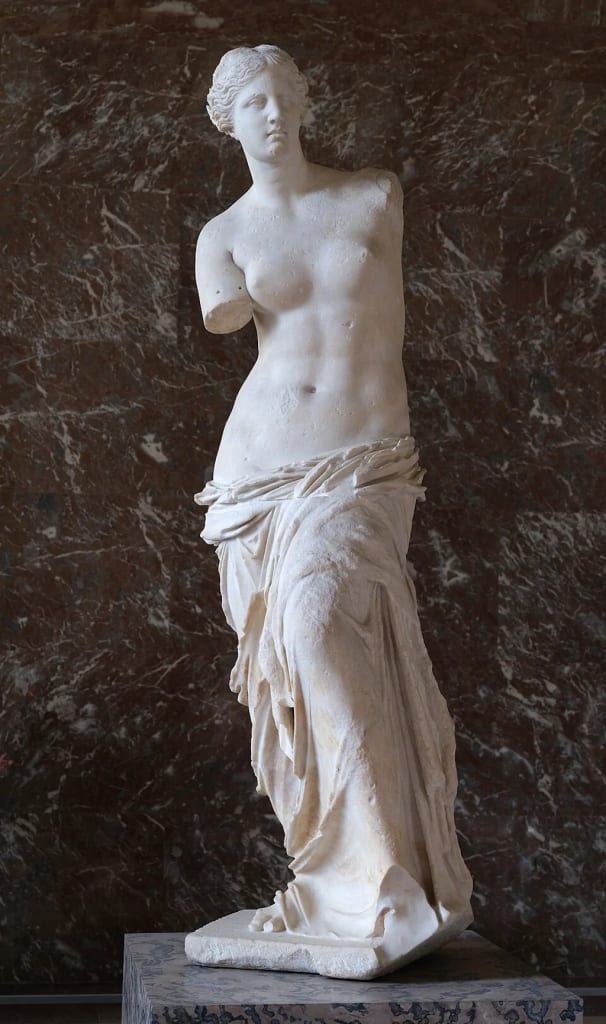
The sculpture’s combination of classical restraint with Hellenistic dynamism represents a pivotal moment in art history. The goddess’s contrapposto stance and the interplay between smooth skin and flowing drapery showcase technical brilliance that influenced centuries of subsequent sculptors. Her placement within the Louvre’s opulent red marble gallery creates a dialogue between ancient Greek artistry and French decorative arts.
The statue’s journey to the Louvre began when French naval officer Olivier Voutier facilitated its acquisition, eventually leading to its presentation to King Louis XVIII in 1821. This diplomatic gift helped establish France’s reputation as a guardian of classical heritage while enriching the emerging museum’s prestigious collection.
Winged Victory of Samothrace: Monument to divine triumph
Perched majestically atop the Daru Staircase, the Winged Victory of Samothrace creates one of the Louvre’s most dramatic encounters. This 5.57-metre monument, dating from approximately 190 BC, originally commemorated a naval victory in the sanctuary of the Great Gods on the Greek island of Samothrace. The sculpture’s positioning on a ship’s prow creates an illusion of divine flight that seems to defy marble’s earthly weight.

French archaeologist Charles Champoiseau’s 1863 discovery of this Hellenistic masterpiece revealed the sculptor’s extraordinary ability to capture movement in stone. The wind-swept drapery clinging to the goddess Nike’s body demonstrates the “wet drapery” technique that became synonymous with Hellenistic sculptural excellence. Despite missing her head and arms, the sculpture’s emotional power remains undiminished, perhaps even enhanced by viewers’ imaginative engagement.
The statue’s restoration in 2014 revealed new details about ancient polychromy and construction techniques, helping scholars better understand Greek sculptural practices. Modern artists from Omar Hassan to Xu Zhen have created contemporary interpretations, while Beyoncé and Jay-Z’s “Apeshit” music video brought this ancient masterpiece into 21st-century popular culture.
Revolutionary spirit: Delacroix’s Liberty Leading the People
Eugène Delacroix’s Liberty Leading the People embodies the revolutionary spirit that shaped modern France, commanding attention in Room 700 of the Denon Wing. Painted in 1830 following the July Revolution that toppled King Charles X, this 2.6m × 3.3m canvas transforms political upheaval into artistic immortality. The bare-breasted figure of Liberty, wearing the Phrygian cap of freedom, leads citizens over barricades while brandishing the tricolour flag.

The painting’s pyramidal composition draws viewers into the revolutionary moment, with Notre-Dame Cathedral’s towers establishing the Parisian setting. Delacroix’s loose brushwork and dramatic chiaroscuro exemplify Romantic painting’s emphasis on emotion over classical restraint. This masterpiece has transcended its historical context to become a universal symbol of popular sovereignty and resistance.
Originally exhibited at the Paris Salon of 1831, the painting’s political message proved so powerful that it was removed from public display during subsequent conservative periods. Its permanent installation in the Louvre reflects the Third Republic’s embrace of revolutionary ideals as foundational to French national identity.
Napoleon’s imperial grandeur: David’s Coronation Spectacular
Jacques-Louis David’s The Coronation of Napoleon represents the apotheosis of Neoclassical history painting, occupying an entire wall in Room 702 with its imposing 9.7m × 6.2m dimensions. Completed in 1807, this meticulous recreation of the December 2, 1804 ceremony at Notre-Dame Cathedral demonstrates David’s role as Napoleon’s official propagandist. The composition’s careful organisation around multiple axes showcases Neoclassical principles while celebrating imperial grandeur.

David’s artistic licence transformed the actual ceremony’s awkward moments into choreographed splendour, notably depicting Napoleon crowning Josephine rather than himself. The inclusion of Napoleon’s estranged mother, who actually boycotted the ceremony, demonstrates how official art serves political rather than documentary purposes. Every figure among the hundreds portrayed represents careful consideration of imperial hierarchy and diplomatic relationships.
The painting’s commission, execution, and subsequent history reflect the complex relationship between artistic genius and political power. David’s exile to Brussels following Napoleon’s downfall adds poignancy to this celebration of imperial triumph, reminding viewers that artistic glory often outlasts political authority.
Romantic tragedy: Géricault’s Raft of the Medusa
Théodore Géricault’s The Raft of the Medusa confronts viewers with humanity’s capacity for both survival and savagery in this monumental 4.9m × 7.2m canvas. Painted between 1818-1819 when Géricault was merely 27, this work transformed a contemporary scandal into timeless artistic statement about human nature. The painting depicts survivors of the French frigate Méduse’s 1816 shipwreck, whose ordeal included starvation, dehydration, and cannibalism during 13 days adrift.

Géricault’s extensive preparation included interviewing survivors, constructing a detailed raft model, and studying corpses in morgues to achieve unprecedented realism. This commitment to authenticity, combined with the work’s ambitious scale, established new standards for contemporary history painting. The composition’s careful balance between hope and despair, embodied in the figure spotting rescue ships, creates emotional complexity that continues resonating with modern audiences.
The painting’s controversial reception at the 1819 Salon reflected French society’s discomfort with unflinching examinations of contemporary failures. Géricault’s decision to tackle this uncommissioned subject demonstrated emerging Romantic ideals about artistic independence and social responsibility.
Neoclassical romance: Canova’s Psyche Revived by Cupid’s Kiss
Antonio Canova’s Psyche Revived by Cupid’s Kiss showcases Neoclassical sculpture’s ability to transform mythological narrative into marble poetry. Created between 1787-1793, this masterpiece depicts the climactic moment from Apuleius’s “Golden Ass” when Cupid’s kiss awakens the lifeless Psyche. The sculpture’s dynamic composition captures the instant of revival, with Psyche reaching toward her divine lover in a gesture that bridges death and rebirth.

Canova’s technical mastery transforms cold marble into convincing flesh through contrasts between smooth skin and textured drapery. The work’s positioning in the Michelangelo Gallery creates dialogue between Italian Renaissance and Neoclassical traditions. The sculpture’s sensuality, expressed through tender gestures rather than explicit nudity, exemplifies Neoclassical ideals about beauty’s moral dimension.
The sculpture’s history reflects changing artistic tastes and political upheavals, passing from Colonel John Campbell’s original commission through Joachim Murat’s ownership before entering the Louvre in 1824. This journey through private and royal collections to public museum demonstrates the democratisation of artistic appreciation.
Navigating the Louvre effectively
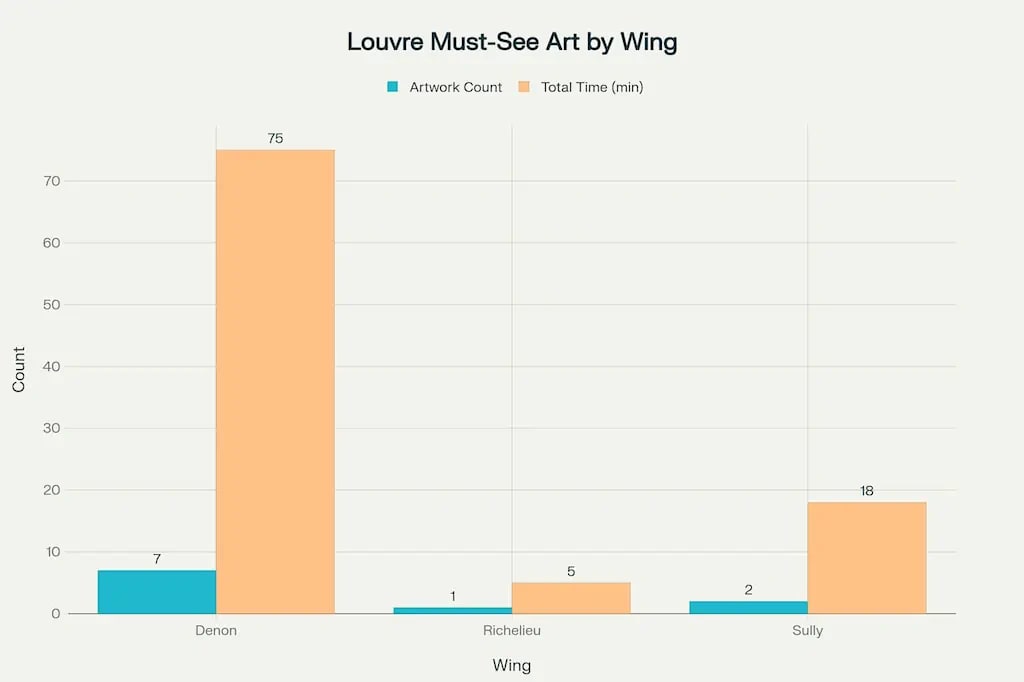
Understanding the Louvre’s layout proves essential for maximising your visit, as the museum’s three wings—Denon, Sully, and Richelieu—each house distinct collections requiring strategic planning. The Denon Wing contains the majority of must-see attractions, including the Mona Lisa, Winged Victory, and major French paintings, making it the logical starting point for first-time visitors. The Sully Wing focuses on ancient civilisations and French sculpture, while the Richelieu Wing emphasises Northern European art and decorative arts.
Strategic entrance selection
Your choice of entrance significantly impacts your museum experience, particularly during peak visiting periods. The main Pyramid entrance offers direct access to all wings but experiences the longest queues, with wait times reaching 30 minutes during peak hours. The Carrousel du Louvre entrance provides covered access via the underground shopping centre, making it ideal for rainy weather or winter visits.
The Porte des Lions entrance represents the savvy visitor’s secret weapon, typically requiring only 5-minute waits even during busy periods. However, this entrance has limited evening hours and provides direct access only to the Denon Wing. For focused visits to highlights like the Mona Lisa and Winged Victory, this entrance offers unparalleled efficiency.
Optimal timing strategies
Museum crowds follow predictable patterns that informed visitors can exploit for enhanced experiences. The 9 AM opening represents the golden hour, offering peaceful viewing conditions and minimal queues for even the most popular artworks. The period between 10 AM and 3 PM brings peak crowds, with the lunch hours of 1-3 PM representing the absolute busiest time.
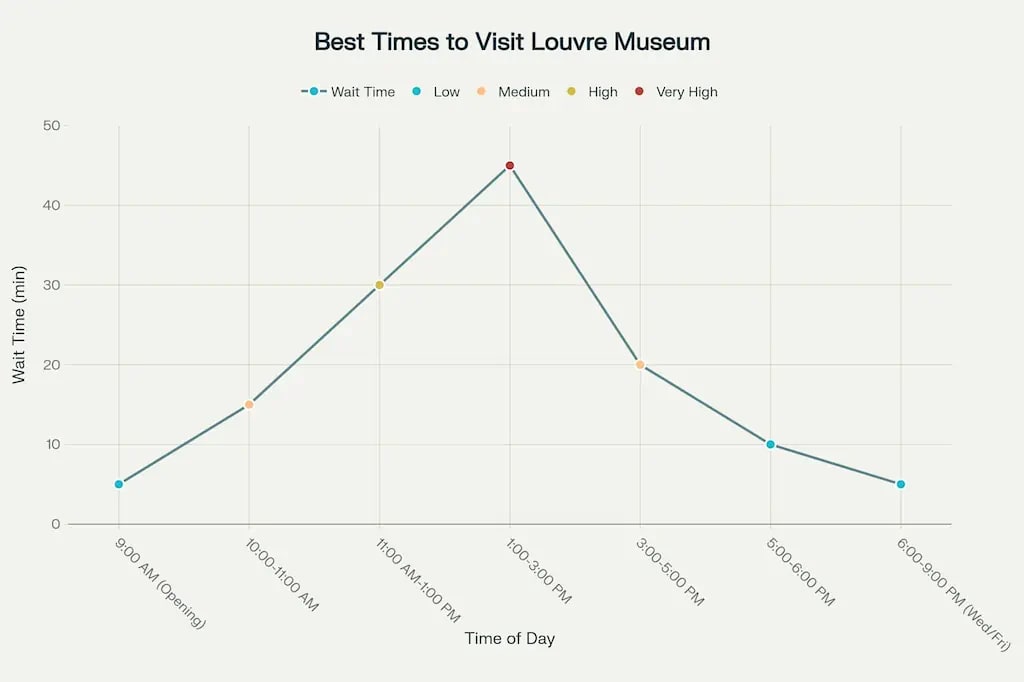
Afternoon visits between 3-5 PM offer a sweet spot of manageable crowds as tour groups depart and exhausted visitors head home. Wednesday and Friday evening hours from 6-9 PM provide the most serene museum experience, though some galleries may have reduced lighting. These extended hours particularly benefit photography enthusiasts and contemplative viewers seeking intimate encounters with masterpieces.
Essential pre-visit planning
Advance ticket booking has evolved from recommendation to necessity, particularly during the June-August peak season when timed entry slots become mandatory. Online booking not only guarantees entry but also allows visitors to bypass ticket queues entirely. The museum’s official app provides interactive maps, suggested itineraries, and real-time information about temporary closures.
Disclosure: This post contains affiliate links that help support and maintain this website. If you click through and make a purchase, I may earn a small commission at no extra cost to you.
Time management becomes crucial when facing the Louvre’s overwhelming scale—even a focused highlights tour requires minimum 2.5-3 hours. Realistic planning acknowledges that attempting to see everything leads to museum fatigue and diminished appreciation. Strategic use of facilities, including strategically positioned cafés and restrooms, prevents unnecessary backtracking through vast galleries.
Planning to visit the Eiffel Tower too? Discover everything you need to know in our ultimate Eiffel Tower visitor guide—from tickets and hours to dining secrets.
Essential ancient treasures beyond the famous three
Code of Hammurabi: Foundation of legal civilisation
The Code of Hammurabi stands as humanity’s earliest comprehensive legal document, preserved on a 2.25-metre black basalt stele in Room 227 of the Richelieu Wing. Dating from 1750 BC, this Babylonian legal code contains 282 laws covering criminal justice, family relationships, and commercial transactions. The stele’s relief sculpture depicts King Hammurabi receiving divine authority from Shamash, the sun god of justice, legitimising royal power through religious sanction.
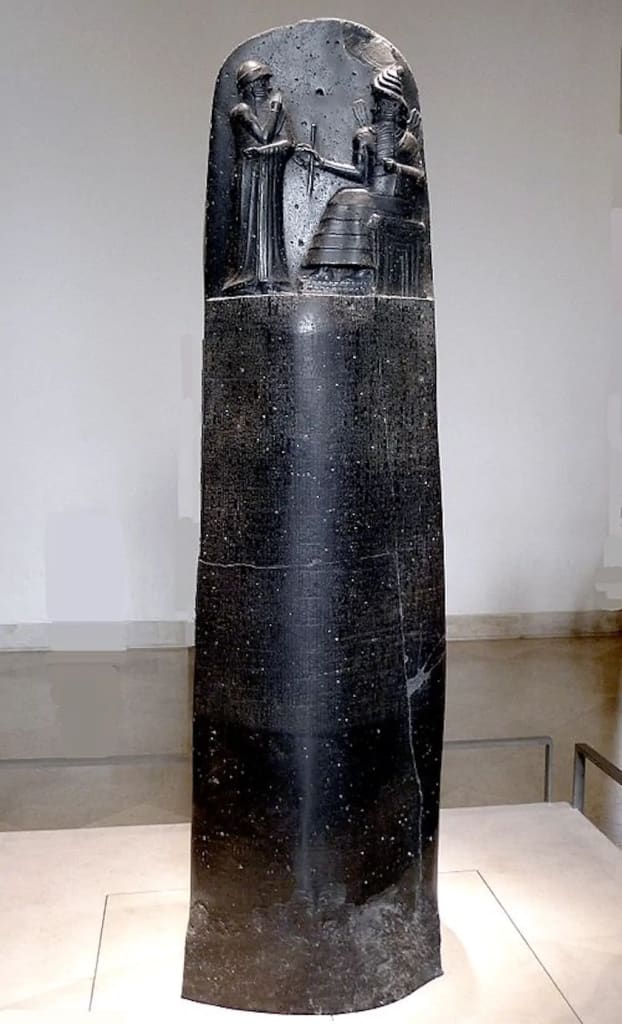
The code’s influence extends far beyond ancient Mesopotamia, establishing legal principles that resonate in modern jurisprudence. Its “eye for an eye” philosophy provided structured justice replacing arbitrary revenge, while its social hierarchy recognised three distinct classes with corresponding rights and obligations. The code’s public display in Babylon’s temple ensured citizens understood laws and consequences, establishing precedents for transparent governance.
French archaeologist’s 1901 discovery at Susa, Iran, revealed how ancient conquerors transported legal monuments as symbols of cultural dominance. The stele’s partial damage reflects its complex history, including Elamite capture and attempted adaptation for new rulers. Modern legal systems worldwide acknowledge Hammurabi’s foundational influence, with the U.S. Capitol displaying his portrait alongside other historic lawgivers.
Egyptian majesty: The Great Sphinx of Tanis
The Great Sphinx of Tanis guards the entrance to the Louvre’s Egyptian Antiquities department in the Crypt of the Sphinx. Dating from approximately 2600 BC, this monumental sculpture combines human intelligence with leonine strength, embodying ancient Egypt’s conception of divine kingship. The sphinx’s placement in the museum’s lower level creates an atmospheric introduction to 5,000 years of Egyptian civilisation.

Jean-François Champollion’s establishment of the Egyptian museum in 1827 began with four rooms but rapidly expanded through archaeological agreements dividing excavation finds. The Department of Egyptian Antiquities now occupies two floors, displaying over 6,000 objects that chronicle humanity’s longest-continuous civilisation. The collection’s highlights include the famous Seated Scribe, royal statuary, and elaborate sarcophagi that reveal ancient beliefs about death and afterlife.
The department’s thematic organisation helps visitors understand daily life in ancient Egypt, from the Nile’s annual flood ensuring agricultural prosperity to elaborate religious practices guaranteeing eternal life. Monumental architecture represented by the mastaba tomb of Akhethotep provides context for understanding pyramid construction and burial customs.
Crown jewels: Royal splendour in the Apollo Gallery
The Crown Jewels of France in the Apollo Gallery represent 60 metres of concentrated luxury, displaying 105 extraordinary pieces that survived revolution, war, and political upheaval. The recently renovated gallery showcases not merely royal jewellery but complete regalia including crowns, sceptres, and ceremonial objects that legitimised monarchical authority. Cartier’s sponsorship of the renovation emphasises the ongoing relationship between historic craftsmanship and contemporary luxury industries.

The collection’s survival represents a miracle of preservation, as most royal treasures were pawned, stolen, or sold during the Revolution. The Louvre has systematically repurchased significant pieces, including Louis XV’s crown and Empress Eugénie’s bow brooch, reuniting scattered heritage. Between these anchoring pieces, visitors discover Empress Marie-Louise’s emerald and micro-mosaic sets alongside the Duchess of Angoulême’s tiara.
Louis XIV’s hardstone vase collection demonstrates royal taste’s international scope, featuring materials like agate, jasper, lapis lazuli, and rock crystal crafted into imaginative forms. These objects often combine components from different periods and cultures, reflecting the global reach of French royal collecting. The gallery’s chronological presentation traces evolving aesthetics from pre-Revolutionary luxury through Second Empire grandeur.
Enhancing your Louvre experience
Audio guide and tour options
The Louvre’s official audio guide, provided on Nintendo 3DS devices for €5, offers professional commentary on major works while allowing self-paced exploration. Third-party apps provide alternative perspectives and additional content, though the official guide ensures accuracy and currency. Guided tours at €12 plus admission cost provide skip-the-line access and expert interpretation, particularly valuable for understanding complex historical contexts.
Private tours offer customised experiences focusing on specific interests or time constraints, while group tours provide social interaction and shared discovery. Evening tours during Wednesday and Friday extended hours create intimate encounters with masterpieces in dramatically reduced crowds. Audio guide rental includes maps and suggestions for efficient navigation through the museum’s labyrinthine galleries.
Photography and practical considerations
Photography remains permitted throughout most galleries, though flash photography is prohibited to protect artworks and avoid disturbing other visitors. Certain special exhibitions may restrict photography entirely, while some galleries limit tripod use during peak hours. The museum’s Wi-Fi network supports sharing experiences on social media, though considerate photography respects other visitors’ viewing opportunities.
Comfortable walking shoes prove essential for navigating marble floors and extensive distances, while modest layers accommodate varying gallery temperatures. Small bags ease security screening, though the museum provides storage for larger items requiring inspection. Staying hydrated becomes crucial during extended visits, with water fountains and café facilities strategically positioned throughout the complex.
Beyond the headline attractions
Napoleon III apartments: Imperial domestic life
The Napoleon III apartments, reopened in June 2024 following extensive restoration, provide intimate glimpses into 19th-century imperial lifestyle. These opulent rooms, originally serving the Minister of State during the Second Empire, showcase the period’s decorative arts at their most refined. The apartments’ integration into the museum following the Finance Ministry’s 1993 relocation represents François Mitterrand’s Grand Louvre Project completing the palace’s transformation.

Second Empire style reaches its apotheosis in these furnished interiors, where original furniture and decorations create authentic period atmospheres. The apartments demonstrate how political power expressed itself through domestic magnificence, with every detail reinforcing imperial grandeur. Period-specific lighting and climate control preserve fragile textiles and gilt surfaces while maintaining authentic ambiance.
Islamic art and decorative treasures
The Louvre’s Islamic Art collection occupies stunning contemporary galleries beneath the Cour Visconti, displaying 3,000 objects spanning 1,300 years of Islamic civilisation. This relatively recent addition addresses historical gaps in Western museum collections while showcasing artistic traditions from Spain to Central Asia. The collection’s highlights include Mamluk metalwork, Persian carpets, and Ottoman ceramics that demonstrate Islamic art’s sophistication and diversity.

Mesopotamian antiquities complement the famous Code of Hammurabi with cylinder seals, relief sculptures, and architectural fragments that illuminate humanity’s earliest urban civilisations. These galleries trace the development of writing, law, and monumental architecture in the Tigris-Euphrates valley. Babylonian, Assyrian, and Sumerian artifacts demonstrate technological and artistic achievements that influenced subsequent cultures throughout the Mediterranean world.
Essential practical information
Opening hours and access
The Louvre maintains consistent daily schedules except Tuesdays, when the museum closes for maintenance and installation work. Monday, Thursday, Saturday, and Sunday hours run from 9 AM to 6 PM, providing ample time for comprehensive visits. Wednesday and Friday extended hours until 9 PM offer unique opportunities for evening visits with dramatically reduced crowds and enhanced photography conditions.
Worried about safety in Paris? Don’t miss our guide to pickpocket hotspots in top cities for 2025. Stay one step ahead while exploring the Louvre and beyond!
Last entry occurs one hour before closing, while visitors must vacate exhibition rooms 30 minutes before closure. Security screening affects all visitors regardless of ticket type, though advance booking expedites the entry process significantly. The Cour Carrée closure from April 7 to June 25, 2025, may affect access routes and should be considered in visit planning.
Transportation and location
Metro lines 1 and 7 serve the Palais-Royal/Musée du Louvre station, providing direct underground access to the museum complex. Line 14’s Pyramides station offers an alternative approach through the Carrousel du Louvre shopping centre. Multiple bus routes (21, 27, 39, 67, 68, 69, 72, 74, 85, 95) serve the museum area, though metro remains most efficient.
Underground parking at 1 Avenue du Général Lemonier operates daily from 7 AM to 11 PM, with reduced rates for visitors with disabilities arranged at the Pyramid’s dedicated assistance area. Vélib’ bicycle stations provide eco-friendly transportation options, with bike parking available near the École du Louvre. Batobus river transport stops at Quai François-Mitterrand, offering scenic arrival via the Seine.
Accessibility and visitor services
The Louvre maintains comprehensive accessibility provisions, including wheelchair rentals, adapted tours, and elevator access to all public areas. Walking sticks, folding stools, pushchairs, and baby carriers are available free of charge for visitors requiring assistance. The visitor assistance area on Level -2 coordinates special needs services and accessibility information.
Multiple dining options accommodate varying budgets and dietary requirements, from the casual Paul bakery to the traditional Bistrot Benoit restaurant. Café Richelieu-Angelina offers terrace seating with views of the Tuileries Garden, while the Goguette cafeteria provides quick meals for families. The main bookshop in the Allée du Grand Louvre operates daily except Tuesdays from 9:30 AM to 6 PM.
Quick reference guide for essential artworks
Denon wing highlights
Allow 90-120 minutes for this wing
| Artwork | Room/Location | Level | Key Details |
|---|---|---|---|
| Mona Lisa | Room 711 (Salle des États) | Level 1 | Peak crowds 10am-3pm; arrive early or visit Wed/Fri evenings |
| Liberty Leading the People | Room 700 | Level 1 | Delacroix’s masterpiece of French Revolution |
| The Coronation of Napoleon | Room 702 | Level 1 | Massive 10m × 6m painting by Jacques-Louis David |
| The Raft of the Medusa | Room 700 | Level 1 | Géricault’s powerful Romantic painting |
| Winged Victory of Samothrace | Daru Staircase | Level 0 | Best viewed from front-left angle |
| Psyche Revived by Cupid’s Kiss | Michelangelo Gallery | Level 0 | Canova’s neoclassical marble masterpiece |
| Crown Jewels of France | Apollo Gallery | Level 1 | Recently renovated gallery with 105 pieces |
Sully wing highlights
Allow 45-60 minutes for these highlights
| Artwork | Room/Location | Level | Key Details |
|---|---|---|---|
| Venus de Milo | Gallery 16 | Level 0 | Ancient Greek sculpture, 130-100 BC |
| Great Sphinx of Tanis | Crypt of the Sphinx | Level -1 | Guardian of Egyptian Antiquities department |
Richelieu wing highlights
Allow 30 minutes for this highlight
| Artwork | Room/Location | Level | Key Details |
|---|---|---|---|
| Code of Hammurabi | Room 227 | Level 0 | Ancient legal code on black basalt stele, 1750 BC |
Navigation tips
Optimal route for first-time visitors (2.5-3 hours)
- Start at Pyramid Entrance (Main entrance)
- Head to Denon Wing Level 0 → Winged Victory on Daru Staircase
- Continue to Michelangelo Gallery → Psyche Revived by Cupid’s Kiss
- Go to Level 1 → Apollo Gallery for Crown Jewels
- Visit Rooms 700-711 → Liberty Leading the People, Napoleon’s Coronation, Raft of the Medusa, Mona Lisa
- Cross to Sully Wing Level 0 → Venus de Milo
- Optional: Sully Level -1 → Great Sphinx of Tanis
- Optional: Richelieu Wing Level 0 → Code of Hammurabi
Best times to visit
- 9:00 AM (Opening): Shortest queues, peaceful viewing
- 3:00-5:00 PM: Afternoon lull after peak hours
- Wednesday/Friday 6:00-9:00 PM: Evening hours, very few crowds
Entrance strategy
- Pyramid: Main entrance, longest queues but most direct
- Carrousel du Louvre: Underground entrance, good for rainy days
- Porte des Lions: Secret entrance with shortest waits (limited evening hours)
Essential practical information
Opening hours:
- Mon, Thu, Sat, Sun: 9:00 AM – 6:00 PM
- Wed, Fri: 9:00 AM – 9:00 PM
- Closed: Tuesdays
Tickets:
- General admission: €22.00 – Get your tickets here!
- Under 18: Free
- EU residents under 26: Free
- Audio guide: €5.00
Disclosure: This post contains affiliate links that help support and maintain this website. If you click through and make a purchase, I may earn a small commission at no extra cost to you.
What to bring:
- Comfortable walking shoes
- Water bottle
- Small bag (large bags require storage)
- Phone/camera (no flash photography)
Pro tips:
- Book tickets online in advance
- Download the Louvre app for navigation
- Allow minimum 3 hours for highlights tour
- Expect 30-45 minute wait for Mona Lisa during peak times
- Visit bathrooms and cafés strategically to avoid backtracking
The Louvre must-see attractions demand careful planning but reward visitors with encounters that can genuinely transform perspectives on art, history, and human achievement. This extraordinary institution continues evolving while preserving humanity’s greatest artistic treasures for future generations. Whether you spend three hours or three days exploring these halls, the Louvre guarantees experiences that resonate long after your visit concludes.
FAQ: Frequently Asked Questions about visiting the Louvre
Q: What is the best time to visit the Louvre?
A: The best times to visit are right at the 9 AM opening or during the extended evening hours on Wednesdays and Fridays (6-9 PM) for minimal crowds. Avoid 10 AM to 3 PM, which are peak hours.
Q: How do I buy tickets for the Louvre?
A: It is highly recommended to book your tickets online in advance, especially during peak season, to guarantee entry and bypass ticket queues.
Q: How much time should I allocate for a visit to the Louvre?
A: Even a focused tour of the Louvre highlights requires a minimum of 2.5-3 hours. For a more comprehensive visit, plan for 4-6 hours or even multiple visits.
Q: Is the Louvre accessible for visitors with disabilities?
A: Yes, the Louvre is fully accessible with wheelchair rentals, adapted tours, and elevator access to all public areas.
Q: Can I take photos inside the Louvre?
A: Photography is generally permitted in most galleries, but flash photography is prohibited to protect the artworks and ensure a pleasant experience for all visitors.
Q: What are the different entrances to the Louvre, and which one should I use?
A: The main Pyramid entrance can have long queues. The Carrousel du Louvre entrance is convenient via an underground shopping center. The Porte des Lions entrance often has the shortest wait times but has limited hours and access to specific wings. Consider your priorities when choosing how to visit the Louvre.
Q: Are there places to eat inside the Louvre?
A: Yes, the museum offers various dining options, from casual cafes to restaurants, and strategically placed water fountains to keep you hydrated.
For more information on other incredible museums in Paris, explore our ultimate Eiffel Tower visitor guide.