
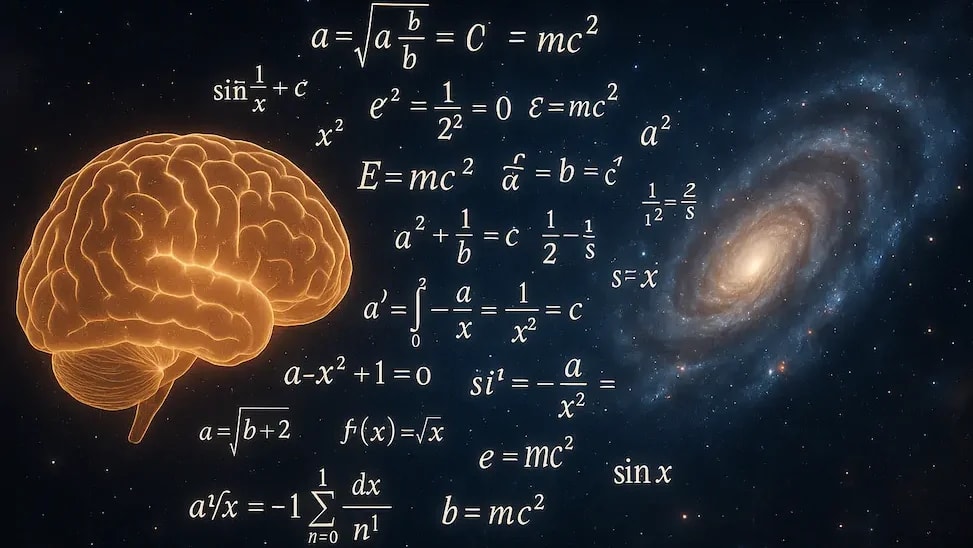
In a world increasingly shaped by algorithms and artificial intelligence, where machines are now venturing into the hallowed halls of mathematical proof, the ancient question of whether mathematics is invented or discovered feels more relevant than ever. Just recently, we’ve seen headlines about AI systems generating novel mathematical conjectures and even assisting in proving complex theorems – a development that makes one pause and wonder: are these intelligent machines inventing new mathematical constructs, or are they discovering pre-existing truths with unprecedented speed and efficiency? This isn’t just an abstract philosophical musing; it’s a profound inquiry that underpins our understanding of knowledge, reality, and even the very nature of human consciousness.
Mathematics, in its elegant simplicity and breathtaking complexity, underpins everything from the dance of subatomic particles to the swirling majesty of galaxies. It is the language through which we attempt to decipher the universe. But when a mathematician unveils a new theorem, are they like an intrepid explorer charting an uncharted island, or are they a brilliant architect designing an entirely new structure? This core philosophical divide, central to the philosophy of mathematics, has captivated the greatest minds for millennia, shaping our perception of scientific truth and the very fabric of reality.
The foundation of mathematical reality: diving deep into the divide
At its heart, the philosophy of mathematics grapples with a monumental question: do mathematical objects – numbers, geometric shapes, logical relationships – exist independently of human thought, or are they intricate constructs born from our cognitive processes? This isn’t merely academic navel-gazing; it directly impacts how we perceive mathematical truth and its intricate relationship with the physical world.
Imagine, if you will, a mathematician proving the infinitude of prime numbers. Are they pulling back a veil to reveal an eternal truth woven into the cosmos, or are they meticulously constructing a logical edifice within a human-designed formal system? The implications are vast. If mathematics is discovered, it suggests an objective, independent mathematical reality. If it’s invented, then our most formidable tool for comprehending nature is, fundamentally, a human creation.
Arguments for mathematics as an invention: humanity’s brilliant craft
The sheer ingenuity and adaptability of mathematics often lead one to ponder its human origins. It bears the unmistakable fingerprints of our inventive spirit.
Human constructs and mathematical systems: the building blocks of thought
The concept of axiomatic systems in mathematics provides compelling evidence for the invention hypothesis. Think of it: mathematical frameworks arise from human choices about fundamental assumptions. The 19th century, in particular, saw a revolutionary shift with the development of non-Euclidean geometries. Visionaries like Gauss, Bolyai, and Lobachevsky didn’t just stumble upon new spaces; they created entirely consistent geometric systems by simply altering Euclid’s parallel postulate.
These alternative geometries aren’t some cosmic revelation of “more true” or “less true” realities; they’re different, highly useful mathematical constructs serving distinct purposes. Euclidean geometry, for instance, perfectly describes flat surfaces, while hyperbolic geometry offers a far better description of curved spaces, crucial in fields like cosmology. This remarkable flexibility strongly suggests that mathematical systems are sophisticated tools, invented by humans, rather than pre-existing truths waiting to be unearthed.
Cultural and historical evolution: a tapestry of innovation
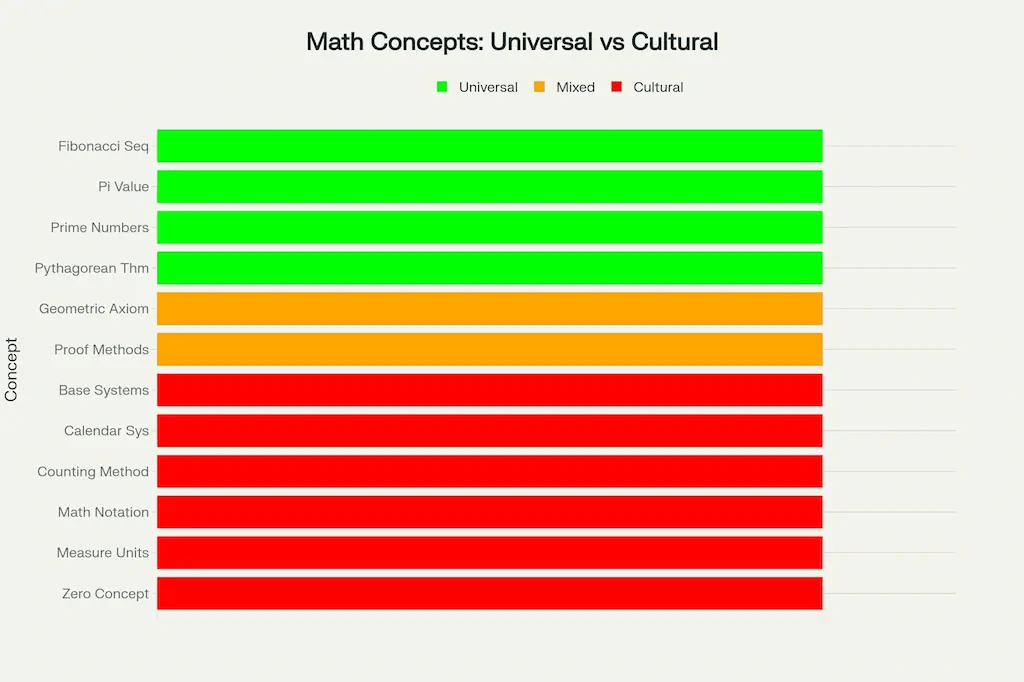
The evolution of mathematical concepts across diverse cultures and historical epochs offers a rich tapestry of evidence for the invention hypothesis. It’s a story of independent innovation and cultural exchange, not universal revelation.
Number systems across civilisations: a testament to human ingenuity
- Babylonians: Pioneers of a sophisticated base-60 system, whose echoes we still see in our measurement of time and angles.
- Mayan mathematicians: Independently developed a base-20 system, notably incorporating an advanced concept of zero, a profound intellectual leap.
- Chinese mathematicians: Utilised rod numerals, a unique and efficient system for complex calculations.
- Modern computing: Relies fundamentally on binary (base-2) systems, a testament to ongoing mathematical invention.

The concept of zero, in particular, stands as a beacon of invention. Indian mathematicians around the 7th century developed this revolutionary concept, while Greek mathematics, for all its brilliance, functioned entirely without it. If mathematical truths were universally discovered, wouldn’t zero have been universally recognized from the outset? Instead, we observe its gradual innovation and spread across civilizations, much like any other profound human invention.
Language, notation, and symbolic systems: the tools of expression
Perhaps the most palpable evidence of invention lies in mathematical notation itself. The symbols we employ daily – the Arabic numerals, the elegant shorthand of algebraic notation, the intricate symbols of calculus – are undeniably human creations. They didn’t fall from the sky; they evolved over centuries, continually refined for clarity and efficiency. The journey from the verbose “rhetorical algebra” to the concise power of “symbolic algebra” perfectly illustrates how human ingenuity crafts increasingly efficient ways to express mathematical ideas.
Furthermore, different cultures forged distinct pathways to mathematical proof:
- Greek geometers: Famously emphasised visual, geometric demonstrations, a legacy we see in Euclid’s Elements.
- Arabic mathematicians: Pioneered algebraic methods.
- Chinese mathematicians: Developed algorithmic approaches.
- Indian mathematicians: Created sophisticated numerical techniques.
These diverse methodologies suggest that even the concept of mathematical proof—supposedly the pinnacle of mathematical objectivity—bears cultural fingerprints.
Arguments for mathematics as a discovery: unveiling cosmic truths
Despite the compelling arguments for invention, the sheer power, consistency, and pervasive presence of mathematics in the natural world lead many to believe it is, in fact, discovered.
Mathematical Platonism and eternal truths: a realm beyond our minds
Mathematical Platonism posits that mathematical objects exist in an abstract, eternal realm independent of human minds. Plato argued that mathematicians don’t create mathematical truths but discover them, much like explorers mapping previously unknown territories.

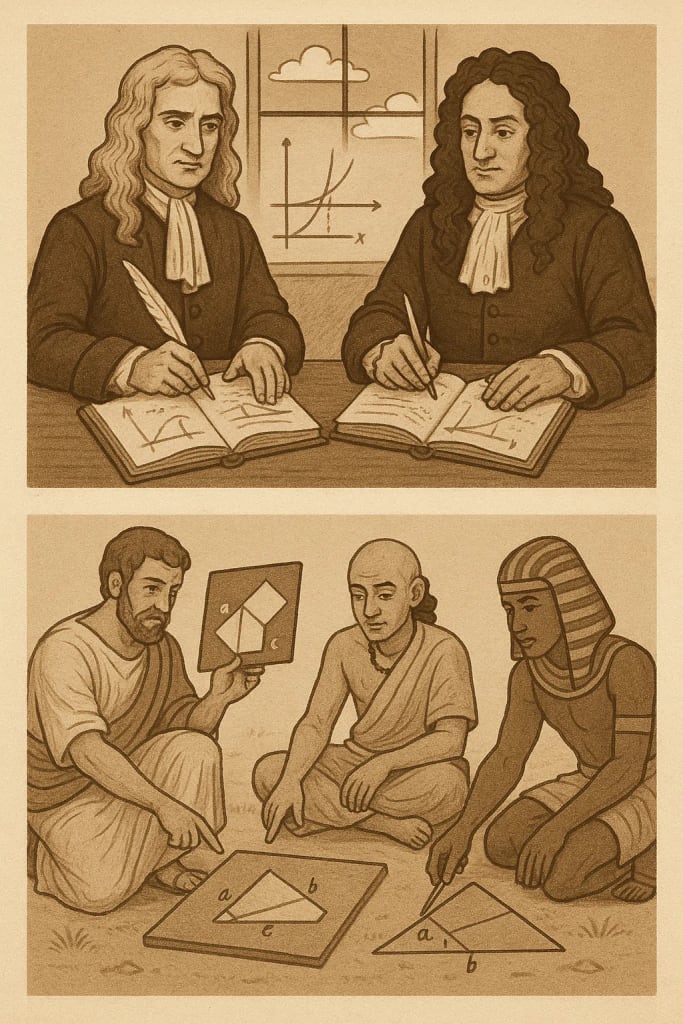
The remarkable consistency of mathematical “discoveries” across disparate cultures lends significant weight to this view. When ancient mathematicians in Greece, India, China, and Babylon independently arrived at the Pythagorean theorem, they weren’t inventing different relationships—they were uncovering the same eternal truth about right triangles.
Universality and consistency: the fabric of reality
The undeniable universality of mathematics provides powerful evidence for the discovery position. Certain mathematical constants and relationships appear consistently across all human cultures and, more profoundly, throughout the natural world.
Universal mathematical constants: nature’s undeniable language
- π (Pi): The ratio of a circle’s circumference to its diameter equals 3.14159… regardless of culture or historical period.
- Prime numbers: The sequence 2, 3, 5, 7, 11, 13… remains identical across all mathematical systems.
- Golden ratio (ϕ): Approximately 1.618… appears in diverse natural phenomena worldwide.
- Fibonacci sequence: 0, 1, 1, 2, 3, 5, 8, 13… emerges independently in multiple mathematical contexts.
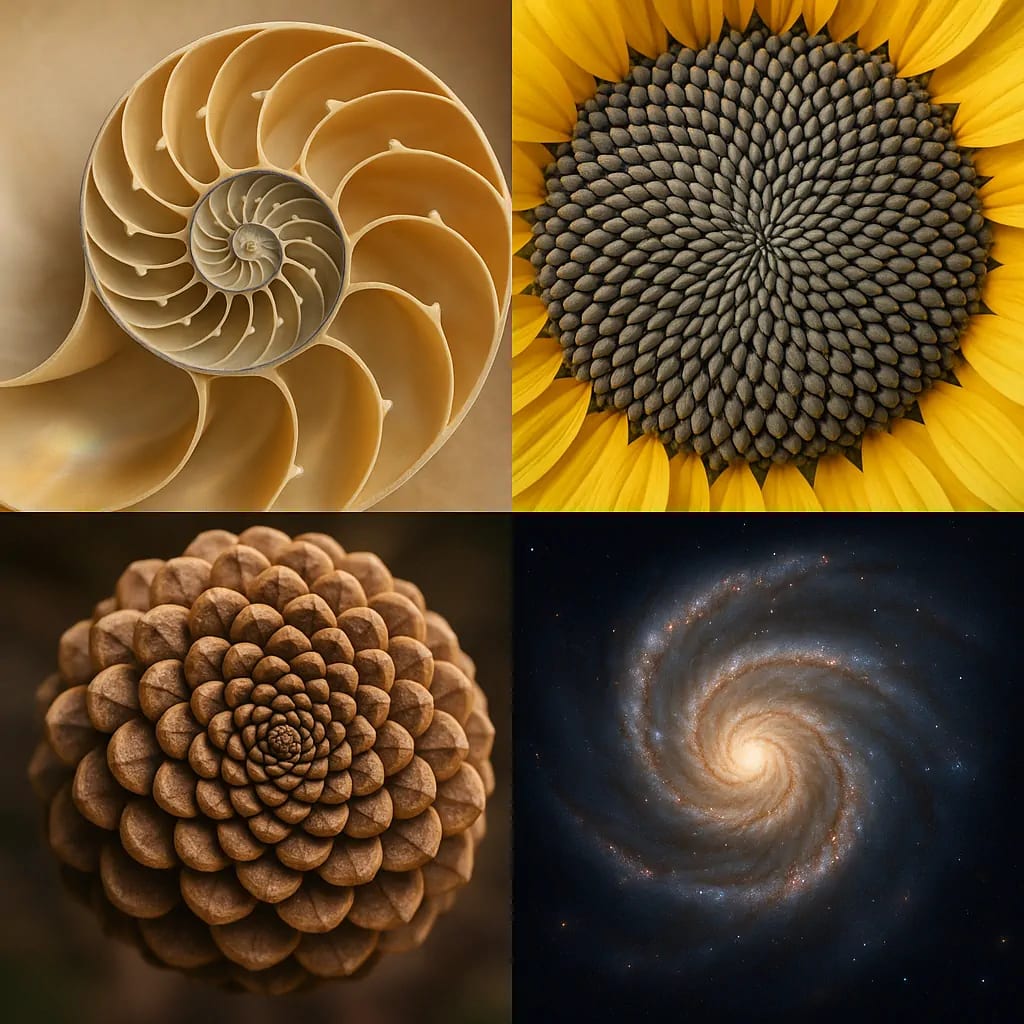
The Fibonacci sequence offers a particularly striking example of this universality. These numbers literally manifest in the spiral arrangements of sunflower seeds, the elegant curves of pinecones, the chambers of a nautilus shell, and even the majestic arms of spiral galaxies. Such pervasive patterns strongly suggest underlying mathematical truths that humans observe and discover, rather than invent.

The unreasonable effectiveness of mathematics: a profound mystery
Eugene Wigner’s famous observation about the “unreasonable effectiveness of mathematics in the natural sciences” is a powerful argument for discovery. How is it that mathematical theories, often developed for purely abstract reasons with no immediate practical application in mind, so frequently turn out to be remarkably, even startlingly, applicable to the physical world? This effectiveness seems to border on the mysterious if mathematics is merely a human invention.
Consider these fascinating examples:
- Complex numbers: Initially dismissed as “imaginary,” they now prove essential for quantum mechanics.
- Non-Euclidean geometry: Developed as abstract mathematics, it became crucial for Einstein’s general relativity.
- Group theory: Created for algebraic purposes, it now underpins particle physics.
The pervasive hexagonal patterns observed throughout nature—from the efficient architecture of honeycomb cells to the intricate beauty of snowflake crystals and the impressive structures of basalt columns—exemplify geometric principles that appear universal across different scales and contexts. Bees, it seems, didn’t attend geometry classes; they “discovered” that hexagons provide the most efficient storage with the minimum amount of material.
Independent mathematical discoveries: synchronicity of truth
The phenomenon of simultaneous discovery strongly supports the discovery position. Time and again throughout history, mathematicians working completely independently, often across continents and without knowledge of each other’s work, have arrived at identical mathematical truths.
Notable independent discoveries: a convergence of minds
- Calculus: Isaac Newton and Gottfried Wilhelm Leibniz independently developed calculus in the 1660s-1670s.
- Non-Euclidean geometry: Carl Friedrich Gauss, János Bolyai, and Nikolai Lobachevsky independently discovered hyperbolic geometry.
- Complex analysis: Multiple mathematicians independently developed the theory of complex functions.
- Statistical mechanics: Ludwig Boltzmann and James Clerk Maxwell independently formulated kinetic theory.
These striking parallel discoveries suggest that mathematicians are uncovering pre-existing truths rather than creating arbitrary systems. If mathematics were purely invented, such convergence would be remarkably coincidental.
Mathematical proofs and logical deduction: the unveiling of necessity
The very essence of logic and mathematics lies in the power of mathematical proofs. These proofs do not create truth; rather, they reveal it through rigorous logical deduction. When mathematicians prove theorems, they’re uncovering necessary logical relationships rather than constructing arbitrary connections.
There’s a profound beauty and elegance to mathematical proofs, a sense that they are revealing something objective and eternal. Consider Euler’s identity, eiπ+1=0. It connects five fundamental mathematical constants in a relationship so exquisitely simple and profound that it seems to transcend any human construction, hinting at a deeper, underlying mathematical reality.
Bridging the gap: a grand synthesis
Modern philosophical thought increasingly recognizes that the debate over whether mathematics is invention or discovery might be a false dichotomy. Perhaps, and this is a fascinating possibility, mathematics involves both in a complex and deeply intertwined dance.
Imagine this synthesis: humans invent mathematical languages, notation systems, and formal frameworks, but within these invented systems, they then discover objective relationships and truths that were always implicitly there. It’s akin to inventing the game of chess; once the rules are established, we then discover the myriad optimal strategies and theoretical positions that exist within those invented rules.
The language analogy: a perfect parallel
- Grammar structures: Linguists observe universal grammatical patterns across all human languages, suggesting a discovery of inherent cognitive structures.
- Specific languages: However, specific languages invent diverse ways to express these universal patterns.
- Mathematical concepts: Similarly, mathematical concepts reveal universal relationships inherent in reality (discovery).
- Mathematical notation systems: Yet, different mathematical notation systems are invented by various cultures to express these relationships (invention).
The role of human intuition and cognitive architecture: our innate mathematical sense
The existence of fundamental human mathematical intuition suggests a fascinating middle ground. Our brains appear to be hardwired with certain innate mathematical capabilities—a rudimentary number sense, an intuitive grasp of geometric shapes, a profound ability to recognize patterns—that appear universal across cultures. These cognitive foundations seem to align with mathematical structures found in reality, which could explain both the widespread universality of mathematics and its remarkable accessibility to the human mind.
Mathematical intuition often serves as a precursor to formal proof. The legendary Srinivasa Ramanujan, with his extraordinary mathematical insights, often arrived at profound theorems through intuition, which were later rigorously proven by others. This suggests that human consciousness might be naturally attuned to, or resonate with, an underlying mathematical truth.
Practical implications for education and research: shaping our future
This profound philosophical debate is far from abstract; it carries significant practical consequences for how we approach mathematics in education and research.
Educational implications:
- If mathematics is primarily discovered, education should emphasise exploration, pattern recognition, and fostering a sense of wonder at pre-existing truths.
- If mathematics is primarily invented, the focus should shift to mastering formal systems, logical construction, and the power of human ingenuity.
- A synthetic approach, recognizing both facets, suggests that a well-rounded mathematical education should cultivate both the ability to discover patterns and the skills to construct formal systems.
Research implications:
- Advocates for the discovery position often pursue mathematical beauty and elegance as guiding lights toward fundamental truths.
- Proponents of the invention hypothesis may prioritize developing mathematical tools for specific practical applications and problem-solving.
- A synthetic approach encourages researchers to combine both aesthetic motivation and utilitarian goals, seeking both profound truths and practical utility.
Notable philosophers and mathematicians on the topic: voices through time
Throughout history, an illustrious line of thinkers has grappled with the question of truth in mathematics and its relationship to reality. Their diverse perspectives continue to illuminate different facets of this enduring debate.

Plato (428-348 BCE): The quintessential champion of the discovery position, whose Theory of Forms posited that mathematical objects exist eternally in an abstract, perfect realm. For Plato, mathematicians are like astronomers, not creating celestial bodies, but observing and mapping their pre-existing forms.
Pythagoras (570-495 BCE): Believed that “all is number,” suggesting that mathematical relationships constitute reality’s fundamental structure. This perspective sees mathematics as the discovered language of the cosmos itself.
Immanuel Kant (1724-1804): Offered a deeply nuanced position, classifying mathematics as “synthetic a priori” knowledge—neither purely logical (analytic) nor purely empirical (posterior), but somehow both universal and informative about reality.
Isaac Newton (1643-1727) and Gottfried Leibniz (1646-1716): Both viewed their independent development of calculus as discovering universal principles governing change and motion. Their mathematical formulations were, for them, revelations of truths about the natural world that transcended mere human construction.
David Hilbert (1862-1943): A leading figure of formalism, he championed the invention position, famously describing mathematics as “a game played according to certain simple rules with meaningless marks on paper”. Yet, even Hilbert couldn’t deny the remarkable and often unexpected effectiveness of this “game” in describing reality.
Kurt Gödel (1906-1978): A staunch supporter of mathematical Platonism despite his own groundbreaking incompleteness theorems, which demonstrated inherent limitations within formal systems. His work is often interpreted as suggesting that mathematical truth transcends formal provability, pointing toward objective mathematical reality.
Eugene Wigner (1902-1995): The Nobel laureate physicist whose essay “The Unreasonable Effectiveness of Mathematics in the Natural Sciences” highlighted the perplexing mystery of mathematics’ profound utility in physics, describing it as “unreasonable” and “bordering on the mysterious”.
Contemporary perspectives: the modern dialogue
Today’s thinkers continue to refine and advance these positions, leveraging new insights from various fields.
Roger Penrose: Argues for objective mathematical truth accessible through human consciousness, suggesting that mathematical discovery involves genuine contact with mathematical reality.
Mark Steiner: Proposes that mathematical effectiveness reflects human cognitive architecture rather than objective mathematical truth, offering an anthropocentric explanation for mathematical success.
Mario Livio: A well-known astrophysicist and author, Livio suggests that mathematics is both invented and discovered: we invent mathematical concepts and notation, but we then discover the inherent, objective relationships among these concepts. This “both/and” approach is gaining significant traction.
The ongoing debate and future directions: a journey without end
Contemporary developments in mathematical philosophy: new frontiers
The ancient debate is constantly reinvigorated by breakthroughs in cognitive science, artificial intelligence, and mathematical logic. Studies of mathematical cognition reveal universal number sense across cultures, whilst research into mathematical creativity explores how new mathematical concepts emerge.
Computer-assisted theorem proving raises new questions about mathematical discovery. When artificial intelligence discovers mathematical proofs beyond human comprehension, are these genuine discoveries or sophisticated manipulations of human-invented formal systems?
Furthermore, cutting-edge foundational approaches like category theory offer fresh perspectives on mathematical unity and diversity, potentially bridging the invention-discovery divide through structural approaches to mathematical knowledge.
The persistence of wonder: an ever-unfolding mystery
The enduring debate over mathematics invention or discovery persists precisely because it touches upon the most fundamental questions about human knowledge, the nature of reality, and the very essence of consciousness. Whether we ultimately categorize mathematics as humanity’s most ingenious invention or its most profound discovery, its extraordinary power to illuminate the universe’s intricate structure remains undeniable.
Perhaps the very persistence of this debate is a testament to mathematics’ unique position—it seems to simultaneously emerge from the creative depths of human minds and yet reveal truths that appear to transcend all human limitations. In grappling with this beautiful paradox, we find ourselves confronting the mystery of consciousness itself and its profound relationship to reality.
Conclusion: a symphony of invention and discovery
The question, “Is math invented or discovered?” remains as captivating today as when ancient philosophers first contemplated mathematical reality. We’ve journeyed through compelling arguments on both sides: the cultural diversity of mathematical systems supporting invention, and the universal consistency of mathematical truths supporting discovery.
Ultimately, the true value of this debate may not lie in definitively declaring a winner, but rather in deepening our collective appreciation for the extraordinary nature of mathematics itself. Whether it is primarily invented or profoundly discovered, mathematics undeniably stands as humanity’s most powerful and elegant tool for understanding reality, and indeed, one of our most refined expressions of rational thought.

A compelling synthesis is increasingly emerging from contemporary philosophy, suggesting that mathematics might, in fact, transcend this seemingly simple invention-discovery dichotomy. Perhaps we invent mathematical languages while simultaneously discovering mathematical truths; we create formal systems while uncovering universal patterns; we construct notation while revealing eternal relationships.
As we continue our relentless pursuit of mathematical knowledge—from the cutting-edge theories of quantum mechanics to the rapid advancements in artificial intelligence—this ancient question will undoubtedly evolve, deepen, and continue to inspire awe. The sheer wonder that mathematics consistently ignites, irrespective of its ultimate nature, serves as a powerful testament to something profoundly significant about both mathematical reality and the boundless capabilities of human consciousness.
In the end, by contemplating whether mathematics is an invention or a discovery, we are, in a deeper sense, contemplating the very mystery of mind meeting reality, of finite consciousness reaching out to grasp infinite truth, and of human creativity encountering a universal, elegant structure. And perhaps, in this very act of contemplation, we touch upon what it truly means to be human.
FAQ: Frequently Asked Questions
Q: What is mathematical Platonism?
A: Mathematical Platonism is a philosophical view that asserts mathematical objects (like numbers, sets, and geometric shapes) and mathematical truths exist objectively and independently of human minds, in an abstract, non-physical realm. Mathematicians, from this perspective, discover these truths rather than inventing them.
Q: Who invented the concept of zero?
A: The concept of zero as a number and a place-value holder, as we understand it today, was primarily developed by Indian mathematicians, notably Brahmagupta, around the 7th century CE. While other civilizations had concepts of ’emptiness’ or placeholders, the Indian innovation of zero was crucial for the development of modern arithmetic.
Q: What does “unreasonable effectiveness of mathematics” mean?
A: This phrase, coined by physicist Eugene Wigner, refers to the surprising and often mysterious accuracy and applicability of abstract mathematical theories to describe and predict phenomena in the physical world. It questions why mathematics, which is often developed for its own internal consistency and beauty, so frequently turns out to be indispensable for understanding the universe.
Q: Are there universal mathematical concepts across all cultures?
A: Yes, while specific notation and systems vary, certain fundamental mathematical concepts appear to be universal across cultures. These include basic number sense, geometric awareness (like the understanding of shapes and spatial relationships), and the recognition of patterns. Constants like Pi (π) and the principles behind the Pythagorean theorem also show remarkable universality in their discovery.
Q: How does AI discovering new proofs relate to this debate?
A: The recent advancements in AI, where systems can generate novel mathematical conjectures and assist in proving theorems, add a fascinating new layer to the debate. If AI “discovers” a proof, does that suggest the truth was pre-existing, waiting for any intelligence (human or artificial) to find it? Or does it highlight the capacity of complex, human-invented systems (the AI itself and its algorithms) to generate new mathematical knowledge? It certainly blurs the lines between invention and discovery.
