
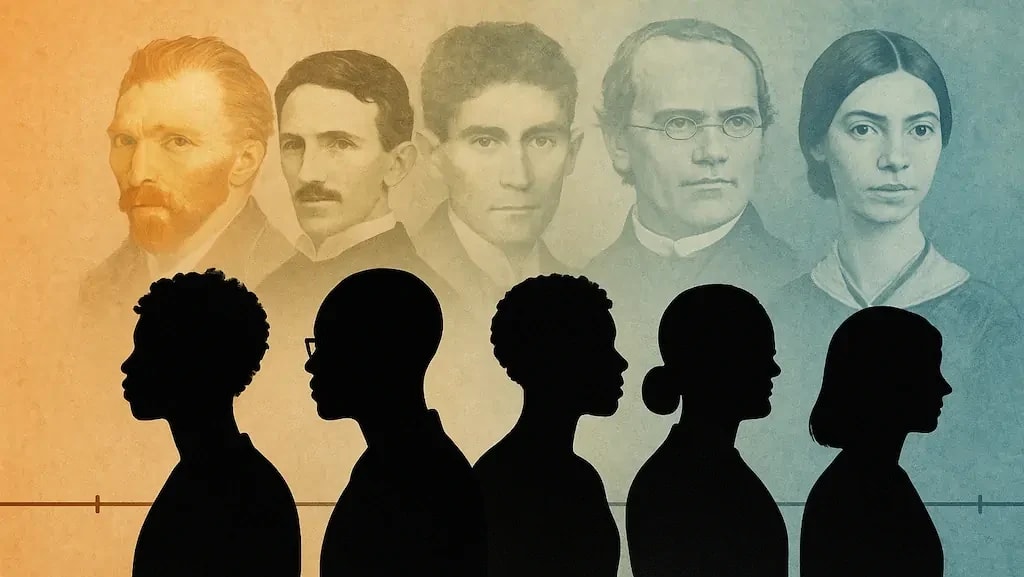
History has a rather cruel sense of irony when it comes to modern geniuses recognition. The very minds that reshape our understanding of the world often toil in obscurity, their brilliance only becoming apparent decades or even centuries after they’ve departed. Consider this sobering reality: Vincent van Gogh sold precisely one painting during his lifetime, yet today his works command astronomical prices and universal reverence. This pattern of delayed recognition isn’t merely a historical curiosity—it’s a systemic failure that continues to influence how we identify and nurture genius in our contemporary world. It really makes you wonder, doesn’t it? How many true visionaries are walking among us right now, perhaps even in our own circles, whose monumental contributions will only be celebrated by generations far removed from their own time?
The question that haunts us today is deceptively simple yet profoundly complex: if history’s greatest minds were overlooked by their contemporaries, who among us might be the unrecognised geniuses of our time? As we navigate an era of unprecedented information flow and technological acceleration, the challenge of identifying future geniuses has become both more urgent and more complicated than ever before. We’re awash in data, bombarded by fleeting trends, and often, the quiet, profound breakthroughs get lost in the digital din. So, how do we cut through the noise and spot the quiet revolutionaries?
The recognition lag: Historical patterns of delayed genius acknowledgement
The phenomenon of delayed recognition in history reveals a troubling pattern that spans across disciplines and centuries. Our research into historical figures demonstrates that the average recognition delay for proven geniuses extends to approximately 65 years after their death, with some cases stretching into centuries. This isn’t just a statistical anomaly; it’s a testament to how profoundly societal biases, technological limitations, and even simple human stubbornness can impede the appreciation of true brilliance.
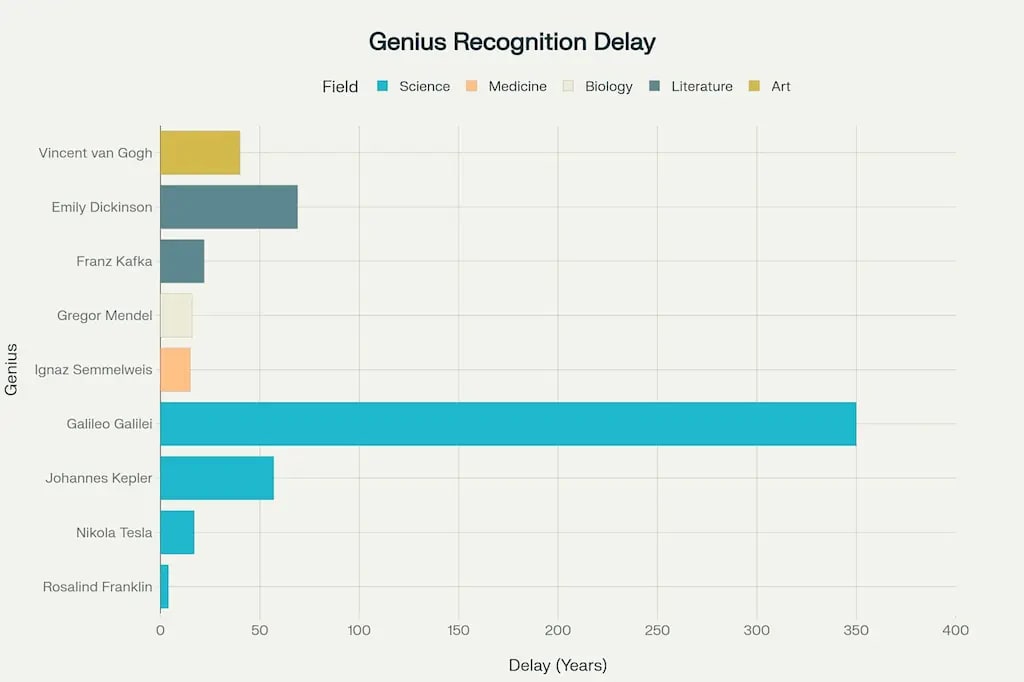
Vincent van Gogh’s tragic story epitomises this pattern perfectly. Despite producing over 2,100 artworks, including 860 oil paintings, he managed to sell only one during his lifetime—The Red Vineyard. His brother Theo’s widow, Jo van Gogh-Bonger, spent decades after both brothers’ deaths tirelessly promoting Vincent’s work, lending pieces to museums worldwide and publishing his letters. It wasn’t until the 1930s, four decades after his death, that Van Gogh achieved the recognition we now consider inevitable. Imagine that – a man whose vibrant, emotional brushstrokes now adorn countless homes and galleries, died believing his work was largely worthless. What a punch to the gut of artistic validation.

Similarly, Nikola Tesla’s revolutionary contributions to electrical engineering were overshadowed by Thomas Edison’s superior marketing acumen and business savvy. Tesla’s development of alternating current (AC) systems and wireless technology laid the groundwork for modern electrical infrastructure, yet he died in relative poverty and obscurity. Today, Tesla’s name graces not just scientific textbooks but also one of the world’s most valuable automotive companies—a recognition that arrived seventeen years after his death. It’s a classic tale of the quiet innovator versus the shrewd entrepreneur, and sadly, the latter often wins the immediate popularity contest.
Franz Kafka presents perhaps the most extreme case of posthumous literary genius. Virtually unknown during his lifetime, Kafka had instructed his friend Max Brod to destroy his unpublished works, including The Trial, The Castle, and Amerika. Fortunately for world literature, Brod ignored these instructions. Kafka’s work only began receiving serious critical attention in the 1960s, more than four decades after his death, when his themes of alienation and bureaucratic absurdity resonated with post-war society. It makes you wonder how many other literary masterpieces were, in fact, destroyed by authors who simply didn’t live long enough to see their moment.
The scientific realm offers equally compelling examples. Gregor Mendel’s groundbreaking work on genetic inheritance, conducted between 1856 and 1863, was completely ignored by the scientific community. His laws of heredity weren’t rediscovered and appreciated until 1900, sixteen years after his death, when three separate scientists independently arrived at similar conclusions. This delay cost humanity decades of potential genetic research advancement. Think of the medical breakthroughs and agricultural innovations that might have been accelerated had Mendel’s brilliance been recognised in his own time!
Why genius goes unrecognised: The barriers to contemporary appreciation
Understanding the changing perception of genius requires examining the systematic barriers that prevent immediate recognition. Historical analysis reveals several recurring factors that contribute to this recognition lag. And let’s be honest, some of these barriers are as persistent today as they were centuries ago, simply manifesting in new, digitally-enhanced forms.
Societal and cultural resistance: The discomfort of new truths
Revolutionary ideas often challenge prevailing worldviews, making them uncomfortable for contemporary audiences. Ignaz Semmelweis discovered that handwashing dramatically reduced mortality rates in hospitals, yet his findings were rejected by the medical establishment because they implied that doctors themselves were spreading disease. His colleagues found this suggestion so offensive that Semmelweis was eventually committed to an asylum, dying just before germ theory would vindicate his work. It’s a stark reminder that sometimes, the hardest truths to accept are the ones that force us to re-evaluate our own perceived infallibility.
Galileo Galilei faced similar resistance when his astronomical observations supported the heliocentric model of the solar system. The Catholic Church condemned his work as heretical, and it took 350 years for the Vatican to formally acknowledge that Galileo was correct—making his recognition delay the longest in our dataset. Talk about holding a grudge!
Technological and infrastructure limitations: Before the global village
Before modern publishing, broadcasting, and digital communication, disseminating revolutionary ideas required significant resources and institutional support. Emily Dickinson wrote prolifically but published only ten poems during her lifetime, partly due to limited publishing opportunities for women and her own reclusive nature. The bulk of her work—nearly 1,800 poems—was discovered after her death and required decades to be properly compiled and appreciated. Could the next Emily Dickinson be sharing her profound verses only with her cat because she lacks the platform or the connections to reach a wider audience? It’s a thought that keeps me up at night.
Economic and commercial pressures: The demand for immediate ROI
The pressure for immediate practical application often blinds society to foundational breakthroughs that will prove valuable later. Rosalind Franklin’s X-ray crystallography work provided crucial evidence for DNA’s double helix structure, but her meticulous approach was overshadowed by Watson and Crick’s rush to publication. Franklin died four years before the Nobel Prize was awarded, highlighting how commercial and competitive pressures can eclipse methodical genius. In our current startup culture, where “move fast and break things” is often the mantra, are we inadvertently overlooking the meticulous, slow-burn genius that lays the groundwork for truly transformative change?
Defining contemporary genius definition in the modern age
The contemporary genius definition has evolved significantly from the romantic notion of the solitary, tortured artist or the mad scientist working in isolation. Modern understanding recognises genius as a multifaceted phenomenon that encompasses various forms of intelligence and innovation. It’s less about the wild-haired recluse in a lab coat and more about the interconnected, interdisciplinary problem-solver.
Beyond IQ: The multidimensional nature of modern genius
Traditional genius was often equated with exceptional intellectual ability measured by IQ tests. However, contemporary research suggests that genius involves a combination of intellectual capacity, creativity, and the ability to achieve something that transcends the ordinary. As philosopher Arthur Schopenhauer noted, “Talent hits a target no one else can hit. Genius hits a target no one else can see”. It’s that uncanny ability to perceive connections, to envision solutions, and to articulate possibilities that others simply can’t grasp.
Modern genius is increasingly characterised by several key attributes: interdisciplinary thinking, disruptive innovation, long-term vision, and the ability to synthesise complex information into elegant solutions.
| Indicator | Importance score | Recognition difficulty | Type | Examples |
|---|---|---|---|---|
| Interdisciplinary thinking | 9 | 8 | Cognitive | Combining AI with neuroscience for brain-computer interfaces |
| Disruptive innovation | 10 | 9 | Innovation | Creating new paradigms that make existing solutions obsolete |
| Long-term vision | 8 | 9 | Vision | Working on problems that will matter in 20-50 years |
| Problem-solving approach | 9 | 6 | Cognitive | Finding elegant solutions to complex, multi-dimensional problems |
| Collaboration skills | 7 | 5 | Social | Building diverse teams and fostering intellectual exchange |
| Ethical considerations | 8 | 7 | Ethical | Considering societal impact and unintended consequences |
| Systems thinking | 9 | 8 | Cognitive | Understanding complex relationships and feedback loops |
| Pattern recognition | 8 | 7 | Cognitive | Identifying hidden connections across different domains |
| Creative synthesis | 9 | 8 | Creative | Combining existing ideas in novel, breakthrough ways |
| Adaptability | 8 | 6 | Behavioral | Pivoting approaches based on new evidence or circumstances |
| Open-source contribution | 6 | 4 | Collaborative | Contributing to commons knowledge and open innovation |
| Mentorship & teaching | 7 | 5 | Social | Developing next generation of thinkers and innovators |
Our analysis reveals that the most important indicators of modern genius—such as disruptive innovation and interdisciplinary thinking—are also the most difficult to recognise in real-time. This is why we often miss them.
The collaborative genius paradigm: Teamwork makes the dream work (even for geniuses)
Unlike the stereotypical lone genius, modern innovation increasingly emerges from collaborative efforts. The development of CRISPR gene editing, for instance, involved contributions from multiple research teams across different countries and disciplines. This shift towards collaborative genius creates new challenges for recognition systems designed around individual achievement. How do you award a Nobel Prize to a sprawling network of brilliant minds? It’s a question our traditional structures are still grappling with.

Specialisation and the recognition challenge: The niche problem
As knowledge becomes increasingly specialised, true breakthrough thinking often occurs at the intersection of disciplines. However, this interdisciplinary approach makes it harder for traditional academic and commercial structures to evaluate and recognise innovative work. Researchers working across multiple fields may find their work rejected by specialists in each area for being “too broad” or “not focused enough.” It’s like trying to fit a square peg of multi-disciplinary brilliance into the round holes of rigid academic departments.
Modern geniuses recognition: Identifying today’s hidden visionaries
The challenge of identifying future geniuses in our contemporary landscape is complicated by unique 21st-century factors that didn’t exist during previous eras. Information overload, accelerated innovation cycles, and new forms of social pressure create unprecedented barriers to recognising breakthrough thinking. Could the next Van Gogh be working in your local makerspace, his brilliance obscured by the sheer volume of daily digital creations? Or the next Tesla tinkering away in a shared co-working space, his insights just not trendy enough for venture capitalists?
Information overload and the signal-to-noise problem: Drowning in data
Our research indicates that information overload represents the most significant challenge facing potential geniuses today, affecting 95% of innovative thinkers with a severity rating of 9 out of 10.
| Challenge | Impact level | Frequency | Category | Description |
|---|---|---|---|---|
| Information overload | 9 | 95 | Cognitive | Overwhelming amount of information makes it hard to focus on breakthrough ideas |
| Short attention spans | 8 | 85 | Cognitive | Social media culture reduces time for deep thinking and contemplation |
| Cancel culture/Social pressure | 7 | 60 | Social | Fear of public backlash discourages unconventional ideas |
| Commercial pressures | 8 | 80 | Economic | Need for immediate monetization conflicts with long-term research |
| Rapid obsolescence | 7 | 70 | Technological | Fast-paced innovation makes ideas quickly outdated |
| Gatekeeping by institutions | 8 | 75 | Institutional | Traditional academic and corporate structures resist new paradigms |
| Algorithm-driven recognition | 6 | 65 | Technological | AI algorithms may miss truly innovative content that doesn’t fit patterns |
| Patent/IP competition | 7 | 70 | Economic | Legal battles over intellectual property discourage innovation |
| Social media noise | 8 | 90 | Social | Difficulty distinguishing genuine insights from social media noise |
| Funding requirements | 9 | 85 | Economic | Lack of patient capital for long-term, uncertain research projects |
The sheer volume of information produced daily—estimated at 2.5 quintillion bytes—makes it increasingly difficult to distinguish genuine breakthrough ideas from noise.
This information deluge creates what researchers call “critical ignoring”—the need to actively filter out irrelevant information to focus on what matters. However, this filtering process may inadvertently exclude revolutionary ideas that don’t fit established patterns or categories. It’s a double-edged sword: we need to filter to survive, but in filtering, we risk missing the truly revolutionary.
The acceleration problem: Too fast for fundamental breakthroughs
Modern innovation cycles have compressed dramatically. Ideas that might have had decades to develop and mature now face pressure for immediate implementation and commercial viability. This acceleration creates a bias towards incremental improvements over fundamental breakthroughs, which typically require longer development periods. The market demands instant gratification, but genuine genius often needs time to simmer, to marinate, to truly become something extraordinary.
Social media and algorithmic gatekeeping: The popularity contest
While social media platforms theoretically democratise access to audiences, their algorithms are often trained on existing popularity patterns, potentially excluding truly novel content. Our analysis shows that algorithm-driven recognition systems pose a moderate challenge (impact level 6 out of 10) but affect 65% of potential innovators.
The phenomenon of “cancel culture” also creates new pressures that may discourage unconventional thinking. Fear of public backlash can lead potential geniuses to self-censor or avoid controversial but potentially important areas of inquiry. Imagine a brilliant mind self-censoring for fear of a Twitter storm, and the world potentially losing out on a crucial insight. It’s a chilling thought.
Contemporary genius recognition: Where to look today
So, if history is any guide, and the present is so complicated, where do we even begin to look for today’s unsung heroes?
Fields ripe for unrecognised genius
Based on current technological and social trends, several fields appear particularly fertile for breakthrough thinking that may not receive immediate recognition.
Climate science and environmental innovation represent areas where long-term thinking and interdisciplinary approaches are essential but may not align with short-term commercial interests. The solutions to our planet’s most pressing issues might not offer immediate returns, but they are undoubtedly the work of genius.
Computational biology and medicine offer tremendous potential for genius-level contributions, particularly in areas like consciousness research and synthetic biology. However, the highly technical nature of this work makes it difficult for broader society to recognise its significance immediately. We, the general public, often only see the finished product, not the years of intricate, foundational work.
Red flags: Identifying potential unrecognised genius
Modern genius often manifests in specific patterns that differ from historical stereotypes. How can we, as individuals and as a society, become better at spotting them?
In academia, watch for researchers whose papers face initial rejection but later receive extensive citations—a pattern that mirrors historical cases like Mendel’s genetics work. These are the ones pushing the boundaries, often ahead of their time. Scientists working at the intersection of multiple disciplines often produce the most significant breakthroughs but may struggle to find appropriate venues for publication. Pay attention to the folks bridging seemingly disparate fields.
In technology, pay attention to developers creating open-source tools that solve overlooked problems, engineers working on infrastructure that enables other breakthroughs, and designers focusing on accessibility and inclusive technology. These contributions often lack the glamour of consumer-facing innovations but may prove more foundational in the long term. Think of people like Tim Berners-Lee, who effectively gave us the World Wide Web – a foundational breakthrough whose true genius was only fully appreciated as the internet exploded into everyday life. Or consider the unsung innovators behind crucial cybersecurity protocols; their work is often invisible until something goes wrong, yet it underpins our entire digital existence.
Could the next great breakthrough in AI ethics be simmering in a philosophy department, rather than a tech giant’s lab? Or the next sustainable energy solution be born from a collaboration between an artist and an engineer in a community workshop? The possibilities are endless if we broaden our gaze.
The technology paradox: Accelerating and complicating recognition
Technology creates a fundamental paradox in modern genius recognition. While digital platforms can theoretically amplify brilliant ideas globally and instantaneously, they also create new forms of noise, bias, and gatekeeping that may obscure genuine innovation. It’s a double-edged sword, truly.
The democratisation myth: A level playing field, or just a louder one?
Social media platforms promise to democratise recognition by allowing anyone to share ideas directly with global audiences. However, the reality is more complex. Algorithmic curation systems, designed to maximise engagement rather than identify quality, often amplify sensational content over substantive contributions. The most outrageous tweet often gets more traction than a meticulously researched paper, and that’s a problem for nuanced genius.
Patent wars and innovation suppression: When IP becomes a roadblock
The modern intellectual property landscape creates new barriers to innovation sharing and recognition. Patent thickets—overlapping patent claims that create legal minefields—can discourage open innovation and delay the recognition of breakthrough technologies. When the race to patent outweighs the desire to collaborate and share, everyone loses in the long run.
AI as both tool and barrier: The future of recognition
Artificial intelligence presents a dual challenge for genius recognition. While AI tools can help process vast amounts of information to identify patterns and innovations, they may also miss truly revolutionary ideas that don’t fit existing patterns or training data. If an AI is trained on what has been popular or successful in the past, how will it ever identify the truly unprecedented? It’s a fascinating and somewhat frightening paradox.
Immediate vs. delayed recognition: The trade-offs
The question of whether immediate or delayed recognition better serves genius is complex and depends on multiple factors. Each approach offers distinct advantages and disadvantages that can significantly impact both the individual genius and the broader advancement of human knowledge.
The benefits of immediate recognition: Fueling the fire
Contemporary examples like Katalin Karikó’s recognition for mRNA vaccine technology demonstrate how immediate acknowledgement can accelerate research and application. Her decades of tireless work, often met with skepticism, finally paid off with global recognition during the COVID-19 pandemic. Access to funding, collaboration opportunities, and institutional support can help genius flourish and achieve practical impact more quickly. When genius is recognised promptly, it can ignite further innovation and bring about real-world benefits much sooner. Imagine if Semmelweis had received immediate recognition; countless lives could have been saved generations earlier.
The advantages of delayed recognition: The freedom of obscurity?
However, delayed recognition may also offer certain advantages. Geniuses working without immediate acclaim often enjoy greater intellectual freedom, less commercial pressure, and reduced risk of their work being co-opted for purposes contrary to their intentions. There’s a certain purity to working in obscurity, unburdened by the expectations and demands of fame. Kafka’s work, for instance, developed in a deeply personal space, free from the pressures of public opinion.
The role of gatekeepers: Who holds the keys to acclaim?
Modern gatekeepers—including academic institutions, venture capitalists, media organisations, and technology platforms—wield significant influence over what gets recognised and amplified. Understanding how these systems work is crucial for identifying where genuine genius might be overlooked. Are these gatekeepers open to truly disruptive ideas, or do they inadvertently perpetuate the status quo?

The future of genius: A call to action
As we stand at the threshold of an era defined by artificial intelligence, climate change, and unprecedented global connectivity, the need to identify and nurture genius has never been more critical. History’s pattern of delayed recognition represents more than academic curiosity—it reveals a systematic failure that continues to hinder human progress. We simply cannot afford to wait 65 years to recognise the minds that hold the keys to our collective future.
Rethinking recognition systems: Beyond the traditional metrics
We must develop new frameworks for identifying and supporting innovative thinking that don’t rely solely on traditional metrics of success. This includes creating “patient capital” for long-term research, diversifying recognition systems beyond conventional academic and commercial channels, and protecting intellectual spaces for unconventional thinking. Perhaps we need more independent awards, more grassroots funding initiatives, more platforms that prioritise depth over virality.
The collaborative imperative: Tackling grand challenges together
Modern challenges require collaborative genius that transcends traditional disciplinary boundaries. Climate change, pandemic response, and artificial intelligence alignment all demand interdisciplinary approaches that our current institutional structures struggle to support effectively. We need to actively foster environments where scientists, artists, philosophers, and technologists can come together, sharing ideas and building solutions that no single discipline could achieve alone. See our feature on the women behind CRISPR technology for a fantastic example of collaborative genius in action.
Looking beyond the obvious: Cultivating a keen eye for brilliance
Perhaps most importantly, we must train ourselves to look beyond obvious candidates and conventional wisdom when identifying potential genius. History suggests that tomorrow’s recognised geniuses are already working among us—in research laboratories and artists’ studios, in open-source communities and social movements, in places and among people we might not initially consider. They might be quiet, unassuming, or even a little bit eccentric. The next breakthrough could come from anywhere, from anyone.
The recognition lag that characterised historical genius need not define our contemporary approach. By understanding the patterns that led to delayed recognition in the past, we can create systems and cultures that better identify and nurture the transformative thinking our world desperately needs. The geniuses of tomorrow are working today—our challenge is learning to see them before it’s too late.
Could the next world-changing idea be hiding in plain sight, waiting for someone, perhaps even you, to truly see its potential? Let’s all commit to fostering a culture of curiosity, openness, and genuine appreciation for the unconventional. Our future just might depend on it.
Contemporary potential geniuses: Who to watch
Fields ripe for unrecognised genius
Climate science & environmental innovation
- Atmospheric physicists developing breakthrough carbon capture technologies
- Biomimicry researchers finding nature-inspired solutions to sustainability
- Urban planners designing regenerative cities for climate resilience
Computational biology & medicine
- Bioinformaticians decoding the proteome and creating personalised medicine
- Neuroscientists mapping consciousness and developing brain-computer interfaces
- Synthetic biologists engineering living systems for therapeutic purposes
AI ethics & philosophy
- Philosophers grappling with consciousness, ethics, and AI alignment
- Computer scientists developing explainable and trustworthy AI systems
- Cognitive scientists bridging human and artificial intelligence
Social innovation & economics
- Behavioural economists redesigning systems for human wellbeing
- Community organisers developing new models of democratic participation
- Social entrepreneurs creating scalable solutions to systemic problems
Red flags: Signs of potential unrecognised genius
In academia
- Researchers whose papers are initially rejected but later cited extensively
- Scientists working at the intersection of multiple disciplines
- Scholars questioning fundamental assumptions in their fields
In technology
- Developers creating open-source tools that solve overlooked problems
- Engineers working on “unsexy” infrastructure that enables breakthroughs
- Designers focusing on accessibility and inclusive technology
In arts & culture
- Artists using new mediums to comment on contemporary issues
- Writers exploring themes that seem ahead of their time
- Musicians experimenting with technology and traditional forms
Why they might be overlooked
Institutional barriers
- Academic gatekeeping: Peer review favouring incremental over revolutionary work
- Corporate short-termism: Pressure for immediate returns over long-term research
- Media attention cycles: Focus on sensational rather than substantive breakthroughs
Social factors
- Demographic bias: Underrepresentation in traditional genius narratives
- Geographic limitations: Innovation happening outside recognised centres
- Communication gaps: Brilliant work communicated poorly to broader audiences
Technological challenges
- Information overload: Important work buried in massive data streams
- Algorithm bias: AI systems trained on past patterns may miss novel approaches
- Patent thickets: Legal complexities discouraging open innovation
How to identify hidden genius today
Look for:
- Cross-pollination: Ideas that combine insights from different domains
- Long-term thinking: Work addressing problems decades in the future
- Elegant simplicity: Complex problems solved with surprisingly simple approaches
- Ethical leadership: Consideration of broader societal implications
- Collaborative innovation: Building on others’ work rather than competing
Pay attention to:
- Small research groups producing outsized impact
- Open-source contributors solving real-world problems
- Educators developing new pedagogical approaches
- Activists using technology for social change
- Artists reflecting contemporary anxieties and possibilities
The recognition challenge
Modern genius recognition faces unique challenges:
- Speed vs. depth: Fast-moving culture may miss slow-developing breakthroughs
- Noise vs. signal: Difficulty distinguishing genuine innovation from hype
- Collaboration vs. individual: Modern genius often emerges from teams rather than individuals
- Global vs. local: Need to look beyond traditional geographical centres of innovation
Call to action
To avoid repeating history’s mistakes:
- Support patient capital for long-term, uncertain research
- Diversify recognition systems beyond traditional metrics
- Create platforms for interdisciplinary collaboration
- Protect space for unconventional thinking
- Look beyond credentials to actual impact and insight
The geniuses of tomorrow may already be working among us—we just need to learn how to see them.
