

Despite 16 billion passwords being exposed in 2025’s largest data breach and cybercrime damages projected to hit $23 trillion by 2027, 78% of people globally still reuse passwords. This staggering contradiction sits at the heart of our connected world. We’re living through the most sophisticated wave of cyber attacks in history, with data breaches now costing an average of £3.8 million per incident, yet the vast majority of internet users continue to exhibit alarming online security negligence. This phenomenon represents one of the most pressing challenges in contemporary cybersecurity, where human behaviour consistently undermines technological advances designed to protect our digital lives.
Recent research reveals a startling reality: 95% of cybersecurity incidents involve human error, yet only 36% of adults actively use dedicated password managers. A staggering 78% globally admit to reusing passwords across multiple accounts. This stark disconnect between the escalating threat landscape and lacklustre security practices represents not merely a technical challenge, but a profound psychological and societal phenomenon that demands urgent examination. The implications extend far beyond individual inconvenience, affecting national security, economic stability, and the very fabric of our digital infrastructure.
The September 2025 healthcare data breach that exposed 14 million patient records across three major hospital networks demonstrated this vulnerability in stark terms. Investigators traced the breach back to a single reused password shared by an administrative assistant across her work email, patient database, and personal Netflix account. When hackers compromised a third-party streaming service, they gained instant access to sensitive medical records. The assistant, whom we’ll call Sarah, told investigators she knew password reuse was risky but found it “impossible to remember different passwords for everything.”
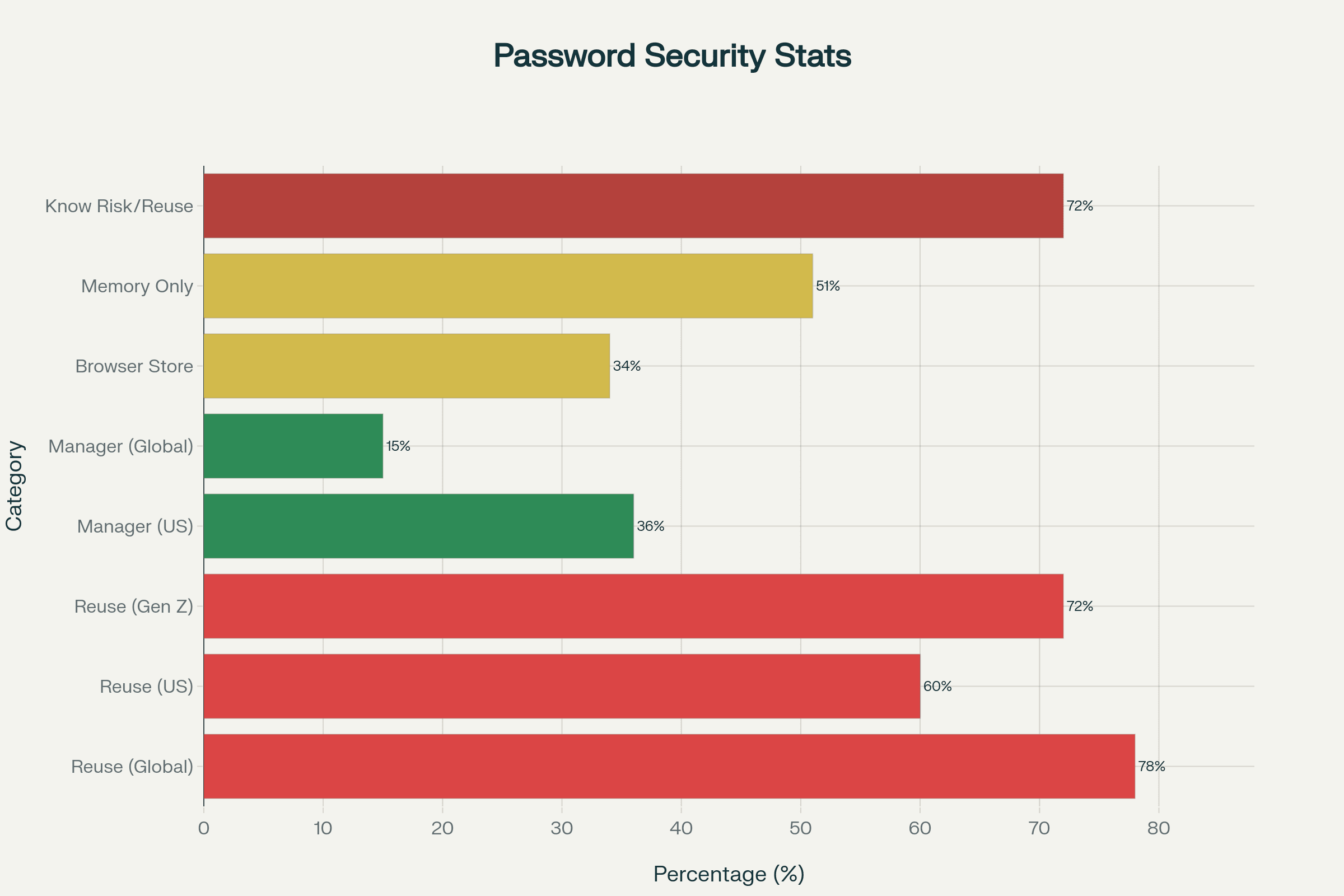
Password security behaviors: the gap between knowledge and practice
The anatomy of digital recklessness: understanding password reuse statistics
The scale of the problem
The statistics surrounding password reuse paint a deeply troubling picture of widespread security negligence. Research conducted across multiple demographics reveals that 60% of Americans reuse passwords, with this figure rising to an alarming 84% when examining global admission rates. Perhaps most concerning is the generational divide: 72% of Generation Z users reuse passwords despite being the first generation to grow up entirely in the digital age. This demographic paradox challenges conventional wisdom about digital nativity translating to security consciousness.
The methodology behind these password reuse statistics involves comprehensive surveys spanning multiple countries and demographics. For instance, the UK’s recent cybersecurity survey found that over six million people use a single password for all their accounts, representing 12.45% of the population. When extrapolated, nearly 80% of respondents admitted to reusing passwords in some form, with 36.23% using only one to three different passwords for all their online platforms.
Consider Marcus, a 28-year-old marketing professional who lost £12,000 when hackers accessed his cryptocurrency wallet in October 2025. The attackers used credentials stolen from an unrelated fitness app breach two years earlier. Marcus had used the same email and password combination across 47 different services. “I’m in tech marketing,” he later reflected. “I write about digital innovation for a living. The irony isn’t lost on me that I couldn’t be bothered to create unique passwords.”
These real-world consequences of weak password habits underscore why people reuse passwords despite knowing better. The gap between understanding and action reveals deeper issues than simple carelessness.
The generational security paradox
Perhaps most perplexing is the behaviour of younger generations, who demonstrate a profound awareness-action gap. Despite 79% of Generation Z respondents believing that password reuse is risky, 72% continue to engage in this very behaviour. This contradiction extends to their response patterns following data breaches: 59% of Gen Z reuse existing passwords when updating accounts after a company experiences a breach, compared to only 23% of Baby Boomers.
The psychological underpinnings of password security behaviors become clearer when examining password fatigue among digital natives. 35% of Gen Z respondents revealed they never or rarely update passwords after a data breach, with only 10% reporting they always update compromised passwords. When prompted to update login credentials, 38% of Gen Z and 31% of Millennials only change a single character or simply recycle an existing password.
This pattern reflects what cybersecurity researchers call “security fatigue,” where the constant barrage of security requirements leads to worse rather than better practices. Young adults average 118 online accounts each, creating an overwhelming cognitive burden that makes digital security negligence almost inevitable without proper tools.
Browser password manager risks: the illusion of security
The false security of convenience
Browser-based password storage represents a particularly insidious form of online security negligence, combining the veneer of security with fundamental vulnerabilities that most users neither understand nor consider. 34% of Americans store passwords in their browsers, often believing this represents a secure solution. However, security researchers consistently warn that browser password managers lack the robust encryption methods found in dedicated solutions.
The technical vulnerabilities of browser password storage are manifold. Malware attacks can easily extract saved passwords from browsers, as these credentials are often stored in easily accessible formats. The Redline Stealer malware, active since 2020, specifically targets browser-stored passwords, enabling cybercriminals to sell these credentials on the dark web. More concerning, browser password managers frequently remain logged in, meaning anyone with physical access to a device can view stored credentials in plain text.
The October 2025 corporate espionage case involving a London fintech startup illustrated these browser password manager risks dramatically. An employee’s laptop was stolen from a coffee shop, and within hours, hackers had accessed the company’s AWS infrastructure, client databases, and financial systems. All passwords were stored in Chrome’s built-in manager, protected only by the laptop’s sleep password. The breach cost the company £2.3 million in emergency security measures and lost contracts.
The shared device vulnerability
The risks associated with browser password storage are amplified in shared environments. 68% of companies reported having no training programmes for cybersecurity awareness, leaving employees vulnerable to simple access-based attacks. When browsers remain logged in, any individual accessing the device can navigate to password repositories and extract credentials without additional authentication.
The enterprise implications are particularly severe, as IT administrators have no visibility into which corporate passwords employees have stored in browsers. This creates significant challenges during employee offboarding, as determining which passwords require changing becomes nearly impossible. Since most data breaches are linked to poorly managed passwords, companies increasingly recognise that browser storage represents an unacceptable security risk.
Even in home environments, shared devices create cascading vulnerabilities. Family members borrowing laptops, partners using each other’s tablets, or children accessing parent devices all represent potential security breaches when browser password managers store credentials without additional authentication layers.
The human factor in cybersecurity: psychology behind security negligence
Cognitive load and the convenience trade-off
The psychological foundations of online security negligence are deeply rooted in human cognitive limitations and behavioural economics. Research into password psychology reveals that cognitive load (the mental effort required to process information) plays a crucial role in security decision-making. When passwords require complex combinations of letters, numbers, and symbols, users’ brains struggle to remember them effectively. Most individuals can only retain 7 to 10 characters before memory becomes problematic.
This cognitive limitation creates what researchers term the security convenience tradeoff, where users consistently prioritise ease of use over protection. Think of it this way: your brain treats password creation like juggling. Adding one ball is manageable. Adding ten becomes impossible without dropping several. Each additional password requirement is another ball in the air.
A comprehensive study found that participants who reported more frequent memory failures in daily life created the weaker passwords, whilst those with higher need for cognition created stronger credentials. The implications extend beyond individual choice, representing a fundamental mismatch between human cognitive architecture and modern security requirements.
The average person now manages over 100 online accounts, each theoretically requiring a unique, complex password. Without assistance, this creates an impossible cognitive burden. It’s no surprise that when faced with this overwhelm, people default to patterns they can remember, even when they understand the risks.
Social proof and risk perception biases
Social proof bias significantly contributes to password sharing and reuse behaviours. Users justify risky practices by observing similar behaviours in their social circles. This psychological phenomenon creates a false sense of security, where widespread adoption of poor security practices reinforces their perceived acceptability. The bias is particularly dangerous because it operates below conscious awareness, making users believe that common practices are inherently safe.
When everyone at the office shares Netflix passwords, or friends casually mention using “Password123” variations, these observations normalize risky cybersecurity behavior. The thinking goes: “If everyone does it and nothing bad happens to them, it must be okay.”
Optimism bias represents another critical psychological factor. Individuals consistently believe they are less likely to experience negative outcomes than statistical reality suggests. This manifests in cybersecurity as the “it won’t happen to me” fallacy. Users acknowledge general risks whilst simultaneously believing their personal exposure is minimal. Research indicates that only 19.12% of users employ unique passwords for every account, suggesting that the vast majority operate under the assumption that their current practices are adequate.
This optimism bias security creates a dangerous feedback loop. Each day that passes without incident reinforces the belief that current practices are sufficient. The threat remains abstract and distant until the moment of breach, when suddenly the statistics become personal reality.
The authority and urgency exploitation
Cybercriminals increasingly exploit psychological vulnerabilities through sophisticated social engineering attacks. Business email compromise attacks have doubled in recent years, specifically because they leverage urgency and authority to bypass rational security considerations. These attacks avoid traditional malware signatures, instead relying on highly personalised information and psychological pressure to prompt immediate, unthinking responses.
The effectiveness of these attacks stems from their exploitation of natural human tendencies to comply with authority figures and respond quickly to urgent requests. 42% of organisations reported increases in phishing and social engineering attacks in 2024, with these methods proving more effective than technical exploitation. The success rate remains high because they target cognitive biases rather than technical vulnerabilities, making them particularly difficult to defend against through technological means alone.
The November 2025 university payroll scam exemplified this perfectly. Finance staff at three UK universities transferred over £890,000 to fraudsters who impersonated senior administrators via email. The messages appeared to come from vice-chancellors, used official letterhead formats, and demanded immediate wire transfers for “confidential acquisition opportunities.” The urgency bypassed normal verification procedures. Staff later described feeling they had no choice but to comply immediately when faced with apparent instructions from top leadership.
Understanding the cyber attack human factor means recognizing that these psychological vulnerabilities aren’t personal failures. They’re features of human cognition that attackers deliberately exploit.
The evolution of cyber threats versus public awareness
Accelerating attack sophistication
The disparity between evolving cyber threats and stagnant user behaviour has created an increasingly dangerous digital environment. 16 billion passwords were exposed in the largest data breach ever recorded in June 2025, demonstrating the massive scale of contemporary threats. This breach encompassed over 30 separate datasets from major services including Facebook, Google, Apple, GitHub, and Telegram, representing fresh credentials that could facilitate widespread account takeovers.
The sophistication of modern attacks extends beyond simple data collection. AI-powered phishing attacks increased by 180% in 2025, with artificial intelligence enabling highly personalised and convincing social engineering campaigns. 47% of organisations experienced deepfake attacks, whilst synthetic identity fraud now causes over 80% of new account fraud. These developments represent a fundamental shift in the threat landscape, where attackers leverage cutting-edge technology whilst defenders rely on users who demonstrate persistent security negligence.
Recent months have seen particularly notable incidents. The August 2025 breach of a major European telecommunications provider exposed not just customer data but also real-time location tracking information for 23 million subscribers. September brought coordinated attacks against municipal water systems across five countries, with hackers gaining access through reused administrative passwords. October witnessed the first successful AI-generated deepfake voice attack on a banking security system, resulting in fraudulent transfers exceeding £7 million.
These 2025 cybersecurity statistics reveal acceleration in both frequency and sophistication. The cyber threat awareness gap continues widening as attacks evolve faster than defensive behaviours adapt.
The persistence of human error
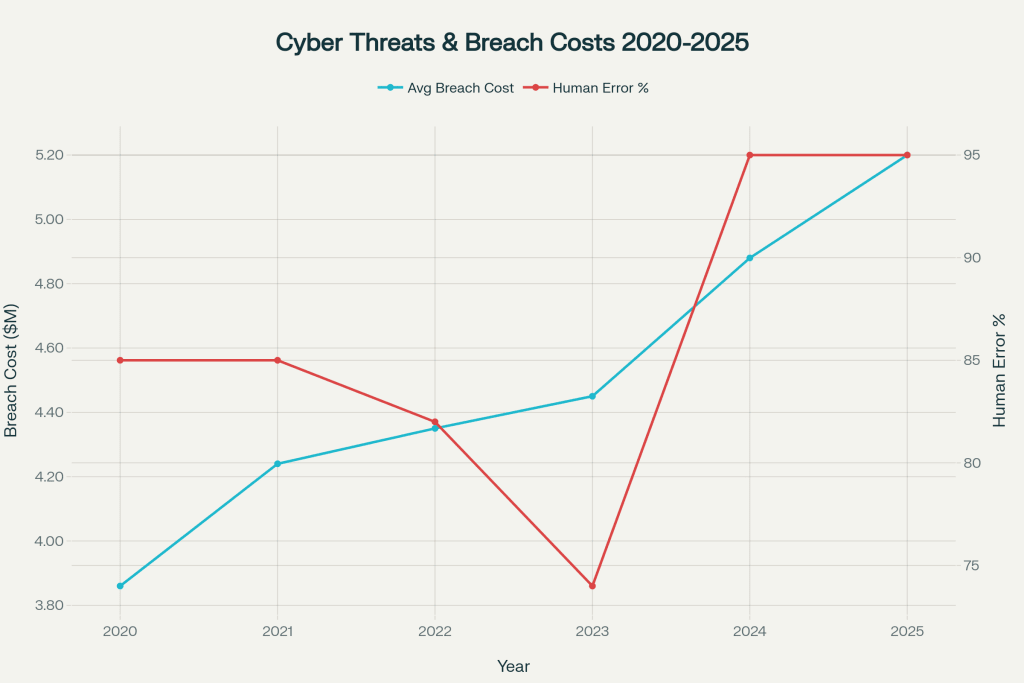
Despite technological advances, human error remains the dominant factor in cybersecurity incidents. 95% of data breaches involve human error according to multiple studies, with this percentage actually increasing from previous years. The annual cost of cybercrime is projected to reach $23 trillion by 2027, representing a 175% increase from 2022. These cybercrime cost 2027 projections underscore how online security negligence continues to enable increasingly costly and damaging attacks.
The consistency of human error rates across different time periods and geographical regions suggests that current awareness campaigns and training programmes are fundamentally inadequate. 74% of organisations lack cybersecurity training programmes, whilst 68% believe no training is needed. This institutional negligence compounds individual carelessness, creating environments where security breaches are statistically inevitable rather than merely possible.
What makes this persistence particularly troubling is that it occurs despite massive investments in cybersecurity infrastructure. Companies spend billions on firewalls, intrusion detection systems, and advanced threat monitoring. Yet a single employee clicking a phishing link or reusing a password can render these investments meaningless. The weakest link isn’t technical anymore. It’s human.
Geographic and sectoral variations
Analysis of regional data breach statistics reveals significant variations in both threat exposure and security consciousness. 50% of UK businesses experienced cyber attacks or security breaches in the previous 12 months, representing an increase from 39% in 2022. However, awareness of government cybersecurity initiatives has steadily declined, with only 24% of micro businesses aware of the Cyber Aware campaign, down from 34% in 2021.
The sectoral analysis reveals particular vulnerabilities in specific industries. Healthcare and financial services face disproportionately high attack rates, with 31.6% of surveyed companies experiencing ransomware attacks. The energy sector accounts for 20.5% of cybersecurity professionals, suggesting concentrated expertise in critical infrastructure protection, yet widespread vulnerabilities persist across other sectors.
North American organizations report 67% higher spending on cybersecurity per employee compared to European counterparts, yet breach rates remain similar. This suggests that spending alone doesn’t solve the human factor problem. Asian markets show the fastest growth in password manager adoption rates, increasing 23% year over year, potentially driven by higher rates of mobile-first internet usage where integrated security tools are more seamless.
The retail sector experienced particularly dramatic increases in credential stuffing attacks during Q4 2025, with the holiday shopping season seeing a 340% spike in automated login attempts using previously breached passwords. This seasonal variation highlights how attackers strategically exploit periods when transaction volumes are high and security vigilance may be lower.
Password manager adoption versus password reuse: the statistical reality
Market penetration and user behaviour
The password manager market presents a complex picture of gradual growth against persistent user resistance. Only 36% of US adults use password managers, representing a mere 2% increase from the previous year. This modest growth contrasts sharply with the exponential increase in cyber threats and the well-documented risks of password reuse. The global situation appears even more concerning, with only 15% of users worldwide employing dedicated password managers.
These password manager usage rates reveal a troubling gap between available solutions and actual adoption. The tools exist. The technology works. The benefits are documented. Yet uptake remains stubbornly low, suggesting that technical solutions alone can’t solve behavioural problems.
Market analysis reveals interesting dynamics in password manager preferences. Google Password Manager dominates with 32% market share, followed by Apple’s iCloud Keychain at 23%. However, these built-in solutions often lack the robust security features of dedicated password managers, suggesting that even users who adopt password management tools may not be receiving optimal protection. LastPass maintains 11% market share despite well-publicised security breaches, whilst Bitwarden captures 10% of the market with its open-source approach.
The dominance of browser-integrated solutions reflects user preference for convenience over comprehensive security. People gravitate toward tools that require no additional download, installation, or learning curve. This creates a concerning dynamic where the most accessible password management options provide the least robust protection.
The economic perspective
The password management market demonstrates significant economic potential, valued at $2.74 billion in 2024 and projected to reach $9.01 billion by 2032, exhibiting a CAGR of 15.8%. This growth trajectory suggests increasing recognition of password security importance, yet password manager adoption rates remain disappointingly low. The disconnect between market growth and user adoption indicates that enterprise purchases may be driving expansion rather than individual consumer behaviour change.
Regional analysis reveals that North America dominates the password management market with 33.58% share, despite representing a smaller portion of global internet users. This suggests that economic development correlates with security tool adoption, potentially creating a digital divide where users in developing markets face disproportionate risks due to limited access to security solutions.
The pricing dynamics also reveal interesting patterns. Free password managers see 8 times higher adoption than premium versions, even though premium options typically offer crucial features like breach monitoring, secure file storage, and priority support. Users demonstrate willingness to adopt security tools, but only when cost isn’t a barrier. This suggests that subsidized or freely available robust password managers might dramatically increase secure password practices across populations.
Enterprise licensing represents the fastest-growing segment, with B2B sales growing 34% annually compared to 12% growth in consumer markets. Organizations increasingly view password manager benefits as essential infrastructure rather than optional security additions, driven partly by cyber insurance requirements that mandate documented password policies.
The browser dependency problem
User reliance on browser-based password storage represents a significant challenge to proper password management adoption. 51% of users rely on memory for password management, whilst 34% store passwords in browsers. These figures indicate that the vast majority of users employ insecure methods for credential management, either through biological limitations (memory) or technically vulnerable solutions (browser storage).
The preference for browser storage stems from its seamless integration and zero-cost accessibility, yet security researchers consistently warn about its limitations. Browser password managers only work within specific browsers, creating portability issues that discourage users from maintaining consistent security practices across devices and platforms. Furthermore, browsers weren’t designed as password managers, meaning their security features often lag behind dedicated solutions.
This browser dependency creates several cascading problems. Users become locked into specific ecosystems, making it difficult to switch browsers even when better options emerge. Password data becomes fragmented across different browsers on different devices, encouraging users to simplify by reusing the same passwords everywhere. The lack of advanced features like password strength analysis or breach monitoring means users receive no feedback about weak or compromised credentials.
Mobile usage patterns further complicate this landscape. Users frequently switch between apps and mobile browsers, creating friction in password access that encourages either extremely simple passwords or reuse across platforms. The small screen size makes manually entering complex passwords particularly frustrating, increasing the appeal of biometric authentication or password reuse as workarounds.
The psychological barriers to proper security behaviour
Understanding user motivations
Research into password psychology reveals complex motivations behind security decision-making that extend far beyond simple convenience preferences. Studies examining personality factors in password security behaviours found that individuals with higher levels of conscientiousness and emotional stability create stronger passwords. Conversely, those reporting frequent memory failures create weaker passwords, suggesting that cognitive limitations directly impact security choices.
The role of social proof in security behaviour cannot be understated. Password sharing behaviours often stem from social pressure rather than individual choice. Users compromise security to appease colleagues or friends. This dynamic creates cascading security vulnerabilities where poor practices spread through social networks, making individual security choices dependent on group behaviour patterns.
Personal values also shape security behaviors in unexpected ways. Users who prioritize efficiency and productivity may view security measures as obstacles to overcome rather than protections to embrace. Those with higher trust in technology companies may believe that platforms will protect them, reducing personal vigilance. Privacy-conscious individuals paradoxically sometimes resist password managers due to concerns about centralized credential storage, even though this stance leads to less secure alternatives.
The emotional dimension matters too. Security fatigue is real and measurable. Each password reset, each security prompt, each authentication step depletes mental resources. Over time, this leads to worse decision-making, shortcuts, and ultimately the very vulnerabilities these measures aimed to prevent.
The knowledge-action gap
Perhaps most concerning is the documented gap between security knowledge and actual behaviour. Research consistently shows that users are generally aware of good cybersecurity practices yet continue to engage in risky behaviours. This knowledge-action gap suggests that education alone is insufficient to drive behaviour change, requiring interventions that address psychological and practical barriers to secure practices.
86% of employees claim they could confidently identify phishing emails, yet nearly 50% admit to falling for scams. This overconfidence bias compounds security risks by creating false assurance about personal capabilities whilst simultaneously demonstrating actual vulnerabilities. The phenomenon extends to password management, where users acknowledge reuse risks whilst continuing to engage in precisely these behaviours.
This disconnect reveals a fundamental truth about cybersecurity behavior: knowing what to do and actually doing it are entirely different challenges. Information campaigns increase knowledge but rarely change habits. Users can recite security best practices whilst simultaneously violating every principle they’ve just explained. The gap between stated intentions and actual behaviors suggests that motivation and capability are only part of the equation. Context, friction, and competing priorities all influence whether knowledge translates into action.
Understanding why people reuse passwords despite knowing the risks requires examining this gap honestly. It’s not stupidity or carelessness. It’s the collision between theoretical understanding and practical reality, where immediate convenience consistently defeats future security concerns.
Cognitive biases and security decision-making
Cognitive biases systematically distort security decision-making in ways that favour convenience over protection. Present bias leads users to prioritise immediate convenience over future security benefits. The mental calculation goes something like: “This will save me 30 seconds now versus potentially preventing a problem that might never happen.” The immediate reward wins.
Probability neglect causes underestimation of cyber attack likelihood. People struggle to conceptualize low-probability, high-impact risks. A 5% annual chance of account compromise seems negligible, even though over a decade it becomes nearly 50%. These biases operate below conscious awareness, making them particularly difficult to address through traditional awareness campaigns.
Optimism bias manifests as the belief that negative outcomes will happen to others rather than oneself, leading to inadequate personal security investments. Combined with social proof bias, where users justify risky behaviours by observing similar practices in others, these psychological factors create powerful resistance to security behaviour change.
The availability heuristic also plays a role. People judge the likelihood of events based on how easily examples come to mind. If you don’t personally know anyone who’s experienced a serious breach, you underestimate the threat. The friend who had their Instagram hacked but recovered it within a day reinforces the belief that breaches are inconvenient rather than catastrophic, even though your financial accounts face very different consequences.
Status quo bias makes changing existing practices feel harder than maintaining them, even when current approaches are objectively inferior. The effort required to set up a password manager, migrate passwords, and learn new workflows feels overwhelming compared to continuing with familiar (if insecure) methods.
Industry response and market dynamics
The password manager industry evolution
The password manager industry has evolved significantly in response to growing security threats, yet adoption rates remain frustratingly low. Market consolidation has seen Google and Apple capture over 55% of the market, leveraging their platform integration advantages. However, this dominance raises concerns about vendor lock-in and single points of failure, particularly given that browser-based solutions often lack advanced security features.
Dedicated password manager providers face significant challenges in competing with integrated solutions. LastPass, despite security breaches in 2022 that exposed encrypted password vaults, maintains significant market share, suggesting that user inertia outweighs security considerations in provider selection. Meanwhile, open-source solutions like Bitwarden grow steadily but remain niche, indicating that technical merit alone doesn’t drive mainstream adoption.
The industry has responded with innovation in several areas. Biometric integration has become standard, reducing friction in password access. Cross-platform synchronization has improved dramatically, addressing earlier complaints about portability. Password strength analysis and breach monitoring now provide proactive security alerts. Family sharing plans make password managers more practical for households. Yet despite these improvements, the fundamental adoption challenge remains.
Emerging players are experimenting with new approaches. Some offer gamified security training within password management apps. Others provide simplified onboarding processes that import existing passwords from browsers automatically. A few have introduced AI-powered security assistants that provide contextual guidance about password health and breach risks.
Corporate versus consumer adoption patterns
Enterprise adoption of password management tools significantly outpaces consumer uptake, driven by regulatory requirements and risk management priorities. 76% of companies rely on traditional password authentication rather than alternatives, yet enterprise password manager deployment is becoming increasingly common. This disparity suggests that institutional pressure and professional consequences drive security behaviour more effectively than personal risk awareness.
Cost-benefit analysis in enterprise environments favours password manager deployment due to quantifiable risk reduction and compliance benefits. However, individual consumers often perceive password managers as unnecessary complexity rather than essential security tools, highlighting the need for different messaging strategies across market segments.
Corporate environments benefit from IT support, mandatory usage policies, and integration with single sign-on systems. Employees don’t choose whether to use password managers; the decision is made at the organizational level. This removes the adoption barrier entirely, demonstrating that when security tools become mandatory rather than optional, usage skyrockets.
Consumer markets lack these forcing functions. Users must self-motivate to research options, choose providers, set up accounts, and migrate existing passwords. Each step represents a potential dropout point. The voluntary nature of consumer adoption means convenience and ease of use matter far more than in enterprise contexts where compliance drives behavior.
Regulatory and compliance drivers
Regulatory pressure increasingly mandates robust password management across multiple jurisdictions. GDPR and similar privacy regulations create financial incentives for proper credential management, whilst industry-specific compliance requirements drive enterprise adoption. However, regulatory frameworks often lag behind technological developments, creating gaps where emerging threats aren’t adequately addressed.
Data breach notification requirements have increased visibility of password-related incidents, potentially driving some adoption growth. The average cost of £3.8 million per breach creates compelling economic arguments for preventive investments. Yet regulatory compliance often focuses on institutional rather than individual behaviour, limiting its effectiveness in driving consumer-level security improvements.
Cyber insurance requirements are emerging as a powerful driver of security tool adoption. Insurers increasingly require documented password policies, multi-factor authentication deployment, and employee security training as conditions for coverage or premium reductions. Organizations that can demonstrate strong password management practices receive better rates and terms, creating direct financial incentives for adoption.
The regulatory landscape varies dramatically by region and industry. Financial services face the strictest requirements, with regulations like PSD2 in Europe mandating strong customer authentication. Healthcare providers must comply with HIPAA in the US or similar health data protection laws elsewhere. Critical infrastructure operators face sector-specific mandates. Yet consumer-facing websites and services often operate with minimal security requirements, creating inconsistent protection across the digital ecosystem.
The path forward: addressing online security negligence
Technological solutions and user experience design
Addressing online security negligence requires fundamental reconsideration of how security tools integrate with user workflows and cognitive limitations. Passwordless authentication technologies show promise in eliminating traditional password vulnerabilities, yet adoption remains limited due to infrastructure requirements and user familiarity preferences. FIDO2 and WebAuthn standards offer robust alternatives, but implementation complexity continues to hinder widespread deployment.
User experience design plays a crucial role in security tool adoption. Password managers with seamless integration and minimal cognitive load demonstrate higher adoption rates than complex solutions requiring significant behaviour change. Auto-fill functionality and cross-platform synchronisation address practical barriers, whilst zero-knowledge architectures provide security assurance for privacy-conscious users.
The future likely involves hybrid approaches. Passkeys combine the security of public-key cryptography with the convenience of biometric authentication, offering what researchers call “unphishable” credentials. Major platforms including Google, Apple, and Microsoft have committed to passkey support, potentially accelerating adoption through ecosystem integration.
Device-based authentication represents another promising direction. Instead of memorizing passwords, users authenticate through trusted devices that handle cryptographic operations automatically. This approach maintains security while reducing cognitive load to effectively zero. The challenge lies in backup and recovery procedures when devices are lost or replaced.
Continuous authentication systems that monitor behavioral patterns and contextual signals may eventually supplement or replace discrete login events. These systems assess ongoing risk levels based on factors like location, device, typing patterns, and usage behaviors, requesting additional verification only when anomalies appear.
Educational and behavioural interventions
Traditional cybersecurity awareness training shows limited effectiveness in driving behaviour change, with 68% of companies believing no training is needed. Gamification and interactive learning approaches demonstrate more promising results, yet sustained behaviour change requires ongoing reinforcement rather than one-time interventions. Social engineering simulation and phishing testing can raise awareness, but must be coupled with practical skill development.
Behavioural economics insights suggest that default settings and choice architecture influence security decisions more effectively than education alone. Making secure options the default choice whilst preserving user autonomy can drive adoption without requiring conscious behaviour change. Time-based interventions that introduce artificial delays before risky actions can also interrupt automatic behaviours and prompt security considerations.
The most effective cybersecurity best practices training combines several elements. Realistic simulations that let employees experience consequences in safe environments prove more memorable than abstract presentations. Personalized feedback showing individuals their specific vulnerabilities creates motivation for improvement. Social learning approaches that leverage peer influence and team competitions harness social proof bias positively rather than allowing it to reinforce bad habits.
Microlearning modules delivered in short, frequent doses maintain engagement better than annual marathon training sessions. Just-in-time guidance that appears at decision points (like password creation) provides contextual learning when motivation is highest. Positive reinforcement for secure behaviors proves more effective than punishment for violations, particularly when building new habits.
Systemic and infrastructure approaches
System-level interventions may prove more effective than individual behaviour change in addressing online security negligence. Mandatory password manager integration in operating systems and browsers could eliminate user choice whilst maintaining security benefits. Industry standards requiring secure-by-default configurations would shift responsibility from users to system designers.
Public-private partnerships in cybersecurity education and tool development could address market failures in security provision. Government subsidisation of password management tools or tax incentives for security software could overcome economic barriers to adoption. International cooperation on cybersecurity standards might create consistent requirements across jurisdictions, preventing regulatory arbitrage.
Infrastructure-level changes could include mandated multi-factor authentication for financial transactions above certain thresholds, required secure password practices for any service handling sensitive data, or standardized breach notification protocols that ensure users receive timely, actionable information about compromised credentials.
Platform responsibility represents another systemic approach. Rather than placing security burden entirely on users, platforms could implement graduated authentication requirements based on action sensitivity. Low-risk activities might require minimal authentication, whilst high-risk actions like large transfers or account changes demand additional verification. This right-sizes security friction to actual risk.
Collective defense mechanisms show promise too. Shared threat intelligence allows platforms to identify credential stuffing attacks and compromised passwords before users even know there’s a problem. When one service detects a breach, others can proactively prompt users to change passwords. This networked approach provides protection beyond what individuals could achieve alone.
Conclusion: bridging the security-behaviour divide
The persistence of online security negligence despite escalating cyber threats represents one of the most significant challenges facing our digital society. With 95% of cybersecurity incidents involving human error and 78% of users admitting to password reuse, the gap between technological capability and human behaviour continues to widen. The projected $23 trillion annual cost of cybercrime by 2027 underscores the urgent need for effective interventions that address psychological, technical, and systemic barriers to security behaviour change.
The evidence overwhelmingly demonstrates that education alone is insufficient to drive widespread adoption of secure password practices. Despite 79% of Generation Z understanding that password reuse is risky, 72% continue to engage in this behaviour. This knowledge-action gap reveals the limitations of awareness-based approaches and highlights the need for solutions that work within human cognitive constraints rather than against them.
Browser password manager risks and the dominance of Google and Apple in the password management market suggest that convenience will always triumph over security in user decision-making. However, this presents an opportunity: by making secure tools as convenient as insecure alternatives, we can harness user preferences for ease of use whilst delivering robust protection. Zero-knowledge password managers with seamless cross-platform integration represent the technical path forward.
The multi-factor authentication rollout across major platforms demonstrates that when security measures integrate smoothly into existing workflows, users adapt without significant resistance. The challenge lies not in user stubbornness but in friction-filled implementation that makes security feel like a burden rather than a benefit.
The human factor in cybersecurity will remain the critical vulnerability until we acknowledge that security is fundamentally a design problem rather than a user problem. Social engineering attacks succeed because they exploit natural human psychology, whilst password reuse occurs because secure alternatives impose excessive cognitive load. Addressing online security negligence requires systemic solutions that make security the path of least resistance rather than an additional burden.
Real progress demands we stop blaming users for behaving predictably human and start designing systems that accommodate rather than fight human nature. The password manager benefits are clear: encryption protects credentials, unique passwords prevent cascade failures, phishing protection reduces social engineering success, reduced keylogger exposure limits credential theft, zero-knowledge architecture ensures privacy, and secure sharing enables collaboration without compromise.
Ultimately, the battle against online security negligence will be won not through changing human nature, but through designing systems that work with human psychology rather than against it. Password managers, multi-factor authentication, and passwordless technologies provide the technical foundation. Behavioural design, regulatory frameworks, and default security configurations offer the systemic interventions. Social proof, authority, and convenience can be harnessed to promote security rather than undermine it.
The stakes could not be higher. As cyber threats evolve and digitalisation deepens, the cost of online security negligence will continue to escalate. The choice before us is clear: we can continue lamenting human security behaviour whilst attacks grow more sophisticated and costly, or we can acknowledge human limitations and design security solutions that embrace rather than resist our psychological realities. The technology exists. The knowledge is available. What remains is the will to implement systemic change that treats security as a shared responsibility rather than an individual failing.
This article reflects cybersecurity statistics and trends through October 2025. Given the rapidly evolving nature of cyber threats and security practices, readers should verify specific statistics and recommendations against current sources.


