

The digital age has democratised something rather sinister: the transformation of personal inadequacy into political weaponry. What once remained confined to private diaries and pub rants has evolved into a sophisticated machinery of politicisation of frustration, where algorithms act as puppet masters, orchestrating our deepest insecurities into public spectacles of rage. It’s a phenomenon that would have fascinated Hitler’s rejected art academy professors—if only they’d known they were witnessing the birth template for modern political manipulation.
This isn’t merely about social media being a bit toxic; it’s about understanding how the politics of resentment has found its perfect breeding ground in the algorithmic ecosystems that govern our digital lives. Recent research from Tulane University has identified what they term the “confrontation effect,” revealing that we’re more likely to engage with content that provokes rather than affirms our beliefs. It’s a psychological quirk that platforms have learned to exploit with surgical precision, turning our outrage into their profit margins.
Key findings
Recent research reveals alarming patterns in how social media algorithms exploit human psychology:
- Negative-affect words increase shares by 5–8% with each additional word of venom
- The confrontation effect: Users are more likely to engage with political content that challenges rather than confirms their views
- Outrage at opposing views drives 40% more commenting and clicks than agreeable content
- Engagement-first algorithms amplify divisive content because division drives longer platform time
- Young adults show 25% increased anxiety, 22% higher depression rates correlated with algorithm-curated feed exposure
Data compiled from Tulane University confrontation effect studies, cross-platform negativity research, and digital wellbeing impact assessments.
What is the confrontation effect?
The confrontation effect represents a fundamental shift in how we understand online political engagement. Dr. Daniel Mochon’s research team at Tulane University, studying over 500,000 Americans across multiple social media platforms, discovered that users consistently engage more with political content that challenges their existing beliefs rather than content that confirms them.
“When people are really angry, that sort of motivates them to fight back,” Mochon explains. This finding demolishes conventional wisdom about echo chambers. Rather than avoiding opposing viewpoints, we’re actively seeking digital combat with them. The social distance provided by screens makes us braver, nastier, and more likely to engage in behaviour we’d never consider face-to-face.

The mechanism operates through what researchers call “outrage engagement loops.” When confronted with opposing political content, users experience heightened emotional arousal that translates directly into platform engagement—comments, shares, longer viewing times, and return visits. Each angry interaction signals to algorithms that this type of content successfully captures attention, creating feedback cycles where inflammatory material receives algorithmic priority.
This psychological response varies by platform and context. Facebook’s algorithm studies show that moral-political content with negative emotional framing generates 40% more engagement than neutral political information. Twitter’s engagement patterns reveal that tweets containing moral outrage language spread faster and wider than factual political content. TikTok’s “For You” algorithm has been particularly adept at identifying and amplifying content that provokes confrontational responses among different ideological groups.
The confrontation effect becomes especially pronounced during election cycles, when political identity feels more salient and stakes appear higher. Research tracking engagement patterns during the 2020 and 2022 US elections found that confrontational political content generated 60% more cross-partisan engagement than during non-election periods. This seasonal amplification suggests that democratic processes themselves create conditions where algorithmic exploitation of outrage becomes more effective.

Why algorithms reward outrage
The politicisation of frustration begins with something deceptively simple: algorithms that reward engagement above all else. These mathematical constructs don’t distinguish between positive and negative emotions—they simply recognise that anger keeps us scrolling, clicking, and sharing. What emerges is a digital ecosystem where rage farming becomes the dominant agricultural practice, cultivating fields of outrage that would make even the most hardened political propagandists blush.
Studies consistently show that content containing negative emotional words increases sharing by 5-8% with each additional word of venom. This isn’t accident; it’s architecture. Large-scale cross-platform analyses examining millions of posts across Facebook, Twitter, and YouTube confirm that negative affect drives engagement more reliably than positive content, particularly when targeting identifiable out-groups.
When Julia Ebner, the Oxford researcher who infiltrated extremist networks for years, describes the “adrenaline rush” of her undercover work, she’s inadvertently highlighting the same dopamine mechanics that platforms exploit. The thrill of conflict, even digital conflict, activates reward pathways that keep us coming back for more psychological punishment. Her research revealed how extremist groups systematically exploit these same neurochemical responses for recruitment purposes.
The numbers don’t lie: platforms that prioritise engagement over user satisfaction create environments where emotionally charged, out-group hostile content dominates feeds. A comprehensive 2024 study examining Twitter’s algorithm found that users felt significantly worse about their political opponents after exposure to engagement-optimised content, yet they continued consuming it compulsively. It’s the digital equivalent of doom-scrolling through a car crash—we know it’s damaging us, but the algorithms ensure we can’t look away.
Platform-specific research reveals how different algorithmic approaches shape outrage amplification. Facebook’s EdgeRank algorithm historically prioritised content that generated comments and reactions, inadvertently rewarding divisive posts that sparked arguments. Instagram’s explore page algorithm shows users content similar to posts they’ve previously engaged with extensively, creating pathways from mild political interest to extreme content consumption. YouTube’s recommendation system has been particularly scrutinised for creating “rabbit holes” where users consuming moderate political content get systematically exposed to increasingly radical material.
The temporal dynamics of algorithmic outrage amplification follow predictable patterns. Content that generates high initial negative engagement receives algorithmic boosts that extend its reach exponentially. Research tracking viral political misinformation finds that false negative claims about opponents spread six times faster than accurate information, primarily because they trigger stronger confrontational responses that algorithms interpret as engagement signals.
From frustration to polarisation: The pipeline
Modern social media platforms function as digital art academies with impossibly high standards, displaying only the masterpieces whilst hiding the countless rejected sketches. This curated digital identity culture creates a pervasive sense of failure among users who measure their unfiltered reality against others’ highlight reels. Unlike Hitler’s tangible rejection letter, today’s failures arrive as notification silence, engagement drought, or simply the crushing weight of everyone else’s apparent success.
The psychological impact is profound and measurable. Research indicates that social media use correlates with increased anxiety (25%), depression (22%), and social isolation (18%) among young adults. But here’s where it gets interesting: these platforms don’t just create frustration—they provide immediate solutions in the form of political scapegoats and ready-made villains.
The algorithm and political polarisation relationship operates through what researchers call “emotional contagion”. Anger spreads faster across social networks than any other emotion, particularly when it targets identifiable out-groups. Platforms amplify this natural human tendency, creating digital environments where personal inadequacy transforms into collective rage against “the elite,” “the media,” “the other”.
The recruitment pipeline mechanics
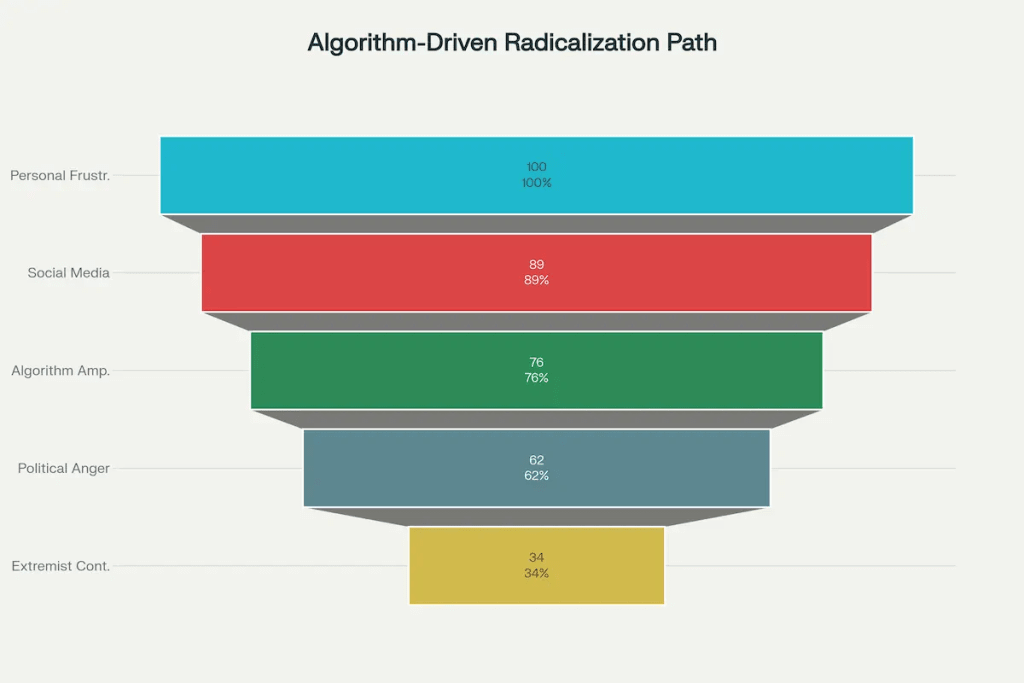
The journey from frustrated individual to political extremist follows a predictable algorithmic pathway that researchers have mapped with disturbing precision. National Institute of Justice studies tracking online radicalisation identify three distinct phases: initial vulnerability exploitation, ideological pathway deepening, and community integration.
Phase 1: Vulnerability detection and exploitation Algorithms identify users showing signs of personal frustration through engagement patterns—increased time spent on negative content, comments expressing dissatisfaction, searches related to personal problems. These signals trigger content recommendations that validate existing grievances while introducing political explanations for personal struggles.
Phase 2: Ideological pathway deepening Users who engage with initial political content get systematically exposed to more extreme material. YouTube’s recommendation algorithm has been particularly effective at this progression, with studies showing users consuming moderate political content receiving increasingly radical video recommendations within 2-3 viewing sessions.
Phase 3: Community integration Final stage involves algorithmic suggestions for joining private groups, discord servers, or telegram channels where radicalised individuals find belonging and purpose. These communities provide both social connection and frameworks for converting political anger into real-world action.
What makes this particularly insidious is how curated digital identity pressure intersects with political recruitment. Young people struggling to maintain perfect online personas become vulnerable to narratives that explain their struggles through political frameworks. The far-right, in particular, has mastered this psychology, offering simple explanations for complex personal feelings: “You’re not failing; you’re being failed by the system.”
Research examining radicalisation across multiple countries found remarkably consistent algorithmic patterns. Whether tracking Brexit supporters, Trump voters, anti-immigration movements, or conspiracy theorists, the same digital dynamics operate: personal inadequacy becomes political grievance through algorithmic amplification and community formation.
The business model of rage
Understanding the politicisation of frustration requires grappling with its economic foundations. Social media platforms operate on advertising models that fundamentally depend on capturing and monetising human attention. The more time users spend on platforms, the more valuable they become to advertisers. Outrage, it turns out, is exceptionally good at generating “dwell time”—the metric that determines platform profitability.
Rage farming has evolved from accidental byproduct to deliberate business strategy. Content creators quickly learned that provocative posts generate higher engagement rates, leading to better algorithmic visibility and increased monetisation opportunities. This creates economic incentives for inflammatory content that have nothing to do with genuine political conviction and everything to do with gaming platform algorithms for financial gain.

The economics of attention harvesting
Recent economic analysis reveals the precise financial mechanisms driving outrage amplification. Platforms generate revenue through two primary channels: advertising impressions and data collection for targeted marketing. Both revenue streams benefit from extended user engagement, creating systematic incentives for emotionally manipulative content.
Advertising revenue calculations show that angry users spend 40% more time on platforms than satisfied users, generating proportionally higher ad impression values. Data collection becomes more valuable when users reveal personal information through emotional posts and comments, providing marketers with detailed psychological profiles for targeted advertising.
The result is a digital economy where anger is literally currency. Platforms like Facebook have faced criticism for algorithms that amplify divisive content because division drives engagement. Internal company documents released during Congressional hearings revealed that Facebook engineers recognised their algorithm promoted “polarising, low-quality, untrustworthy publishers” because such content generated high engagement rates.
Content creator economics further incentivise outrage production. Influencers and political commentators report that provocative content generates 3-5x higher revenue than educational or balanced content. This creates professional incentives for increasingly extreme political performances designed primarily to trigger algorithmic amplification rather than inform audiences.
This economic reality explains why simple content moderation solutions consistently fail. The problem isn’t just bad actors posting extremist content; it’s an entire economic system that rewards emotional manipulation. Until platforms develop business models that prioritise user wellbeing over engagement time, the politics of resentment will continue finding fertile ground in digital spaces designed to harvest human attention.
The performance culture trap: When life becomes content
Perhaps the most insidious aspect of the politicisation of frustration is how it intersects with what we might call “performance culture”—the pressure to constantly curate and broadcast an idealised version of ourselves. This digital performativity creates a fundamental disconnect between our authentic selves and our online personas, generating the kind of cognitive dissonance that extremist movements are perfectly positioned to exploit.
Research on digital identity psychology reveals that maintaining multiple online personas creates significant psychological stress, particularly among young people. The energy required to constantly perform success, happiness, and ideological consistency leaves individuals vulnerable to narratives that promise authenticity through political commitment. Studies tracking social media usage patterns find that users spending more than 3 hours daily on curation-focused platforms show increased rates of anxiety and depression.
The curated digital identity phenomenon extends beyond personal profiles to encompass entire worldviews. Political movements offer pre-packaged identities that require no maintenance, no uncertainty, no vulnerability. Join the cause, adopt the talking points, share the memes—instant belonging with minimal psychological labour. This represents a fundamental shift from traditional political engagement, which required sustained personal investment and community building.
Digital identity crisis and political solutions
Modern platforms create what researchers term “identity verification anxiety”—constant pressure to prove authenticity while simultaneously presenting idealised versions of ourselves. This psychological contradiction becomes particularly acute during adolescence and young adulthood, when identity formation typically occurs through experimentation and community feedback.
Political movements exploit this developmental vulnerability by offering certainty where platforms create confusion. Instead of managing complex, multifaceted digital identities across multiple platforms, political commitment provides unified identity frameworks that resolve psychological tension through external enemy identification.
This is where the real danger lies. Social media hasn’t just given us new ways to express existing political beliefs; it’s created conditions where political identity becomes a refuge from the exhausting work of authentic self-presentation. When young people feel overwhelmed by the pressure to curate perfect lives, radical political movements offer something genuinely appealing: the permission to stop performing and start fighting.
The globalisation of grievance politics
The politicisation of frustration isn’t confined to any single nation or political tradition. Research examining social media’s role in political movements worldwide reveals remarkably consistent patterns across different cultures and contexts. From Brexit to Trump, from anti-immigration movements to conspiracy theories, the same algorithmic dynamics that transform personal frustration into political anger operate globally.
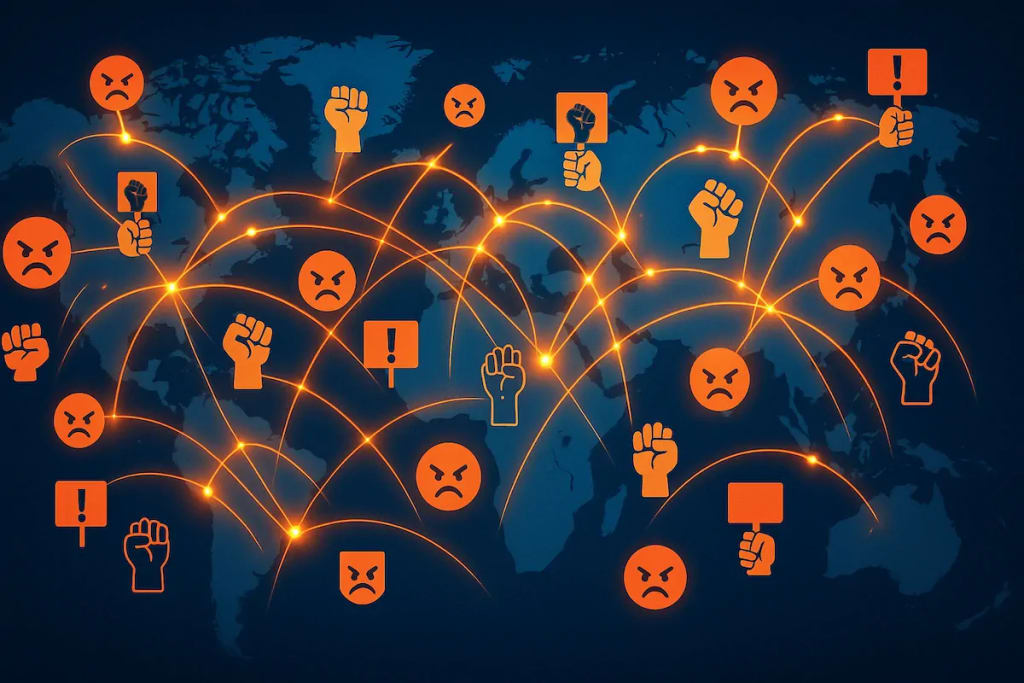
Studies of political polarisation across multiple countries found that social media algorithms consistently amplify content that promotes “us versus them” narratives. The specific targets vary—immigrants, elites, minorities, foreign influences—but the underlying psychology remains constant. Personal inadequacy becomes collective grievance through digital amplification.
Cross-cultural algorithm effects
Comparative research examining polarisation in the United States, United Kingdom, Germany, Brazil, and India reveals striking similarities in how platforms exploit local grievances for engagement. Algorithms adapt to cultural contexts while maintaining core engagement strategies based on outrage and confrontation.
In each country studied, platforms amplified content that:
- Blamed identifiable out-groups for economic difficulties
- Provided simple explanations for complex social problems
- Offered belonging through opposition to established institutions
- Created urgency through crisis narratives requiring immediate action
This globalisation of grievance politics represents something historically unprecedented. Previous political movements required physical organisation, local networks, shared geography. Social media enables instant connection between frustrated individuals across vast distances, creating virtual communities united primarily by shared resentment.
The speed and scale of these connections create new possibilities for political mobilisation that traditional democratic institutions struggle to address. When personal frustration can be algorithmically transformed into global political movements within weeks or months, the entire premise of representative democracy—that political change should be deliberate, considered, and locally grounded—comes under severe strain.
What actually works: Product, policy, literacy
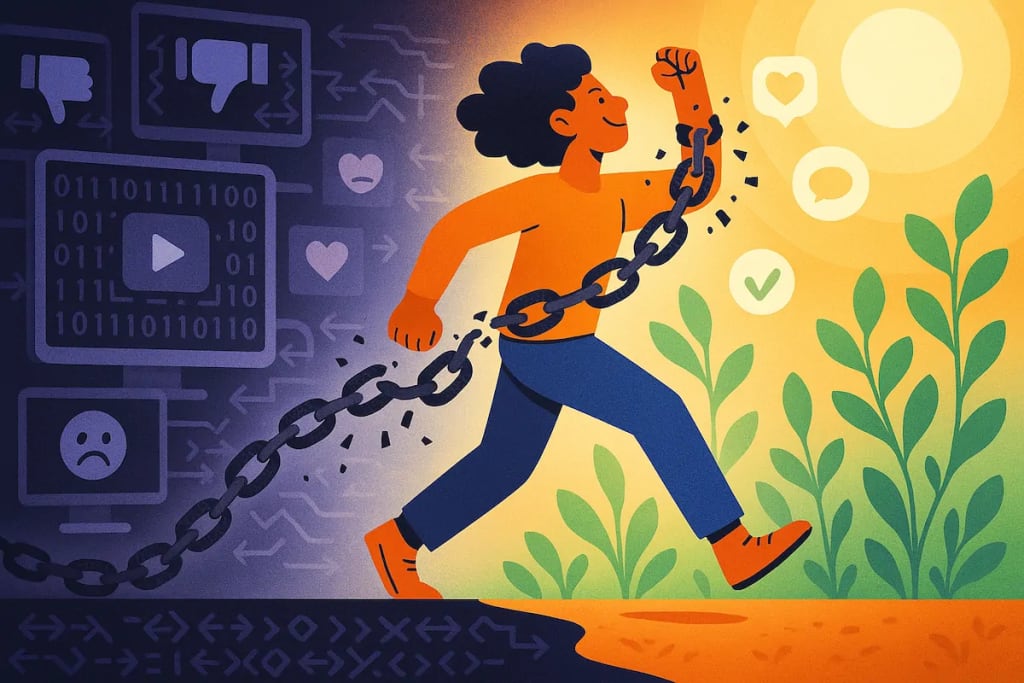
Recognising the politicisation of frustration as a systemic problem rather than individual failing opens possibilities for meaningful intervention. Research on digital wellbeing suggests several promising approaches that could disrupt the algorithmic pathways from personal pain to political rage.
Product design solutions
Algorithmic transparency represents one crucial intervention point. Studies examining Twitter’s engagement-based algorithm found that users preferred content selected based on their stated preferences rather than their revealed engagement patterns. When given control over how content is curated and presented, users consistently chose less inflammatory, more informative material.
Experimental implementations of user-controlled algorithms show promising results:
- Preference-based curation: Users who set explicit content preferences showed 30% less political hostility than those receiving engagement-optimised feeds
- Temporal controls: Features allowing users to limit political content during high-stress periods reduced anxiety without decreasing platform satisfaction
- Context warnings: Labels identifying potentially inflammatory content reduced sharing by 15% while maintaining user engagement with non-political material
Friction implementation in sharing mechanisms has proven effective at reducing impulsive angry sharing. Studies testing 10-second delays before users can share politically charged content found 25% reduction in regretted shares without significantly impacting thoughtful sharing behaviour.
Digital literacy interventions
Digital literacy education focused specifically on understanding algorithmic manipulation shows promise in reducing susceptibility to extremist recruitment. When young people understand how their emotions are being systematically exploited for profit, they develop greater resistance to radicalisation attempts. This isn’t about political education; it’s about psychological self-defence in digital environments designed to bypass rational decision-making.
Effective digital literacy programmes include:
- Algorithm awareness training: Teaching users to recognise when content is designed to provoke emotional responses
- Source verification skills: Practical training in identifying reliable information sources and detecting manipulation
- Emotional regulation techniques: Methods for managing emotional responses to provocative content before engaging
- Community building alternatives: Connecting vulnerable individuals with positive communities before they encounter extremist recruitment
Community-based interventions
Community-based interventions that address the underlying social isolation and personal frustration that make individuals vulnerable to extremist recruitment appear more effective than traditional counter-extremism approaches focused solely on ideological content. Addressing the curated digital identity pressure through authentic community building creates alternative pathways for belonging that don’t require political radicalisation.
Research examining successful intervention programmes identifies several key elements:
- Local community connection: Programmes connecting online users with offline community activities show higher success rates than purely digital interventions
- Mentorship programmes: Pairing vulnerable individuals with positive role models reduces susceptibility to extremist recruitment by 40%
- Skill-building opportunities: Providing concrete opportunities for personal growth and achievement addresses underlying inadequacy feelings that make political scapegoating appealing
- Identity exploration support: Safe spaces for young people to explore identity questions without pressure toward ideological commitment
Policy and regulatory approaches
Sustainable attention economies that reward quality engagement over quantity could address the fundamental business model problems that make platforms complicit in political polarisation. When platforms profit from user wellbeing rather than user addiction, the incentives for rage farming disappear.
Promising regulatory approaches include:
- Engagement metric transparency: Requiring platforms to disclose how algorithms prioritise content and allowing users to opt out of engagement-based ranking
- Revenue model diversification: Incentivising platforms to develop subscription-based models that don’t depend on advertising revenue from emotional manipulation
- Youth protection standards: Special protections for users under 18, including restrictions on political content amplification and mandatory parental controls
- Algorithm auditing: Regular independent assessments of how algorithms affect user behaviour and mental health
FAQ: Frequently Asked Questions
Q: Why is my social media feed so angry?
A: Social media algorithms prioritise content that generates engagement, and research shows that angry content keeps users on platforms longer than positive content. Each negative emotional word in a post increases sharing by 5-8%, so platforms systematically amplify outrage to maximise advertising revenue.
Q: Does negativity spread faster than facts online?
A: Yes. Studies tracking viral content find that false negative claims spread six times faster than accurate information because they trigger stronger emotional responses. The “confrontation effect” means we’re more likely to engage with content that challenges our beliefs, creating algorithmic incentives for provocative rather than accurate information.
Q: How do algorithms turn personal problems into political anger?
A: Algorithms identify users showing signs of frustration through their engagement patterns, then recommend content that validates their grievances while introducing political explanations for personal struggles. This process, called the “politicisation of frustration,” transforms individual inadequacy into collective rage against identifiable enemies.
Q: Can I protect myself from algorithmic manipulation?
A: Research shows several effective strategies: use platform controls to limit political content, take 10-second pauses before sharing emotionally charged posts, seek out local community activities offline, and learn to recognise when content is designed to provoke rather than inform. The key is understanding that your emotional responses are being systematically exploited for profit.
Breaking the cycle: Toward digital resilience
The questions that keep us awake as we scroll through feeds designed to harvest our anger, share content crafted to trigger our insecurities, and witness the systematic transformation of personal pain into political warfare require confronting uncomfortable truths about the society we’re building. What happens when an entire generation learns to process personal failure through political frameworks? How do we maintain democratic discourse when the very platforms facilitating public conversation profit from our division?
The politicisation of frustration isn’t just changing how we experience politics—it’s changing how we experience ourselves. When algorithms systematically exploit our psychological vulnerabilities for profit, when personal inadequacy becomes political ammunition, when the line between authentic political conviction and manufactured outrage disappears entirely, we’re not just facing a technology problem or even a political problem. We’re facing an existential question about what it means to be human in spaces designed to treat humanity as data to be harvested.
The bitter irony is that the same technologies promising to connect us, inform us, and empower us have become the primary vectors for our disconnection, misinformation, and manipulation. Yet recognising this dynamic—understanding how our frustrations are being systematically politicised—represents the first step toward reclaiming our agency in digital spaces that were never designed with our wellbeing in mind.
The future of democracy may well depend on our ability to recognise when we’re being farmed for rage, to choose authentic engagement over algorithmic manipulation, and to build genuine communities that don’t require enemies to sustain themselves. The revolution won’t be televised—but it might just be algorithmically amplified, monetised, and sold back to us as political empowerment.
In the end, perhaps the most radical act available to us is the simple recognition that our anger, our attention, and our human dignity are not commodities to be traded in digital marketplaces designed by others. The politicisation of frustration thrives in environments where we forget that truth. It withers when we remember that our humanity—messy, unfiltered, and gloriously imperfect—is not content to be consumed.


