

On the morning of 1st November 1755, as church bells across Lisbon chimed for All Saints’ Day, the earth itself seemed to rebel against the natural order. What began as a routine Catholic feast day would end as Europe’s first modern disaster—a catastrophic Lisbon earthquake 1755 that didn’t merely destroy a city but fundamentally altered how humanity understood natural disasters, urban planning, and the very foundations of Enlightenment thought. This was the day when modernity began not with grand declarations or scientific breakthroughs, but quite literally under the rubble of one of Europe’s greatest capitals.
The Great Lisbon earthquake stands as a pivotal moment that bridges medieval thinking and modern scientific understanding, offering lessons that resonate powerfully with today’s urban planners, seismologists, and disaster management specialists. From Tokyo’s earthquake-resistant skyscrapers to San Francisco’s flexible building codes, the innovations pioneered in post-1755 Lisbon continue to save lives worldwide.
The catastrophe: A three-part disaster that changed history
The earth trembles: When medieval Europe faced modern seismic reality
At precisely 9:40 AM on that All Saints’ Day morning, Lisbon experienced what modern seismologists estimate was a magnitude 8.5 to 9.0 earthquake—making it one of the most powerful seismic events ever recorded in European history. To understand the scale, this 1755 Lisbon earthquake was comparable in magnitude to the devastating 2004 Indian Ocean earthquake or Japan’s 2011 Tohoku disaster, events that reshaped our understanding of tsunami risk and nuclear safety.
The timing couldn’t have been more devastating. As Portugal’s most devoutly Catholic city, Lisbon’s churches were packed with worshippers attending morning mass, their interiors illuminated by countless votive candles for the holy day. Modern earthquake engineering teaches us that unreinforced masonry buildings—exactly what dominated 18th-century Lisbon—are particularly vulnerable to seismic forces, creating what experts today call “soft story collapse.”
The earthquake unfolded in three distinct phases over approximately six minutes. Witnesses described the first tremor as accompanied by “a horrible subterranean noise,” followed by increasingly violent shocks that reduced the city’s magnificent architecture to rubble. The Portuguese Royal Palace crumbled, taking with it centuries of imperial grandeur. Churches, unable to withstand the seismic forces, became death traps for thousands of faithful parishioners.

Contemporary accounts describe scenes that would be familiar to survivors of recent major earthquakes. The ground undulated “like the waves of the sea,” buildings swayed before collapsing, and panic-stricken residents fled into streets filled with debris. These observations, recorded by untrained witnesses, provide remarkably accurate descriptions of seismic wave propagation and ground liquefaction—phenomena that wouldn’t be scientifically understood until the 20th century.
The waters rise: Europe’s first recorded tsunami disaster
Between 40 and 90 minutes after the final tremor, those who had survived the initial destruction and fled to the perceived safety of Lisbon’s harbour witnessed something unprecedented: the Tagus River suddenly retreated, exposing its muddy bottom littered with shipwrecks and lost cargo. This ominous withdrawal preceded the arrival of 1755 Lisbon tsunami waves that reached approximately 5 metres in height, thundering up the river with such force that mounted riders had to “gallop as fast as possible to the upper grounds for fear of being carried away.”

The tsunami Atlantic 1755 wasn’t merely a local phenomenon but a transoceanic event that demonstrated principles of wave propagation we now understand through sophisticated computer modeling. This transoceanic wave crossed the entire Atlantic, demonstrating the earthquake’s extraordinary magnitude. Records show that tsunami waves reached heights of 13 feet in the Caribbean island of Martinique—some 3,790 miles from Lisbon—arriving there just 10 hours after the initial earthquake. In Cádiz, Spain, waves towered at over 10 metres, whilst even the coasts of Cornwall experienced 3-metre surges.
Modern tsunami warning systems, like those developed after the 2004 Indian Ocean disaster, operate on the same principle of rapid detection and international communication that was tragically absent in 1755. The Atlantic lacks the comprehensive tsunami warning network found in the Pacific, making the lessons from Lisbon’s experience particularly relevant for contemporary coastal communities from Morocco to Ireland.
The phenomenon of water retreat before tsunami arrival—witnessed by terrified Lisbon residents—is now a crucial component of public education campaigns worldwide. This natural warning sign, properly understood, can provide coastal populations with precious minutes to reach higher ground, a lesson learned at enormous cost on that November morning in 1755.
The fires consume: Urban planning lessons written in smoke
The third phase of this catastrophe proved the most destructive of all, offering stark lessons about urban fire prevention that remain relevant today. The abundance of candles lit for All Saints’ Day, combined with overturned cooking hearths, ignited hundreds of small fires throughout the damaged city. These quickly coalesced into a massive firestorm that raged for nearly six days, consuming what the earthquake and tsunami had spared.

Modern fire science explains how the narrow, winding medieval streets of old Lisbon created perfect conditions for fire spread—a phenomenon witnessed again in the 1906 San Francisco earthquake and fire, and more recently in earthquake-triggered fires following Japan’s 1995 Kobe earthquake. The lack of firebreaks, wide evacuation routes, and organized firefighting capabilities transformed individual blazes into an unstoppable urban conflagration.
The irony wasn’t lost on contemporary observers: whilst Lisbon’s grandest religious buildings lay in ruins, many of the city’s more humble wooden brothels remained standing. As Voltaire would later write with characteristic sardonic wit, the Jesuit Inquisitors of Lisbon had disappeared, but the city’s prostitutes largely survived whilst its nuns perished.
Revolutionary response: The birth of modern disaster management
Marquis of Pombal’s decisive leadership: Blueprint for modern emergency management
From this apocalyptic chaos emerged one of history’s most decisive disaster responses, orchestrated by Sebastião José de Carvalho e Melo, the future Marquis of Pombal. His pragmatic approach is immortalised in his famous directive: “What now? We bury the dead and heal the living.” Within 24 hours of the disaster, Pombal had established a crisis control structure that would become a model for modern emergency management, predating by centuries the systematic disaster response protocols we see today.
Pombal earthquake response methods established principles that modern emergency management agencies like FEMA or the UN’s Office for the Coordination of Humanitarian Affairs still follow: immediate needs assessment, rapid resource mobilization, prevention of secondary disasters, and systematic data collection for future preparedness. His approach demonstrated what we now recognize as the four phases of emergency management: mitigation, preparedness, response, and recovery.
Pombal’s response was methodical and comprehensive. He immediately organised the burial of the dead to prevent disease, arranged temporary shelter for survivors, and crucially, closed the ports to prevent looting. More importantly for posterity, he initiated what many consider the world’s first systematic scientific investigation of an earthquake’s effects, establishing the foundation of modern seismology origins.
In January 1756, Pombal issued instructions for a comprehensive inquiry—the inquérito—to be conducted in every parish throughout Portugal. This pioneering survey included 13 specific questions about the earthquake’s timing, direction, damage patterns, casualties, and any environmental anomalies observed before or during the event. The 600 responses received over the course of 1756 provided the first scientific assessment of earthquake impact in history, creating a database that modern seismologists still reference today.
This systematic approach to disaster data collection anticipated modern practices by nearly three centuries. Today’s post-earthquake reconnaissance missions, conducted by teams from organizations like the Earthquake Engineering Research Institute, follow remarkably similar protocols to gather rapid, systematic information about building performance, ground effects, and human response patterns.
Revolutionary urban planning: The Pombaline cage and modern earthquake engineering
The reconstruction of Lisbon urban planning downtown area, known as the Baixa, represented a quantum leap in urban planning and earthquake-resistant construction that directly influenced modern building codes worldwide. Under the supervision of military engineer Manuel da Maia, Pombal’s team developed six alternative reconstruction plans, ultimately selecting the most radical: a complete rebuilding with an orthogonal grid system.
The Baixa Pombalina reconstruction established principles that remain fundamental to modern urban planning: wide streets for evacuation and fire prevention, standardized building heights for optimal light and air circulation, integrated infrastructure planning, and most importantly, systematic implementation of seismic-resistant construction techniques across an entire urban district.
The centrepiece of this reconstruction was the revolutionary Pombaline cage (gaiola pombalina) earthquake resistant construction system. This innovative technique involved embedding a three-dimensional wooden framework within traditional masonry walls, creating what was essentially the world’s first systematically implemented earthquake-resistant construction method, predating modern understanding of structural dynamics by over two centuries.

The Pombaline cage: Precursor to modern seismic design
The gaiola system worked on principles that wouldn’t be fully understood until modern structural engineering developed in the 20th century. The wooden framework, resembling a cage (hence the name), functioned as a shock absorber during seismic events. The timber’s inherent flexibility allowed buildings to sway rather than collapse, whilst triangulated wooden trusses distributed seismic forces throughout the structure—concepts that form the basis of modern seismic design philosophy.
Modern engineers recognize the Pombaline cage as an early example of what we now call “base isolation” and “damping systems.” The flexible wooden framework served as a primitive but effective shock absorber, while the interlocking timber connections provided the redundancy that modern building codes require for seismic resistance. Today’s advanced earthquake engineering employs sophisticated materials like steel moment frames and reinforced concrete, but the fundamental principle—allowing controlled flexibility to dissipate seismic energy—remains unchanged.
What makes this system remarkable is that it was developed and tested using empirical methods that predated modern structural analysis by centuries. Military engineers tested their designs by having troops march in formation within partially constructed buildings, simulating seismic vibrations—a primitive but effective precursor to modern dynamic testing and shake table experiments that validate contemporary earthquake-resistant designs.
The success of the Pombaline cage system can be measured by its longevity: many buildings constructed using this technique survived subsequent earthquakes throughout the 19th and early 20th centuries, including significant seismic events in 1858, 1886, and 1909. This performance record validates the system’s effectiveness and demonstrates how empirical observation and practical innovation can sometimes achieve results that pure theory might miss.
Modern urban planning Lisbon takes shape: Grid systems and rational design
The reconstruction plan, finalised on 12th June 1758, represented more than mere rebuilding—it was Europe’s first comprehensive modern urban planning project, establishing principles that would influence city planning from New York’s Manhattan grid to Tokyo’s post-war reconstruction. The new Baixa featured wide, straight streets arranged in a rational grid pattern, with improved drainage systems and fire prevention measures built into the city’s infrastructure.
This wasn’t simply functional planning; it was philosophical. The new Lisbon reflected Enlightenment earthquake ideals of rationality, order, and progress. Wide boulevards allowed for better air circulation and fire prevention, whilst the uniform building heights ensured optimal sunlight distribution—principles that modern urban planners recognize as fundamental to sustainable city design. The plan even included expansion areas beyond the city’s existing limits, applying the same rational principles to future growth, anticipating the master planning approach used in modern urban development.
The Pombaline reconstruction established the template for what we now recognize as comprehensive disaster-resilient urban planning. Modern cities facing seismic risk, from Los Angeles to Istanbul, employ similar strategies: building codes that mandate earthquake-resistant construction, urban design that facilitates emergency evacuation, infrastructure redundancy to maintain critical services after disasters, and land use planning that considers seismic hazards in development decisions.
The intellectual revolution: How disaster sparked enlightenment
Science emerges from superstition: The birth of systematic seismology
The pre-modern seismology that emerged from the Lisbon disaster marked a crucial transition from supernatural to natural explanations of catastrophic events, laying the groundwork for the scientific method that would characterize modern earthquake philosophy Enlightenment. This transformation from religious interpretation to empirical observation represents one of the most significant paradigm shifts in human understanding of natural phenomena.
The Royal Society of London, already experienced in collecting earthquake observations, organised one of the first systematic international data collection campaigns, establishing protocols for scientific collaboration that remain standard practice today. Modern seismological networks like the Global Seismographic Network operate on the same principle of international data sharing and standardized observation methods pioneered in response to the Lisbon earthquake.
This proto-seismological work involved gathering eyewitness accounts from across the Atlantic world, creating a comparative database of earthquake effects that spanned continents. Ship captains, merchants, and colonial administrators contributed observations that allowed natural philosophers to begin mapping the earthquake’s extraordinary geographical reach—an early example of what we now call crowdsourced scientific data collection.
The German community in Lisbon played a particularly important role in circulating scientific information about the disaster. Many German residents were involved in technological professions—printing, glassmaking, finance—and their international connections helped disseminate accurate information across Europe’s intellectual networks, demonstrating how professional networks could facilitate rapid scientific communication in an age before electronic media.
Modern earthquake science connections: From 1755 to contemporary seismology
The systematic approach to earthquake investigation pioneered after 1755 established methodological foundations that remain central to modern seismology. Today’s earthquake scientists employ sophisticated instruments—seismographs, GPS arrays, satellite interferometry—but they follow the same fundamental approach: systematic data collection, comparative analysis across multiple sites, and international collaboration to understand large-scale phenomena.
The concept of using multiple observation points to triangulate earthquake effects, first developed in response to the Lisbon earthquake, directly anticipates modern seismological networks. The Global Seismographic Network, which monitors earthquake activity worldwide, operates on principles of distributed observation and rapid data sharing that were pioneered by 18th-century natural philosophers studying the 1755 event.
Recent major earthquakes—from the 2010 Haiti disaster to the 2023 Turkey-Syria earthquakes—are studied using methods that build directly on the observational and analytical frameworks established after Lisbon. Modern post-earthquake reconnaissance teams collect the same types of data that Pombal’s investigators gathered: building damage patterns, ground effects, human casualties, and social impacts.
Voltaire Candide Lisbon: Literature confronts meaningless suffering
The earthquake’s most famous literary response came from Voltaire, whose reaction evolved from immediate poetry to enduring philosophical fiction that continues to influence how we understand the relationship between natural disasters and human meaning-making. His response demonstrates how major disasters can catalyze fundamental shifts in cultural worldview, a pattern we see repeated in contemporary responses to events like the 2004 Indian Ocean tsunami or the COVID-19 pandemic.
Voltaire’s “Poème sur le désastre de Lisbonne” (1755) directly challenged the optimistic philosophy of Gottfried Leibniz and Alexander Pope’s assertion that “whatever is, is right.” This wasn’t merely academic philosophical debate—it represented a fundamental questioning of whether natural disasters could be reconciled with beliefs about divine benevolence and cosmic order.
In this savage 180-line attack on philosophical optimism, Voltaire demanded answers: “What crime, what sin, had those young hearts conceived / That lie, bleeding and torn, on mother’s breast? / Did fallen Lisbon deeper drink of vice / Than London, Paris, or sunlit Madrid?” The poet’s anguish was genuine—reports reaching Geneva spoke of 100,000 deaths, though later estimates proved more conservative.
Voltaire’s Candide, published four years later, immortalised the Lisbon earthquake literature as a pivotal moment in literature’s engagement with inexplicable suffering. The novella’s famous earthquake scene, where Candide and Pangloss experience the disaster firsthand, became a literary touchstone for discussions of theodicy and the problem of evil in an supposedly benevolent universe.
Contemporary relevance: Disaster literature and meaning-making
Voltaire’s literary response to the Lisbon earthquake established a template for how writers engage with natural disasters that remains influential today. Contemporary disaster literature—from Don DeLillo’s novels about industrial accidents to climate fiction addressing environmental catastrophe—follows similar patterns of using specific disasters to explore broader questions about human vulnerability, social responsibility, and the search for meaning in an apparently indifferent universe.
The philosophical questions Voltaire raised about suffering, responsibility, and cosmic justice continue to resonate in contemporary discussions about climate change, pandemic response, and disaster equity. Modern environmental literature often echoes Voltaire’s challenge to optimistic assumptions about progress and human control over natural forces.
Kant Lisbon earthquake: Philosophy turns scientific
Immanuel Kant’s response proved even more consequential for the development of modern thought, representing a crucial bridge between 18th-century natural philosophy and modern scientific methodology. In 1756, the then-unknown scholar published three separate texts on the Kant Lisbon earthquake, marking what many consider a crucial turning point in his philosophical development and in the broader emergence of systematic scientific thinking.

Kant’s Lisbon earthquake writings represented an early commitment to natural rather than supernatural explanations for natural phenomena. He theorised that earthquakes resulted from underground explosions caused by the fermentation of inflammable materials in subterranean caverns—inaccurate by modern standards, but revolutionary for rejecting divine punishment as an explanation.
More significantly, Kant’s earthquake studies contributed to his later critical philosophy. The experience of confronting an apparently meaningless natural disaster helped shape his mature understanding of human reason’s limits and the distinction between phenomena and things-in-themselves. Walter Benjamin suggested that Kant’s earthquake writings “probably represent the beginnings of scientific geography in Germany. And certainly the beginnings of seismology.”
From Königsberg to contemporary earthquake science
Kant’s approach to the Lisbon earthquake—systematic observation, hypothesis formation, and testing against available evidence—anticipated the scientific method that modern seismologists employ. His recognition that natural phenomena require natural explanations, regardless of their apparent meaninglessness or destructiveness, established a philosophical foundation for scientific objectivity that remains central to contemporary earth science.
Modern earthquake scientists work within an intellectual framework that Kant helped establish: the assumption that natural phenomena follow discoverable laws, that human reason can understand these laws through systematic investigation, and that such understanding need not depend on religious or metaphysical assumptions about ultimate purpose or meaning.
The philosophical earthquake: Enlightenment thought meets natural disaster
The 1755 Lisbon earthquake significance extended far beyond Portugal’s borders, fundamentally challenging Enlightenment assumptions about progress, divine benevolence, and human understanding. The disaster forced European intellectuals to confront the possibility that nature was indifferent to human moral categories—a recognition that would prove foundational to modern scientific thinking.
Jean-Jacques Rousseau, responding to Voltaire’s poem, argued that the earthquake’s devastating impact resulted from human choices rather than natural malevolence—specifically, the decision to concentrate so many people in an urban environment. This interpretation presaged modern discussions about disaster vulnerability as a social rather than purely natural phenomenon, anticipating contemporary frameworks that emphasize how social conditions shape disaster impacts.
The earthquake thus became what modern scholars term “intangible geoheritage”—a geological process with profound cultural and intellectual significance that transcended its immediate physical effects. It marked the moment when European thought began its decisive turn toward secular, scientific explanations for natural phenomena, establishing intellectual foundations that continue to influence how we understand the relationship between human society and natural processes.
Long-term impact: From 18th-century innovation to 21st-century applications
Urban planning innovation: Lessons for contemporary cities
The modern urban planning Lisbon pioneered after 1755 established principles that remain relevant to contemporary urban development, particularly in seismically active regions. The Pombaline reconstruction’s emphasis on rational grid layouts, earthquake-resistant construction, and integrated infrastructure planning influenced urban development across Europe and its colonies, creating a template for disaster-resilient city design that continues to evolve today.

Modern cities facing seismic risk employ strategies that build directly on Pombaline innovations. Los Angeles’s building codes mandate earthquake-resistant construction using principles pioneered in post-1755 Lisbon. Tokyo’s urban planning incorporates wide evacuation corridors and fire-resistant building materials that echo the fire prevention strategies developed after Lisbon’s six-day conflagration. San Francisco’s flexible building codes reflect the same understanding of structural dynamics that informed the Pombaline cage system.
The Pombaline cage system, whilst specific to its historical moment, embodied principles of flexible construction that anticipate modern seismic engineering. The system’s use of timber frameworks within masonry walls created hybrid structures that combined the fire resistance of stone with the seismic resilience of wood—a solution that remained effective for over two centuries and influenced the development of modern composite construction techniques.
Contemporary earthquake engineering employs sophisticated materials and computer modeling, but the fundamental insight that buildings must be able to flex and dissipate seismic energy remains unchanged from the principles first systematically applied in post-earthquake Lisbon.
Economic and social transformation: Disaster as opportunity
The earthquake’s economic impact was staggering—estimated at between 32 and 48 percent of Portugal’s entire GDP, making it one of the most costly natural disasters in European history relative to national economic capacity. Yet this disaster became, in the words of one contemporary observer, “an opportunity to reform the economy and to reduce the economic semi-dependency vis-à-vis Britain.”
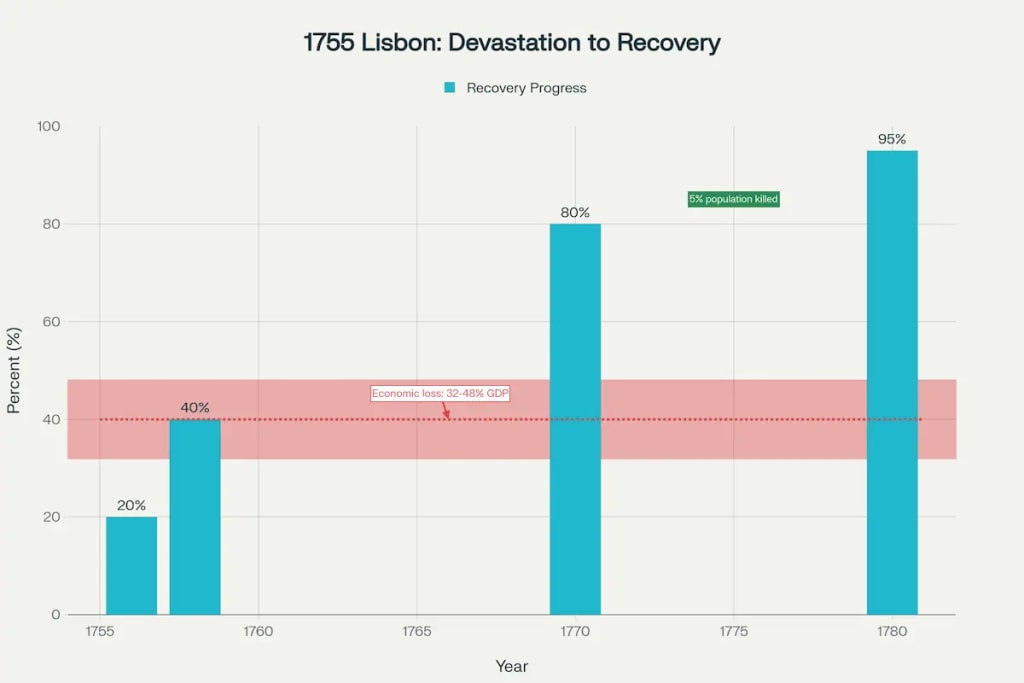
The reconstruction effort fundamentally altered Portugal’s social structure, weakening the traditional aristocracy and Catholic Church whilst strengthening centralised, bureaucratic governance. Pombal used the disaster as justification for extensive social reforms, creating what scholars consider one of Europe’s first modern, centralised states. This pattern—disasters catalyzing broader social and political transformations—remains visible in contemporary disaster recovery efforts worldwide.
Modern examples include how Hurricane Katrina accelerated educational reform in New Orleans, how the 2004 Indian Ocean tsunami led to improved early warning systems across the Pacific, and how the COVID-19 pandemic accelerated digital transformation across multiple sectors. The Lisbon earthquake established a template for how societies can use disaster recovery as an opportunity for broader modernization and reform.
Scientific legacy: From 1755 to contemporary earthquake research
The 1755 Lisbon earthquake significance for scientific development cannot be overstated. It marked the beginning of systematic seismology, established protocols for international scientific cooperation during disasters, and demonstrated the practical value of empirical observation over theoretical speculation. These contributions continue to influence modern earthquake science and disaster research.
The earthquake also catalysed the development of risk management as a scientific discipline. Pombal’s systematic data collection, combined with the practical application of earthquake-resistant construction techniques, established the template for modern disaster risk reduction that guides contemporary organizations like the United Nations Office for Disaster Risk Reduction.
Modern seismological research employs sophisticated technology—satellite monitoring, deep ocean sensors, computer simulation—but operates within conceptual frameworks established in response to the 1755 disaster. The recognition that earthquakes follow natural laws that can be studied and partially predicted, that building design can significantly reduce earthquake damage, and that systematic data collection enables better disaster preparedness all trace their origins to the scientific revolution sparked by Lisbon’s catastrophe.
Disaster management history: Evolution from Pombal to modern emergency response
The systematic disaster response pioneered by the Marquis of Pombal established principles that continue to guide modern emergency management. His approach—immediate needs assessment, coordinated resource deployment, prevention of secondary disasters, and systematic documentation for future preparedness—anticipated by centuries the comprehensive emergency management frameworks used by contemporary organizations like FEMA, the European Emergency Response Coordination Centre, and the UN’s humanitarian response system.
Modern disaster management incorporates lessons learned from every major catastrophe since 1755, but the fundamental structure established after the Lisbon earthquake—centralized coordination, systematic data collection, evidence-based policy development, and integration of immediate response with long-term recovery—remains the foundation of contemporary emergency management practice.
Recent disasters, from the 2010 Haiti earthquake to the ongoing challenges of climate change-related disasters, demonstrate both the continuing relevance of principles first systematically applied in post-1755 Lisbon and the ongoing evolution of disaster management science.
Philosophical inheritance: Secularization and scientific thinking
Perhaps most profoundly, the Lisbon earthquake contributed to what historians call the “secularisation of disaster.” By forcing European intellectuals to abandon supernatural explanations for natural catastrophes, it accelerated the Enlightenment’s broader project of substituting scientific for religious understanding of the natural world.
This intellectual transformation had practical consequences that continue to influence contemporary approaches to disaster preparedness and response. The shift from viewing disasters as divine punishment to understanding them as natural phenomena amenable to human intervention justified the kind of comprehensive state response that Pombal pioneered and that modern emergency management agencies continue to develop.
Contemporary debates about climate change, pandemic preparedness, and disaster equity often reflect the same tension between fatalistic acceptance and active intervention that characterized 18th-century responses to the Lisbon earthquake. The precedent established in 1755—that human societies can and should take systematic action to reduce disaster risks—continues to influence policy discussions about everything from building codes to international aid.
Contemporary connections: Lessons for the modern world
Earthquake preparedness: From Lisbon to Los Angeles
The innovations pioneered in post-1755 Lisbon continue to influence contemporary earthquake preparedness worldwide. Modern seismically active cities employ strategies that build directly on principles established during the Pombaline reconstruction: systematic building codes that mandate earthquake-resistant construction, urban planning that facilitates emergency evacuation and response, infrastructure design that maintains critical services after disasters, and public education programs that prepare residents for seismic events.
Los Angeles’s comprehensive earthquake preparedness program, developed after decades of seismic research and refined through events like the 1994 Northridge earthquake, employs methods that would be recognizable to Pombal’s engineers: systematic retrofitting of vulnerable buildings, development of flexible building codes that incorporate new understanding of seismic forces, and community education programs that prepare residents for earthquake response.
Similarly, Japan’s world-leading earthquake engineering, developed through painful experience including the 1995 Kobe and 2011 Tohoku earthquakes, applies the same fundamental insight that guided the Pombaline cage system: buildings must be designed to flex and dissipate seismic energy rather than resist it rigidly.
Urban resilience: Building back better in the 21st century
The concept of “building back better” after disasters—now standard in international development and disaster recovery—traces its intellectual origins to the comprehensive reconstruction approach pioneered in post-earthquake Lisbon. Modern disaster recovery efforts, from post-hurricane rebuilding in the Caribbean to post-earthquake reconstruction in Nepal, apply the same principle that guided Pombal: disasters create opportunities to address pre-existing vulnerabilities and build more resilient communities.
Contemporary examples include New Orleans’s post-Katrina efforts to improve flood protection and urban drainage, Chile’s implementation of stricter building codes after the 2010 earthquake, and Indonesia’s efforts to build better early warning systems after the 2004 tsunami. Each reflects the same understanding that effective disaster recovery must address underlying vulnerabilities rather than simply restore pre-disaster conditions.
Climate change and natural disasters: Contemporary philosophical challenges
The philosophical questions raised by the 1755 Lisbon earthquake—about human responsibility, natural processes, and the search for meaning in the face of large-scale suffering—have found new expression in contemporary discussions about climate change and environmental catastrophe. Like the 18th-century thinkers who grappled with the earthquake’s implications, contemporary scholars and policymakers must confront questions about human agency, natural limits, and moral responsibility in an age of anthropogenic environmental change.
Climate fiction, environmental literature, and contemporary philosophy of science continue to engage with the same fundamental questions that Voltaire and Kant addressed in their responses to the Lisbon earthquake: How do we find meaning in the face of natural processes that seem indifferent to human values? What is the appropriate balance between acceptance of natural limits and active intervention to reduce risks? How do we maintain hope and agency while acknowledging our ultimate vulnerability to forces beyond our control?
Conclusion: When the World Broke, modernity began
The Lisbon earthquake 1755 represents a singular moment when catastrophe catalysed transformation across multiple domains of human experience that continue to influence contemporary life. In just nine minutes of seismic violence, followed by hours of flooding and days of fire, an old world ended and a new one began to emerge from the rubble—a transformation whose effects we still experience today.
This disaster established templates that remain recognisable in our contemporary world: systematic scientific investigation of natural phenomena using international collaboration and standardized methods, evidence-based policy responses to catastrophic events that integrate immediate relief with long-term preparedness, innovative engineering solutions for seismic resilience that balance flexibility with strength, and international cooperation in disaster response that transcends national boundaries.
The Great Lisbon earthquake also marked philosophy’s decisive turn toward secular explanations for natural phenomena and literature’s mature engagement with meaningless suffering—intellectual developments that continue to influence how we grapple with large-scale disasters, from climate change to pandemics to economic crises.
The reconstruction of Lisbon created more than a rebuilt city—it produced a model for how societies might respond to catastrophic disruption through rational planning, technological innovation, and administrative competence. The Pombaline cage system, the orthogonal street grid, and the comprehensive disaster response protocols pioneered in post-earthquake Portugal established principles that continue to influence urban planning, earthquake engineering, and emergency management worldwide.
Most significantly, the 1755 Lisbon earthquake demonstrated that disasters need not simply destroy—they can also create opportunities for societies to reimagine and rebuild themselves according to new principles. In Lisbon’s case, those principles were Enlightenment ideals of reason, order, and progress. The city that rose from the rubble wasn’t just reconstructed; it was fundamentally reconceived according to rational principles that anticipated modern urban planning by centuries.
Contemporary cities facing seismic risks—from San Francisco to Istanbul, from Tokyo to Los Angeles—continue to apply lessons learned from Lisbon’s catastrophe and reconstruction. Modern earthquake-resistant construction, comprehensive emergency planning, and integrated urban design all trace their conceptual origins to innovations pioneered in post-1755 Portugal.
When the world broke on that All Saints’ Day morning in 1755, it broke in ways that allowed modernity to begin. The earthquake that destroyed medieval Lisbon created the conditions for the birth of the modern world—a world where natural disasters could be studied rather than simply endured, where cities could be planned rather than simply grown, and where human reason could be applied to the fundamental challenges of existence in an apparently indifferent universe.
This was indeed the day the world broke—and in breaking, revealed possibilities for reconstruction that would reshape European civilisation and continue to influence how we respond to disasters, plan cities, and understand our relationship with natural forces. The story of Lisbon 1755 thus becomes the founding episode of our ongoing series “When the World Broke,” exploring how moments of catastrophic disruption become catalysts for transformation, innovation, and renewal that echo through centuries to influence our contemporary world.


