The future of healthcare might be sitting right there on your wrist. Apple’s groundbreaking research into Apple Watch AI health detection has revealed something rather extraordinary: your Apple Watch could soon know you’re pregnant before you do, detect infections before symptoms appear, and predict health conditions with an accuracy that would make your GP rather envious. But before you start planning your life around what your smartwatch tells you, there’s quite a bit more to this story than meets the eye.

The dawn of predictive health monitoring
We’re living through a remarkable shift in how we approach health and wellness. Gone are the days when health monitoring meant quarterly check-ups and reactive treatments. The integration of artificial intelligence (AI) with wearable technology is ushering in an era of predictive healthcare that’s both thrilling and, frankly, a bit unsettling.

At the heart of this revolution lies Apple’s Wearable Behavior Model (WBM), a sophisticated AI system that doesn’t just count your steps or monitor your heart rate—it learns from your behaviour, sleep patterns, activity levels, and physiological responses to paint a comprehensive picture of your health. This isn’t your typical fitness tracker; it’s more like having a health detective living on your wrist, constantly piecing together clues about your wellbeing.
The technology represents a fundamental shift from reactive to proactive healthcare. Rather than waiting for symptoms to manifest, AI-powered wearables can identify subtle patterns in your daily behaviour that might indicate underlying health changes. It’s like having a smoke detector that not only alerts you to a fire but also detects the faint smell of smoke long before flames appear, allowing you to prevent the fire entirely.
The science behind the magic: Understanding WBM
The Wearable Behavior Model isn’t magic—it’s machine learning at its most sophisticated. Developed through Apple’s Heart and Movement Study, this AI system was trained on an absolutely staggering amount of data: over 2.5 billion hours of behavioural information from more than 162,000 participants.
But here’s where it gets interesting. Unlike traditional health monitoring that focuses on raw sensor data like heart rate or blood oxygen levels, WBM analyses higher-level behavioural metrics. We’re talking about step count patterns, sleep duration variations, heart rate variability changes, mobility shifts, and even subtle alterations in how you move throughout your day.
Think of it this way: while your doctor might check your blood pressure during a ten-minute appointment, WBM is constantly observing how your body responds to daily stresses, how your sleep patterns fluctuate with your menstrual cycle, or how your activity levels change when you’re fighting off an infection—even before you realise you’re unwell.
The model uses a time-series machine learning architecture designed to identify changes in behaviour over days or weeks, rather than instant readings. This temporal approach allows it to detect health conditions that unfold gradually, making it particularly effective for conditions like pregnancy, where physiological changes occur slowly over time.
Pregnancy detection: The 92% accuracy achievement
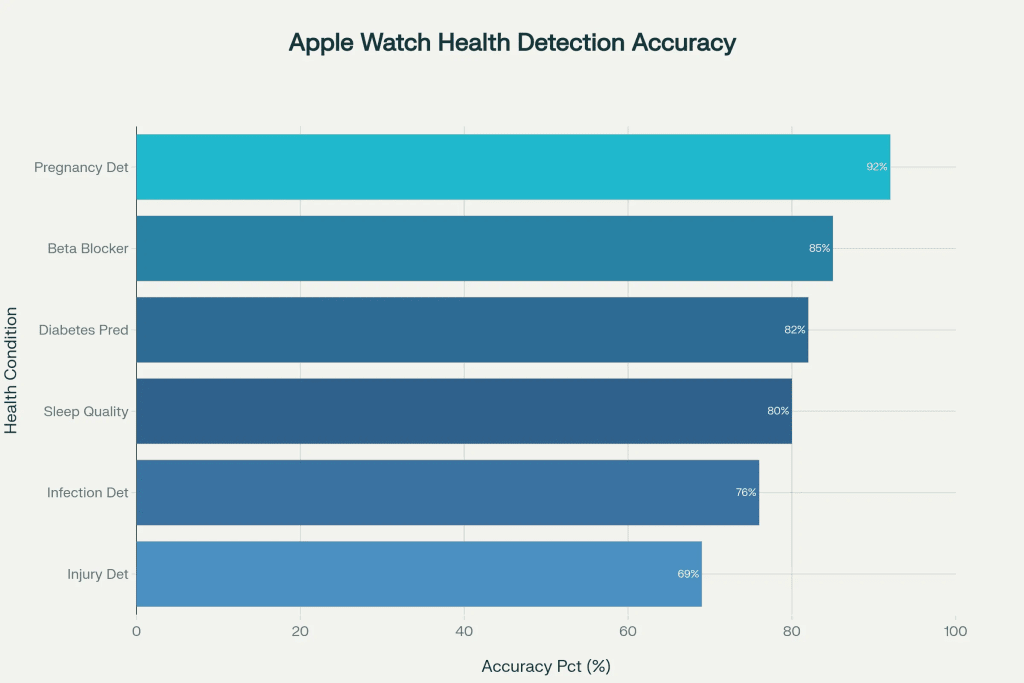
Perhaps the most remarkable application of WBM is its ability to detect pregnancy with up to 92% accuracy. This isn’t about detecting the obvious signs—it’s about identifying the subtle physiological and behavioural changes that occur in the early stages of pregnancy, often before traditional tests would be positive.

The research, published in a study titled “Beyond sensor data: Foundation models of behavioral data from wearables improve health predictions,” analysed data from 430 pregnancies and compared it with information from over 24,000 women who weren’t pregnant. The AI identified patterns in everything from sleep quality and heart rate variability to step count patterns and temperature fluctuations.
What makes this particularly fascinating is that pregnancy causes substantial changes in both underlying physiology and behaviour. The model picks up on increased resting heart rate, changes in sleep patterns, alterations in physical activity levels, and subtle shifts in daily routines that collectively paint a picture of early pregnancy.
However, and this is crucial, this technology isn’t available to the public yet. There’s no timeline from Apple for when—or if—this capability will make it into consumer devices. Currently, the Apple Watch only allows manual logging of pregnancy and symptoms through the Health app.
Quick facts:
- Pregnancy detection accuracy: 92%
- Data set: Over 2.5 billion hours from 162,000+ users
- Diabetes prediction accuracy: 82%
- Infection detection accuracy: 76%
- Injury identification accuracy: 69%
Beyond pregnancy: A health detection revolution
While pregnancy detection grabs headlines, WBM’s capabilities extend far beyond reproductive health. The system has demonstrated impressive accuracy across a range of conditions: 82% accuracy for diabetes prediction, 76% for infection detection, and 69% for injury identification.
The AI excels particularly at identifying what researchers call “static health states”—determining whether someone takes beta blockers, has a history of smoking, or has been diagnosed with hypertension. It’s also remarkably good at detecting “transient health states” like sleep quality fluctuations or early signs of respiratory infections.
This broad applicability suggests we’re looking at the early stages of a comprehensive health monitoring ecosystem. Imagine a world where your wearable device could alert you to elevated stress levels that might indicate burnout, detect early signs of depression through changes in activity patterns, or identify irregular gait patterns that could suggest neurological issues.
Current Apple Watch capabilities: What’s actually available now
Let’s be clear about what your Apple Watch can and can’t do right now. The latest watchOS 11 has introduced some impressive features, but we’re still some way from the AI-powered health detection promised by WBM research.

Currently, the Apple Watch offers:
- Heart health monitoring: ECG readings, irregular rhythm notifications, and heart rate alerts. The device has FDA clearance as a Class II medical device for these specific functions.
- Sleep analysis: Sleep apnea notifications, sleep duration tracking, and basic sleep quality assessment.
- Activity tracking: Step counting, exercise recognition, and fitness goal monitoring.
- Cycle tracking: Manual logging of menstrual cycles, symptoms, and pregnancy-related information.
- Vitals monitoring: The new Vitals app, available with watchOS 11, provides overnight health metrics including heart rate, respiratory rate, wrist temperature, and sleep duration.
What it doesn’t do—yet—is automatically detect pregnancy, predict diabetes, or identify infections before symptoms appear. These capabilities remain in the research phase, with no official timeline for public release. This means features like the highly anticipated “Apple Watch pregnancy detection” are still a futuristic prospect.
The medical professional perspective: Cautious optimism
Healthcare professionals are watching these developments with a mixture of excitement and healthy scepticism. Dr. Rod Passman, a cardiologist at Northwestern Medicine, represents the optimistic camp: “This is a very powerful tool, and many of us are using it not only to diagnose disease but perhaps even manage diseases like abnormal rhythms”.
Some doctors are already recommending Apple Watches, including the latest Apple Watch Series models, to patients for specific conditions, particularly heart rhythm monitoring and post-surgery recovery tracking. The device’s ability to provide continuous, real-time data allows physicians to monitor patients remotely and catch issues that might be missed during brief office visits. This is an area where Apple Watch AI health detection could significantly enhance patient care.
However, medical professionals consistently emphasise several crucial points:
- Diagnostic limitations: Wearables are supplementary tools, not replacements for professional medical assessment. As one study noted, “We don’t make a diagnosis purely because your watch says something’s wrong”.
- Accuracy concerns: While impressive, wearable data isn’t infallible. Device positioning, user behaviour, and environmental factors can all affect accuracy.
- Professional oversight: Medical-grade confirmation is essential before embarking on any treatment based on wearable data.
Regulatory landscape: Navigating the rules
The regulatory environment for AI-powered health wearables is complex and evolving. The Apple Watch currently holds FDA clearance as a Class II medical device for specific functions like ECG monitoring and irregular rhythm detection. This “FDA Apple Watch approval” refers to specific features, not the entire device for all health conditions.
Class II devices are considered moderate-risk and require FDA clearance rather than full approval. This classification means the Apple Watch won’t be life-threatening if it malfunctions, unlike Class III devices such as pacemakers.
For future AI health detection features, the regulatory pathway becomes more complex. Any new health-related functionality must undergo FDA review, potentially including clinical trials and safety assessments. The process can take months or years, depending on the complexity and risk level of the proposed features.
Privacy regulations add another layer of complexity. Under GDPR, health data collected by wearables is considered sensitive personal information requiring explicit consent and robust protection measures. Companies must implement privacy-by-design principles and provide transparent information about data collection and usage.
Privacy and security: The price of prediction
With great predictive power comes great privacy responsibility. AI-powered health detection requires processing vast amounts of personal data, raising significant concerns about privacy, security, and consent. This is where the concept of “health data privacy” becomes paramount.
The data collected by wearables is incredibly intimate—heart rate patterns, sleep behaviours, movement data, and potentially reproductive health information. This information could be valuable to insurance companies, employers, or advertisers if it fell into the wrong hands.
Current privacy challenges include:
- Data ownership: Who owns the health insights generated by AI analysis of your data?
- Third-party sharing: How is aggregated health data shared with research institutions or commercial partners?
- Security vulnerabilities: Many wearable devices have documented security weaknesses, including weak encryption and insecure communication protocols.
- Informed consent: Do users truly understand what they’re agreeing to when they enable AI health analysis?
Apple has generally maintained a strong privacy stance, implementing on-device processing and encrypted data transmission. However, the sheer volume and sensitivity of health data required for AI analysis presents ongoing challenges. Users should be vigilant, regularly reviewing privacy settings and understanding the terms of service for any “wearable health devices” they use.
The future of wearable health AI: What’s coming next
The trajectory of wearable health AI suggests we’re on the cusp of a healthcare revolution. Future developments likely include:
- Multimodal AI integration: Combining data from multiple sensors and devices to create comprehensive health profiles.
- Biochemical sensing: Next-generation wearables may analyse sweat, tears, or interstitial fluid to detect biomarkers for various conditions.
- Mental health monitoring: AI systems capable of detecting early signs of depression, anxiety, or cognitive decline through behavioural pattern analysis.
- Predictive health coaching: Personalised recommendations based on individual health trends and risk factors.
- Integration with healthcare systems: Seamless data sharing with healthcare providers for continuous patient monitoring.
The potential applications seem limitless. Researchers are exploring AI-powered wearables for detecting everything from Parkinson’s disease to COVID-19, from monitoring chronic pain to predicting cardiac events. This highlights the immense potential of “digital health” and “predictive healthcare.”
Challenges and limitations: The reality check
Despite the promising research, significant challenges remain before AI health detection becomes mainstream:
- Data quality: Wearable sensors are susceptible to motion artifacts, poor contact, and environmental interference.
- Algorithmic bias: AI models trained on limited demographic groups may not perform equally well across diverse populations.
- Health equity: Advanced wearable technology may exacerbate health disparities if not accessible to all socioeconomic groups.
- Over-reliance: There’s a risk that users might become overly dependent on AI recommendations, potentially neglecting professional medical care.
- Regulatory lag: Approval processes for new AI health features can be slow, potentially stifling innovation.
Medical guidance: The irreplaceable human element
Regardless of how sophisticated AI health detection becomes, medical professionals consistently emphasise that wearable technology should complement, not replace, traditional healthcare.
Dr. Passman’s perspective is telling: “We always want to get medical grade confirmation before we embark on any treatment”. This sentiment is echoed throughout the medical community—wearables can provide valuable insights and early warnings, but diagnosis and treatment decisions should always involve qualified healthcare professionals.
The most effective approach appears to be collaborative, with wearables providing continuous monitoring data that healthcare providers can use to make more informed decisions. This partnership between technology and human expertise offers the best of both worlds: the convenience and continuity of wearable monitoring with the expertise and judgement of medical professionals.
Conclusion: The promise and responsibility of predictive health
Apple’s Wearable Behavior Model represents a genuine breakthrough in predictive health monitoring. The ability to detect pregnancy with 92% accuracy, predict diabetes, and identify infections before symptoms appear points toward a future where our wearable devices, powered by Apple Watch AI health detection, serve as intelligent health guardians.
However, this future comes with significant responsibilities. Privacy protection, regulatory compliance, and maintaining the centrality of professional medical guidance will be crucial as these technologies evolve. The most exciting aspect isn’t just the technology itself, but how Apple Watch AI health detection might democratise access to continuous health monitoring and early intervention.
Imagine a world where an early morning nudge on your wrist changes your life—alerting you not just to stand or breathe, but to health shifts you haven’t noticed. This is closer to reality than science fiction. Still, trust and transparency will decide whether millions embrace Apple’s latest health push or keep relying on good old instinct and a human doctor. What to watch for as Apple rolls out new health AI features is how they balance these powerful capabilities with user trust and privacy.
As we stand on the brink of this AI-powered health revolution, the key is to remain both optimistic about the possibilities and realistic about the limitations. Your Apple Watch might one day know you’re pregnant before you do, but it will never replace the irreplaceable: the expertise, empathy, and judgement of human healthcare professionals.
The future of health is undoubtedly digital, but it remains fundamentally human. And perhaps that’s exactly as it should be.
FAQ: Frequently Asked Questions
Q: Is Apple Watch pregnancy detection available now?
A: Not yet—AI pregnancy detection is currently in the research phase and has not been released to general users. The Apple Watch Series currently allows manual logging of pregnancy symptoms.
Q: How accurate is Apple’s AI health detection?
A: According to research on the Wearable Behavior Model (WBM), pregnancy detection has shown up to 92% accuracy. Other conditions like diabetes, infection, and injury detection have shown accuracies ranging from 69% to 82%.
Q: Is my health data private with Apple?
A: Apple generally maintains a strong privacy stance, employing on-device processing and encrypted data transmission for health data. However, the sheer volume and sensitivity of health data used for AI analysis present ongoing privacy challenges, requiring explicit user consent and robust protection measures under regulations like GDPR.
Q: Does Apple Watch replace my doctor?
A: No, AI insights from wearable health devices are intended for guidance and supplementary information, not as a replacement for professional medical assessment. It is crucial to always consult a qualified healthcare professional for diagnosis and treatment decisions.
Q: What health features does Apple Watch offer now?
A: Currently, Apple Watch models, including those running watchOS 11, offer ECG readings, irregular rhythm notifications, heart rate alerts (with FDA clearance for these functions), sleep analysis (including sleep duration and basic quality assessment), activity tracking (step counting, exercise recognition), manual cycle tracking, and the new Vitals app for overnight health metrics.