As Netflix’s ambitious six-part series brings his story to global audiences in late 2024, Ayrton Senna remains, three decades after his tragic death, one of motorsport’s most captivating and mythologized figures. This Brazilian phenomenon, whose raw talent, competitive fire, and almost spiritual dedication to racing transformed him from a privileged São Paulo kid into a symbol of national pride, continues to inspire a new generation of Formula 1 enthusiasts. With three Formula 1 World Championships, 41 Grand Prix victories, and a record 65 pole positions, Senna’s statistics alone would secure his place in racing history. But what truly separates this Ayrton Senna biography from every other driver who has ever gripped a steering wheel is something far more intangible: an almost mystical ability to extract the impossible from himself and his machine, particularly on rain-soaked tracks where he seemed to operate on a different plane of consciousness altogether. His life, cut devastatingly short on 1 May 1994 at Imola, transformed him into more than just an athlete. He became an idea, a living embodiment of Brazilian possibility in an era when his country desperately needed something, or someone, to believe in.
The rise of a champion: From karting prodigy to Formula 1 sensation
The early years: Karting and junior formulae excellence

Ayrton Senna’s journey to motorsport immortality began not on some glamorous European circuit, but in a São Paulo neighbourhood where his father, a wealthy industrialist, assembled a kart from a lawnmower engine for his curious son. Born on 21 March 1960 into the comfortable confines of Brazil’s middle-to-upper class, young Ayrton showed a precocious talent that would soon mark him as different from his peers. By age 13, he was competing officially in karting championships; by his late teens, he had claimed the South American Kart Championship in 1977 and was already drawing attention from European racing scouts.
But Senna was never satisfied with regional glory. He possessed an almost obsessive drive to test himself against the world’s best, which is why, in 1981, at just 21 years old, he packed his bags and moved to Britain to pursue a European racing career with virtually no financial backing. The decision proved prescient. Over the next three years, Senna systematically dismantled the junior formula hierarchy, winning the British and European Formula Ford 2000 championships in 1982, and then, in 1983, delivering a masterclass in domination by winning the British Formula Three Championship with 12 victories from 20 races. This stunning 60% win rate wouldn’t be surpassed for over a decade, establishing early evidence of what would become the Ayrton Senna career trajectory.
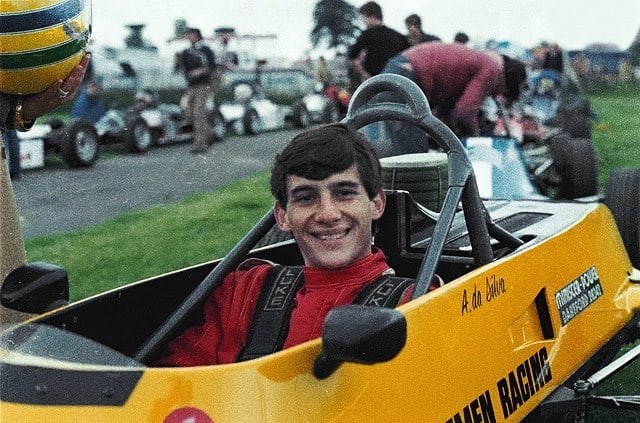
His 1983 title battle with future F1 driver Martin Brundle became the stuff of legend. Senna qualified on pole position for 12 of the 20 races and built an early commanding lead before a series of mechanical retirements allowed Brundle to close the gap, but Senna’s clinical dominance in the finale proved decisive. More importantly, the championship demonstrated what would become his signature characteristic: an almost supernatural ability to extract maximum performance from machinery and to maintain devastating consistency while operating at the absolute limit. This combination of raw speed and relentless precision would define the Ayrton Senna life story throughout his Formula 1 years.
The F1 debut: Monaco 1984 and the birth of a legend
When Ayrton Senna arrived at his first Formula 1 race, the 1984 Brazilian Grand Prix in Rio, he did so driving for Toleman, then regarded as a respectable but decidedly midfield team. Nobody expected much from this earnest Brazilian kid with the intensive stare and the spiritual demeanor. But Senna had other ideas. Within five races, at the 1984 Monaco Grand Prix, he announced himself to the world in a manner that still resonates through the decades.

Driving an inferior Toleman-Hart that qualified 13th on the grid, Senna delivered one of the most beguiling performances of wet-weather driving ever witnessed. In torrential rain that would have sent lesser drivers into conservative mode, Senna hunted down the championship-leading Alain Prost in his McLaren, closing a gap that seemed impossible with each lap that passed. By race’s end, he had moved from 13th to 2nd place, lapping faster than the world champion and convincing everyone in the paddock that they were witnessing something extraordinary. The race was stopped for safety reasons before Senna could complete his overtaking manoeuvre, but the message was unmistakable: a new force had entered Formula 1, and it was terrifyingly talented.
Later, Senna would reflect on that Monaco experience, a race he did not win but that catalysed his entire career philosophy. “Monaco was the turning point in the championship,” he explained. “The mistake I made woke me up psychologically and mentally and I changed a lot after that. That was when I took the biggest step in my career as a racing driver, as a professional and as a man.” This wasn’t mere athlete-speak; it revealed something fundamental about Senna’s psychological makeup: his ability to transmute disappointment into fuel, to view setbacks as spiritual lessons rather than mere racing defeats. This philosophical approach to competition would become central to understanding who was Ayrton Senna beyond the statistics and podium finishes.
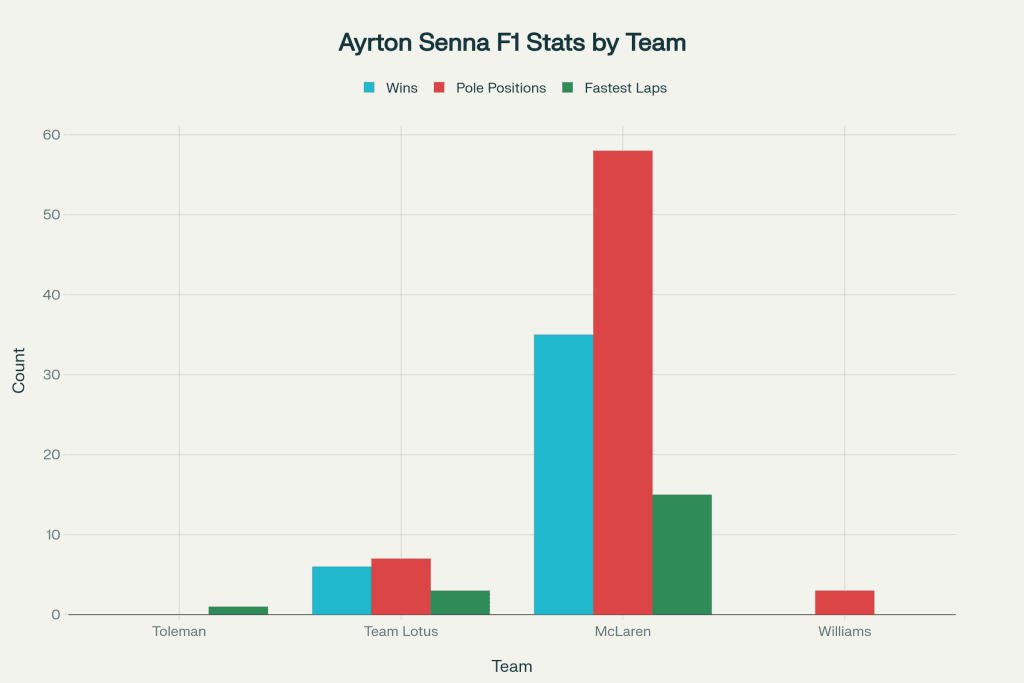
Ayrton Senna’s Formula 1 statistics by team
Throughout his career, Senna’s performance varied significantly depending on his machinery, yet his ability to extract maximum potential from each car remained constant. His Toleman debut season in 1984 showed flashes of brilliance despite limited equipment. The Lotus years from 1985 to 1987 produced six victories and established his reputation as a genuine championship contender. But it was his McLaren period from 1988 to 1993 where Senna truly cemented his legacy, claiming 35 of his 41 career victories and earning all three of his world championships. His final season with Williams in 1994, though tragically cut short, demonstrated his willingness to adapt to new challenges even as he approached the peak of his abilities.
The golden years: Lotus, McLaren, and the emergence of greatness
The Lotus era: Establishing the rain maestro
Between 1985 and 1987, driving for Team Lotus, Senna entered a creative peak that cemented his reputation as the most thrilling driver on the grid. His first Grand Prix victory came not in some championship-deciding battle, but in the rain at Portugal in 1985, a soggy, chaotic affair at Estoril where Senna’s combination of fearlessness and precision in handling an aquaplaning machine proved decisive. That victory would be the first of six during his Lotus years, but more importantly, it established the mythology that would define his career: Ayrton Senna and rain became synonymous, almost mythologically bonded.

Other drivers, including Alain Prost, Nigel Mansell, and Senna’s various teammates, all possessed considerable wet-weather credentials. But none possessed Senna’s almost supernatural ability to divine where grip existed, to sense it before his tyres found it, to dance on the edge of physics in a way that defied comprehension. What made Senna so exceptional in wet conditions was his unique approach to tire management and weight transfer. While other drivers waited for feedback from their tires to understand available grip, Senna seemed to anticipate grip levels milliseconds before his tires made contact with the track surface. This predictive ability, combined with his extraordinarily smooth steering inputs and throttle control, allowed him to maintain speed through corners where others were forced to slow dramatically.
Technical analysis of his wet-weather driving reveals several key factors. First, Senna possessed an exceptional sensitivity to weight transfer, allowing him to feel exactly how the car’s balance shifted through each phase of a corner. Second, he demonstrated remarkable patience with throttle application, modulating power delivery with microscopic precision to avoid overwhelming the rear tires. Third, and perhaps most importantly, he showed an almost obsessive attention to racing line experimentation during practice sessions, methodically exploring different trajectories to identify where water pooled and where the track offered optimal drainage.
Teammates at Lotus, including several highly talented drivers, found themselves regularly outpaced when the skies opened. Journalists began referring to him as the “Rain Man,” a sobriquet that would follow him throughout his career, though Senna himself was always careful to downplay the mysticism. “Do you think I like to drive with 5 centimetres of visibility in front of me?” he once asked. “No, I don’t.” Yet his actions on track contradicted his words. When conditions were at their most treacherous, that’s precisely when Senna seemed most in his element, most alive, most perfectly synchronized with his machinery. This mastery of wet-weather driving would become a defining element of the Ayrton Senna rain master legend.
The McLaren dynasty: Three titles and unforgettable brilliance
If the Lotus years established Senna as a world-class talent, his move to McLaren in 1988 transformed him into something approaching a force of nature. Over the next six seasons (1988-1993), Senna would claim three World Championships and accumulate statistics that remain extraordinary nearly four decades later. An impressive 35 of his 41 career wins came in an Ayrton Senna McLaren, 58 of his 65 pole positions were achieved in the papaya and grey livery, and he established records that seemed utterly unbreakable at the time.

The 1988 season alone was a masterclass in automotive domination. The McLaren team won 15 of 16 races, an almost inconceivable level of superiority that wouldn’t be approached again until the Mercedes-dominated 2010s. That year, paired with the great Alain Prost, Senna and McLaren essentially redefined what was possible in Grand Prix racing, winning the drivers’ and constructors’ championships with mathematical inevitability. The technical package, featuring Honda’s powerful turbocharged engine and an aerodynamically advanced chassis designed by Gordon Murray and Steve Nichols, provided the foundation. But it was the driving talents of Senna and Prost that transformed a merely excellent car into a historically dominant machine.
But statistics, whilst impressive, fail to capture the essence of what made Senna’s McLaren years so captivating to anyone who witnessed them. What made him transcendent was not mere speed; plenty of drivers throughout motorsport history have been similarly quick. Rather, it was the manner in which he extracted that speed, the psychological intensity with which he approached racing, and his willingness to push himself and his machinery to the absolute threshold of disaster. Contemporary observers spoke of Senna entering a kind of trance state during qualifying sessions, where he would dial out the world around him and seemingly access some deeper reservoir of consciousness that allowed him to find lap times that defied rational explanation.

He studied tracks obsessively, often remaining in Monaco during race weekends specifically to absorb the circuit’s rhythms, understanding that mastery of the street circuit required not merely driving ability but intellectual comprehension of every corner, every braking point, every subtle variation in grip. His engineer at McLaren, Steve Hallam, recalled that Senna would spend hours reviewing telemetry data, comparing not just lap times but individual corner speeds, brake pressure traces, and throttle application patterns. This meticulous approach to data analysis, combined with his natural driving talent, created a feedback loop of continuous improvement that his rivals struggled to match. These Ayrton Senna championships in 1988, 1990, and 1991 were built on this foundation of technical obsession and unrelenting pursuit of perfection.
Monaco: The cathedral of Senna’s genius
Six victories at the Principality
If you were to distill Ayrton Senna’s Formula 1 career into a single location, that place would be Monaco. Across nine entries into the Monaco Grand Prix from 1984 to 1993, Senna won six times, a record that stands to this day, remarkable considering that Lewis Hamilton, who cites Senna as his primary inspiration and idol, has never equaled this achievement despite being the most successful F1 driver in history by overall wins. But the numbers, once again, understate the reality. Senna’s relationship with Ayrton Senna Monaco transcended mere statistics; it was almost spiritual, a symbiotic connection between driver and circuit that commentators struggled to articulate in conventional sporting language.

His dominance at Monaco began in 1987, when driving for Lotus, he secured his first victory on the streets of the Principality in a car that was markedly inferior to the field. From 1989 onwards, he achieved something almost incomprehensible: five consecutive Monaco victories, establishing a sequence of triumphs that seemed to suggest he had achieved some form of permanent lock-out on victory at this most challenging of circuits. What made these victories so remarkable was not merely the winning itself; any capable driver might win five races in a row in a good car. Rather, it was the manner in which Senna won, often from difficult qualifying positions, often overcoming machinery that was theoretically disadvantaged.
In qualifying, Senna produced lap times that appeared to exist in a different temporal dimension. His famous 1988 qualifying lap remains perhaps the most discussed single lap in Formula 1 history, setting a time 1.5 seconds faster than his teammate Alain Prost, a monumental margin that left the entire paddock in a state of collective astonishment. To put this margin in perspective, 1.5 seconds at Monaco typically represents the difference between pole position and eighth or ninth on the grid. Achieving such a gap over a four-time world champion in identical machinery seemed to defy the laws of physics and probability.
“I was in a different dimension,” Senna later reflected on that qualifying session, and watching footage of that lap, contemporary viewers struggle to argue with his assessment. The onboard camera reveals a driver operating at speeds that appear reckless to the untrained eye, yet every input is calculated, every braking point optimized, every apex precisely clipped. Current F1 drivers, including Charles Leclerc, who grew up in Monaco and now calls it home, and Pierre Gasly, who has studied Senna’s techniques extensively, speak of this lap with something approaching reverence. They recognize that what Senna achieved represented not just excellent driving but a transcendent moment where human capability briefly exceeded what seemed possible.
The art and philosophy of Monaco mastery
What explained Senna’s unparalleled success at Monaco? Part of it was undoubtedly mechanical talent: his precision, his late braking, his ability to manage an F1 car on circuits where the margin between excellence and catastrophic error was measured in millimeters. But interviews with those who worked most closely with Senna, including mechanics, engineers, and teammates, reveal something deeper: an almost monastic dedication to understanding every detail of the circuit.
Giorgio Ascanelli, one of Senna’s mechanics at McLaren, recalled that “He treated every lap like a masterpiece,” a comment that captures something essential about Senna’s approach. Monaco wasn’t just a racetrack to him; it was a canvas upon which to paint precision and artistry. He would immerse himself in the circuit’s particularities, understanding how track temperature variations from early morning to midday affected grip, how different weather patterns altered which lines provided optimal adhesion, how the minute details of tire pressures, fuel levels, and brake balance interacted with the circuit’s unique characteristics.
Senna developed a practice of walking the Monaco circuit during race weekends, not just casually strolling but intensely studying every surface change, every painted line, every slight gradient variation. He would note where shadows fell at different times of day, understanding that track temperature affected grip levels and that cooler sections required different driving techniques. This level of circuit immersion went far beyond what his contemporaries practiced. While other drivers might walk the track once or twice, Senna would do so repeatedly, building a mental three-dimensional map that became so ingrained he could visualize it with his eyes closed.
The psychological dimension of his Monaco success cannot be overlooked. Senna understood that the street circuit’s unforgiving nature, where barriers line every meter of the track and mistakes result in immediate race-ending crashes, actually played to his strengths. While the danger intimidated most drivers into leaving small margins for error, Senna thrived on the adrenaline and intensity that came from operating on the absolute edge. He once explained that Monaco demanded “complete commitment, absolute focus, no room for doubt.” This psychological framework, where the circuit’s difficulty became a source of motivation rather than anxiety, gave him a crucial mental advantage over rivals who approached Monaco with greater trepidation.
The Prost-Senna rivalry: Sport’s greatest duel
The championship collisions of 1989 and 1990
The most controversial and defining element of Ayrton Senna’s Formula 1 career was his rivalry with Alain Prost, a competitive relationship that transcended mere sporting contest and entered the realm of psychological warfare, philosophical opposition, and personal animosity. The two drivers represented almost opposite approaches to racing: Prost was the calculating, intellectually precise perfectionist who believed in conservative race craft and optimal tire management; Senna was the intuitive, aggressive, almost reckless competitor who seemed willing to risk everything for victory.
Together at McLaren from 1988 onwards, they produced some of the most exciting Formula 1 racing ever witnessed, but their rivalry also generated controversies that would reshape discussions about fairness, integrity, and sportsmanship within the sport. The Ayrton Senna vs Alain Prost rivalry has been analyzed extensively in the recent Netflix documentary series, which devoted significant screen time to exploring the psychological dimensions of their conflict and how it shaped both drivers’ careers.
The rivalry reached its climax in two championship-deciding collisions at Suzuka, the Japanese Grand Prix, in consecutive years. The first occurred in 1989, with Senna chasing Prost and the championship in the season finale. Senna arrived at Suzuka needing to win the remaining races to claim the title, whilst Prost merely needed to avoid retirement. In what remains the most controversial moment in F1 history, Senna attempted an audacious overtake at the Casio chicane on lap 46, diving to the inside in a move that many observers, and Prost himself, believed was fundamentally reckless.
The two cars collided, both retiring from the race, and Prost’s points lead transformed into an automatic championship. Senna was subsequently disqualified for cutting the chicane during his restart attempt, a decision that many felt compounded an already questionable stewards’ judgment. What made the incident even more controversial was evidence suggesting that FIA president Jean Marie Balestre harbored a pro-Prost bias, leading Senna to believe, rightly or wrongly, that the rulebook had been deliberately interpreted against him. This perception of institutional bias would influence Senna’s decision-making in the following year’s championship showdown.
The following year, 1990, brought almost poetic symmetry: another championship-deciding collision, again at Suzuka, but this time the positions reversed. Prost, now driving for Ferrari, arrived at the final race requiring a win to claim the title; Senna needed only for Prost to fail to finish. And in a moment that remains controversial to this day, Senna drove directly into Prost at the first corner of the first lap, ending both drivers’ races and securing Senna his second World Championship.
Prost, somewhat understandably, accused Senna of deliberately taking him out, and telemetry evidence suggested that Senna kept his throttle open through the corner rather than braking as a prudent driver would. Senna was not penalized for the incident, but the damage to his reputation was already inflicted. Here was evidence that Senna’s competitive intensity could cross ethical boundaries, that his willingness to risk everything extended even to deliberately crashing if it meant achieving his objective. Years later, Senna would acknowledge the incident more candidly, admitting that he had felt justified in his actions given what he perceived as the injustice of the previous year’s championship decision.
The human dimension: Friendship beyond rivalry
What makes the Prost-Senna rivalry so enduring in sporting memory, however, is that it transcended the racetrack. Away from the circuits, despite the intensity of their competition and the genuine animosity that developed during their McLaren years, the two drivers maintained periods of cordial, almost affectionate interaction. After Senna’s death, Prost famously said, “When he died, I said that I felt a part of me had died.” This wasn’t mere platitude or posthumous sentimentality; Prost genuinely recognized that his rivalry with Senna had defined him as a driver, that their battles had elevated both of them to heights neither might have achieved alone.
The two men represented opposing philosophies, but they respected each other’s commitment to excellence, understanding that sport’s greatest competitions require worthy opponents. In the years following Senna’s death, Prost has spoken frequently about their relationship, revealing moments of private conversation where mutual respect temporarily superseded competitive antagonism. He recalled instances where Senna would seek his technical opinion on car setup, or where they would discuss the political dynamics within Formula 1’s governing bodies. These glimpses of camaraderie suggest a more nuanced relationship than the purely adversarial narrative that dominated contemporary media coverage.
Contemporary drivers like Lewis Hamilton, who has studied both Senna and Prost extensively, often cite their rivalry as the gold standard for how competition can elevate both participants. Hamilton has noted that his own rivalries, including those with Nico Rosberg and Sebastian Vettel, were inspired by the intensity and sporting respect that eventually characterized the Prost-Senna dynamic. The Netflix series examining Senna’s life devotes considerable attention to this relationship, using previously unseen footage and interviews to illustrate how two fundamentally different personalities created motorsport’s most compelling rivalry.
The master of wet weather: Donington Park 1993
The “lap of the gods”
If you required definitive proof of Ayrton Senna’s mastery in rain, you would find it not in any of his Monaco victories, not in the 1984 debut that announced his talent to the world, but in a single opening lap of the 1993 European Grand Prix at Donington Park. This performance, often referred to simply as “Ayrton Senna Donington 1993,” has achieved legendary status among Formula 1 enthusiasts and is frequently cited by current drivers as the greatest single lap of racing they have ever studied.

Qualifying had taken place in dry conditions, placing Senna fourth on the grid behind Alain Prost (pole position), Damon Hill, and Michael Schumacher. The race itself began in torrential rain, conditions so severe that the Formula 1 media struggled to find adequate descriptors. And in the first lap alone, Senna produced one of the most extraordinary driving performances ever recorded, overtaking Schumacher, Hill, and Prost to take the race lead, a stunning display of car control that left seasoned observers speechless.
What made Donington 1993 so remarkable was not merely the overtakes themselves; any talented driver might execute a successful pass in wet conditions. Rather, it was the manner in which they were executed and, more fundamentally, Senna’s apparent ability to predict where grip would exist before his tires found it. In the opening lap, as other drivers were still hunting for adhesion, still attempting to understand where the track offered traction and where it offered only slippery chaos, Senna seemed to possess an almost clairvoyant awareness of optimal lines.
The technical explanation for his advantage in these conditions relates to his exceptional sensitivity to hydroplaning dynamics. While most drivers relied on visual cues to identify standing water, Senna appeared to sense through steering feedback and chassis vibrations exactly when his tires were beginning to lose contact with the track surface. This allowed him to modulate his speed and steering inputs milliseconds earlier than his competitors, maintaining grip where others experienced sudden slides. Additionally, his willingness to explore unconventional racing lines during the formation lap, something most drivers avoided in treacherous conditions, gave him crucial information about where the track drained most effectively.
Commentator Murray Walker famously described it as “the greatest lap in Formula 1 history,” and few who witnessed it would argue with his assessment. The recent Netflix series dedicated an entire segment to this race, using enhanced footage and technical analysis to help modern viewers understand the magnitude of Senna’s achievement. Current F1 drivers, including Max Verstappen, who is often compared to Senna for his exceptional wet-weather abilities, have stated that they study this particular lap repeatedly to understand Senna’s techniques and decision-making process.
The race itself: A masterclass in wet-weather strategy
The race itself became a masterclass in wet-weather racecraft. Over the course of 76 laps, the weather transformed multiple times, from torrential downpour to damp to drying to spray-inducing wet again, forcing drivers to make constant decisions about tire strategy. Other drivers, including the Williams pilots in theoretically superior machinery, made eight, nine, even ten pit stops. Senna made four. And he did so because he possessed something beyond raw talent: an intuitive understanding of how tires behaved in various conditions, what the track surface offered in terms of grip, and how to position his car to exploit those minute variations that meant the difference between competitive performance and dominance.
Rival Alain Prost made seven pit stops; Hill, his teammate, made six. Senna’s fewer stops weren’t luck or prescience but rather the product of meticulous observation and supreme car control. He demonstrated an exceptional ability to preserve his tires even while driving at competitive speeds, a skill that requires enormous sensitivity to weight transfer and throttle application. Where other drivers were forced to pit for fresh tires as their current rubber degraded beyond usability, Senna found ways to extend his stints by adjusting his driving style, taking slightly different lines through corners to utilize less-worn sections of his tires.
The victory margin, over one minute ahead of second-placed Damon Hill, represented one of the most dominant wet-weather performances in Formula 1 history. But perhaps more significant than the margin was the manner in which Senna controlled the race. After taking the lead on the first lap, he never relinquished it, building and maintaining his advantage through constantly changing conditions while his rivals struggled to adapt. His pit crew later revealed that Senna’s radio communications throughout the race were remarkably calm and analytical, providing detailed feedback about track conditions and tire performance rather than the emotional reactions that characterized many drivers in such challenging circumstances.
The 1994 season: Tragedy at Imola
The challenging Williams era
Following his successes at McLaren, where he had achieved three World Championships and rewritten the record books for Ayrton Senna pole positions and victories, Senna made what would ultimately prove his final career decision: a move to Ayrton Senna Williams for the 1994 season. The Williams team, coming off a dominant 1993 campaign with Alain Prost claiming his fourth world title, appeared to offer Senna the machinery to claim a fourth world championship of his own. But the 1994 season would be remembered not for Senna’s achievements but for a weekend of tragedy that transformed Formula 1 forever.
The catalyst for disaster was a change in FIA regulations. The previous year’s dominant Williams FW15C had featured active suspension, a computer-controlled system that allowed the car to maintain an optimal ride height just millimeters above the track surface, granting extraordinary downforce and aerodynamic efficiency. In 1994, active suspension was banned, along with several other technological aids including traction control, ABS braking systems, and launch control that had characterized the previous season.
Williams had to hastily redesign its cars, and the resulting FW16 emerged as fundamentally unstable, difficult to drive, and unpredictable in its handling characteristics. Senna, accustomed to the precision and predictability of McLaren machinery, struggled with the car from his first test session. In pre-season interviews, he expressed discomfort with how the machine behaved, noting that it felt “immediately less stable” and “harder to drive” without the electronic aids, resulting in frequent spinning and off-track excursions. Test driver David Coulthard, who also drove the FW16 during development, later confirmed that the car had significant handling issues that the team struggled to resolve.

The 1994 season began ominously. In the opening three races, Brazil, Pacific, and San Marino, Senna failed to complete a single lap in the points. The first two were retirements resulting from mechanical failures and contact with other cars; the third would prove fatal. On Friday, 29 April 1994, Jordan’s Rubens Barrichello, a young Brazilian driver who idolized Senna, suffered a massive high-speed accident at the same circuit, narrowly avoiding serious injury when his car became airborne and struck the tire barriers at approximately 140 mph. Senna visited Barrichello in the medical center, visibly shaken by the severity of the crash.
Then on Saturday, during qualifying, Simtek driver Roland Ratzenberger crashed fatally at the Villeneuve curve after a front wing failure sent his car into the barriers at high speed. Ratzenberger became the first driver to die in a Grand Prix weekend since 1982, ending a twelve-year period without fatal accidents that had led some to believe that modern safety standards had made the sport significantly safer. Senna, who witnessed the accident on track monitors, was profoundly affected by Ratzenberger’s death. That evening, he spoke with his girlfriend about potentially retiring from racing, expressing doubts about whether the sport’s risks were justified. These doubts would prove tragically prescient less than 24 hours later.
The fatal crash: Tamburello, 1 May 1994
Sunday’s race saw Senna immediately take pole position and lead from the start, a brief moment of competitiveness and control before everything changed. The start itself was chaotic, with a collision involving Pedro Lamy and JJ Lehto causing the deployment of the safety car for five laps. During this period, tire temperatures dropped significantly, and Senna expressed frustration over the radio about the slow pace, concerned that his tires were losing optimal operating temperature. When racing resumed on lap 6, Senna pulled away from the pack, attempting to rebuild his advantage before his tires could be challenged by Michael Schumacher’s Benetton.
On lap 7, whilst leading the race and driving smoothly, Senna’s Williams failed to turn at the Tamburello corner, a high-speed left-hander that had previously seen accidents. The car ran straight into an unprotected concrete barrier at approximately 192 mph (309 km/h), striking at a speed that the weakened structure could not withstand. The impact was devastating. The front of the car collapsed, tearing the right front wheel from its suspension. That wheel, a carbon composite assembly traveling at near-lethal velocity, struck Senna’s helmet at its right frontal area with catastrophic force. Additionally, a piece of the car’s suspension pierced through his helmet visor, causing severe head trauma.

The immediate response revealed the severity of the accident. Medical personnel reached the car within seconds, finding Senna unconscious but still breathing, though irregularly. An on-site emergency tracheotomy was performed by Professor Sid Watkins, Formula 1’s chief medical officer and a close friend of Senna’s, who had rushed to the scene. Senna was airlifted by helicopter to Bologna’s Maggiore Hospital, arriving 43 minutes after the crash. Medical staff attempted heroic interventions, including emergency surgery to relieve brain swelling and repair the skull fracture, but the severity of the head trauma proved insurmountable. Senna’s heart stopped in the hospital, was restarted through cardiac massage, and finally ceased irreversibly at 18:37 on 1 May 1994. He was 34 years old.
The announcement of his death sent shockwaves through the sporting world and particularly through Brazil, where the news was received with a level of collective grief rarely witnessed for any public figure. Television broadcasts were interrupted, the government declared three days of national mourning, and millions of Brazilians gathered in churches and public spaces to commemorate the Ayrton Senna death Imola 1994 that had robbed them of their greatest sporting hero. The Netflix series recreating these events, featuring actor Gabriel Leone as Senna, provides a visceral depiction of both the crash and its aftermath, introducing this tragedy to a new generation of viewers who did not experience it in real time.
The cause and controversy
The precise cause of the Ayrton Senna crash remains, even three decades later, a matter of debate and ongoing investigation. Some observers speculated that the modified Williams FW16, still struggling with stability issues, had simply failed at a critical moment. Others suggested that trackside debris from the earlier start-line accident, which had scattered small pieces of carbon fiber across the circuit, might have punctured a tire. Still others proposed that the steering column, which had been modified to accommodate Senna’s preferred seating position, had fractured under the extreme loads experienced during the high-speed corner.
The track conditions on the day were damp in places, though not raining, and visibility was adequate. What seems clear from post-accident analysis is that some combination of factors, possibly suspension failure, possibly a steering column fracture, possibly a momentary loss of tire pressure, conspired to send Senna into the barrier. Italian authorities conducted an extensive criminal investigation, eventually charging Williams team principal Frank Williams and designer Adrian Newey with manslaughter, though both were ultimately acquitted. The investigation revealed that the steering column had been modified by welding an extension to accommodate Senna’s driving position, and this weld may have created a weak point that fractured under load.
Subsequent analysis of the telemetry data showed that Senna did not brake or lift off the throttle before impact, suggesting that either he believed he could make the corner at full speed (unlikely given his experience) or that some mechanical failure prevented him from doing so. The car’s black box recorded a sudden loss of steering input just before the corner, supporting the steering column failure theory. However, definitive proof has remained elusive, and the exact sequence of events that led to the crash continues to be debated by engineers and motorsport historians.
What also seems clear, in hindsight, is that the 1994 season represented a watershed moment in Formula 1 safety consciousness. Two drivers dead in a single weekend, with a third, Rubens Barrichello, narrowly avoiding serious injury, finally galvanized the sport’s governing bodies and teams into treating safety with the seriousness it demanded. Ironically, Senna himself had been increasingly vocal about the need for improved safety measures and driver autonomy in these discussions. In the days leading up to Imola, he had been working on reforming the Grand Prix Drivers’ Association to give drivers a stronger voice in safety decisions. His death, more than any individual advocate’s efforts, created the political will to implement meaningful changes that have made Formula 1 dramatically safer in the 30 years since.
The legacy: Champion beyond the racetrack
The Instituto Ayrton Senna and educational transformation
What separates Ayrton Senna from many other sporting legends is that his influence extended far beyond the racetrack into the social and educational fabric of his nation. Just weeks before his death, Senna had spoken with his sister, Viviane Senna, about establishing a charitable foundation dedicated to improving educational outcomes for Brazil’s most disadvantaged children. Six weeks after his fatal crash, Viviane transformed that conversation into reality by establishing the Instituto Ayrton Senna, a non-governmental organization that has spent the last three decades fundamentally reshaping Brazilian education.
The Instituto’s approach was deliberately systemic rather than cosmetic. Rather than establishing individual model schools or creating showcases of excellence in privileged neighborhoods, the organization chose to work at a structural level, improving teacher training, developing pedagogical methodologies, and implementing literacy programs across entire municipalities. The results have been extraordinary: over 30 years of operation, the Instituto has helped more than 25 million children and trained over 70,000 teachers annually. In municipalities where the Instituto implemented its literacy programs, particularly in Brazil’s impoverished northeast, dropout rates plummeted and educational outcomes improved dramatically.
Sobral, a city in Ceará state, transformed from a location where students routinely failed and abandoned education to a model of best practice, now studied by educational organizations worldwide. When the Instituto began working with Sobral in the late 1990s, only 15% of students demonstrated adequate literacy levels by third grade. Within a decade, that figure had increased to over 90%, representing one of the most dramatic educational transformations documented in developing countries. The Sobral model has since been replicated across Brazil and studied by education researchers from UNESCO, the World Bank, and various governmental organizations seeking to understand how systemic change can be achieved in challenging educational environments.
The Instituto’s success reveals something fundamental about Senna’s character that extended beyond his competitive brilliance: a genuine commitment to human potential and social equity. “Wealthy men can’t live on an island that is encircled by poverty,” Senna once said, a philosophy that his sister has spent the last three decades putting into practice. The Ayrton Senna legacy Brazil continues to feel is not just through motorsport but through education. The Instituto’s work focuses not merely on traditional academic subjects but on developing the “soft skills” essential for 21st-century success, including leadership, teamwork, resilience, collaboration, and critical thinking.
The organization has published extensive research on social-emotional learning, demonstrating that students who develop these competencies alongside traditional academic knowledge achieve better life outcomes across multiple dimensions. This research has influenced educational policy throughout Latin America and beyond, with the Instituto serving as a consultant to governments and NGOs seeking to implement similar programs. The Netflix series documenting Senna’s life includes segments about the Instituto’s work, helping international audiences understand how his legacy continues to transform lives decades after his death.
Senna as Brazilian icon and symbol of national pride
Ayrton Senna’s death in 1994 occurred at a transformative moment in Brazilian history. The nation was beginning to emerge from decades of political and economic turmoil; the Real Plan, implemented just weeks after Senna’s death, would eventually stabilize an economy ravaged by inflation and corruption. In this context of national uncertainty, Senna represented something invaluable: proof that Brazil could produce excellence on the world’s greatest stages, that Brazilians could compete with and defeat the world’s best.
The scale of Senna’s funeral, more than one million people lining the streets of São Paulo to pay respects, provides quantitative evidence of his cultural significance. But that number alone fails to capture the emotional resonance of his death within Brazilian society. Senna was not merely a racing driver; he was a symbol of possibility, a living refutation of the national inferiority complex that had plagued Brazilian society. When he waved the Brazilian flag after victories, he wasn’t simply celebrating a sporting achievement. He was affirming the dignity and capability of his nation.
Journalists noted that Senna’s success coincided with a decline in Brazilian football’s dominance during the late 1980s and early 1990s, creating a cultural moment where the racing driver filled a void left by the national team’s inconsistency. While Brazil had historically defined itself through football excellence, Senna’s Formula 1 achievements provided an alternative source of national pride. His success demonstrated that Brazilian excellence could manifest in domains beyond football, that the nation possessed the capability to produce world-class talent across multiple disciplines.
That connection between Senna and Brazilian national identity remains potent even three decades later. The 2024 Netflix series chronicling his life, with Gabriel Leone portraying Senna in a nuanced performance that captures both his competitive intensity and personal complexity, has introduced him to a new generation. Viewership statistics suggest that his legend continues to resonate across different age groups and international audiences, with the series becoming one of Netflix’s most-watched biographical productions globally.
+ Read more: Brad Pitt F1 movie breaks career records: How Apple’s strategic gamble revolutionised cinema and sports entertainment
His influence on contemporary drivers is unmistakable. Lewis Hamilton has spoken repeatedly about how Ayrton Senna inspiration shaped his career, stating that watching Senna’s races as a child convinced him that Formula 1 represented the ultimate challenge in motorsport. The moment Hamilton equaled Senna’s all-time wins record in 2020, Senna’s family presented him with one of the Brazilian’s iconic helmets, a gesture that transcended mere sporting acknowledgment to constitute an almost spiritual passing of the torch. Hamilton was visibly emotional during the ceremony, later describing it as one of the most meaningful moments of his career. Current drivers including Charles Leclerc and Pierre Gasly have similarly cited Senna as their primary inspiration, with both keeping photographs or memorabilia related to him in their personal racing trailers.

The spiritual and philosophical dimension
Faith, mysticism, and the pursuit of perfection
To discuss Ayrton Senna’s career without addressing his spiritual dimension is to miss something fundamental about his psychology and competitive approach. Senna was a devout Catholic who carried a Bible in his racing bag, and his faith was not merely a Sunday observance but an integral part of his understanding of racing itself. In a sport dominated by technical analysis, mechanical optimization, and statistical performance metrics, Senna introduced an almost mystical element: the belief that excellence in racing required not merely physical skill or mechanical knowledge but spiritual alignment.
Senna’s faith crystallized during his early McLaren years, following a disappointing Monaco race in 1988 where he crashed whilst leading. That disappointment, rather than devastating him, became what he later described as an awakening: “Somehow I learned from that experience and came closer to God.” From that point forward, Senna’s approach to racing incorporated daily scripture study and a practice of occasionally opening the Bible at random pages when facing difficult decisions, seeking spiritual guidance for motorsport challenges. His mechanics recalled seeing him in quiet prayer before qualifying sessions, entering a meditative state that seemed to focus his mental energy.
Colleagues and rivals found this spiritual dimension both fascinating and, in some cases, unsettling. Alain Prost, whilst respecting Senna’s faith, expressed concern about its competitive implications, suggesting that Senna’s belief in divine protection might make him unreasonably reckless, willing to take risks that jeopardized not merely himself but other drivers. But this critique perhaps misunderstood Senna’s philosophy. His faith was not fatalistic; he didn’t believe that God would protect him from the consequences of foolishness. Rather, his spirituality provided a psychological framework for processing the intense pressure, fear, and uncertainty inherent in professional racing at the highest levels.
In interviews, Senna spoke about racing as a form of meditation, a state where conscious thought dissolved and instinct took over. He described moments during qualifying laps where he felt disconnected from his physical body, operating on a plane of pure consciousness where the car became an extension of his will rather than a separate machine he controlled. Modern neuroscience might explain these experiences as flow states, moments of peak performance where the brain’s default mode network quiets and performers achieve effortless excellence. But Senna interpreted them through a spiritual lens, believing he was accessing something divine or transcendent.
This philosophical approach to competition influenced how he prepared mentally for races. While other drivers might use sports psychology techniques or visualization exercises, Senna’s preparation incorporated prayer, meditation, and spiritual reflection. He viewed each race weekend as not just a sporting challenge but a test of character, an opportunity to demonstrate commitment to excellence that went beyond mere competitive success. This integration of spirituality and sport gave him a psychological resilience that served him well during difficult periods, allowing him to maintain focus and motivation even when facing mechanical unreliability or political controversies within the sport.
The Netflix documentary explores this dimension of Senna’s character through interviews with his family, particularly his sister Viviane, who shares insights into how their Catholic upbringing shaped his worldview. The series depicts moments of private prayer and reflection that humanize Senna beyond his public image as an aggressive competitor, revealing the contemplative, philosophical side that those closest to him knew well but that rarely appeared in contemporary media coverage.
The records that endure
Statistical supremacy three decades later
Three decades after his final race, many of Ayrton Senna records remain stunning in their dominance. His 65 pole positions stood as an unbeaten record until 2006, when Michael Schumacher finally surpassed him after an additional dozen years of competition. His record of eight consecutive pole positions, achieved between 1988 and 1989, remains untouched. His five consecutive Monaco victories, from 1989 to 1993, represents a sequence of dominance at a single circuit that has never been equaled, despite Lewis Hamilton’s extraordinary success rate at that venue across a career spanning nearly two decades.
His 1988 season, during which the McLaren team won 15 of 16 races (Senna claimed eight of those victories), remains one of the most dominant single-season performances in F1 history, comparable in scope only to the Mercedes dominance of the 2010s that saw Lewis Hamilton and Nico Rosberg win multiple championships. But the Mercedes drivers achieved their success over multiple seasons; Senna’s 1988 campaign was a singular expression of near-total dominance compressed into one championship year.
Perhaps more impressive than the records he set are the records he didn’t set, the championships he didn’t win, the victories he didn’t achieve, the seasons he was denied by mechanical failure, circumstance, or rivals of extraordinary talent. Statistical analysis suggests that without mechanical retirements, Senna might have won five or six world championships instead of three. In 1988, mechanical failures cost him three probable victories; in 1989, questionable stewarding arguably denied him a championship he deserved on merit. Had he survived beyond 1994 and continued competing through the late 1990s and early 2000s as contemporary rivals like Michael Schumacher and later Fernando Alonso would, his statistics would almost certainly have been even more dominant.
The question of what Senna might have achieved with another decade of prime-years competition remains one of motorsport’s great counterfactual mysteries. He died at age 34, an age when most racing drivers are still at or near their peak performance levels. Contemporary drivers like Lewis Hamilton and Fernando Alonso have remained competitive well into their late 30s and early 40s, suggesting that Senna might have continued winning races and competing for championships for another five to seven years had he lived. The Ayrton Senna greatest driver debate continues three decades later, with fans and analysts arguing whether his shortened career prevents fair comparison to drivers like Schumacher and Hamilton, or whether his peak performance level, which many consider unmatched, justifies his status regardless of total statistics.
Modern statistical analysis, incorporating factors like teammate performance, machinery quality, and era-adjusted performance metrics, consistently ranks Senna among the top three drivers in Formula 1 history. When researchers control for car quality by comparing drivers to their teammates in identical machinery, Senna’s margins remain extraordinary. His average qualifying gap to teammates, his race-pace advantage, and his ability to extract performance from inferior machinery all suggest a driver operating at an exceptional level even among Formula 1’s elite.
Conclusion: The enduring mythology of Ayrton Senna
Ayrton Senna transcended the boundaries of motorsport to become something approaching a secular saint in his native Brazil, a figure venerated not for religious significance but for the way his life, career, and death seemed to embody a certain type of transcendent human possibility. He was a man who believed absolutely in pushing human capability to its limits, who saw racing not as mere competition but as a form of spiritual expression, who understood that excellence required not merely talent but obsession, sacrifice, and an almost monastic dedication to perfection.
His death at Imola in 1994 crystallized a turning point in Formula 1 history, the moment when the sport’s governing bodies finally prioritized driver safety with appropriate seriousness. But his enduring influence extends far beyond those regulatory changes. Through the Instituto Ayrton Senna, his commitment to expanding human potential through education continues to transform the lives of millions of Brazilian children, providing opportunities that might otherwise remain inaccessible. Through his example, he inspired generations of drivers, from his contemporaries through to today’s grid, to push themselves to extraordinary levels.
Through his records, his achievements, and his legendary performances, he established a standard of excellence that continues to define what greatness in Formula 1 looks like. The Netflix series bringing his story to global audiences in 2024, with its substantial production investment and international reach, ensures that new generations will discover the Ayrton Senna 30 years after his death, understanding why he remains such a compelling figure in sporting history.
Ayrton Senna was, ultimately, more than a racing driver. He was an idea, the embodiment of what humans can achieve when they commit absolutely to excellence, when they refuse to accept limitations, when they view setbacks as spiritual lessons rather than defeats. In a world frequently defined by compromise and mediocrity, Senna represented an almost radical commitment to operating at the absolute frontier of human capability. It is that legacy, not merely his victories or statistics, but his philosophy, his approach, his refusal to settle for anything less than complete commitment to his craft, that ensures his name will continue to resonate through motor racing and Brazilian culture for generations to come.