In 2025, the Brad Pitt F1 movie has done something remarkable: it has broken every box office record in the actor’s career and has fundamentally changed how we view the relationship between cinema, technology, and sports entertainment. With global earnings of $545.6 million, F1: The Movie has become more than just a blockbuster; it is a masterclass in strategic entertainment that points to how tech companies will come to dominate Hollywood in the future. The film’s success is not just about Brad Pitt returning to the racing genre, but about Apple Studios’ complex strategy to gain streaming dominance, secure Formula 1 broadcasting rights, and increase cultural relevance in an increasingly competitive entertainment industry.
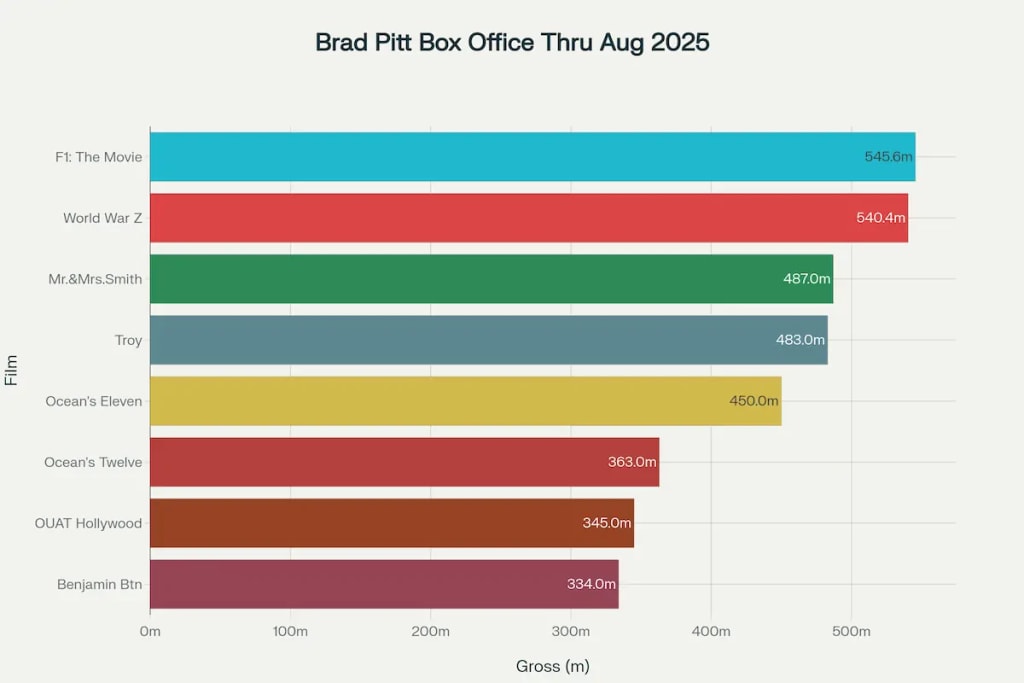
The success of the Apple Studios F1 film signifies a major shift in how entertainment companies approach content creation, where films are not only artistic projects but also sophisticated business tools designed to capture entire markets instead of just box office receipts.
The strategic genesis: More than just another racing film
The perfect storm of timing and opportunity
The Brad Pitt F1 movie’s success was not an accident; it capitalized on a cultural moment that had been building for years. The Netflix series Drive to Survive had already started to turn Formula 1 from a niche European motorsport into a worldwide entertainment phenomenon, especially in the United States. Since its 2019 debut, the docuseries is credited with lowering the average age of F1 viewers from 44 to 32 and significantly increasing the number of female viewers. This demographic change created the ideal conditions for Apple Studios to launch its most ambitious theatrical project yet.

Director Joseph Kosinski, fresh from the huge success of Top Gun: Maverick, brought both technical skills and a proven track record for blockbusters to the project. The collaboration with producer Jerry Bruckheimer and the participation of seven-time Formula 1 champion Lewis Hamilton as a producer and creative consultant guaranteed authenticity that serious racing fans would appreciate while still appealing to a broad audience. This was not just celebrity involvement—it was a strategic move to give the film credibility within the F1 community while expanding its reach beyond traditional motorsport fans.
The production was committed to authenticity in an unprecedented way. Instead of relying heavily on CGI or studio sets, the filmmakers embedded themselves in actual Grand Prix weekends, filming during the 2023 and 2024 World Championships. This decision, while significantly increasing production costs, created an immersive experience that captures the genuine atmosphere of Formula 1 racing in a way that previous motorsport films had struggled to achieve.
The Apple studios gambit: Cinema as strategic infrastructure
What makes the Brad Pitt F1 movie particularly interesting is not just its commercial success, but how it fits into Apple’s larger entertainment strategy. Apple Studios has had difficulty establishing a theatrical presence, with previous big-budget releases like Napoleon and Killers of the Flower Moon failing to generate significant box office returns. The company had reportedly been rethinking its strategy for wide theatrical releases, with most future films planned for limited cinema runs before streaming exclusively on Apple TV+.

F1: The Movie completely changed that calculation. The film’s success has justified Apple’s willingness to invest significant resources—with production costs estimated between $200–300 million—in projects that can serve multiple strategic purposes. In addition to box office revenue, the film works as a sophisticated marketing tool for Apple TV+ and positions the company for a potential expansion into live sports broadcasting.
This cinema streaming strategy reflects a fundamental change in how technology companies approach content creation. Rather than simply producing content for their platforms, companies like Apple are using theatrical releases as a way to build credibility and market presence in preparation for more profitable long-term opportunities.
Brad Pitt’s evolution: From star to strategic architect
Redefining celebrity in the digital age
At 61, Brad Pitt’s performance in F1: The Movie is more than just another leading role; it shows how established stars can stay relevant by aligning themselves with forward-thinking entertainment strategies. The film’s success, which surpassed his previous career high of World War Z‘s $540 million in global earnings, proves that star power is still important when used correctly within modern entertainment ecosystems.

Pitt’s involvement went far beyond his on-screen role. As both star and producer, he helped ensure the project’s authenticity through extensive preparation that included three months of intensive racing training with Formula 2 drivers. This dedication to realism was not just method acting; it was a strategic move to ensure the film would appeal to both casual moviegoers and knowledgeable motorsport enthusiasts.
His choice to work with Apple Studios instead of traditional Hollywood studios shows Pitt’s understanding of how the industry is changing. While established studios have become more risk-averse, technology companies like Apple are willing to invest heavily in prestigious projects that improve their brand image. For Pitt, this partnership provided creative freedom and significant financial backing while associating him with innovation rather than nostalgic franchise filmmaking.
The producer’s perspective: Building beyond performance
As a producer, Pitt showed a sophisticated understanding of how modern entertainment projects must work on multiple levels at the same time. The Brad Pitt movie career has always been characterized by smart project selection, but F1: The Movie is his most strategically complex project yet. By making sure the film’s production values were of the highest quality while still appealing to a wide audience, Pitt helped create a model for how A-list talent can successfully work with technology companies.
The film’s marketing also reflected this strategic thinking. Instead of relying only on traditional promotional methods, the production used its authentic F1 connections to create excitement within racing communities while using Pitt’s global appeal to attract mainstream audiences. This dual-approach marketing strategy played a significant role in the film’s ability to exceed box office expectations in both domestic and international markets.
The broader entertainment revolution: Corporate blockbusters and market consolidation
The streaming wars intensify through cinema
The success of the Brad Pitt F1 movie has accelerated Apple’s broader ambitions in the sports entertainment business. Reports suggest that Apple is now the top contender to secure U.S. broadcasting rights for Formula 1 starting in 2026, with bids reportedly between $120–150 million per year. This is a significant increase from ESPN’s current deal, which is estimated at $75–90 million per year.
| Platform | Sport/Property | Deal Value (Annual) | Contract Period | Status | Strategic Focus |
|---|---|---|---|---|---|
| Apple TV+ | Formula 1 (Potential) | $120-150M | 2026 onwards | Negotiating | Global F1 Growth |
| Netflix | WWE Raw | $500M | 2025-2035 | Confirmed | Live Programming |
| Amazon Prime Video | Thursday Night Football | $1B+ | 2023-2033 | Active | Premium Sports |
| ESPN | Formula 1 (Current) | $75-90M | 2018-2025 | Ending | Traditional Broadcasting |
| Disney+ | ESPN+ | N/A | Ongoing | Active | Sports Hub |
This potential acquisition would turn Apple TV+ from a premium streaming service into a major sports entertainment destination. The success of F1: The Movie provides crucial evidence that Apple can successfully monetize Formula 1 content while expanding its audience. Unlike traditional broadcasters who rely mainly on advertising revenue, Apple’s model allows for more experimental and subscriber-focused programming.
The success of Drive to Survive on Netflix has already shown how serialized sports content can keep audiences engaged all year. Apple’s potential combination of exclusive racing broadcasts with high-quality theatrical releases creates a complete entertainment ecosystem that competitors would find difficult to replicate. This vertical integration strategy represents the future of sports entertainment, where content, distribution, and technology all come together under a single corporate umbrella.
Hollywood corporate blockbusters: The new entertainment paradigm
F1: The Movie is an example of the rise of what could be called “platform blockbusters”—films designed not just to make money at the box office but to establish a market position for their parent companies. This approach is fundamentally different from traditional studio filmmaking, where individual projects succeed or fail mostly independently of broader corporate strategies.
Apple’s willingness to invest heavily in prestigious theatrical releases shows a recognition that cultural credibility requires more than just streaming success. By producing films that compete directly with traditional Hollywood blockbusters, technology companies can establish legitimacy within the entertainment industry while building relationships with top-tier talent and creative professionals.
This trend extends beyond Apple to include Amazon’s Prime Video investments and Netflix’s growing focus on theatrical prestige projects. The result is an entertainment landscape where films function as sophisticated marketing tools for much larger business goals. For audiences, this creates both opportunities—higher production values and more diverse funding sources—and potential concerns about creative independence and artistic vision.
Critical analysis: Spectacle, strategy, and substance
The art versus commerce equation
While F1: The Movie has achieved remarkable commercial success, its artistic merits are more complex. The film received generally positive reviews, with an 83% “fresh” rating on Rotten Tomatoes and an “A” CinemaScore from audiences. However, critics suggest that the film prioritizes spectacle and broad appeal over complex storytelling or thematic depth.
Compared to more sophisticated racing films like Ron Howard’s Rush (2013), F1: The Movie opts for emotional accessibility rather than psychological complexity. This approach reflects the film’s main purpose as an entertainment product designed for global audiences rather than for awards or critical acclaim. The choice represents the broader trend of Hollywood corporate blockbusters toward projects that maximize international appeal while minimizing cultural or narrative friction.
The film’s technical achievements, however, deserve recognition. The authentic racing sequences, filmed during actual Grand Prix events with specially modified Formula 2 cars, deliver a visceral excitement that few motorsport films have achieved. Hans Zimmer’s score and Joseph Kosinski’s direction create genuine spectacle that justifies the theatrical experience while serving the film’s broader strategic purposes.
The cultural impact question
Beyond box office numbers, F1: The Movie‘s cultural significance lies in its demonstration of how entertainment properties can reshape audience relationships with sports and technology brands. The film’s success has already contributed to increased interest in Formula 1 in key markets, particularly the United States, where the sport has historically struggled to achieve sustained popularity.
This cultural bridging function is one of the most sophisticated aspects of modern entertainment strategy. Rather than simply capitalizing on existing popularity, successful projects like F1: The Movie can actively create cultural momentum that benefits everyone involved—the sport, the streaming platform, the talent, and audiences looking for new forms of entertainment.
The film’s influence goes beyond motorsport to include broader questions about celebrity culture, corporate ownership of entertainment, and the future of theatrical experiences. As technology companies increasingly dominate entertainment production and distribution, projects like F1: The Movie provide crucial data about audience preferences and market dynamics that will influence industry decisions for years to come.
Future implications: The road ahead
Redefining entertainment success metrics
The success of the Brad Pitt F1 movie suggests that traditional ways of measuring entertainment success—box office receipts, critical acclaim, and awards—may no longer be enough to evaluate modern projects. When films function as parts of larger strategic initiatives, their value extends far beyond theatrical performance to include market positioning, brand enhancement, and platform development.
This evolution creates new opportunities for creative professionals who are willing to embrace hybrid commercial-artistic approaches while potentially limiting the space for more experimental or purely artistic projects. The financial resources that technology companies can use for entertainment content far exceed what traditional studios can do, but their ultimate goals may prioritize platform growth and market expansion over creative innovation.
For audiences, this change offers both better production values and potential concerns about creative homogenization. As entertainment becomes more and more integrated with technology platforms and corporate strategies, maintaining a diversity of voices and perspectives becomes a crucial challenge for industry stakeholders and cultural critics alike.
The streaming sports entertainment convergence
Apple’s potential acquisition of Formula 1 broadcasting rights would be a significant milestone in the evolution of the sports entertainment business. Unlike traditional broadcasters who have to balance multiple sports properties and programming obligations, technology companies can afford to focus intensely on specific sports that align with their brand positioning and audience demographics.
This focused approach could revolutionize how sports content is produced, marketed, and consumed. Apple’s integration of high-quality film content with live broadcasts, enhanced by their technological capabilities for interactive and immersive viewing experiences, might set new standards for sports entertainment that competitors struggle to match.
The success of F1: The Movie gives Apple crucial credibility within both the entertainment and sports communities, positioning them as serious long-term partners rather than opportunistic technology disruptors. This credibility will be essential as they navigate complex relationships with sports organizations, broadcast partners, and regulatory authorities in multiple international markets.
Conclusion: The checkered flag of entertainment evolution
The remarkable success of the Brad Pitt F1 movie is more than just a career milestone for one of Hollywood’s most enduring stars. It signals a fundamental change in how entertainment content works within larger technology and media ecosystems, where films serve as artistic projects, marketing tools, and strategic business initiatives all at once.
Apple Studios’ willingness to invest significant resources in theatrical releases that support their streaming platform ambitions shows how technology companies are reshaping the dynamics of the entertainment industry. For Brad Pitt, the project represents a successful adaptation to these new realities while maintaining his position as a globally recognized star capable of anchoring major international productions.
As the entertainment landscape continues to evolve, F1: The Movie will likely be remembered as a crucial turning point—the moment when technology companies proved they could compete directly with traditional Hollywood studios while building the foundations for even more ambitious long-term strategies. Whether this evolution ultimately benefits creators, audiences, and cultural diversity remains an open question, but the immediate results suggest that strategic entertainment integration has become an irreversible industry trend.
The film’s success proves that with the right timing, authentic execution, and strategic vision, entertainment projects can go beyond their immediate commercial goals to influence entire industries and cultural movements. In racing terms, Apple Studios has taken pole position in a race that has only just begun.