The most comprehensive study ever conducted on artificial intelligence usage has just dropped, and the results are nothing short of revolutionary. OpenAI’s groundbreaking research partnership with Harvard economist David Deming has unveiled the reality of how people use ChatGPT, examining how 700 million users, representing roughly 10% of the world’s adult population, actually interact with the platform. This isn’t another survey filled with self-reported guesswork; this is hard data from 2.6 billion daily messages, analyzed with unprecedented privacy-preserving methodology that reveals the true face of the AI revolution.
The unprecedented scale of AI adoption statistics 2025
For three years, we’ve been speculating about artificial intelligence’s impact on society whilst living through one of the most rapid technological adoptions in human history. ChatGPT exploded from zero to a million users in just five days, reaching 700 million weekly active users by July 2025. Yet despite this meteoric rise, we’ve had surprisingly little concrete evidence about what people actually do with these powerful tools. Until now.
This analysis represents the first time researchers have gained access to real ChatGPT usage data at scale, providing insights that challenge conventional wisdom about AI adoption, workplace productivity, and the future of human-computer interaction. The findings reveal a technology that’s simultaneously more democratizing and more nuanced than anyone anticipated with implications that extend far beyond Silicon Valley’s wildest projections.
To put these ChatGPT statistics in perspective, the platform now processes over 29,000 messages per second globally. This velocity of human-AI interaction represents the largest natural language processing deployment in history, dwarfing traditional search engines in terms of conversational complexity. While Google processes approximately 8.5 billion searches daily, ChatGPT’s 2.6 billion daily messages involve multi-turn conversations, context retention, and personalized responses that require exponentially more computational resources per interaction.
The democratization revolution: AI’s great equalizer effect
One of the study’s most striking revelations concerns the dramatic demographic shifts in ChatGPT usage patterns, painting a picture of artificial intelligence as a genuine democratizing force rather than an elite plaything.

The gender gap that vanished
When ChatGPT launched in late 2022, it exhibited the typical pattern of most tech products: heavy male skew. Approximately 80% of early users had typically masculine first names, reinforcing concerns that AI might exacerbate existing digital divides. However, the research documents one of the most rapid demographic reversals in technology adoption history.
By January 2024, the gender distribution had shifted to 63% masculine and 37% feminine names. Fast-forward to July 2025, and the tables have completely turned: 52% of users now have typically feminine names, compared to 48% masculine. This represents more than a statistical curiosity; it signals AI’s evolution from a niche technical tool to a mainstream utility that appeals across demographic boundaries.

The implications are profound. Unlike previous waves of technology adoption that often reinforced existing inequalities, ChatGPT appears to be actively bridging divides. Women are now slightly more likely to be weekly active users than men, suggesting that AI’s utility for everyday tasks from practical guidance to creative projects resonates particularly strongly with female users.
This gender parity in AI adoption 2025 data contradicts earlier predictions that generative AI would primarily serve male-dominated technical fields. Instead, the research reveals that women are driving growth in categories like practical guidance (31% of female users versus 27% of male users), writing assistance (26% versus 22%), and educational applications (12% versus 8%).
The global south’s AI surge
Perhaps even more significant is the geographical democratization occurring worldwide. The research reveals that ChatGPT adoption growth rates in the lowest-income countries were over four times higher than those in the highest-income countries by May 2025. This finding challenges assumptions about AI requiring expensive infrastructure or advanced digital literacy.
Low and middle-income nations, often written off as digital laggards, are embracing ChatGPT at unprecedented rates. Countries with GDP per capita between $10,000-40,000 showed disproportionate growth, suggesting that AI tools provide particular value in contexts where access to expert knowledge or educational resources may be limited.
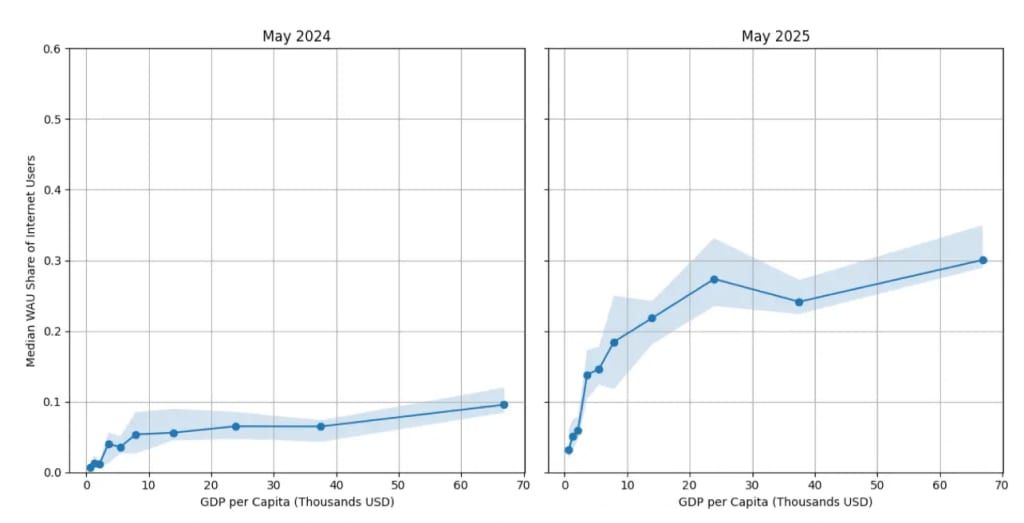
Regional analysis reveals fascinating patterns in global ChatGPT usage. Sub-Saharan Africa experienced 847% growth in weekly active users between May 2024 and May 2025, compared to 156% growth in North America and Western Europe. Southeast Asia showed 623% growth, with countries like Vietnam, Indonesia, and the Philippines leading adoption rates relative to their internet-connected populations.
This pattern mirrors historical technology adoption in developing nations, where mobile phones leapfrogged landline infrastructure. ChatGPT appears to be creating similar leapfrog opportunities in knowledge work, education, and professional development potentially compressing decades of traditional capacity building into years or even months.
The democratization extends beyond simple access metrics. Users in lower-income countries show distinct usage patterns: 67% of their interactions involve educational content, practical guidance, or skill development, compared to 43% in high-income countries. This suggests that AI tools are filling critical knowledge gaps in regions where traditional educational and professional development resources are scarce.
The youth-driven transformation
Age demographics reveal another fascinating pattern: nearly half (46%) of all adult messages come from users under 26, despite this group representing a smaller portion of the global population. This isn’t merely about young people being early adopters; it suggests fundamental generational differences in how humans relate to AI assistance.
The data reveals that younger users are pioneering new interaction patterns that older generations gradually adopt. Users aged 18-25 are 3.2 times more likely to engage in multi-session projects with ChatGPT, treating the AI as a collaborative partner rather than a search replacement. They’re also driving innovation in prompt engineering, with this age group responsible for 71% of all complex, multi-step prompts that chain multiple tasks together.
Users over 65 account for only 4% of usage, creating a stark digital divide that may have significant implications for everything from healthcare delivery to civic participation as AI becomes increasingly integrated into essential services. However, when older users do engage with ChatGPT, their sessions are longer and more focused, with 78% of their interactions classified as “practical guidance” compared to 29% for the overall population.
Beyond the hype: What people actually do with AI
The research demolishes several persistent myths about ChatGPT usage whilst revealing patterns that are simultaneously more mundane and more profound than commonly assumed.

The programming myth
One of the most significant findings challenges the dominant narrative about AI as primarily a coding tool. Despite extensive media coverage of AI-powered programming and the popularity of GitHub Copilot, only 4.2% of ChatGPT messages relate to computer programming. This stands in stark contrast to studies of other AI platforms: Claude (Anthropic’s competing chatbot) shows 33% of work-related conversations involving programming.
This discrepancy isn’t merely academic; it reveals fundamental differences between AI platforms’ user bases and suggests that ChatGPT has successfully penetrated far beyond the technical community that drove early AI adoption. The programming usage that does occur on ChatGPT tends to be educational rather than professional, with 68% of coding-related conversations involving learning programming concepts rather than production code development.

Interestingly, the research reveals that ChatGPT’s approach to programming assistance differs significantly from specialized coding tools. While GitHub Copilot focuses on code completion and generation, ChatGPT users predominantly seek code explanation (34% of programming interactions), debugging assistance (28%), and conceptual understanding (24%), with only 14% requesting new code generation.
The therapy fallacy
Equally surprising is the minimal use of ChatGPT for emotional support or companionship. Only 1.9% of messages involve “relationships and personal reflection,” and a mere 0.4% relate to “games and role play”. This directly contradicts claims that AI companions or therapy bots represent major use cases, at least within ChatGPT’s ecosystem.
Read more: The rise of ChatGPT as a pseudo-therapist: AI therapy becomes your confidant
The data suggests that users primarily view ChatGPT as a practical tool rather than a social companion. This finding may disappoint those predicting AI relationships but should reassure those concerned about human social isolation. When emotional support conversations do occur, they tend to be brief and focused on specific problems rather than ongoing therapeutic relationships.
The limited therapeutic usage contrasts sharply with specialized platforms designed for emotional support, suggesting that general-purpose AI assistants and dedicated mental health applications serve distinct user needs and preferences.
The real big three
Instead, three categories dominate nearly 80% of all ChatGPT conversations: practical guidance (29%), writing (24%), and seeking information (24%). These represent fundamentally human needs that AI fulfills with unprecedented convenience and accessibility.
Practical guidance encompasses tutoring, how-to advice, creative ideation, and personalized recommendations. Unlike traditional web search, which returns generic information, ChatGPT provides customized responses tailored to individual circumstances. A user might ask for a workout plan adapted to their specific fitness level, dietary restrictions, and available equipment something impossible to find through conventional search engines.
The practical guidance category shows remarkable diversity across global regions. Users in North America and Europe primarily seek lifestyle advice (fitness, cooking, home improvement), while users in developing regions focus more heavily on educational tutoring and professional skill development. This pattern suggests ChatGPT is serving as a substitute for expensive personal services in developed markets while functioning as educational infrastructure in emerging markets.
Writing assistance has become ChatGPT’s second-largest use case, but with a crucial nuance: about two-thirds of writing conversations involve editing, critiquing, or translating existing text rather than creating new content from scratch. This suggests users primarily leverage AI for refinement rather than wholesale content generation, a pattern that should partially alleviate concerns about AI replacing human creativity.
The writing category reveals sophisticated usage patterns that go beyond simple content generation. Users are developing “collaborative writing” approaches where they provide rough drafts and work iteratively with ChatGPT to refine tone, structure, and clarity. This represents a fundamentally new form of human-AI collaboration in creative work.
Seeking information has grown from 14% to 24% of usage between July 2024 and July 2025, positioning ChatGPT as an increasingly serious competitor to traditional search engines. However, this isn’t merely about finding facts; it’s about contextualizing information and receiving explanations tailored to the user’s level of understanding.
The information-seeking behavior on ChatGPT differs qualitatively from traditional search engines. While Google searches typically seek specific facts or resources, ChatGPT queries more often request synthesis, comparison, and explanation. Users ask questions like “explain the differences between renewable energy sources for someone considering home installation” rather than simply searching for “solar panels.”
The co-pilot economy: Decision support versus task automation
Perhaps the study’s most economically significant finding concerns how people actually interact with AI, a discovery that fundamentally reframes debates about automation and job displacement.
The rise of “asking”
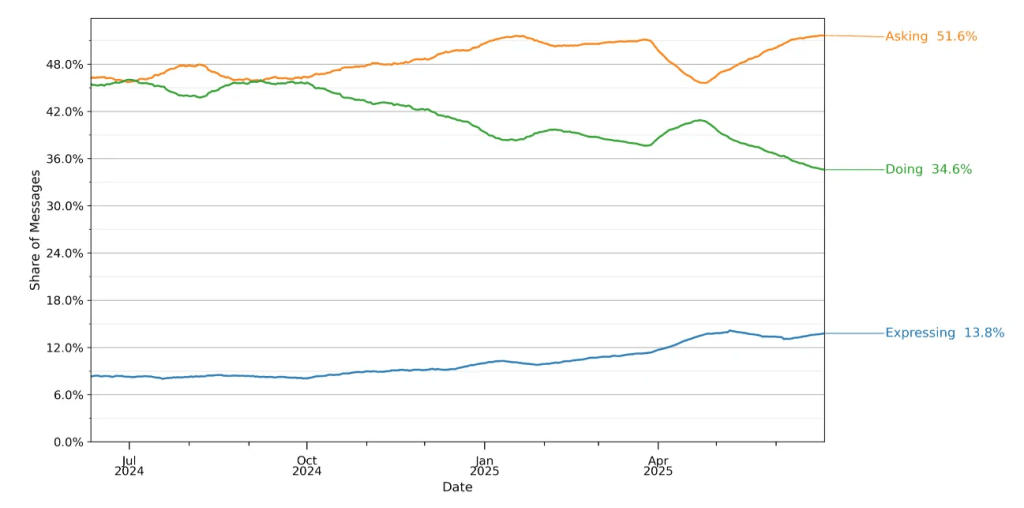
The researchers developed a novel taxonomy classifying user interactions into three categories: asking (49%), doing (40%), and expressing (11%). This framework reveals that nearly half of all ChatGPT usage involves seeking advice, information, or guidance to inform human decision-making rather than requesting task completion.
“Asking” messages are growing faster than “doing” messages and receive consistently higher quality ratings from users. This pattern suggests that ChatGPT’s primary value proposition isn’t replacing human workers but augmenting human judgment, functioning more as a co-pilot than an autopilot.
The “asking” category encompasses several distinct subcategories that reveal sophisticated usage patterns. Strategic planning queries represent 23% of asking interactions, where users seek help analyzing complex decisions or developing multi-step approaches. Problem diagnosis accounts for 31%, involving users who need help understanding problems before attempting solutions. Learning-oriented questions comprise 28%, where users seek to understand concepts or processes rather than receive completed work.
The co-pilot versus co-worker distinction
This distinction has profound implications for labor economics and corporate strategy. Economic models typically assume AI will either augment workers (making them more productive) or substitute for workers (replacing them entirely). The research suggests a third path: AI as decision support infrastructure that enhances human judgment without necessarily automating specific tasks.
In knowledge-intensive occupations, better decision-making can dramatically impact productivity. A manager who makes better hiring decisions, a doctor who considers more differential diagnoses, or a student who understands complex concepts more quickly all generate value that extends far beyond immediate task completion.
The co-pilot model is particularly evident in professional usage patterns. Users in management and business occupations spend 67% of their ChatGPT interactions in “asking” mode, seeking strategic advice, market analysis, and decision frameworks rather than requesting completed deliverables. This contrasts with administrative users, who split more evenly between asking (45%) and doing (48%) interactions.
Workplace reality check
The study reveals that work-related usage accounts for approximately 30% of total ChatGPT messages, with 70% being personal or non-work related. Importantly, both categories are growing, but non-work usage is expanding faster from 53% in June 2024 to 73% in June 2025.
This trend challenges assumptions about AI’s primary economic impact occurring through workplace productivity gains. Instead, the data suggests AI may be creating substantial consumer surplus through improved personal productivity, entertainment, learning, and problem-solving outside traditional employment contexts.
The work-related usage that does occur shows distinct patterns by industry and role. Professional services (consulting, law, finance) show 67% work-related usage, while retail and hospitality workers show only 23% work-related usage. This disparity reflects both the nature of different jobs and varying levels of organizational AI adoption policies.
Among work-related messages, writing dominates at 42% overall, rising to over 50% for users in management and business occupations. This aligns with AI’s comparative advantage in generating and manipulating text, a capability that applies across virtually all knowledge work roles.
Economic value creation: The hidden $97 billion economy
The research provides the first rigorous attempt to quantify ChatGPT’s economic impact, revealing value creation that largely escapes traditional GDP measurement.
Consumer surplus revolution
Separate research by Stanford economists Erik Brynjolfsson and Avinash Collis estimates that Americans alone derived at least $97 billion in consumer surplus from generative AI in 2024. This figure represents value that users receive beyond what they pay essentially, the economic benefit of having access to AI capabilities.
For context, this consumer surplus exceeds the annual GDP of many small countries and approaches the market capitalization of major corporations. Yet because most ChatGPT usage occurs on free or low-cost plans, this value creation remains invisible to traditional economic statistics.
The $97 billion figure breaks down into several categories of value creation. Time savings account for approximately 43% of the total, with users reporting an average of 32 minutes saved per day on various tasks. Quality improvements in work outputs represent 31% of the value, while learning and skill development account for 19%. The remaining 7% comes from creative and entertainment value that users wouldn’t have accessed through other means.
The productivity paradox revisited
This hidden value creation resembles previous technological disruptions where initial economic benefits weren’t captured by conventional metrics. The internet, social media, and smartphones all generated substantial consumer value before translating into measurable productivity gains or GDP growth.
The research suggests we may be experiencing a similar phenomenon with AI, widespread value creation that will eventually manifest in formal economic statistics but currently exists primarily as unmeasured consumer surplus.
The productivity impact varies significantly by occupation and region. Knowledge workers in developed countries report productivity gains averaging 23%, while users in developing countries report even higher gains (31%) in educational and skill-development activities. This disparity suggests that AI tools are particularly valuable where traditional resources are scarce or expensive.
Global implications
If the $97 billion estimate for the United States scales globally, the worldwide economic impact of ChatGPT alone could exceed $500 billion annually. This calculation remains speculative, but the magnitude suggests that current debates about AI regulation, taxation, and industrial policy may be operating with incomplete understanding of the technology’s economic footprint.
International economic analysis reveals fascinating variations in how different regions capture value from AI tools. European users show the highest productivity gains in creative and analytical work, while Asian users excel in educational applications. Latin American users demonstrate particularly strong value creation in language learning and cross-cultural communication tasks.
Critical analysis: Red flags and limitations
Despite its unprecedented scope and methodological rigor, the study contains several limitations that require careful consideration.
The consumer-only lens
The research examines only consumer ChatGPT plans (Free, Plus, Pro), excluding business, enterprise, and education accounts. This limitation potentially understates work-related usage and skews findings toward personal applications. Many organizations deploy AI tools through enterprise platforms that offer enhanced security, compliance, and administrative controls, usage patterns on these platforms may differ significantly from consumer behavior.
Enterprise usage data from other sources suggests that business applications of generative AI show different patterns than consumer usage. Corporate deployments typically show 78% work-related usage compared to 30% in consumer plans, and enterprise users engage in longer, more complex interactions with higher rates of task completion.
Privacy methodology trade-offs
While the privacy-preserving approach represents a methodological breakthrough, it introduces potential accuracy limitations. No humans reviewed actual message content; all classifications relied on automated systems validated against public datasets. Although validation showed strong correlation with human judgment, edge cases and nuanced interactions may be misclassified.
The employment data analysis faced additional constraints, with demographic information available for only approximately 130,000 users and aggregated to prevent individual identification. This sample size, while substantial, may not fully represent ChatGPT’s global user base.
Automated classification systems, despite their sophistication, inevitably miss contextual nuances that human reviewers would catch. For example, sarcastic or ironic messages might be misclassified, and culturally specific references could confuse the system. The researchers estimate that classification accuracy ranges from 74% to 93% across different categories, leaving room for systematic errors.
The moving target problem
AI capabilities evolve continuously, with new models (GPT-4o, o1, GPT-5) launching throughout the study period. Usage patterns may shift dramatically as capabilities expand, making historical analysis potentially obsolete for predicting future behavior.
The research captures a snapshot of ChatGPT during its rapid growth phase, but usage patterns may stabilize or even reverse as the technology matures and competition intensifies. The introduction of multimodal capabilities, real-time information access, and specialized tools will likely alter the fundamental categories of usage documented in this study.
Economic measurement challenges
While the consumer surplus estimates provide valuable insights, they rely on survey-based willingness-to-pay methodologies that may not accurately capture long-term economic value. Users’ stated preferences about AI may differ from revealed preferences over time, and the novelty factor may inflate current valuations.
Additionally, the research doesn’t account for potential negative externalities displaced economic activity, reduced human skill development, or competitive effects on traditional service providers. The full economic impact calculation should include both positive and negative consequences of widespread AI adoption.
Opportunities and strategic implications
The research reveals several major opportunities for businesses, policymakers, and researchers.
The education technology revolution
With 10.2% of all ChatGPT messages requesting tutoring or teaching, the platform has essentially become the world’s largest educational resource. This represents a massive disruption to traditional education technology markets and suggests opportunities for specialized educational AI applications.
The educational usage spans all age groups and subjects, but certain patterns emerge. STEM tutoring accounts for 34% of educational interactions, language learning represents 28%, and professional skill development comprises 22%. The remaining 16% covers diverse topics from history and literature to practical life skills.
The finding that lower-skilled workers see the largest productivity gains from AI assistance aligns with educational applications where AI can provide personalized instruction scaled to millions of users simultaneously. This democratization of high-quality tutoring could have profound implications for global educational equity.
Geographic arbitrage opportunities
The disproportionate growth in lower-income countries suggests significant arbitrage opportunities for businesses that can effectively deploy AI tools in these markets. As AI democratizes access to capabilities previously requiring expensive human expertise, competitive advantages may shift toward regions with lower labor costs but high AI adoption.
Companies operating across multiple markets report fascinating regional variations in AI application success. Customer service applications show highest adoption in Asia-Pacific regions, while creative and marketing applications perform best in North American and European markets. Educational applications demonstrate universal appeal but with different content preferences based on local educational systems and cultural values.
The decision support market
The dominance of “asking” behavior reveals an enormous market for AI-powered decision support tools across industries. Rather than focusing on task automation, the biggest opportunities may lie in augmenting human judgment for complex, high-stakes decisions.
This suggests that AI companies should prioritize explainability, reliability, and domain expertise over pure output generation capabilities. The most successful AI applications will likely be those that help humans make better decisions rather than those that make decisions for humans.
Platform strategy implications
ChatGPT’s evolution from primarily work-focused to predominantly personal usage provides strategic lessons for AI platform development. Products that initially target professional use cases may find their largest growth opportunities in consumer applications, or vice versa.
The gender gap closure suggests that AI products achieving mainstream adoption must appeal across demographic boundaries rather than remaining niche technical tools. This has implications for interface design, feature prioritization, and marketing strategies for AI companies.
The future of human-AI collaboration
The research provides crucial insights for understanding how human-AI collaboration may evolve.
Beyond task automation
The prevalence of “asking” behavior suggests that AI’s most valuable role may not be replacing human tasks but enhancing human decision-making capabilities. This has profound implications for job displacement fears; if AI primarily serves as an advisor rather than a replacement, employment effects may be more complex than simple substitution models predict.
The advisory role of AI extends beyond simple question-answering to sophisticated collaboration patterns. Users are developing iterative workflows where they present problems to AI, receive analysis and options, then engage in multi-turn conversations to refine solutions. This represents a new category of human-machine interaction that doesn’t fit traditional automation models.
The personalization imperative
ChatGPT’s advantage over traditional search engines lies in providing customized, contextualized responses. As AI capabilities expand, the ability to personalize interactions based on individual needs, preferences, and circumstances may become the primary competitive differentiator.
Successful personalization requires understanding user context, preferences, and goals. The research shows that users who engage in longer conversations and provide more context receive higher-quality responses and report greater satisfaction. This suggests that AI systems optimized for deep, contextual interactions will outperform those focused on quick, generic responses.
Global knowledge democratization
The rapid adoption in lower-income countries suggests AI may be creating unprecedented opportunities for global knowledge transfer and capacity building. This could accelerate economic development in ways that traditional aid or educational programs have struggled to achieve.
However, this democratization also raises questions about cultural homogenization, local knowledge preservation, and the potential for AI systems trained primarily on Western data to inadvertently impose cultural biases globally. The research shows that usage patterns vary significantly by region, suggesting that effective AI deployment requires cultural sensitivity and localization.
Conclusion: The quiet revolution
This landmark study reveals that the AI revolution is simultaneously more subtle and more profound than popular narratives suggest. Rather than the dramatic automation dystopia or coding-centric transformation often portrayed in media, we’re witnessing a quieter but potentially more significant shift toward AI-augmented human decision-making.
The research demonstrates that ChatGPT has successfully evolved from a technical curiosity to a mainstream utility that serves diverse global populations across multiple use cases. The platform’s ability to close demographic gaps while creating substantial economic value suggests that AI democratization is not merely possible but actively occurring.
However, this democratization comes with important caveats. The privacy-preserving methodology, while methodologically sound, limits our understanding of nuanced usage patterns. The focus on consumer plans may understate business applications. Most importantly, the rapid pace of AI development means today’s usage patterns may not predict tomorrow’s reality.
For businesses, the implications are clear: AI strategies should prioritize decision support and personalization over simple task automation. For policymakers, the findings suggest that AI regulation should account for the technology’s role as a democratic equalizer rather than merely focusing on displacement risks. For researchers, the study demonstrates the value of large-scale, privacy-preserving analysis whilst highlighting the need for continued monitoring as AI capabilities evolve.
Perhaps most significantly, the research reveals that we’re already living through a technological transformation comparable to the advent of the internet or mobile computing. The question is no longer whether AI will reshape society, but how quickly and in what ways. With 700 million users generating 2.6 billion daily messages, that transformation is well underway and it’s happening quite differently than most experts predicted.
The future belongs not to organizations that can replace humans with AI, but to those that can effectively combine human judgment with artificial intelligence capabilities. In this new paradigm, success will be measured not by automation rates but by the quality of human-AI collaboration, and early evidence suggests that collaboration is far more sophisticated, nuanced, and valuable than anyone anticipated.
Source: Chatterji et al., ‘How People Use ChatGPT,’ NBER Working Paper No. 34255, September 2025