Every single day, millions of people ask ChatGPT questions, copy the answers directly, and publish them without so much as a cursory glance. They trust the tool completely, which is rather like getting into your car, pulling on a blindfold, and hoping the navigation system doesn’t drive you off a cliff. The truth is, people are using artificial intelligence tools with alarming carelessness, treating them as infallible oracles when they’re actually probabilistic engines making educated guesses about which words should come next. Whilst AI has genuinely extraordinary capabilities, the way most users interact with these tools fundamentally misunderstands what they are, how they work, and what they’re actually good for. This article cuts through the hype and explains exactly how to use ChatGPT effectively, not as an infallible oracle, but as something far more useful: a thinking partner that requires your constant, active oversight.
The reality of AI hallucinations: Understanding the numbers
To understand why blindly trusting ChatGPT is dangerous, we need to talk about a phenomenon that makes researchers lose sleep: hallucination. This is where AI generates plausible-sounding information that is completely fabricated. It’s not a glitch but rather baked into how these systems work at their core. ChatGPT doesn’t “know” facts the way humans do. It predicts the statistically likely next word based on patterns in its training data. Sometimes those predictions are spot-on. Sometimes they’re wildly, catastrophically wrong.
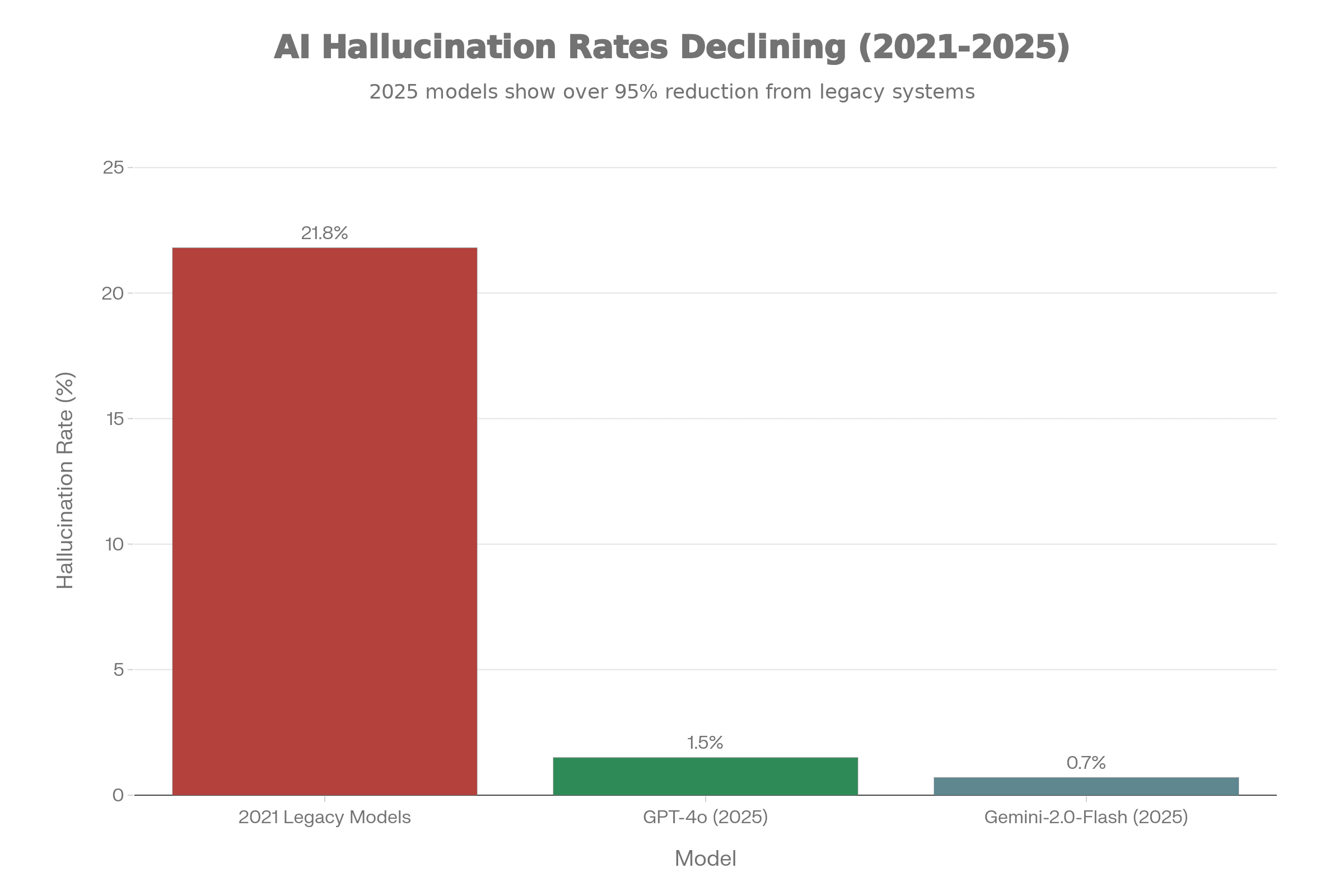
The data is sobering. According to recent 2025 benchmarking studies, ChatGPT’s GPT-4o model hallucinates approximately 1.5% of the time, which sounds minor until you realise that even a 1% error rate means you cannot trust any individual piece of information without verification. But this varies dramatically by task complexity. When researchers tested ChatGPT and other models on systematic reviews (a task requiring synthesis of multiple sources), hallucination rates skyrocketed. In one peer-reviewed study, GPT-3.5 hallucinated in 39.6% of citations, GPT-4 in 28.6%, and Bard (now Gemini) achieved a staggering 91.4% hallucination rate when asked to generate academic references. Even more alarming, when OpenAI tested its newer reasoning models like o3 and o4-mini on factual questions, hallucination rates climbed to between 33% and 79% depending on the benchmark.
Current hallucination rates for major AI models demonstrate significant variance, with newer models like Gemini-2.0-Flash leading at 0.7% whilst older or less optimised models struggle with rates exceeding 10%. What’s crucial to understand is that improvement is happening. Hallucination rates have dropped from 21.8% in 2021 to just 0.7% in 2025 for the best models like Gemini-2.0-Flash-001. But improvement does not equal perfection. Every single percentage point of error represents thousands of people reading false information confidently presented as fact. The highest-performing model, Gemini-2.0-Flash, still occasionally manufactures information. GPT-4o still does. They all do.
The question isn’t whether AI hallucinates, because it does. The question is: how do we use these tools knowing this reality? And perhaps more importantly, how do we build habits that protect us from the consequences of those hallucinations? Understanding the statistical nature of these errors is the first step towards developing a healthier relationship with AI tools. When you know that even the best systems fail a small percentage of the time, you begin to appreciate why verification isn’t optional but essential.

The GPS analogy: Why analogies matter
Here’s a useful mental model: think of ChatGPT exactly like a satellite navigation system. This analogy works because both tools share surprising similarities, and understanding this comparison will fundamentally change how you interact with AI.
When you use a GPS, you don’t blindly follow every instruction. If the GPS tells you to turn left but you see a “No Entry” sign, you ignore the GPS and obey the sign. If the navigation suggests a route through a flood zone, you take an alternative path. You use the GPS to augment your decision-making, not to replace it. You benefit from its ability to see the whole road network and traffic patterns, things you cannot see from ground level. But you remain in the driver’s seat, attentive and ready to override.
Similarly, you should use ChatGPT to augment your thinking, not replace it. Use it to handle what it does brilliantly: summarising massive documents in seconds, brainstorming fifty ideas at once, formatting content, debugging code, or exploring a topic from multiple angles. These are the “traffic alerts” and “route suggestions” where the GPS truly shines. But just as you never blindly follow GPS directions into obviously dangerous territory, you must never blindly publish AI-generated content without verification.
+ Read more: The ultimate AI model comparison for 2025: Strengths, weaknesses, and how to choose the right LLM for you
The GPS analogy extends further. When you drive a familiar route you’ve travelled a hundred times, do you ignore the GPS entirely? No, most people still use it to check for unexpected traffic, roadworks, or accidents. Similarly, if you’re an expert in your field, you should still use ChatGPT to speed up your workflow. But precisely because you know the “route,” you’ll instantly spot when the AI has made a detour into fiction. An accountant using ChatGPT for tax advice will catch made-up tax codes. A lawyer using it for legal arguments will spot fabricated case law. But a non-expert asking the same system for the same information? They won’t have a chance.
Think about how GPS systems have evolved over the years. Early satellite navigation units were notorious for outdated maps, sending drivers down roads that no longer existed or missing entirely new motorways. Modern GPS systems update regularly, incorporate real-time traffic data, and learn from user feedback. Yet despite all these improvements, no driver would dream of following GPS instructions without paying attention to the actual road conditions. We’ve collectively learned that technology assists judgement but never replaces it.
The same evolutionary process is happening with AI right now. Early language models were crude and obvious in their failures. Modern systems like GPT-4o produce outputs so sophisticated that errors blend seamlessly with accurate information. This makes them simultaneously more useful and more dangerous. A GPS that occasionally suggests turning into a lake is obviously broken. An AI that weaves fabricated citations into otherwise accurate analysis is far harder to catch.
This brings us to the most important principle of using AI effectively: the human must always remain the expert driver. The tool can suggest routes, highlight obstacles, and process information at speeds humans cannot match. But responsibility for the final destination, and for safely navigating the journey there, rests entirely with you.
The “blindfolded” problem: Why most people get it wrong

The problem begins with a misconception about what ChatGPT is. It’s presented as a search engine replacement, a knowledge base, a research tool. It’s none of those things fundamentally. It’s a language prediction machine. You feed it text (a prompt), and it predicts, with remarkable statistical accuracy, what text should come next. This prediction is so good that it feels like knowledge. It feels authoritative. It sounds certain. But beneath the surface, there’s no actual “understanding” of truth. There’s pattern recognition, weighted by what appeared frequently in training data.
Here’s where people go wrong: they treat this pattern-matching prowess as equivalent to comprehension. They assume that because ChatGPT answers with confidence, it’s answering with accuracy. They read the output, think “that sounds right,” and move on. The term researchers use is “anthropomorphisation.” We attribute human-like understanding to a system that doesn’t actually understand anything.
The consequences are measurable. In medical fields, when researchers tested ChatGPT’s ability to diagnose rare diseases, error rates jumped to 83%. In complex legal tasks, accuracy dropped to 50% or lower. Yet for each of these tasks, users reported feeling confident in the results. The scariest type of AI error isn’t an obvious mistake but rather the plausible lie told with complete confidence. The GPS occasionally taking a wrong turn is recoverable. A cancer diagnosis delivered with perfect grammar and calm certainty, but completely wrong, is not.
This confidence problem extends beyond just the words on screen. The entire user interface of modern AI tools reinforces trust. ChatGPT presents information in clean, well-formatted paragraphs. It uses proper grammar and sophisticated vocabulary. It rarely hedges or expresses uncertainty. When it does admit limitations, it often does so in ways that feel like false modesty rather than genuine epistemic humility. The system is designed, intentionally or not, to inspire confidence.
Compare this to how human experts communicate uncertainty. A doctor might say, “Based on these symptoms, I’m fairly confident this is X, but we should run tests to rule out Y and Z.” A lawyer might hedge with, “Precedent suggests this interpretation, though courts in different jurisdictions have ruled differently.” These qualifications aren’t weakness. They’re professionalism. They signal the boundaries of knowledge and the presence of judgement.
AI systems, trained to produce fluent text, have learned that confidence reads better than uncertainty. Hedging makes prose choppy. Qualifications interrupt flow. So the models learn to commit, even when commitment isn’t warranted. This creates a peculiar psychological trap: the more confidently an AI states something false, the more likely humans are to believe it without checking.
This is why treating AI like an autopilot is catastrophically dangerous. When you rely on it completely, you lose the chance to catch errors until it’s too late. You become a passenger instead of a driver. And passengers don’t notice when the route is wrong until they’ve driven off a cliff.
How to use ChatGPT effectively: The defensive AI framework
So how do you actually use ChatGPT the right way? It requires adopting what we can call the “defensive AI” mindset, a set of practices borrowed from defensive driving that translates perfectly to AI usage.
Step one: Be extremely specific with your prompts
The first rule of getting good results from AI is understanding that vague prompts produce vague, useless outputs. Your prompt is the destination you’re giving the GPS. If you say “take me somewhere nice,” the system might take you to a random scenic park when you wanted a Michelin-starred restaurant. The garbage-in, garbage-out principle applies with brutal consistency.
Instead of asking ChatGPT “Tell me about digital marketing,” ask it “Explain five specific digital marketing strategies for small e-commerce businesses selling sustainable clothing to Gen Z audiences, emphasizing platforms where they spend time.” Instead of “Write me a summary,” ask “Summarise this academic paper in exactly 150 words, focusing on the methodology section and the limitations the authors identified, using formal academic tone but accessible language.”
Specificity dramatically improves output quality. Research on ChatGPT usage shows that marketing agencies reduced editing time by 50% simply by crafting precise prompts instead of vague ones. A legal services firm using ChatGPT to draft client emails reported 40% reduction in revision time by specifying word limits and tone.
The technique is sometimes called “chain-of-thought prompting.” Instead of asking for a final answer, ask the AI to think through a problem step-by-step. Ask it to explain its reasoning. Ask it to consider counterarguments. This slows the system down and makes errors more visible. When you force the AI to show its work, you create opportunities to spot logical leaps, unfounded assumptions, or complete fabrications before they make it into your final output.
Consider the difference between these two prompts: “What causes inflation?” versus “Explain the relationship between money supply, velocity of money, and price levels in causing inflation. Walk through the mechanism step by step, then identify the main criticisms of this monetarist explanation from Keynesian economists.” The second prompt not only gets you more detailed information but also forces the AI to engage with competing perspectives, which naturally surfaces areas of uncertainty or debate.
The investment in prompt engineering pays dividends throughout the entire workflow. A well-crafted prompt saves hours of editing and fact-checking later. It’s the difference between receiving a rough draft that needs complete rewriting and receiving a solid foundation that needs refinement. Think of prompts as the initial briefing you’d give a research assistant. The clearer and more detailed your instructions, the more useful their work will be.
Step two: Apply lateral reading (the professional fact-checker’s technique)
Here’s where the defensive driving analogy becomes crucial. Just as you check road signs and the surrounding environment, you must verify AI claims using lateral reading, a technique developed by professional fact-checkers and extensively researched by the Stanford History Education Group.
Lateral reading means this: when ChatGPT gives you a fact (especially a specific one), you don’t stay on the AI output and read deeper. You leave the AI completely and open new browser tabs to verify the claim independently.
For example, if ChatGPT claims “Research by Professor Jane Smith found that meditation increases productivity by 47% in office workers,” you:
- Leave the AI output immediately
- Google “Professor Jane Smith productivity meditation research”
- Check whether this person actually exists, whether they published this research, and whether the statistic is accurate
- Read the original paper if you find it (don’t trust the AI’s summary of it)
- Look for corroboration from other researchers or news sources
This isn’t paranoia but rather professionalism. Research demonstrates that students taught lateral reading techniques correctly identify misinformation significantly better than those who don’t learn these strategies. College students improved their ability to spot bias and unreliable sources dramatically after just 50 minutes of instruction in lateral reading.
The key principle: with AI, instead of asking “who’s behind this information?” you must ask “who can confirm this information?”. AI has no author you can research, no institutional affiliation you can verify, no professional reputation on the line. You must evaluate the claim itself, not the source making the claim.
Lateral reading becomes particularly critical when dealing with statistical claims or scientific findings. AI systems have a tendency to present numbers with false precision. They might cite “a 47% increase” when the original study actually reported a range of 40-55%, or they might attribute findings to the wrong researcher, or they might conflate correlation with causation. These errors are subtle enough that they won’t trigger your immediate scepticism but significant enough to undermine the credibility of anything you publish based on them.
The technique also protects against a more insidious problem: real information presented in misleading contexts. Sometimes ChatGPT will cite a genuine study but misrepresent its conclusions or apply its findings to situations where they don’t apply. Lateral reading forces you to engage with the source material directly, which means you’ll catch these contextual errors even when the basic facts are correct.
Professional fact-checkers have developed a useful habit: they maintain a healthy scepticism about claims that seem too convenient or too perfectly aligned with a narrative. If an AI gives you exactly the statistic you need to support your argument, that’s precisely when you should verify most carefully. Confirmation bias affects humans naturally, but when combined with AI’s tendency to hallucinate, it becomes a recipe for publishing falsehoods that feel true.
Step three: The human-in-the-loop model
Never, under any circumstances, copy-paste AI output directly to publish. Ever. This is where you move from using AI as a tool to letting it use you as a publishing mechanism.
The correct approach is what’s called the “human-in-the-loop” model. The AI generates content. You, the human expert, review it critically. You fact-check it. You edit it. You take responsibility for it. The human is always the final filter.
This is particularly important for high-stakes applications. In document processing, adding human verification to AI workflows increases accuracy from roughly 80% to 95% or higher. In content moderation, in medical recommendations, in legal advice (any area where errors have consequences), human review transforms AI from a liability into an asset.
What this looks like in practice: ChatGPT generates your first draft of a blog article, but you spend three times as long editing and fact-checking it as you would have spent writing from scratch. ChatGPT generates code, but you review it line-by-line and test it thoroughly. ChatGPT generates a business proposal, but you verify every statistic and client name before sending it.
The human-in-the-loop model acknowledges a fundamental truth about AI: these systems are excellent at generating plausible content but terrible at evaluating truth. They can produce a thousand variations of text on any topic, but they cannot tell you which variation is accurate. That judgement remains uniquely human.
This model also addresses the productivity paradox of AI tools. Many early adopters discovered that whilst AI could generate content faster, the time saved in creation was often consumed by verification and editing. The solution isn’t to skip verification but to reframe how you think about the tool. AI shouldn’t be measured by how much writing time it saves but by how it changes the nature of the work. Instead of spending hours on initial drafting, you spend hours on critical analysis and refinement. For many professionals, this shift actually increases the quality of output because you’re investing cognitive effort where it matters most: in judgement rather than generation.
The worst-case scenario is that you’ve wasted time. The best-case scenario is that you’ve caught AI hallucinations before they damaged your credibility, misinformed your audience, or led to poor decisions. When you consider the reputational cost of publishing false information, the time investment in verification becomes not just reasonable but essential.
Step four: Recognise the limits of your own expertise
Here’s a genuinely uncomfortable truth: if you’re not an expert in a field, ChatGPT becomes exponentially more dangerous. If you’re an expert, AI can speed up your work. If you’re a novice, AI can confidently lead you completely astray and you won’t notice.
A medical doctor using ChatGPT to brainstorm diagnoses and then fact-checking its suggestions will benefit enormously. A patient with WebMD and ChatGPT skills will confidently misdiagnose themselves. A tax accountant using ChatGPT to research new regulations and then verifying them against official sources will save time. Someone using ChatGPT to file their taxes without understanding tax law will probably break the law.
Know the limits of your expertise before trusting AI output in that domain. If you’re using ChatGPT in an area where you don’t have strong background knowledge, treat every claim as suspect. Treat every citation as unverified. Treat every statistic as fiction until proven otherwise.
This expertise gap explains why AI tools have been so unevenly adopted across different professions. Fields with clear right and wrong answers (like software engineering) have embraced AI more readily because experts can quickly verify outputs. Fields with more ambiguous judgements (like therapy or strategy consulting) have been more cautious because verification is harder and the cost of errors is higher.
+ Read more: The rise of ChatGPT as a pseudo-therapist: AI therapy becomes your confidant
The Dunning-Kruger effect becomes particularly dangerous when combined with AI assistance. People who know just enough to be dangerous can use ChatGPT to generate sophisticated-sounding content that they’re completely unqualified to evaluate. The AI doesn’t know whether you’re an expert or a novice, so it generates the same confident responses regardless. This creates a false sense of competence that can lead novices to publish expert-level content without having expert-level understanding.
The solution isn’t to avoid using AI in unfamiliar domains entirely but to adjust your verification standards accordingly. When working outside your expertise, every fact needs checking. Every claim needs a second source. Every technical term needs defining. You essentially need to learn alongside the AI, using it as a starting point for research rather than as a final authority.
Iterative prompting: Refining your way to better answers
Just as you might adjust your GPS route by dragging waypoints around the map, you should refine your ChatGPT interactions through iteration.
If you ask ChatGPT something and the response is too technical, ask again with “Explain this to someone without a background in this field.” If it’s too short, ask it to expand. If you suspect an error, ask it directly: “I don’t think that’s accurate. Can you reconsider?” If you want a different perspective, ask it to argue the opposite position.
Research on AI prompting shows that this iterative approach significantly improves results. Students trained to refine their prompts and interact repeatedly with AI demonstrated substantially better critical thinking than those who accepted first-draft responses. The technique of asking AI to explain its reasoning, then challenging that reasoning, is particularly powerful for catching hallucinations.
This iterative engagement also has a secondary benefit: it teaches you to think more deeply about the topic. You’re not passively consuming AI output but rather actively engaging with it, questioning it, refining your understanding. This is the opposite of the “blindfolded” approach. You’re keeping your eyes open, paying attention to the road.
Iteration works because it forces both you and the AI to reconsider assumptions. When you push back on an initial response, you often discover that the AI’s first answer was based on a misunderstanding of your intent. Or you might realise that your original prompt was ambiguous in ways you didn’t recognise. Each round of refinement clarifies both what you’re asking for and how the AI interprets that request.
Some of the most effective AI users have developed conversational patterns that feel almost like Socratic dialogue. They ask questions, receive answers, probe the reasoning, identify gaps, ask follow-up questions, and gradually build up a comprehensive understanding. This approach takes more time than simply accepting the first response, but it produces dramatically better results.
The iterative approach also helps you develop pattern recognition for AI errors. After refining dozens of conversations, you start noticing when the AI is hedging, when it’s extrapolating beyond its training data, when it’s making logical leaps, or when it’s simply making things up. These patterns aren’t explicitly taught; they emerge from repeated interaction. It’s similar to how experienced drivers develop an intuition for when GPS directions seem off based on subtle inconsistencies in the suggested route.
Practical applications: When AI shines and when it fails
Understanding where AI genuinely excels versus where it frequently fails is crucial for using these tools effectively. ChatGPT and similar models are spectacularly good at:
- Summarization: Condensing dense, long-form content into concise summaries. The broader the source material, the better AI performs, because it can identify main themes across documents.
- Brainstorming: Generating dozens of ideas, angles, or perspectives on a topic. You’ll filter the ideas, but having AI rapidly generate possibilities saves enormous time.
- Formatting and structure: Turning rough notes into organized outlines, converting text between formats, or restructuring arguments logically.
- Code debugging: Identifying logical errors in programming and suggesting fixes. For routine coding tasks, ChatGPT achieves accuracy rates up to 87.5%.
- Explanation and teaching: Breaking down complex concepts into simpler language, providing analogies, and explaining the same idea from multiple angles.
- Translation and adaptation: Converting text between languages or adapting content for different audiences whilst maintaining core meaning.
- Pattern identification: Spotting trends, themes, or structures across large datasets or documents that would take humans hours to analyse manually.
Where AI frequently falters:
- Generating citations and references: Error rates spike to 28% to 91% depending on the model. Never trust an AI-provided citation without verification.
- Rare or specialized knowledge: Medical diagnosis for uncommon diseases, niche legal interpretations, or highly specialized academic domains where training data is sparse.
- Recent events and information: ChatGPT’s training data has a cutoff date. Current information requires you to provide it, and even then the model may confuse recent events with older patterns.
- Mathematical reasoning: Complex calculations, especially involving probabilities or multi-step problem solving, still produce errors at surprising rates.
- Ethical judgments: Deciding what’s “right” in ambiguous situations. AI can present perspectives but shouldn’t replace human judgment on moral questions.
- Nuanced context: Understanding sarcasm, reading between the lines, or grasping implicit cultural references that aren’t explicitly stated in text.
- Consistency over long conversations: Maintaining coherent positions or remembering details from earlier in a conversation beyond a certain length.
The pattern is clear: AI excels at pattern-matching and synthesis, but struggles with verification and judgment. It’s brilliant at processing and reorganizing existing information but terrible at creating genuinely new insights or validating truth claims. Understanding this distinction helps you delegate appropriately. Ask AI to do the heavy lifting on tasks that involve processing volume, but keep the responsibility for accuracy, judgment, and originality firmly in human hands.
The infrastructure of critical AI usage: Tools and practices
Beyond mindset, there are practical tools and frameworks that support defensive AI usage.
Lateral reading tools: Several resources now exist specifically to support fact-checking. The SIFT method (Stop, Investigate the source, Find better coverage, Trace claims to original context) is a structured framework that works beautifully with AI outputs. It provides a systematic approach to verification that prevents you from skipping steps when you’re in a hurry.
Verification workflows: When publishing AI-generated content, build in verification checkpoints. Before publication, ask yourself:
- Have I verified every factual claim?
- Have I checked every citation?
- Does this contradict anything I know with certainty?
- Could I defend this content to a sceptical expert?
If you can’t answer “yes” to all four, don’t publish. These questions serve as quality gates that prevent errors from reaching your audience.
Knowledge management: Keep a personal database or notes of AI hallucinations you’ve caught. Over time, you’ll notice patterns in certain topics where your particular AI consistently errs. This learned experience makes you more cautious in those domains. It’s similar to how you might remember that your GPS always suggests a particular turn that’s actually restricted during rush hour.
Collaborative verification: When high stakes are involved, have someone else (ideally with expertise in the domain) review AI-generated content before it goes live. Human-in-the-loop verification with multiple reviewers catches errors that single reviewers miss. Fresh eyes spot inconsistencies that you’ve become blind to through repeated reading.
Version control and documentation: Keep records of your prompts and the AI’s responses. This audit trail helps you understand what went wrong if errors slip through, and it makes it easier to refine your approach over time. In professional contexts, this documentation can also provide legal protection by demonstrating due diligence.
Checklist systems: Develop standardised checklists for different types of AI-assisted work. A checklist for blog posts might include items like “verified all statistics,” “checked author names,” “confirmed publication dates.” A checklist for code might include “tested edge cases,” “reviewed security implications,” “checked for deprecated functions.” These systems reduce cognitive load and ensure consistency even when you’re tired or rushed.
The psychology of trust: Why AI feels reliable when it isn’t
One final critical insight: AI output is often more convincing precisely because it’s wrong. A hallucinated scientific study described with perfect academic prose sounds more trustworthy than an uncertain human saying “I’m not sure.” Humans hedge. They qualify. They express doubt. AI commits confidently to false statements.
This isn’t accidental but rather structural to how large language models work. The system is trained to produce coherent, flowing text. Uncertainty and hedging make text choppy. Confidence makes it flow. The model therefore learns that confident statements work better, even though confident false statements are more dangerous than uncertain true ones.
Your defensive driving mindset must account for this. You must be more sceptical of AI output that sounds certain and authoritative. You must presume that plausible-sounding claims are lies until proven true. This is not cynicism but rather realism based on how these systems function.
The psychology goes deeper than just confidence in tone. AI-generated text often exhibits what researchers call “superficial fluency.” It reads smoothly, uses sophisticated vocabulary, and maintains consistent structure. These surface-level qualities trigger our cognitive shortcuts for assessing credibility. In human communication, we’ve learned that people who express themselves clearly and confidently are often worth listening to. But this heuristic breaks down completely with AI because the system has been explicitly optimised for fluency without any comparable optimisation for accuracy.
There’s also a novelty effect at play. When people first encounter AI capabilities, they’re often amazed by what these systems can do. This amazement translates into trust. But as you gain experience with AI tools, you begin noticing the seams in the outputs. You catch the repeated phrases, the hedging patterns, the tells that indicate the AI is extrapolating beyond its knowledge. Experienced users develop a kind of sixth sense for when AI output needs extra scrutiny.
The trust problem is compounded by the fact that AI systems are often correct. If ChatGPT produced obviously wrong answers most of the time, users would naturally develop scepticism. But when the system gets things right 98% or 99% of the time, that remaining 1% or 2% of errors becomes invisible against the background of reliable performance. You stop checking every fact because checking has repeatedly confirmed the AI’s accuracy. Then, when the error finally appears, you miss it because your guard is down.
The future of AI: Getting better, but never perfect
Here’s something encouraging: AI is getting better. Hallucination rates have dropped 96% from 2021 to 2025. Better training, architectural improvements, and techniques like Retrieval-Augmented Generation (RAG) that let AI access real-time information reduce errors by up to 71%. Several models now operate below 1% hallucination rates, and the trajectory suggests further improvements ahead.
But “better” does not mean “good enough to trust blindly.” A 0.7% hallucination rate still means errors appear regularly if you use the tool frequently. And as AI systems get more sophisticated (with more capabilities, faster processing, and greater reach), the stakes of those errors increase proportionally. A mistake in a personal email is embarrassing. A mistake in published content damages credibility. A mistake in medical or legal advice could literally be life-threatening.
The architectural improvements coming in the next generation of models are genuinely impressive. Systems that can verify their own outputs, that can access external databases in real-time, that can show confidence levels for specific claims rather than maintaining uniform certainty throughout. These advances will make AI safer and more reliable. But they won’t eliminate the fundamental problem: these remain probabilistic systems making statistical predictions, not knowledge bases with guaranteed accuracy.
There’s also an economic reality to consider. As AI becomes more capable, the temptation to use it without human oversight increases. Companies looking to reduce costs will be tempted to automate away the human verification step. Content farms will use AI to generate thousands of articles without editorial review. The volume of AI-generated content will explode, and much of it will contain subtle errors that degrade the overall information ecosystem.
The solution isn’t to reject AI progress but to insist that technological advancement be matched by growing sophistication in how we use these tools. As models improve, our standards for verification must improve alongside them. We need to build cultural norms and professional standards that treat human oversight as non-negotiable, regardless of how reliable AI becomes.
Final thoughts: You’re the driver
Using ChatGPT effectively requires one fundamental mindset shift: you are not a passenger hoping the AI drives you to the right destination. You are the driver, and the AI is your co-pilot, a powerful tool that sees things you don’t, but which needs your constant attention and judgment.
The GPS analogy ultimately holds because both tools succeed when humans respect them enough to override them. Use ChatGPT to augment your capabilities. Use it to speed up work you understand. Use it to explore domains you’re learning about. But keep your eyes on the road. Notice road signs. Verify claims. Catch hallucinations before they become published content. Maintain the human element (judgment, expertise, responsibility) because these are precisely what AI lacks.
The people using AI blindly, copying output without checking, publishing without verifying, they’re the ones driving with a blindfold. The people using AI wisely, treating it as a powerful tool that requires human oversight, are the ones actually reaching their destinations safely. They’re the ones building sustainable workflows that leverage AI’s strengths whilst guarding against its weaknesses.
The choice about how you’ll use AI is yours. But now you know what “using it effectively” actually means. It means treating the technology as a GPS rather than an autopilot. It means staying in the driver’s seat. It means verifying before trusting, questioning before accepting, and taking responsibility for every output that bears your name. These practices don’t diminish the value of AI; they maximise it by ensuring that its tremendous capabilities enhance human judgment rather than replace it.
The road ahead involves increasingly powerful AI systems integrated into every aspect of our work and lives. Those who learn to use these tools wisely, with appropriate scepticism and rigorous verification, will thrive. Those who surrender judgment to the machines will find themselves lost, having followed confidently stated directions straight off a cliff. The difference between these outcomes isn’t access to better technology but rather the wisdom to use technology well.