Jensen Huang’s remarkable ascent from washing dishes at Denny’s to founding Nvidia, the world’s first company to reach a $5 trillion valuation, represents one of the most compelling rags-to-riches narratives in technology history. What makes this story extraordinary isn’t merely the spectacular wealth accumulation (though a $179 billion net worth is certainly noteworthy) but rather the unlikely fusion of humble beginnings, near-catastrophic business failures, visionary technological foresight, and an unwavering commitment to innovation that transformed a garage startup into the backbone of the artificial intelligence revolution. Born in Taipei, Taiwan on 17 February 1963, Jen-Hsun “Jensen” Huang navigated a labyrinth of personal adversity, cultural displacement, and professional setbacks before architecting one of Silicon Valley’s greatest comebacks. Today, as the president and CEO of Nvidia since its founding in 1993, Huang has constructed a technology empire so fundamental to modern computing that an estimated 92 per cent of United States GDP growth in the first half of 2025 stemmed directly from investments in data centres powered by his company’s processors. This article explores the multifaceted journey that transformed a dishwasher into a technological visionary, examining how discipline cultivated through hardship, strategic pivots during existential crises, and prescient investments in graphics processing became the foundation for humanity’s current artificial intelligence infrastructure.
From Taiwan to Kentucky: The formative years of adversity and resilience
Jensen Huang’s early life read like a deliberate blueprint for building extraordinary resilience. The middle of two sons born to Huang Hsing-tai, a chemical engineer, and Lo Tsai-hsiu, a schoolteacher, Jensen spent his childhood in a household that valued education and intellectual rigour above almost all else. His mother, determined to equip her sons for success in an English-speaking world despite having no formal English training herself, developed an ingenious language acquisition strategy. Each morning, she randomly selected ten words from the dictionary and taught them to her children, repeating this ritual day after day. This seemingly simple act of maternal determination would instil in young Jensen a profound appreciation for discipline, systematic learning, and the transformative power of incremental improvement. Yet displacement, not stability, characterised his early years. When Jensen was five years old, his family relocated to Bangkok, Thailand, where his father had secured employment at an oil refinery. The political instability and escalating conflict engulfing Southeast Asia (particularly the Vietnam War’s expansion into Cambodia and Laos) convinced his father that his sons needed to escape to America, where opportunities for education and safety seemed assured.
At the age of nine, Jensen and his older brother were dispatched to the United States, leaving behind their parents and the only home they had known. This separation, commonplace in many immigrant families yet profoundly dislocating for a child, became the crucible in which Huang’s character was forged. In 1972, the brothers arrived in Tacoma, Washington, to stay with an uncle, but their guardians made a fateful decision that would fundamentally shape the young immigrant’s subsequent development. They enrolled Jensen and his brother at the Oneida Baptist Institute in rural Kentucky, believing they were enrolling them in a prestigious prep school; in reality, the institution was a religious reform academy designed for troubled youth who required rigorous discipline and structured rehabilitation. The shock of discovering he had been consigned to what amounted to a reform school, coupled with the harsh realities of being an undersized, non-English-speaking Asian child surrounded by older boys with tattoos and knife scars, subjected Jensen to relentless bullying and a brutal initiation into American culture. Yet adversity, channelled productively, becomes the forge of excellence. Whilst his brother was assigned to work on a neighbouring tobacco farm, Jensen attended Oneida Elementary, where he excelled academically despite the social ostracism. He established himself as a nationally ranked table-tennis player, joined the swimming team, and appeared in Sports Illustrated at age fourteen. Most remarkably, he taught his illiterate, intimidating seventeen-year-old roommate (a youth covered in tattoos and bearing the physical scars of violence) how to read, whilst his roommate reciprocated by teaching Jensen proper weightlifting technique. These formative experiences instilled in Huang values that would permeate his leadership philosophy decades later: the transformative power of education, the possibility of redemption through discipline, and the counterintuitive reality that mentorship flows in multiple directions.
Two years after arriving in Kentucky, Jensen’s parents finally completed their immigration journey to America, settling in Beaverton, Oregon, near Portland. The family reunification marked a turning point, yet Jensen’s hunger for achievement had already crystallised. He attended Aloha High School, where he demonstrated exceptional academic prowess, skipping two grades and graduating at age sixteen whilst becoming a nationally ranked table-tennis player and active member of mathematics, computer, and science clubs. Yet it was during these formative teenage years that Jensen secured his first paid employment (one that would become central to his personal mythology and corporate identity). Beginning at age fifteen and continuing until 1983, Jensen worked the graveyard shift at a local Denny’s restaurant, starting as a dishwasher before progressing to busboy and eventually waiter. This experience, which could have been merely an unexceptional teenage employment episode, became instead a profound educational experience in operational excellence and systematic thinking.
Denny’s dishwasher: The first laboratory of excellence

Jensen Huang’s years at Denny’s occupy a paradoxical position in his narrative (simultaneously dismissed as humble drudgery and celebrated as the source of his exceptional work ethic and operational philosophy). In interviews conducted decades later, Huang articulated precisely why this experience proved transformative, revealing an almost poetic appreciation for the discipline embedded in seemingly menial labour. “I organised my tasks. I was systematic. I was mise en place,” Huang recalled in a 2024 discussion with Stanford Graduate School of Business, employing a French culinary term meaning “everything in its place.” This is not mere nostalgia; it represents a philosophical conviction that excellence in any domain (whether dishwashing or semiconductor architecture) demands the same commitment to systematic organisation, meticulous execution, and relentless attention to detail.
When reflecting on his progression from dishwasher to busboy to waiter, Huang articulated a self-imposed standard: “I never left the station without something in hand. I always returned with something. I prided myself on my efficiency.” This commitment to perpetual productivity, to never wasting motion or opportunity, to optimising every interaction (these principles internalised at Denny’s during the late 1970s would become the foundational principles of Nvidia’s culture decades later). Most intriguingly, Huang has spoken of how the high-pressure environment of a restaurant during rush hours (with multiple orders simultaneously demanding execution, precise timing required to prevent bottlenecks, and the necessity of maintaining quality whilst accelerating output) provided visceral training for the chaos of startup environments and the pressure of competition. His heart rate, he explained, actually drops during periods of intense pressure, and he attributes this physiological composure directly to having “worked through countless rush hours in youth,” learning that peak performance emerges not from relaxation but from channelling stress into focused execution.
By 2024, Denny’s corporate headquarters formally honoured this historical connection by unveiling the “Nvidia Booth” (the precise corner booth in a San Jose location where, thirty years earlier, Jensen and his eventual co-founders had conceived the company that would revolutionise computing). More remarkably, Denny’s introduced the “Nvidia Breakfast Bytes,” a menu item named after Huang’s journey, creating a permanent institutional marker of this improbable origin story. This wasn’t corporate nostalgia but rather an explicit recognition that Jensen Huang’s formative professional experience at Denny’s crystallised the operational philosophy that would later define Nvidia’s culture and enable its transformation into the world’s most valuable company.
Educational foundation and the path to Silicon Valley
After graduating from high school at age sixteen, Jensen enrolled at Oregon State University, selecting the institution not for its prestige but for its accessibility (the in-state tuition aligned with his family’s financial constraints). He pursued electrical engineering, demonstrating the same disciplined excellence that had characterised his earlier academic endeavours, graduating in 1984 with a bachelor’s degree in electrical engineering. Unlike many contemporaries who immediately commenced full-time employment, Jensen harboured ambitions for advanced study, yet he made a pragmatic decision that reflected his understanding of real-world constraints. Rather than abandoning employment to pursue graduate studies full-time, he secured a position as a microchip designer at Advanced Micro Devices (AMD) in Silicon Valley, subsequently advancing to a role at LSI Logic Corporation, where he rose through the ranks to become director of a company division. Concurrently, he pursued graduate studies at Stanford University through evening classes, a gruelling schedule that demanded extraordinary discipline yet demonstrated his unwavering commitment to deepening his technical expertise. In 1992, he earned a master’s degree in electrical engineering from Stanford, establishing the theoretical and practical foundation that would enable him to conceptualise and execute Nvidia’s transformative vision.
The timing of Huang’s graduate work proved auspicious. The early 1990s represented a critical inflection point in computing architecture, as researchers increasingly recognised that the sequential processing paradigm of central processing units (CPUs) had fundamental limitations for certain computational tasks. Traditional CPUs, designed for serial execution of complex instructions, inherently struggled with highly parallelisable problems (tasks where thousands of simple calculations could be executed simultaneously). Huang recognised that graphics rendering, the process of converting mathematical models into visual representations, was precisely such a problem; millions of pixels required calculation and display in parallel, and dedicated processors optimised for this parallelism could vastly outperform general-purpose CPUs for this specific domain. This insight (that hardware could be purposefully designed for specific problem classes rather than attempting universal optimisation) would become foundational to Nvidia’s entire strategic architecture.
The founding of Nvidia: Desperation, vision, and three hundred dollars
By 1993, Jensen Huang had accumulated sufficient technical expertise, industry experience, and intellectual conviction to attempt something that 99 per cent of corporate employees never risk (founding a startup in a domain where established competitors possessed vastly superior resources). Yet his decision wasn’t born from youthful hubris but rather from intellectual certainty and collaborative serendipity. At LSI Logic, Huang worked alongside Chris Malachowsky and Curtis Priem, both talented microchip designers and both harbouring entrepreneurial ambitions. When business conditions deteriorated and positions at Sun Microsystems (where they had all subsequently worked) became untenable, the trio began contemplating an audacious venture: founding a company dedicated to creating graphics processing units optimised for emerging 3D gaming applications. Their conviction regarding market opportunity was profound, yet their capital resources were minimal.
The founding narrative captures the humble audacity characteristic of Huang’s entire career trajectory. To formally incorporate the company, Huang secured James Gaither of Cooley Godward as their attorney, but Gaither made an unusual demand (the lawyer required $200 in cash to capitalise the company as founder, a symbolic amount that nonetheless represented a significant portion of Huang’s personal resources). Jensen then approached Malachowsky and Priem, requesting that each contribute $200 for their respective equity stakes. The resulting capitalisation (precisely $600 total) represented perhaps the most consequential three hundred dollars in technology history. On 5 April 1993, Jensen personally signed Nvidia’s articles of incorporation into effect, assuming the title of president and CEO despite being younger than his co-founders. “Basically, we had no idea how to start a company,” Huang later reflected with characteristically candid humility. “Did they know how to do anything? No. They basically deferred to me on day one,” Huang explained, recounting Malachowsky and Priem’s deference to his leadership despite his youth.
What distinguished Nvidia’s founding from countless other Silicon Valley startups was not the initial capital or formal credentials but rather Huang’s deliberate choice regarding physical location. The three founders selected a specific Denny’s restaurant in East San Jose as their preferred meeting location (not for romantic sentimentality but for precisely the same reasons that had defined Huang’s work ethic two decades earlier: the restaurant was “quieter than home and had cheap coffee”). In this breakfast booth, over countless coffees and meals, Huang, Malachowsky, and Priem refined their business strategy, sketched architectural blueprints on napkins, and strategised about creating a chip that could “allow realistic 3D graphics on personal computers,” a capability that existing hardware could not deliver. By extraordinary fortune, LSI Logic’s CEO Wilfred Corrigan, who maintained positive relationships with the departing employees, facilitated introductions to venture capital firms. Don Valentine, the legendary founder of Sequoia Capital (one of Silicon Valley’s most influential venture capital firms) made the consequential decision to invest in this three-person startup with a $600 capitalisation and an audacious vision. This $20 million initial investment, though modest by later standards, provided the runway that transformed Huang’s entrepreneurial aspiration into technical reality.
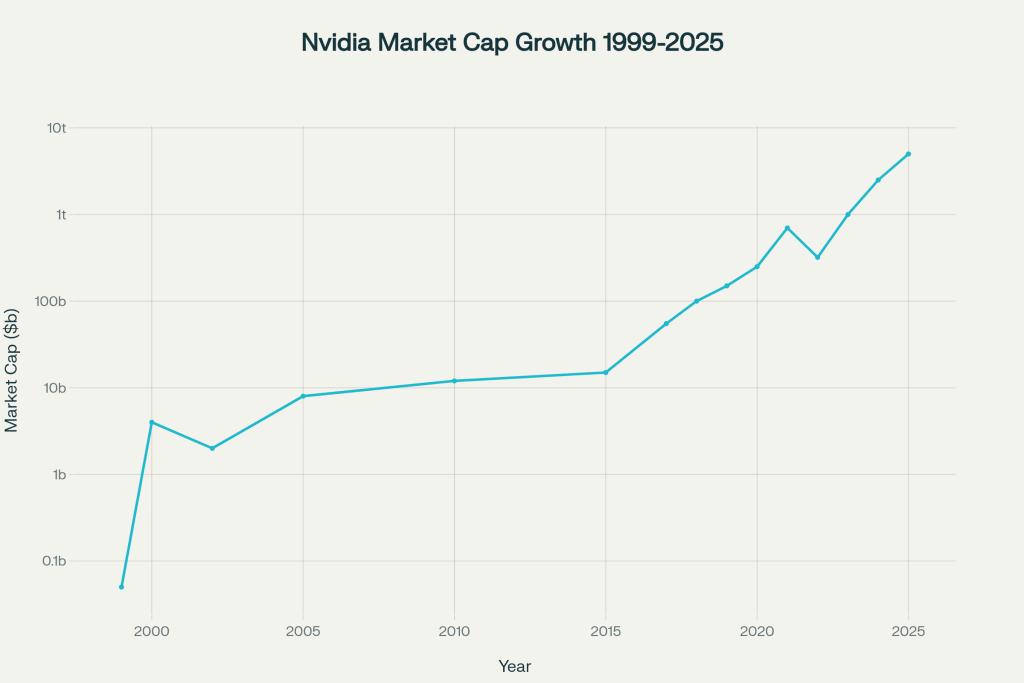
Nvidia’s market capitalisation journey: From $50 million IPO to $5 trillion milestone
The GPU revolution: From GeForce 256 to AI dominance
Nvidia’s first years proved torturous, testing every dimension of the founders’ commitment and vision. The company’s initial chips, the NV1 and subsequent iterations, were fundamentally flawed (not merely underperforming but technologically incompatible with the dominant software architecture then governing graphics rendering). Microsoft’s DirectX standard had become the de facto specification for 3D graphics, and Nvidia’s NV1 chip failed to properly support this critical standard. The consequence was catastrophic; game developers, the target market for Nvidia’s technology, essentially ignored the NV1, leaving the company with approximately 249,000 useless chips gathering dust in warehouses. By 1996, merely three years after incorporation, Nvidia hovered perpetually on the precipice of insolvency (salaries couldn’t be paid, electricity bills were being skipped to preserve scarce cash reserves, and office lights were deliberately dimmed to reduce energy expenditures). The company was literally weeks away from running out of cash; the parking lot at Nvidia’s headquarters, which would later become famous for being perpetually full even on nights and weekends, was nearly empty as the company hemorrhaged employees.
It was at precisely this existential moment that Jensen Huang made the most consequential decision of his leadership career. Rather than abandoning the enterprise or pursuing alternative strategies, Huang made what amounted to an all-in gamble: he committed the company’s remaining venture capital resources to an accelerated production schedule for a new chip design. The deadline was brutally compressed, the risk was asymmetrical (failure meant insolvency) and the pressure was unrelenting. In this crucible of desperation, his team produced the RIVA 128, which was ultimately branded as the GeForce 256 upon its August 1999 launch. This chip represented more than incremental performance improvement; it embodied revolutionary architectural thinking. Nvidia marketed the GeForce 256 as “the world’s first graphics processing unit” (a term that Huang and his team effectively popularised) and the chip delivered performance that was genuinely revolutionary for its era. Within four months of its release, one million units had been sold, rescuing Nvidia from the precipice of bankruptcy and establishing it as the dominant force in graphics processing for gaming applications.
This recovery transformed not merely Nvidia’s financial trajectory but established the architectural and cultural foundations that would define the company’s subsequent decades. The GeForce 256 succeeded because it was purposefully designed for the parallel processing demands of graphics rendering (thousands of pixels requiring simultaneous calculation, a computational pattern that traditional CPUs handled inefficiently). Nvidia recognised that CPUs were fundamentally architecture-inappropriate for this problem class and that dedicated parallel processors could deliver orders-of-magnitude performance improvements. This insight (that specialised hardware designed for specific problem classes could vastly outperform general-purpose solutions) became the foundational principle underlying every subsequent strategic decision.
Throughout the late 1990s and 2000s, Nvidia refined its GPU architecture through successive generations (GeForce2, GeForce3, GeForce4, and the GeForce FX series) with each generation advancing capabilities and performance. The company went public in January 1999 at $19.69 per share, and subsequent stock splits created exponential wealth for early shareholders. An investor holding even a single share purchased at the IPO would, accounting for six subsequent stock splits through 2024, possess 480 shares worth approximately $58,000 by 2024 (a return of approximately 338,850 per cent over 25 years). Yet these gaming successes, whilst establishing Nvidia as an unquestionable leader in graphics rendering, represented merely the prologue to the company’s true revolutionary contribution to human computing. The genuinely transformative pivot (the strategic decision that would ultimately drive Nvidia to a $5 trillion valuation) emerged not from deliberate planning but from an accidental discovery that would reshape entire industries.
The unexpected turn: GPUs and artificial intelligence
By the mid-2000s, academic researchers began experimenting with repurposing GPUs for general-purpose computing tasks beyond graphics rendering. The parallel processing architecture that made GPUs exceptional at rendering millions of pixels proved equally exceptional for training artificial neural networks (the fundamental computational substrate of machine learning). Unlike CPUs, which executed complex instructions sequentially, GPUs possessed thousands of simple cores capable of executing identical operations in parallel, precisely the computational pattern required by neural networks training on massive datasets. This serendipitous alignment between gaming hardware architecture and artificial intelligence requirements represented one of the most fortuitous accidents in computing history.
Recognising this emerging opportunity, Nvidia introduced CUDA (Compute Unified Device Architecture) in 2007, a groundbreaking software platform that enabled developers to harness GPU parallel processing for general-purpose computing tasks. CUDA was revolutionary not because it was technically sophisticated (though it certainly was) but because it democratised access to GPU acceleration, transforming GPUs from specialised graphics components into general-purpose computing accelerators. Developers using CUDA could exploit GPU parallelism without requiring deep expertise in graphics rendering or low-level hardware programming. By providing high-level programming abstractions, curated libraries (cuDNN, TensorRT, and others), and integration with popular machine learning frameworks (PyTorch, TensorFlow), Nvidia essentially constructed an entire ecosystem that made GPU-accelerated machine learning accessible to researchers worldwide.
The transformative moment crystallised in 2012, when graduate student Alex Krizhevsky, working with Geoffrey Hinton and Ilya Sutskever, trained AlexNet (a deep convolutional neural network) on two GeForce GTX 580 GPUs to win the ImageNet Large Scale Visual Recognition Challenge (ILSVRC). AlexNet’s performance was so superior to traditional computer vision approaches that the machine learning community suddenly grasped an essential truth: the entire field of artificial intelligence was becoming fundamentally GPU-dependent. Suddenly, researchers who had theoretically understood neural networks for decades possessed the computational substrate to train models at unprecedented scale. This inflection point proved decisive. Nvidia, which had spent three decades as a graphics card company, was suddenly positioned at the absolute centre of a technological revolution that would ultimately dwarf even the gaming market.
Throughout the 2010s, Nvidia systematically optimised GPU architecture specifically for machine learning workloads. The Tesla K80 (2013), K40 and K80 series, the P100 (2016), and subsequently the V100 (2017) and A100 (2020) represented increasingly sophisticated purpose-built accelerators for AI training and inference. Each generation incorporated architectural improvements specifically targeting deep learning (enhanced tensor processing units, increased memory bandwidth, specialised low-precision arithmetic (FP16, TF32, FP8) that enabled faster computation with acceptable accuracy for neural networks). Nvidia invested billions in research and development to create specialised silicon for AI computation, recognising that the company controlling AI infrastructure would effectively control the computational substrate upon which the entire AI industry depended.
The Hopper and Blackwell architectures: Engineering dominance
By the 2020s, Nvidia’s strategic positioning became unambiguously clear. The explosive growth of large language models (ChatGPT, GPT-4, Llama, and their successors) created insatiable demand for GPU clusters capable of training and deploying transformer-based architectures at scale. Nvidia introduced its Hopper architecture (H100 GPU) in 2022, incorporating revolutionary innovations specifically targeting large language model training. The H100 featured an upgraded Transformer Engine offering 4x faster training compared to previous generations, advanced tensor cores supporting multiple precision formats, and exceptional memory bandwidth (3.35 terabytes per second) necessary for the massive datasets these models required.
The Hopper architecture proved extraordinarily successful, becoming the de facto standard GPU for training every major large language model deployed globally. Microsoft, OpenAI, Google, Meta, and Amazon collectively purchased hundreds of thousands of H100 GPUs, spending billions annually on Nvidia hardware. The combined effect created what economists termed a “winner-take-most” market structure (Nvidia controlled approximately 80-95 per cent of AI accelerator market share, a dominance sustained by the powerful combination of superior hardware, the CUDA software ecosystem, and network effects that made competing platforms progressively harder to adopt).
Building upon Hopper’s success, Nvidia engineered the next-generation Blackwell architecture, featuring 208 billion transistors (compared to Hopper’s 80 billion), revolutionary interconnect technology (NV-HBI providing 10 terabytes per second chip-to-chip bandwidth), and architectural innovations targeting inference efficiency (the computational process of deploying trained models in production). By October 2025, Nvidia announced that the company had achieved “visibility into half a trillion dollars in revenue,” with Blackwell chips securing orders extending through 2026. This projection alone contributed to Nvidia’s achievement of a $5 trillion market capitalisation in October 2025, making it the first publicly traded company ever to reach this extraordinary valuation.
The $5 trillion milestone: Infrastructure provider for the AI revolution
Nvidia’s achievement of a $5 trillion market capitalisation on 29 October 2025 represented the culmination of Jensen Huang’s thirty-two-year vision (transforming a $600-capitalised startup conceived in a Denny’s booth into the foundational infrastructure provider for humanity’s artificial intelligence revolution). This valuation transcended typical financial metrics; it represented market recognition that Nvidia, rather than functioning as a chip company in the traditional sense, had become something more fundamental (a platform company controlling the essential computational substrate without which modern artificial intelligence could not exist).

The scale of Nvidia’s dominance becomes apparent when examining its role in global economic growth. According to Harvard economist Jason Furman, data centre investments powered by Nvidia chips accounted for approximately 92 per cent of United States GDP growth in the first half of 2025. Without Nvidia’s computational infrastructure enabling cloud providers to deploy AI services at scale, the United States economy would have contracted slightly rather than expanding. This extraordinary statistic reflects Nvidia’s positioning not as a mere component supplier but as the enabling technology for the entire artificial intelligence economic transformation reshaping industries, labour markets, and geopolitical competition.
The company’s current market positions it ahead of Apple ($3.9 trillion), Microsoft ($4 trillion), Google/Alphabet ($3.2 trillion), Amazon ($2.4 trillion), and Meta ($1.8 trillion), establishing Nvidia as unquestionably the most valuable corporation ever created. From its $50 million IPO valuation in 1999, to $100 billion market cap in 2018, to $1 trillion in March 2023, to $5 trillion in October 2025, Nvidia compressed into three decades the value accumulation that typically requires generational companies to build over multiple centuries.
Jensen Huang’s leadership philosophy: Excellence through adversity
Jensen Huang’s leadership style (the operational philosophy that has driven Nvidia from near-bankruptcy to unquestionable technological dominance) emerges directly from the adversity that characterised his personal journey. Rather than operating as a traditional hierarchical corporation with numerous layers of management, Nvidia functions as what observers describe as an “extremely flat” organisation, with approximately 60 people reporting directly to Huang. This structure, which might seem chaotic in other contexts, has proven extraordinarily effective at Nvidia because it enforces accountability, enables rapid decision-making, and ensures that organisational priorities flow directly from Huang’s strategic vision.
Huang’s leadership approach emphasises what he describes as “the mission is the boss” (a principle suggesting that the company’s central mission (currently advancing artificial intelligence infrastructure) supersedes individual advancement, departmental turf protection, or quarterly financial targets). Rather than rewarding short-term goal achievement, Huang expects employees to organise themselves around this higher-order mission, continuously adapting strategies as circumstances evolve. He practices what observers term “reasoning out loud,” deliberately explaining his decision-making processes in group settings so that employees understand not merely what decisions have been made but how leaders think through complex problems.
Most remarkably, Huang’s commitment to Nvidia’s mission manifests in an almost monastic dedication to work. By his own account, Huang works from the moment he wakes until he retires for sleep, seven days weekly, with his mind remaining engaged with Nvidia challenges even during nominally personal time. His wake-up time shifted from 5 AM to 6 AM not for personal comfort but out of consideration for his dogs, whom he felt guilty disturbing at the earlier hour. When employees expressed confusion about receiving intense work emails from Huang during vacations, he responded with characteristic candour: “Work is how I relax.” This isn’t motivational rhetoric but rather an authentic description of how Huang has structured his existence around building Nvidia. Colleagues describe parking lots perpetually full at Nvidia’s Santa Clara headquarters even on nights and weekends (not because of mandatory policies but because the culture of intensity cascading from Huang’s personal example creates an environment where extraordinary effort becomes normalised).
Equally critical to Huang’s leadership philosophy is what might be termed “productive paranoia” (the systematic conviction that Nvidia remains perpetually vulnerable to failure). Despite commanding 80-95 per cent of the AI chip market and operating with unprecedented financial resources, Huang publicly described waking “worried and concerned” rather than “proud and confident,” a mindset that propels continuous innovation despite existing dominance. This paranoia, forged in the crucible of Nvidia’s near-bankruptcy in the mid-1990s, drives relentless investments in research and development, continuous architectural innovation (the transition from Fermi to Kepler to Maxwell to Pascal to Volta to Turing to Ampere to Ada to Hopper to Blackwell to Rubin occurring approximately every 1-2 years), and unwillingness to become complacent about competitive threats.
Critics occasionally characterise Nvidia’s culture as ruthlessly demanding, yet Huang’s 98 per cent approval rating on Glassdoor (amongst major technology company CEOs) suggests that employees broadly appreciate his leadership style, even when acknowledging its intensity. Huang has explicitly rejected conventional wisdom suggesting that “the best jobs are those that bring you happiness all the time,” arguing instead that true fulfilment derives from pursuing genuinely difficult objectives that demand sustained effort, repeated failure, learning, and eventual triumph. “I don’t love every day of my job; not every day brings me joy,” he acknowledged. “But I love the company every single second.” This distinction (between daily pleasure and deep purpose) captures the philosophical orientation that has driven Huang’s entire career and shaped Nvidia’s transformative culture.
The technological pivots: From graphics to gaming to AI
Nvidia’s trajectory represents a masterclass in strategic adaptation (successfully navigating multiple technological transitions that have destroyed less flexible competitors). From graphics rendering (1990s) to PC gaming dominance (1999-2010s) to cryptocurrency mining (2017-2018) to enterprise data centres (2010s-present) to artificial intelligence (2012-present), Nvidia has repeatedly recognised emerging inflection points and invested resources proactively to position itself advantageously. This requires not merely technical competence but organisational humility (a willingness to question whether current strategic positioning remains optimal despite existing market dominance).
The transition to AI acceleration exemplifies this flexibility. Gaming represented an extraordinarily profitable market where Nvidia held unquestionable dominance; yet Huang recognised in the early 2010s that artificial intelligence represented an even more fundamental opportunity. The company invested billions in CUDA ecosystem development, curated partnerships with universities and research institutes, and deliberately built infrastructure (data centre GPUs, high-bandwidth interconnects, specialised software libraries) that positioned Nvidia to capture maximum value when the AI boom inevitably arrived. This wasn’t gambling but rather disciplined capital allocation based on technological conviction. By 2012, when AlexNet demonstrated GPU-accelerated deep learning’s revolutionary potential, Nvidia was already positioned to capture the resulting opportunity.
The Omniverse, robotics, and future vision
Beyond current AI dominance, Jensen Huang has articulated an expansive vision for Nvidia’s future that extends to robotics, autonomous vehicles, industrial automation, and what he terms “physical AI” (the application of artificial intelligence to controlling physical systems rather than merely processing information). The Omniverse platform, Nvidia’s ambitious software ecosystem for creating three-dimensional digital twins and simulating physical systems, represents this vision made concrete. More than 300,000 developers have accessed Omniverse, and over 250 enterprises have deployed systems using the platform for manufacturing simulation, autonomous vehicle development, and industrial optimisation.
In October 2025, Nvidia announced a partnership with Uber to deploy 100,000 robotaxis by 2027, combining Nvidia’s autonomous driving systems, data processing capabilities, and computational infrastructure with Uber’s operational expertise and customer access. Simultaneously, Lucid Motors partnered with Nvidia to integrate Level 4 autonomous driving capabilities in future vehicles, offering “mind-free” driving functionality comparable to current Waymo robotaxi systems. These initiatives represent Huang’s conviction that autonomous robotics represent a “trillion-dollar opportunity” and potentially the next great economic transformation following artificial intelligence.
The upcoming Rubin architecture, expected to launch in 2026, further illustrates Nvidia’s forward-looking technological strategy. Rubin introduces an architectural innovation called “disaggregated inference,” separating the computational tasks of processing vast context windows (handled by Rubin CPX, capable of processing one million tokens simultaneously) from token generation (handled by the Rubin GPU). This architectural innovation directly addresses the bottlenecks emerging as large language models require processing increasingly massive context windows (entire documents, hours of video, extensive code repositories) simultaneously. The Rubin CPX alone can process what would require sequentially breaking massive inputs into smaller chunks on previous architectures, enabling qualitatively different AI applications.
Legacy, inspiration, and the persistence of discipline
Jensen Huang’s ascent from dishwashing in rural Oregon to founding the world’s first $5 trillion company encapsulates essential truths about entrepreneurship, technological innovation, and the relationship between adversity and excellence. His journey validates no romanticised notions that hardship guarantees success (countless people experience deprivation without subsequently creating technology revolution). Rather, Huang’s story demonstrates how discipline, intellectual integrity, and an almost obsessive commitment to continuous improvement can transform unpromising beginnings into extraordinary achievement. The specific combination of character traits that enabled his rise (humility acquired through early adversity, intellectual confidence forged through rigorous education, operational excellence cultivated through demanding work, and the paranoia born from experiencing catastrophic business failure) created precisely the psychological profile necessary to navigate the extraordinary risks and uncertainties endemic to transformative technological innovation.
Most importantly, Jensen Huang’s narrative demonstrates that exceptional achievement remains fundamentally possible through relentless effort, strategic thinking, and willingness to embrace discomfort. He has explicitly rejected fashionable contemporary management philosophies suggesting that employee wellbeing requires constant pleasure or that leadership requires maintaining personal comfort. Instead, Huang has consciously structured his existence around pursuing extraordinarily difficult objectives, maintaining the discipline he first learned whilst washing dishes four decades ago, and building an organisation where “the mission is the boss” rather than individual advancement or departmental convenience. In doing so, he has created one of history’s great companies (not accidentally but through methodical, deliberate execution of a vision held with such conviction that it survives stock market crashes, competitive threats, near-bankruptcy, technological disruption, and the countless other challenges that destroy the overwhelming majority of ambitious enterprises). The remarkable result (that a teenager working graveyard shifts at Denny’s eventually commanded a company valued at $5 trillion and fundamentally shaped how humanity processes information) stands as extraordinary testament to what becomes possible when discipline, vision, and relentless execution combine to create transformative technological infrastructure.