Ireland has long prided itself on something rather extraordinary in today’s world: a national police force that doesn’t carry guns. An Garda Síochána, literally meaning “Guardians of the Peace,” has maintained this tradition for nearly a century, embodying a gentler approach to law enforcement that reflects the nation’s values and history.
But beneath this veneer of peaceful policing, a troubling trend is emerging that’s forcing uncomfortable questions about whether Ireland’s unique approach can withstand the pressures of modern crime. Growing public unease in communities across the country reflects a stark reality that can no longer be ignored.
Knife crime in Ireland has quietly but persistently evolved from an occasional concern to a pressing reality that’s stretching the resources, resolve, and safety of both the Gardaí and the communities they serve. The latest figures reveal a stark picture: over 11,000 knives have been seized by Gardaí in just the past five years, with over 2,100 blades confiscated in 2024 alone. Meanwhile, concerns in communities have intensified as assaults on police officers have more than doubled since 2020, reaching a concerning peak of 470 incidents in 2023.
This isn’t just about numbers on a spreadsheet – it’s about a fundamental shift in the nature of crime and violence in a country that has historically managed to maintain order through community policing and moral authority rather than force of arms.
The Garda crisis has become a daily reality for officers and citizens alike. As we delve into this evolving crisis, we’ll explore how Ireland’s cherished tradition of unarmed policing is being tested by rising blade-related violence, institutional challenges, and a justice system that many argue has lost its way.

The data-driven reality: Numbers don’t lie
Growing availability of blades: A decade of disturbing growth
The most telling indicator of Ireland’s evolving relationship with knife crime lies in the Garda Síochána knife seizures data. Recent figures confirmed that over 2,100 knives were seized by Gardaí in 2024, compared to 2,193 in 2023. While this represents a slight decrease, it still marks a staggering 60% increase from seizure levels a decade earlier.
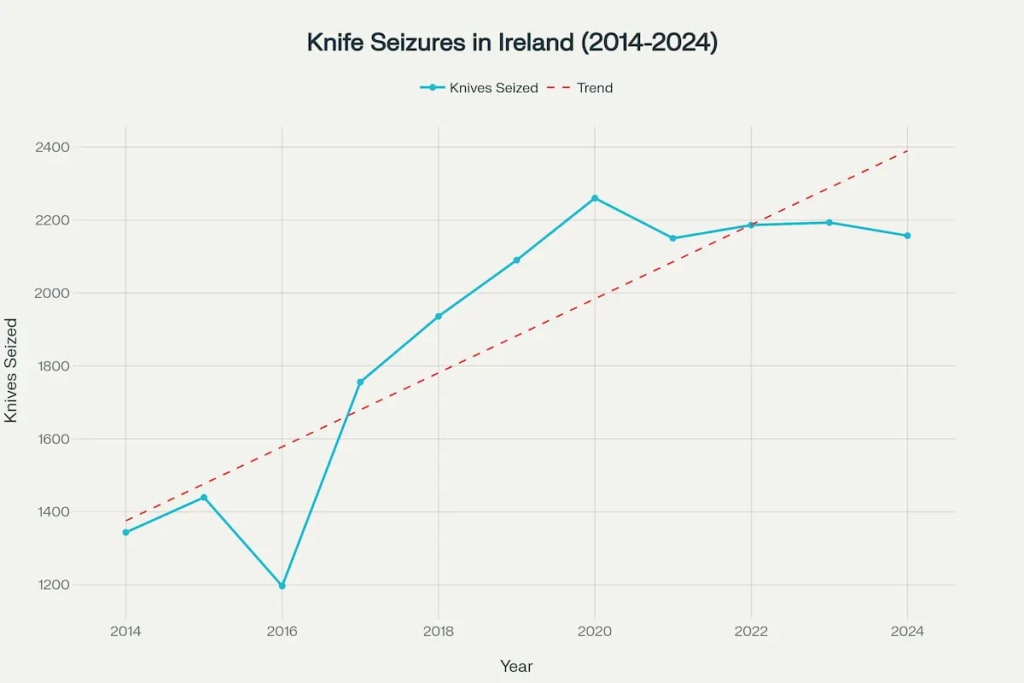
Minister for Justice Jim O’Callaghan’s newly released data shows an average of more than 2,000 knives a year being seized by Gardaí between 2020-2024. Aontú leader Peadar Tóibín has described the prevalence of knife seizures as “alarming,” echoing concerns reverberating through communities nationwide.
This isn’t a statistical blip; it’s a trend that speaks to the fundamental availability and normalisation of blade-carrying in Irish society. What makes these figures particularly concerning is their consistency across different years and circumstances.
Even during the COVID-19 lockdowns, when much of normal life ground to a halt, knife seizures remained elevated. This suggests that blade-carrying had become entrenched in certain communities and criminal networks. The slight dip in 2024 might offer hope to optimists, but seasoned observers know that seizures only represent the tip of the iceberg.
For every knife confiscated, growing public unease questions how many more remain on the streets, creating an atmosphere of anxiety that affects daily life in affected communities. The psychological impact extends far beyond direct victims, as families alter their daily routines and young people face new restrictions on their freedom of movement.
The Dublin concentration: Half the problem in one city
Perhaps most telling is the geographical distribution of these seizures. Roughly half of all knife confiscations occur within Dublin’s six police divisions, with Dublin North Central leading the charge at 325 seizures in 2024, followed by Dublin South Central at 250.
This concentration isn’t simply a reflection of population density – it speaks to deeper socioeconomic issues, gang activity, and the urban pressures that make blade-carrying seem like a rational choice to some young people. Concerns in communities have reached such levels that parents report changing their children’s routes to school and limiting their evening activities.
Beyond the capital, significant seizure numbers emerged from Limerick (141), Cork City (126), and the Cavan-Monaghan/Louth region (112). These figures indicate that Dublin knife crime isn’t an isolated phenomenon but part of a broader national challenge affecting both urban centres and border regions.
Local community leaders across these areas report a growing sense of vulnerability. Residents speak of increased vigilance when walking at night, while shop owners describe heightened tensions during evening hours. The ripple effect touches every aspect of community life, from reduced participation in evening activities to changes in local business hours.
Broader criminal trends: The context behind the blades
The Central Statistics Office (CSO) data reveals that knife seizures are just one facet of a broader trend in weapons-related crime. In 2024, while some crime categories showed decreases, weapons-related offences continued to cause concern among law enforcement officials.
Recent quarterly data shows persistent challenges in multiple crime categories that intersect with knife-related incidents. These aren’t abstract categories – they represent real violence affecting real communities, from family disputes that escalate to serious assault, to gang-related incidents that terrorise neighbourhoods.
When we see Irish knife crime statistics showing sustained patterns in weapons possession and assault-related offences, we’re witnessing the erosion of the social fabric that has historically made Ireland’s unarmed policing model viable. Growing public unease reflects this reality, as communities grapple with changes they struggle to understand or address.
The psychological impact extends beyond direct victims. Teachers report increased anxiety among students, social workers describe heightened tensions in youth programmes, and community centres note declining participation in evening activities. This creates a vicious cycle where reduced community engagement leads to further social isolation and potential criminal recruitment.
Institutional challenges: When guardians need guarding
Under-resourced and undermanned: A force under pressure
The irony of Ireland’s policing crisis is stark: as knife crime rises, the very force tasked with addressing it finds itself increasingly vulnerable and under-resourced. An Garda Síochána unarmed police operates with chronic staffing shortages that have been decades in the making – a legacy of austerity policies and governmental neglect that has left the force ill-equipped to handle evolving threats.
Current Garda strength stands at 14,300 members, still below the government target of 15,000 minimum, with the long-term aim of growing to 18,000. The Garda recruitment challenges persist despite government commitments and budget allocations.
This isn’t just about numbers – though the numbers are sobering enough. It’s about the practical reality that officers face when confronting knife-wielding suspects with nothing but batons, pepper spray, and their wits.
Recent reports reveal that public order Gardaí are reluctant to use force due to lack of numbers, with overtime being used to substitute for understaffing leading to fatigue and chronic burnout among personnel. The traditional Irish approach to policing relied heavily on moral authority and community respect, but these tools lose their effectiveness when confronted with individuals who have moved beyond the social contract that makes such policing possible. Growing public unease reflects awareness that the guardians themselves need protection.

The equipment shortages extend beyond personal protection. Many Garda stations lack adequate vehicles, communication equipment, and even basic protective gear. Officers routinely report having to use personal mobile phones for work communications and driving vehicles that should have been retired years ago.
It’s a recipe for disaster when dealing with increasingly sophisticated and well-armed criminal elements. Concerns in communities intensify when residents realize their local officers may be outmatched by the very criminals they’re meant to apprehend. The degradation of police infrastructure affects response times, investigation quality, and officer morale in ways that compound the existing challenges.
The human cost: Assaults on Gardaí reaching crisis levels
The statistics on violence against Gardaí tell a story of escalating danger that should alarm anyone who values law and order in Irish society. The trajectory is unmistakable and deeply troubling, creating growing public unease about Ireland public safety:
- 2020: 223 assaults on Gardaí
- 2021: 266 assaults
- 2022: 316 assaults
- 2023: 470 assaults (a shocking peak)
- 2024: 372 assaults (a decrease, but still 67% higher than 2020)
- 2025 (through July): 156 assaults already recorded
These aren’t just numbers – they represent individual officers who went to work to serve their communities and instead found themselves victims of violence. Each incident reverberates through Garda stations, affecting morale and operational capacity.
The 2023 peak of 470 assaults represents more than one attack on a police officer every single day of the year. Even the “improvement” in 2024 still left assault rates at nearly double what they were just four years earlier.

Community reactions have been mixed. While many express sympathy for officers under attack, others question whether the traditional model of unarmed policing remains viable in contemporary Ireland.
The ripple effects extend far beyond the immediate victims. Days lost due to injuries increased by 13% in 2023, totalling 85,396 days of absence. That’s equivalent to losing nearly 235 officers for an entire year – a devastating blow to a force already struggling with staffing levels.
When officers are injured, their colleagues must cover additional shifts, leading to fatigue, decreased morale, and ultimately, reduced public safety. Concerns in communities grow as response times increase and visible policing decreases in affected areas. The psychological trauma affects not just the injured officers but their families and colleagues, creating long-term impacts on the force’s effectiveness and recruitment efforts.
The narrative of impunity: Justice delayed, justice denied
Perhaps the most damaging aspect of Ireland’s current approach to knife crime isn’t what happens on the streets – it’s what happens in the courtrooms afterwards. Growing public unease stems from observable patterns suggesting that the Irish justice system operates on disturbing double standards when prosecuting violent crime.
The 2023 Dublin riots serve as a perfect case study in this dysfunction. Despite clear video evidence and widespread public outrage, the prosecution of rioters has been characteristically slow and lenient.

Many of those arrested were quickly released, with charges either dropped or reduced to minor offences. Community reactions ranged from frustration to outright anger, with many questioning whether the justice system serves the public interest.
The message this sends to both criminals and law-abiding citizens is profoundly damaging: violence has no meaningful consequences if you’re young and Irish. This creates a two-tier system that undermines faith in equal justice.
Contrast this with the swift and public action taken when incidents involve non-Irish individuals. Immigration-related violence receives immediate media attention, rapid prosecution, and severe penalties. While all violence should be prosecuted vigorously, the disparity in treatment creates a toxic dynamic.
This selective enforcement doesn’t just undermine public confidence in the justice system – it actively encourages criminal behaviour among those who’ve learned they can act with impunity. Growing public unease reflects awareness that justice appears to depend more on demographics than actions.
When young Irish offenders see their peers receive minimal consequences for serious crimes, while immigrant communities face the full force of the law for similar offences, it creates both a sense of entitlement and a dangerous precedent. The long-term implications for social cohesion and respect for law enforcement are severe.
The international context: Ireland’s unique challenge
Learning from abroad: What other nations tell us
Ireland’s situation with knife crime isn’t unique globally, but the country’s response – or lack thereof – stands out for all the wrong reasons. The United Kingdom, facing similar challenges with blade-related violence, has implemented comprehensive knife crime strategies.
UK approaches include enhanced stop-and-search powers, mandatory minimum sentences for repeat offenders, and substantial investment in youth intervention programs. While controversial, these measures have shown measurable results in some areas.
Scotland’s experience is particularly relevant, having successfully reduced knife crime through a combination of enforcement and prevention. The Violence Reduction Unit model, treating violence as a public health issue while maintaining strong law enforcement responses, has delivered measurable results.
Glasgow, once dubbed the “murder capital of Europe,” has seen dramatic reductions in blade-related violence through sustained, coordinated effort. Community leaders there report significant improvements in public confidence and safety. The Scottish model demonstrates that cultural change is possible with sustained political commitment and adequate resources.
France has taken a different but equally robust approach, with specialized anti-knife crime units and swift judicial processing of blade-related offences. The message is clear: carry a knife illegally, use it in crime, and face immediate, serious consequences.
Ireland’s approach, by contrast, seems characterised by institutional drift and political reluctance to acknowledge the severity of the problem. While other nations have adapted their strategies to meet evolving threats, Ireland continues to rely on policing methods designed for a gentler era.
Growing public unease reflects awareness that Ireland is falling behind international best practices, potentially endangering both officers and citizens. The international examples show that knife crime can be reduced, but only with comprehensive, sustained efforts that combine enforcement, prevention, and community engagement.
The technology gap: 21st century crime, 20th century response
Modern knife crime isn’t just about blades – it’s about the technology and communication methods that enable it. Social media platforms facilitate gang recruitment and territorial disputes, encrypted messaging apps coordinate criminal activity, and online marketplaces make weapon acquisition easier than ever.
Irish law enforcement’s response to these technological challenges has been notably slow. While criminals embrace new tools and methods, the Gardaí often seem stuck with outdated equipment and procedures.
This technological gap isn’t just about hardware – it’s about the strategic thinking and resource allocation needed to stay ahead of criminal innovation. Concerns in communities grow as residents realize criminals may be better equipped than the police meant to protect them.
The consequence is a force that’s increasingly reactive rather than proactive, responding to crimes after they occur rather than preventing them. In the knife crime context, this reactive approach can be literally life-or-death, as blade violence often unfolds too quickly for traditional policing responses to be effective.
Community policing initiatives struggle to keep pace with rapidly evolving criminal methods, creating gaps that undermine both public safety and confidence in law enforcement capabilities. The digital divide between law enforcement and criminal elements widens daily, creating new vulnerabilities that traditional policing methods cannot address.
Government response: Too little, too late?
Legislative changes: Playing catch-up with reality
The Irish government’s response to rising knife crime has been characteristically incremental and reactive. Recent legislative changes include enhanced penalties for assaulting Gardaí (increased from seven to twelve years maximum in November 2023) and proposals for expanded stop-and-search powers.
Minister for Justice Jim O’Callaghan has announced he will be bringing forward new legislation to address knife crime concerns. However, critics argue these measures are addressing symptoms rather than causes.
The expansion of stop-and-search powers represents a significant philosophical shift for Irish policing. Traditionally, such powers have been limited and carefully regulated, reflecting democratic values and community sensitivities.
However, the reality of knife-carrying has forced a reconsideration of these restrictions. Growing public unease demands action, even if it challenges traditional approaches to civil liberties and police powers.
Enhanced penalties for knife-related crimes are also under consideration, with proposals for minimum sentences for repeat offenders and graduated penalties based on blade characteristics. While such measures may deter some potential offenders, their effectiveness depends entirely on consistent enforcement and judicial compliance.
Areas where Ireland’s track record raises serious concerns among communities already struggling with crime-related anxiety. The gap between legislative intent and courtroom reality continues to undermine public confidence in the justice system’s ability to respond effectively to blade-related violence.
Resource allocation: Promises vs. reality
Political promises of increased Garda resources have been a constant refrain for years, yet the reality on the ground tells a different story. The provision of more than €2.48 billion in Budget 2025 will support the recruitment of new Garda members, with the Programme for Government committing to funding at least 5,000 new Gardaí over the next five years.
Despite these commitments, Garda recruitment challenges persist. The latest statistics show continuing pressure across multiple crime categories, yet staffing levels remain insufficient to address these challenges effectively.
Community expectations rise with each government announcement, but growing public unease reflects the gap between political rhetoric and operational reality. Residents in affected areas report little improvement in visible policing despite substantial budget allocations.
The government’s latest recruitment drive aims to add substantial numbers to Garda ranks, but even if successful, these recruits won’t be operational for months. Meanwhile, experienced officers continue to retire or transfer to less dangerous assignments.
This creates a brain drain that undermines institutional knowledge and capability. Concerns in communities intensify as they realize that even successful recruitment may not address immediate safety needs.
Equipment upgrades have been similarly slow and inadequate. While some units have received improved protective gear and communication equipment, many front-line officers still work with outdated tools.
The disconnect between political rhetoric about supporting law enforcement and the practical reality of under-equipped officers is stark and dangerous. Growing public unease reflects awareness that promises don’t translate into protection. Training programs for new recruits also need updating to address modern challenges, but institutional resistance to change slows necessary adaptations.
The social dimension: Understanding the ‘why’ behind the blades
Youth culture and normalisation
One of the most troubling aspects of Ireland’s knife crime evolution is how blade-carrying has become normalised within certain youth demographics. What was once considered extreme criminal behaviour is now treated as routine self-protection by some young people, particularly in disadvantaged communities.
This normalisation doesn’t occur in a vacuum. It reflects broader social failures: inadequate youth services, limited economic opportunities, family breakdown, and the glamourisation of criminal lifestyles through social media and popular culture.
Concerns in communities intensify as parents struggle to counteract these influences. When young people see successful drug dealers driving expensive cars while their law-abiding neighbours struggle with unemployment and poverty, the moral calculus becomes distorted.
The education system’s response has been similarly inadequate. While schools implement anti-bullying programs and conflict resolution initiatives, they often lack the resources and authority to address the underlying issues that make knife-carrying seem attractive to some students.
Teachers report increased anxiety when discussing safety issues, unsure whether their interventions will be effective or whether they might inadvertently escalate situations. Growing public unease reflects these institutional uncertainties.
Metal detectors and bag searches, common in other jurisdictions, remain controversial and largely unimplemented in Irish schools. The debate reflects deeper questions about how far Ireland should go in adapting to crime realities. The resistance to such measures may be admirable in principle, but it leaves vulnerable young people without adequate protection.
Community breakdown and social cohesion
Ireland’s traditional strength in community-based solutions to social problems has weakened significantly in recent decades. The extended family networks, church involvement, and neighbourhood solidarity that once provided natural deterrents to antisocial behaviour have eroded.
This erosion is particularly pronounced in urban areas affected by rapid demographic change and economic inequality. Growing public unease reflects awareness that traditional social controls no longer function effectively in many communities.
The breakdown creates fertile ground for criminal exploitation. Young people lacking positive role models and community connections become vulnerable to gang recruitment and criminal influence.
The knife becomes not just a weapon but a symbol of belonging and protection in environments where legitimate authority has lost credibility. Concerns in communities grow as residents realize that informal social controls have weakened substantially.
The COVID-19 pandemic accelerated many of these trends, disrupting already fragile social connections and creating new stressors around mental health, economic insecurity, and social isolation.
The spike in knife seizures during and after lockdown periods suggests a direct correlation between social disruption and weapon-carrying behaviour. Community workers report lasting effects from pandemic-era isolation, particularly among young people.
Religious and community organisations that traditionally provided support structures struggled to maintain connections during restrictions. The resulting gaps in social support continue to affect vulnerable populations. Youth clubs, sports organizations, and mentoring programs all saw reduced participation that hasn’t fully recovered, leaving young people with fewer positive outlets for their energy and ambitions.
The path forward: Realistic solutions for complex problems
Immediate measures: Stopping the bleeding
Ireland needs immediate action on multiple fronts to address the knife crime crisis. Enhanced police powers, while controversial, appear necessary given current realities. Growing public unease demands action, even if it challenges traditional approaches to civil liberties.
Stop-and-search authorities must be expanded and properly regulated, with clear guidelines and oversight mechanisms to prevent abuse while enabling effective enforcement. Community consultation should inform implementation to maintain public confidence.
Judicial reform is equally urgent. The current system of lenient sentences and delayed prosecutions has created a culture of impunity that actively encourages criminal behaviour. Concerns in communities intensify with each highly publicized case that results in minimal consequences.
Mandatory minimum sentences for knife-related offences, while not a panacea, would send a clear message that blade-carrying has serious consequences. The legislation must be crafted carefully to ensure proportionality while deterring criminal behaviour.
Resource allocation must also reflect current priorities. This means not just more Gardaí, but better-equipped and properly trained Gardaí. Officers need protective equipment, communication tools, and vehicles appropriate for 21st-century challenges.
The current situation, where officers face knife-wielding suspects with minimal protection, is unsustainable and unfair to both police and public. Ireland public safety depends on adequately protected and equipped law enforcement. Investment in officer safety isn’t just about protecting individual Gardaí – it’s about maintaining the viability of unarmed policing as a concept.
Long-term strategies: Addressing root causes
Sustainable solutions require addressing the social conditions that make knife-carrying attractive to young people. This means substantial investment in youth services, education, and economic opportunities in disadvantaged communities.
Programs that have shown success elsewhere – mentoring initiatives, sports and arts programs, educational support, and job training – need proper funding and coordination. Growing public unease can only be addressed through comprehensive social interventions.
Community policing must be reimagined for modern realities. The traditional Irish model of the village bobby who knew everyone by name remains valuable but needs adaptation for urban environments characterised by diversity, mobility, and social fragmentation.
This requires new approaches to building police-community relationships that go beyond traditional methods. Concerns in communities must be addressed through genuine engagement and transparent communication.
Technology must become an ally rather than an obstacle. Modern policing requires modern tools: improved communication systems, data analytics capabilities, and technological solutions that enable proactive rather than reactive responses to crime trends.
Investment in police technology isn’t just about efficiency – it’s about officer safety and public protection. The Garda crisis cannot be resolved without adequate technological support. Early warning systems, predictive policing models, and improved forensic capabilities all contribute to more effective law enforcement while potentially reducing the need for confrontational encounters.
Political leadership: Courage to confront reality
Perhaps most importantly, Ireland needs political leadership willing to confront uncomfortable truths about crime, punishment, and social responsibility. The current approach of denial, deflection, and half-measures has failed demonstrably.
Politicians must be willing to acknowledge that Ireland’s crime problem is real, growing, and requires serious responses that may challenge traditional assumptions about Irish exceptionalism. Growing public unease reflects frustration with political rhetoric that doesn’t match operational reality.
This includes honest discussions about immigration, integration, and social cohesion that go beyond simplistic narratives of either blind acceptance or reflexive rejection. It means acknowledging that rapid demographic change creates challenges that must be managed thoughtfully and proactively.
Most importantly, it requires admitting that Ireland’s justice system has become dysfunctional and needs fundamental reform. Concerns in communities will only intensify if political leaders continue to avoid difficult conversations about crime and punishment.
Public confidence in both policing and political leadership depends on honest acknowledgment of problems and credible commitments to solutions. The stakes are too high for continued evasion and half-measures. Electoral consequences await politicians who fail to address public safety concerns, but more importantly, social stability depends on effective responses to crime and disorder.
Conclusion: A tipping point for Irish society
Ireland stands at a crossroads. The country can continue down its current path of institutional drift and political denial, watching knife crime statistics rise while pretending that traditional approaches remain adequate for modern challenges.
Or it can acknowledge that the “Guardians of the Peace” model, while admirable in principle, requires substantial adaptation to remain viable in contemporary reality. Growing public unease demands honest assessment and credible action.
The statistics are unambiguous: knife seizures up 60% in a decade, assaults on police more than doubled since 2020, and weapons-related crimes continuing to cause concern despite minor fluctuations. These aren’t statistical artifacts or temporary anomalies – they represent fundamental changes in the nature of crime and violence in Irish society.
The human cost extends far beyond the immediate victims. Every assault on a Garda represents not just individual trauma but institutional damage to Ireland’s unique policing tradition. Every unprosecuted knife crime sends a message that violence has no consequences.
Every inadequately resourced police response undermines public confidence in the state’s ability to maintain order. Concerns in communities reflect awareness that the social contract underpinning Irish democracy is under strain.
Yet challenges also create opportunities. Ireland has natural advantages in addressing knife crime: a relatively small, cohesive society; strong democratic institutions; and historical experience in community-based problem-solving.
The question is whether the political will exists to deploy these advantages effectively. Growing public unease creates both pressure for action and opportunity for leadership.
The choice facing Ireland isn’t between maintaining the status quo and abandoning cherished traditions. It’s between thoughtful adaptation that preserves the best of Irish values while acknowledging new realities, or passive drift that risks losing both public safety and the policing model that has served the country well.
The knife crime Ireland crisis is ultimately a mirror reflecting broader challenges around authority, accountability, and social cohesion in modern Ireland. How the country responds will determine not just crime statistics but the kind of society Ireland becomes in the decades ahead.
The guardians of the peace deserve better than inadequate resources and political indifference. More importantly, the Irish people deserve honest leadership and effective solutions to the challenges threatening their communities.
Time is running short for half-measures and political posturing. The sharp edge of change is already cutting deep into Irish society. The question now is whether the country will respond with the seriousness and sustained commitment the crisis demands.
Every day of delay means more weapons on the streets, more officers at risk, and more communities living in fear. Ireland’s tradition of peaceful policing hangs in the balance, and with it, a crucial part of the country’s identity and future.
The choice remains Ireland’s to make, but the window for effective action is closing rapidly. Growing public unease and concerns in communities across the nation signal that Irish society recognizes the gravity of the situation.
What remains to be seen is whether political and institutional leaders will match this public awareness with the courage and commitment necessary to preserve both public safety and Ireland’s distinctive approach to policing. The stakes could not be higher, and the time for decisive action is now.
The international examples demonstrate that knife crime can be reduced through comprehensive strategies combining enforcement, prevention, and community engagement. Ireland has the resources and capability to implement such strategies, but it requires political will and sustained commitment. The alternative is continued deterioration of public safety and the ultimate abandonment of the unarmed policing model that has been central to Irish identity for nearly a century.
To the members of An Garda Síochána,
Thank you for standing on the front line for our communities with courage, restraint, and integrity. Your service demands exceptional professionalism and calm under pressure. We see the risks you face, the growing complexity of the streets, and the personal sacrifices behind every call you answer.
Our concern is not with you, it is for you. You deserve the staffing, training, equipment, and judicial follow-through that match today’s realities. We admire your commitment to protecting people with dignity, even when the environment makes that harder every day. Your steadfast presence holds together the promise of community policing in Ireland.
We stand with you, we value you, and we believe you should never be asked to do this work without the resources and protection worthy of your responsibility. Thank you for your service, for your patience with a system still catching up, and for the humanity you bring to every shift.