

Movember has evolved from a simple pub conversation in Melbourne into a global powerhouse that has fundamentally transformed how we discuss men’s health. Since its inception in 2003, this annual Movember campaign 2025 has transcended being merely about growing a moustache for charity. It has become a genuine, life-saving global men’s health initiative that addresses some of the most pressing health challenges affecting millions of men worldwide.
Every November, millions of people across more than 20 countries participate in Movember’s initiatives, collectively raising awareness and substantial funds for research, programmes, and support services that directly impact men’s lives. The campaign’s power lies not just in its fundraising capacity (having raised over £400 million to date) but in its ability to normalise conversations about men’s health issues that society has long kept hidden behind a veil of stigma and silence.
Quick facts about Movember and men’s health
- Movember campaign 2025 runs throughout November – grow a moustache, move 60km, or host events
- Over £400 million raised globally since 2003 for men’s health initiatives
- Men die 4.5 years earlier than women from largely preventable causes
- Prostate cancer: 63,000+ annual UK diagnoses – now England’s most common cancer
- Testicular cancer: Most common cancer in men aged 25-49, but 95%+ survival rate when detected early
- Male suicide crisis: 60 men die by suicide globally every hour – 3 out of 4 suicides are male
- 60% of men never or rarely discuss their mental health – breaking the silence saves lives
Understanding the men’s health crisis: Why Movember matters
The stark reality of male health inequality
The statistics surrounding men’s health in the modern world paint a sobering picture that demands immediate attention and systemic change. Men are dying significantly earlier than women for largely preventable reasons (on average, four and a half years earlier), yet men’s health remains consistently under-resourced and under-discussed compared to women’s health initiatives. This health inequality disparity is not accidental. It reflects systemic inequalities that have been embedded within healthcare systems, workplace cultures, and societal expectations for decades.
When examining the broader picture of male mortality, the figures are genuinely alarming. Men are twice as likely as women to die prematurely from cardiovascular disease, lung cancer, liver disease, and accidents. Perhaps most disturbingly, three out of every four suicides are committed by men. In England specifically, suicide has become the single largest cause of death for men under the age of 50. These are not abstract statistics. They represent fathers, sons, brothers, partners, and friends; individuals with hopes, dreams, and people who depended upon them.
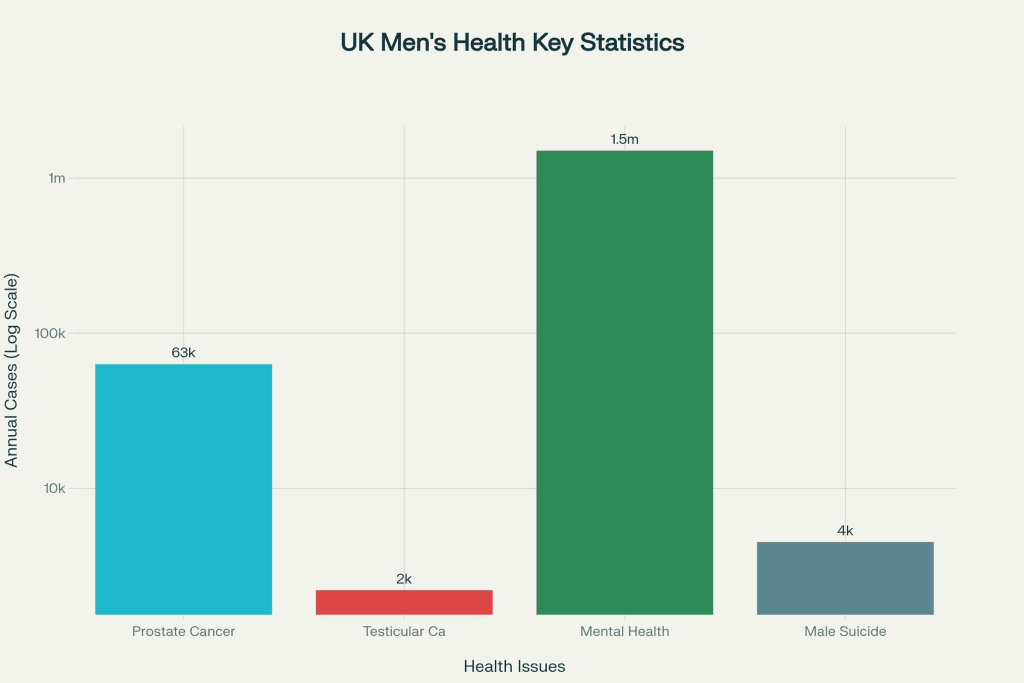
The four pillars of Movember’s mission
Movember’s founder vision has crystallised into four critical areas: prostate cancer awareness, testicular cancer screening, men’s mental health support, and male suicide prevention. Each of these represents a distinct yet interconnected challenge to men’s wellbeing, and each requires different approaches to awareness, detection, and support. The genius of Movember lies in recognising that men’s health cannot be addressed through a singular lens. It demands a multifaceted, comprehensive strategy that acknowledges the complexity of male health across the lifespan.
Prostate cancer awareness: Britain’s hidden epidemic

The rising tide of prostate cancer diagnoses
Prostate cancer has quietly become an epidemic in the United Kingdom, yet it receives a fraction of the public awareness afforded to other major cancers. The statistics are striking: prostate cancer is now the most common cancer among men in the UK, with more than 63,000 diagnoses occurring annually. In fact, prostate cancer UK statistics reveal that it has only recently superseded breast cancer as England’s most common cancer overall, with 2022 recording 50,751 prostate cancer diagnoses compared to 48,531 breast cancer cases.
The scale of this challenge becomes even more apparent when examining the trajectory of prostate cancer incidence over recent decades. Between 1993 and 2018, prostate cancer incidence increased by approximately 57 per cent in men aged 35-69 years. Projections suggest this upward trend will continue, with prostate cancer incidence rates expected to rise by 15 per cent between 2023-2025 and 2038-2040, potentially reaching around 85,100 new cases annually by 2038-2040.
Understanding prostate cancer and risk factors
Prostate cancer presents a distinctive clinical conundrum. Most men diagnosed with prostate cancer will live with the disease rather than die from it. Five-year survival for patients diagnosed at stage I or II approaches 100 per cent, whereas stage IV disease carries a five-year survival of approximately 50 per cent. Yet this relatively optimistic prognosis should not breed complacency. Each year, approximately 12,200 men in the UK die from prostate cancer, equating to approximately 33 deaths per day.
The disease does not affect all men equally. Black men face a significantly elevated risk, with 1 in 4 Black men likely to receive a prostate cancer diagnosis in their lifetime compared to 1 in 8 for men of other ethnicities. Men living in deprived areas also experience higher prostate cancer mortality rates, 11 per cent higher than those in less deprived areas. Age represents another critical risk factor, with incidence rates highest in men aged 75 to 79.
The importance of prostate cancer screening and early detection
Despite being the most common cancer in men, prostate cancer awareness remains surprisingly low, and many men lack understanding of their individual risk profiles. The prostate-specific antigen (PSA) test has become central to prostate cancer screening and detection, yet controversy surrounds its use due to concerns about overdiagnosis and overtreatment of indolent disease.
Men should understand that whilst PSA testing remains the primary screening tool, discussions with healthcare providers about the benefits and potential harms of screening form an essential prerequisite to any testing decision. Men of Black African or Caribbean descent are advised to consider prostate cancer screening from age 40, whilst other men might reasonably consider screening discussions from age 50 onwards.
Additional resources for prostate cancer
Learn more about prostate cancer screening guidelines and when to get tested. Read our comprehensive guide to understanding PSA test results. Explore treatment options for different stages of prostate cancer. Access support groups for men living with prostate cancer.
Testicular cancer: The silent threat to young men
An epidemic among the young
Testicular cancer occupies a unique and troubling position within the landscape of male health challenges. It represents the most common cancer diagnosis in men aged 25 to 49, yet awareness of this malignancy remains distressingly low. In the UK, between 2,400 and 2,500 men receive a testicular cancer diagnosis annually.
The survival statistics for testicular cancer, whilst genuinely encouraging, somewhat paradoxically contribute to complacency about the condition. Greater than 95 per cent of men with testicular cancer achieve successful outcomes when the disease is caught and treated appropriately. This remarkable survival rate represents one of medicine’s genuine success stories. However, survival rates do not tell the entire narrative. Many men experience significant treatment-related side effects that profoundly compromise quality of life long after treatment concludes.
How to perform testicular self-examination: A complete guide
Unlike many cancers requiring sophisticated diagnostic equipment for detection, testicular cancer symptoms frequently present with signs that a man himself can recognise through regular testicular self-examination. Most testicular cancers are discovered by men themselves or their partners rather than through medical screening, underscoring the critical importance of familiarisation with one’s own body.
The recommended approach to how to perform testicular self-examination is straightforward and requires only a few minutes monthly. The optimal time for examination is during or immediately following a warm shower or bath, when the scrotum is naturally relaxed and the testicles are most readily palpable. A man should examine each testicle separately, beginning by gently gripping the top of the scrotum with thumb positioned above and fingers beneath. The spermatic cord, a normal structure, can typically be felt running upward from the testicle.
Using both hands, a man should gently roll each testicle between his thumb and fingers along both sides, front and back, feeling for any unusual lumps, bumps, or hardening. It is entirely normal for one testicle to be slightly larger than the other or to hang slightly lower; this symmetry variation requires no action. Similarly, the epididymis (a tube-like structure positioned at the top and back of each testicle) is a completely normal anatomical feature.
Warning signs to watch for:
A man should become alert to any of the following: an unexpected lump or swelling (typically painless), unexpected pain or heaviness in the scrotum, an enlarged testicle, a change in size or consistency compared to baseline, or a dull ache in the lower abdomen or groin. Notably, cancerous testicular tumours typically do not cause pain. The disease frequently manifests as a painless mass, which paradoxically can lead to dangerous diagnostic delays as men assume that painless lumps must be benign. Upon discovery of any abnormality, men are strongly encouraged to consult their general practitioner urgently.
Monthly testicular self-examination checklist
Perform during or after a warm shower or bath when scrotum is relaxed. Examine each testicle separately using both hands. Roll gently between thumb and fingers feeling for lumps or changes. Note that size differences between testicles are normal. Seek medical attention immediately if you notice any lumps, swelling, or changes.
Remember: Most testicular cancers are painless, so don’t wait for pain to seek help!
The male mental health crisis: Breaking the silence
Understanding male suicide and the wider men’s mental health challenge
The men’s mental health dimensions of the Movember campaign perhaps represent its most urgent and tragic focus area. The statistics surrounding male mental health represent a genuine public health emergency that has been inadequately addressed despite mounting evidence of crisis-level proportions.
In 2023, the male suicide rate in England reached 17.4 deaths per 100,000 people, up from 16.4 in 2022, representing the highest rate since statistical recording began in 1999. Men aged 45 to 49 face the highest risk at an alarming 25.5 deaths per 100,000. Men are consistently three times more likely to die by suicide than women, a disparity that reflects not greater mental illness among men (rates of depression and anxiety are actually higher in women) but rather fundamental differences in help-seeking behaviours.
Globally, the picture is equally devastating. Globally, a man dies by suicide every minute, equating to 60 men lost to male suicide prevention efforts falling short every hour worldwide. In Ireland, three out of every four suicide victims are male. These figures transcend statistics; they represent individuals with names, faces, and stories. The fathers missing from family dinners, the friends whose text messages will never arrive, the colleagues whose chairs sit permanently empty.
Barriers to help-seeking in men: Understanding male mental health stigma
The tragedy of male suicide is substantially exacerbated by a profound reluctance amongst men to seek help or disclose emotional struggle. Research has consistently revealed that nearly 60 per cent of men never or rarely speak about their mental health. When asked about the reasons for this silence, men consistently cite embarrassment, uncertainty about whom to approach, difficulty articulating their feelings, and fear of burdening others.
Perhaps most troublingly, 40 per cent of men have literally never spoken to anyone about their mental health. Not partners, not family members, not healthcare professionals. The roots of this reticence lie deep within cultural constructions of masculinity that emphasise stoicism, emotional restraint, and self-reliance. This male mental health stigma proves devastatingly consequential. In the year preceding suicide, fewer than 1 in 5 men had contact with mental health professionals, compared to more than 1 in 3 women.
Workplace mental health: A critical intervention point
Workplace-related stress represents a significant and modifiable driver of poor mental health among men. Over one in three men report experiencing unhelpful stress at work, and work-related stress, depression, or anxiety affects an estimated 875,000 workers annually in the UK alone, resulting in 17.1 million working days lost. Men in certain occupations face particularly elevated suicide risks. Men in construction, for example, are 3.7 times more likely to die by suicide than the national average.
Workplace mental health initiatives can become genuine forces for prevention by creating cultures where men feel safe acknowledging struggle, where seeking help is normalised rather than stigmatised, and where realistic performance expectations prevent the burnout and inadequacy that precipitate mental health crises.
Immediate mental health support resources
UK Samaritans crisis line: 116 123 (24/7 free support). Mind mental health charity: www.mind.org.uk. CALM (Campaign Against Living Miserably): 0800 58 58 58. Shout crisis text line: Text ‘SHOUT’ to 85258. Access workplace Employee Assistance Programmes (EAP) through your employer. Learn more about recognising male mental health warning signs in our dedicated guide.
How to participate in Movember 2025: Practical pathways to engagement

The classic: Growing a moustache for charity
The most iconic Movember participation method remains the traditional challenge of growing a moustache for charity throughout November. Participants begin November 1st clean-shaven, commencing their month-long facial hair journey. The moustache serves both as a visible symbol of participation and as a conversation starter. The distinctive facial hair naturally prompts questions, providing perfect opportunities to discuss the men’s health issues Movember champions.
Successful moustache growth requires modest preparation and consistent care. Several weeks before November, men should begin preparing their skin through regular exfoliation and moisturisation to establish healthy skin conditions that support hair growth. Starting November with a clean shave ensures uniform growth patterns and clear demarcation of the month’s beginning. During the first week, expect an awkward stubble phase that feels itchy and looks patchy. Persisting through this transitional period proves essential as the moustache gradually fills in and develops.
Utilising beard oils and moisturisers during this phase alleviates discomfort whilst promoting optimal growth conditions. By weeks three and four, the moustache assumes a more defined appearance, at which point men can begin styling their growth. Experimenting with handlebar styles, classic chevrons, or pencil-thin variants helps discover what suits their face shape and hair characteristics.
Move for mental health: The 60km Movember challenge
Beyond moustache cultivation, Movember offers “Move for mental health,” a Movember challenge wherein participants commit to walking or running 60 kilometres throughout November. This distance symbolises the tragic statistic that 60 men die by suicide globally every hour. Rather than representing a burden, this challenge transforms a devastating statistic into a tangible, achievable goal that creates community and purpose.
Participants can approach this challenge individually or as teams, with flexibility to distribute the 60 kilometres across the month in whatever manner fits their schedule and fitness level. Some participants walk or run daily; others complete longer ventures on weekends. The flexibility enables engagement from individuals across varying fitness levels and life circumstances. The challenge is participatory rather than performance-oriented.
The profound beauty of the Move for Movember challenge lies in its dual impact. Physically, participants benefit from increased activity, which directly supports both cardiovascular health and mental wellbeing; regular physical activity is an evidence-based intervention for depression and anxiety. Psychologically, the challenge creates space for reflection, conversation, and community connection. Walkers frequently traverse routes with friends or family members, transforming individual exercise into shared experience and opportunity for meaningful dialogue about mental health and male wellbeing.
Host a Mo-ment: Creating community conversations
Beyond individual actions, Movember encourages participants to “Host a Mo-ment.” This means organising social events or Movember fundraising ideas that bring communities together whilst supporting the campaign’s mission. These events can range from intimate dinner parties to large-scale workplace functions; what matters is that they create gatherings where men’s health conversations can organically emerge.
Popular Mo-ment ideas include trivia nights focused on men’s health knowledge, fitness challenges like running clubs or gym competitions, bake sales featuring moustache-themed treats, casual dress days with small donations supporting the campaign, and lunchtime educational sessions where speakers discuss prostate cancer, testicular cancer, or mental health.
Movember workplace participation ideas particularly benefit from structured engagement. Employers can establish Movember committees involving HR, senior leadership, and employee resource groups to coordinate workplace participation. Creating realistic fundraising goals, establishing leaderboards tracking moustache progress, and recognising participants throughout the month builds momentum and engagement. Corporate gift matching (wherein employers donate funds matching employee contributions) effectively doubles the fundraising impact.
Mo your own way: Personal creativity
Recognising that men have diverse interests and capacities, Movember explicitly encourages participants to “Mo their own way.” This means creating unique personal challenges aligned with their individual passions and abilities. A musician might host Movember concerts; an artist might create moustache-themed artwork; a gamer might participate in a Movember gaming marathon. This flexibility ensures that virtually anyone can find meaningful ways to participate.
Movember participation ideas: Quick reference
| Participation method | Description |
|---|---|
| Grow a moustache | Start clean-shaven on November 1st and grow throughout the month |
| Move 60km | Walk, run, or cycle 60 kilometres throughout November |
| Host a Mo-ment | Organise fundraising events, workplace challenges, or social gatherings |
| Mo your own way | Create personalised challenges based on your interests and abilities |
Ready to join Movember 2025?
Register today at movember.com and start making a difference in men’s health. Every moustache grown, every kilometre moved, and every conversation started saves lives.
The economic impact and workplace wellness benefits
Movember’s proven financial reach
The financial magnitude of Movember’s global impact cannot be overstated. Since its inception, Movember has raised over £400 million for men’s health initiatives worldwide. In 2024 alone, over 285,000 people participated in Movember globally, collectively generating substantial funds for prostate cancer research, testicular cancer initiatives, mental health programmes, and suicide prevention projects.
To contextualise this achievement: 2004, just one year after Movember’s modest Melbourne beginning with 30 men, saw nearly 500 participants raising over £40,000 for the Prostate Cancer Foundation of Australia, then the largest single donation the foundation had ever received. By 2012, 1.1 million people participated in Movember globally, collectively raising over £95 million.
This financial trajectory demonstrates the exponential power of grassroots movements coupled with institutional support. The annual reports reveal an organisation scaling sustainably whilst maintaining its core mission of genuinely transforming men’s health outcomes. The funds raised directly finance innovative research projects, community-based early intervention programmes, and mental health initiatives that reach men often marginalised by traditional healthcare systems.
Return on investment for workplace wellness initiatives
From an employer perspective, workplace Movember engagement delivers measurable returns extending far beyond charitable giving. Organisations participating in Movember frequently report enhanced team cohesion, improved workplace mental health literacy, and demonstrable improvements in employee engagement and retention. Research consistently demonstrates that there is a positive return on investment of approximately £5 for every £1 invested in workplace mental health interventions.
Employee participation in Movember creates psychological safety around mental health discussions. When senior leaders visibly participate in growing moustaches, host educational events about men’s health, or share their own mental health experiences, they implicitly signal that vulnerability, help-seeking, and conversation about wellbeing are organisational values rather than individual failings. This cultural shift proves invaluable; workplaces where mental health is normalised and supported experience demonstrably lower sickness absence rates related to mental health, reduced presenteeism, and improved overall productivity.
Men’s health issues: Statistical comparison
| Health issue | Annual cases (UK) | Survival rate | Most affected age |
|---|---|---|---|
| Prostate cancer | 63,000+ | Nearly 100% (early stage) | 75-79 years |
| Testicular cancer | 2,400-2,500 | >95% | 25-49 years |
| Mental health crisis | Ongoing epidemic | Highly treatable | 45-49 years (peak risk) |
| Male suicide | ~5,000 deaths/year | Preventable | Under 50 years |
Practical resources and year-round support services
The Movember Foundation’s comprehensive support infrastructure
Beyond fundraising, the Movember Foundation operates substantial programmes providing direct support to men facing health challenges. The “Movember Conversations” tool, available through the official Movember website, provides accessible guidance for men uncertain how to initiate difficult conversations about health with loved ones. For men already diagnosed with prostate cancer, testicular cancer, or mental health challenges, the Foundation offers curated information resources, peer support networks, and connections to professional services.
Projects like “Nuts & Bolts,” specifically designed for men navigating early-stage testicular cancer, provide mobile-optimised resources supporting men from diagnosis through treatment and beyond.
Broader mental health and suicide prevention resources
Whilst Movember concentrates activity during November, men facing mental health challenges require support throughout the year. The Samaritans (UK telephone: 116 123) provides 24/7 crisis support for individuals experiencing suicidal thoughts or emotional distress. Similarly, Mind (www.mind.org.uk) offers comprehensive men’s mental health support information and support services.
In Ireland, Pieta House and Samaritans Ireland provide crisis support, whilst Scotland and Wales maintain region-specific mental health services through their respective health systems. Beyond crisis services, men should know that accessing psychological therapy through their general practitioner is entirely appropriate and encouraged. Early engagement with mental health support frequently prevents escalation to crisis-level situations.
Workplace Employee Assistance Programmes (EAPs) frequently provide confidential counselling and mental health support to employees. Many men remain unaware that these services are available through their employers at no personal cost. Discussing mental health with occupational health services, employee resource groups focused on wellbeing, or workplace mental health champions can connect struggling men with support resources they might otherwise never discover.
Overcoming barriers and creating sustainable cultural change
From campaign month to year-round commitment
Movember’s greatest challenge, paradoxically, is ensuring that the awareness and conversations catalysed during November translate into sustained, year-round changes in how men and organisations approach men’s health advocacy. The campaign’s visibility peaks in November, media attention concentrates during this period, and participation enthusiasm naturally follows. Yet the health issues Movember addresses (prostate cancer, testicular cancer, mental health challenges, suicide) persist throughout the calendar. A man living with prostate cancer does not experience his disease solely during November; a suicidal crisis may emerge in March; testicular self-examination proves equally important in June as in November.
Converting Movember’s momentum into sustained action requires deliberate strategy. Men’s health services, both within the NHS and through private practitioners, should utilise Movember’s heightened visibility to encourage men to establish baseline health assessments, understand their individual risk profiles, and commit to regular health monitoring. Workplaces should institutionalise the mental health conversations and cultural shifts initiated during Movember, ensuring that psychological wellbeing becomes a consistent organisational priority rather than a monthly initiative. Community organisations should leverage the volunteer energy mobilised during Movember to sustain peer support networks and mental health initiatives year-round.
Addressing specific barriers to engagement
Men from certain demographic groups remain particularly underrepresented in Movember participation and men’s health engagement more broadly. Black men, facing significantly elevated prostate cancer risk, need targeted Movember outreach tailored to their communities. Men from working-class occupations and deprived areas, experiencing dramatically elevated suicide and mortality rates, require accessible, non-stigmatising pathways to health engagement.
Younger men, seemingly invulnerable, often dismiss health concerns until serious disease develops. Movember initiatives specifically designed for these populations (featuring trusted community representatives, addressing culturally-specific communication preferences, and acknowledging the real barriers these men face) could substantially expand the campaign’s reach and impact.
Similarly, recognising that many men have negative prior experiences with healthcare (being dismissed by clinicians, feeling judged for health concerns, or receiving incompetent care) helps organisations understand why some men remain reluctant to engage. Creating healthcare environments where men feel genuinely heard, where their concerns receive appropriate clinical attention, and where clinicians demonstrate competence in addressing men’s specific health needs represents an essential prerequisite to improved health engagement.
Looking forward: The future of men’s health advocacy
The remarkable achievement of Movember lies not merely in funds raised or moustaches grown, but in fundamentally shifting societal conversations about male vulnerability, health equity, and the necessity of gendered health strategies. The campaign has demonstrated that men respond enthusiastically to health initiatives presented with humour, community spirit, and genuine respect for their agency. Movember has proven that men do care deeply about their health. They simply required permission to express this care and accessible pathways for engagement.
Looking ahead, sustained progress in men’s health requires several interconnected developments. Healthcare systems must allocate resources proportionate to men’s health burden, implementing specialist services and research programmes addressing prostate cancer, testicular cancer, and male mental health with urgency matching that afforded to other major health challenges. Workplace wellness initiatives must continue evolving to normalise mental health disclosure and support-seeking amongst men, recognising that “real men” are those courageous enough to acknowledge struggle and seek assistance.
Educational initiatives must reach young men before problematic patterns of health avoidance become entrenched, creating lifelong habits of proactive health engagement. Media representation must move beyond tired stereotypes of stoic, emotionless masculinity, instead celebrating men who speak honestly about health challenges and seek support. Demonstrating that strength and vulnerability prove compatible rather than contradictory.
The Movember movement, now two decades into its remarkable journey, has proven that millions of men yearn for permission and pathways to engage with their health genuinely and openly. As this global men’s health initiative continues evolving, its ultimate measure of success will not be the number of moustaches grown in November, but whether the conversations sparked during that month culminate in healthier, longer lives for men worldwide. Men who feel secure acknowledging health concerns, pursuing screening and treatment, and seeking mental health support without shame or hesitation. This represents Movember’s true gift to the world: not merely raising funds, but fundamentally transforming how men understand themselves, their health, and their right to wellbeing within families, workplaces, and communities.
Frequently asked questions about Movember
What is Movember and when does it take place?
Movember is a global men’s health awareness campaign that takes place annually throughout the entire month of November. The Movember campaign 2025 will run from November 1st to November 30th, encouraging participants to grow moustaches, move 60 kilometres, host fundraising events, or create personalised challenges to raise awareness and funds for prostate cancer awareness, testicular cancer screening, men’s mental health support, and male suicide prevention.
How do I register for Movember 2025?
You can register for Movember 2025 by visiting the official website at movember.com. Registration is free and allows you to create a personal fundraising page, track your progress, connect with teams, and access resources including Movember fundraising ideas, moustache grooming tips, and workplace participation guides. Whether you’re growing a moustache, taking on the 60km Move challenge, or creating your own initiative, registration helps you track your impact and contribute to the £400 million+ raised globally since 2003.
When should men start getting screened for prostate cancer?
Prostate cancer screening recommendations vary based on individual risk factors. Men of Black African or Caribbean descent should consider discussing prostate cancer screening from age 40 due to significantly elevated risk (1 in 4 will be diagnosed in their lifetime). Other men should consider screening discussions with their GP from age 50 onwards. Men with a family history of prostate cancer should discuss screening earlier. The PSA (prostate-specific antigen) test is the primary screening tool, though it’s important to discuss both benefits and potential harms with healthcare providers before testing.
How to perform testicular self-examination correctly?
To perform testicular self-examination, conduct monthly checks during or after a warm shower when the scrotum is relaxed. Examine each testicle separately using both hands. Gently roll each testicle between thumb and fingers checking for lumps, swelling, or changes in consistency. Note that one testicle being slightly larger or hanging lower is normal.
Look for warning signs including painless lumps or swelling, heaviness in the scrotum, changes in testicle size, or dull aches in the lower abdomen. Remember: most testicular cancers present as painless lumps, so don’t wait for pain to see your GP. Early detection achieves over 95% survival rates.
Why are men three times more likely to die by suicide than women?
Men are three times more likely to die by suicide due to multiple interconnected factors, not because men experience more mental illness (depression and anxiety rates are actually higher in women). Key factors include: male mental health stigma preventing help-seeking (60% of men never or rarely discuss mental health), cultural expectations of stoicism and emotional restraint, reluctance to burden others, choice of more lethal methods, and significantly lower rates of mental health service engagement.
In 2023, England’s male suicide rate reached 17.4 per 100,000, the highest since records began in 1999. Men aged 45-49 face the highest risk at 25.5 per 100,000. Breaking down barriers to help-seeking and creating supportive workplace mental health cultures are critical to male suicide prevention.
Can women participate in Movember?
Absolutely! While Movember focuses on men’s health issues, women play crucial roles in the campaign. Women can participate in the Move for mental health challenge (60km throughout November), host Mo-ment fundraising events, support male partners, friends, and family members growing moustaches, join workplace Movember initiatives, and raise awareness about men’s health in their communities. Many women participate as “Mo Sistas,” actively supporting the campaign’s mission while encouraging the men in their lives to engage with their health.
What workplace wellness initiatives can employers implement during Movember?
Effective Movember workplace participation ideas include establishing Movember committees with HR and senior leadership involvement, creating team challenges with leaderboards tracking moustache growth or Move kilometres, implementing corporate gift matching to double employee donations, hosting lunchtime educational sessions on prostate cancer awareness and mental health, organising workplace wellness initiatives like fitness challenges or mental health training, providing visible senior leadership participation to normalise conversations, creating casual dress days with small donations, and establishing permanent employee mental health programmes.
Research shows workplace mental health interventions deliver £5 return for every £1 invested through reduced absenteeism, lower turnover, and improved productivity.
Where can men access immediate mental health support?
Men can access immediate men’s mental health support through UK Samaritans: 116 123 (24/7 free crisis support), CALM Campaign Against Living Miserably: 0800 58 58 58, Shout crisis text line: text ‘SHOUT’ to 85258, Mind: www.mind.org.uk for comprehensive resources, workplace Employee Assistance Programmes (EAPs) offering confidential counselling, GP surgeries for referrals to psychological therapy, and the Movember Foundation’s Conversations tool.
In Ireland, access Pieta House and Samaritans Ireland. Scotland and Wales have region-specific services. Early engagement with mental health support prevents escalation to crisis situations. Seeking help is a sign of strength, not weakness.
Take action for men’s health today
Register for Movember 2025 at movember.com. Schedule prostate cancer screening discussions with your GP if over 50 (or over 40 if Black). Perform monthly testicular self-examinations. Have one conversation about mental health this week. Champion workplace mental health initiatives in your organisation.
Together, we can save lives and transform men’s health outcomes globally.


