

The question haunts the sleepless nights of countless parents: “Who will care for my autistic child when I’m gone?” It’s the unspoken fear that shadows birthday celebrations and milestone moments, growing heavier with each passing year. For families where autism and older parents future care planning hasn’t yet begun, that weight can feel overwhelming. Yet you’re far from alone in wrestling with these concerns, and there are concrete steps you can take to ensure your loved one’s security and wellbeing.
Note: This article was written by an autistic person with lived experience in autism advocacy and financial planning.
Recent research paints a stark picture of this growing demographic challenge. A comprehensive study examining the experiences of 51 parents over age 50 caring for adult children with autism revealed that 75% of adults with developmental disabilities live at home with family caregivers. These ageing parents face a perfect storm of escalating pressures: their own health concerns, dwindling energy levels, and the persistent anxiety about their autistic adult child’s uncertain future.
The statistics are sobering. With over 200,000 people currently waiting for autism assessments in England alone, a 25% increase in just one year, the support infrastructure is already stretched to breaking point. Current data shows that 1 in 68 children are diagnosed with autism spectrum disorder, representing nearly 1.5% of all children. As these children become adults, the demand for long-term support services continues to outpace availability. For families dealing with existing autism diagnoses, the challenge isn’t getting recognised; it’s planning for a future when parents may no longer be able to provide care.

Research from the National Autistic Society indicates that 70% of autistic adults report feeling financially insecure, with many struggling to access employment or maintain stable housing. These statistics underscore the critical importance of comprehensive autism financial planning for families preparing for the future.
The emotional weight of uncertainty: Understanding the “what if?” phenomenon
Autism and older parents future care concerns don’t emerge in a vacuum. They’re rooted in decades of intense caregiving, advocacy battles, and the gradual realisation that your child’s support needs may well outlast your ability to provide them. Dr Lois Shingler, a 70-year-old attorney caring for her 45-year-old autistic son Paul, captures this reality perfectly: “The emotional angst of planning for who will care for your son with special needs when you are no longer able to is overwhelming.”
Research conducted across multiple countries consistently identifies four core themes in future planning for autistic child scenarios:
Difficulty identifying caregiving support
Over two-thirds of older parents report struggling to identify suitable future caregivers. Unlike typical aging scenarios where adult children naturally assume caregiving roles, autism families face the complex reality of needing specialised, potentially lifelong support.
Recent surveys show that only 32% of autistic adults live independently, compared to 85% of neurotypical adults. This disparity highlights the ongoing need for structured support systems that extend well beyond traditional family caregiving models.
Barriers to making plans
The bureaucratic maze of autism special needs trust regulations, guardianship processes, and benefit eligibility rules creates paralysing complexity. Many parents report feeling overwhelmed by legal jargon and conflicting advice from various professionals.
A 2024 study found that families typically encounter an average of 7-12 different agencies when trying to establish comprehensive care plans, with each having different eligibility criteria, application processes, and waiting periods. This fragmentation contributes to planning delays and family stress.
Fear of the unknown
Parents worry not just about care quality, but about their child’s emotional wellbeing when familiar routines and caregivers change. This fear is particularly acute given autism’s association with difficulty processing change and transitions.
Research shows that 68% of autistic adults experience significant anxiety during major life transitions, making gradual preparation and systematic planning even more crucial for successful outcomes.
Urgent need to act now
Despite these barriers, research shows that 71% of older autism parents feel an urgent need to begin planning immediately. This creates a stressful paradox: knowing action is needed while feeling overwhelmed by the complexity involved.
The urgency is justified, recent data indicates that families who begin comprehensive planning at least 5-7 years before it’s needed report 40% better outcomes and significantly reduced stress levels compared to those who wait until crisis situations arise.
Financial architecture: Building security through strategic planning
Autism financial planning requires a fundamentally different approach than typical retirement or estate planning. Traditional inheritance structures can actually harm autistic beneficiaries by disqualifying them from crucial government benefits. Understanding this landscape is essential for protecting your family’s financial future.
The financial challenges facing autistic adults are significant. Current employment statistics show that only 16% of autistic adults are in full-time employment, compared to 80% of the general population. Even more concerning, 77% of unemployed autistic adults report wanting to work but facing barriers to employment. These statistics make comprehensive financial planning not just advisable, but absolutely essential for family security.
The special needs trust: Your financial foundation
A special needs trust autism arrangement serves as the cornerstone of effective financial planning. These legal structures allow families to leave substantial assets to autistic beneficiaries without jeopardising their eligibility for means-tested benefits like Supplemental Security Income (SSI) and Medicaid.
Key advantages of discretionary trusts include:
- Benefit protection: Trust assets don’t count toward the £16,000 capital limit for means-tested benefits
- Flexibility: Trustees can adapt spending to changing needs and circumstances
- Quality of life enhancements: Funds can pay for items not covered by benefits, such as technology, holidays, or specialised therapies
- Professional management: Experienced trustees can handle complex financial decisions
The National Autistic Society recommends including multiple potential beneficiaries in discretionary trusts, such as siblings, nephews, nieces, or even autism charities like Autistica. This ensures sufficient beneficiary pools while allowing parents to specify in their “letter of wishes” that the autistic beneficiary’s needs should take priority during their lifetime.
ABLE accounts and government benefits
Recent legislative changes have created additional autism elder care planning tools. ABLE (Achieving a Better Life Experience) accounts allow families to save up to £15,000 annually for disability-related expenses without affecting benefit eligibility. These accounts grow tax-free and can fund qualified expenses like education, housing modifications, and assistive technology.
ABLE accounts autism planning has become increasingly popular since their introduction. Key benefits include:
- Tax-free growth: Investment earnings are not subject to federal income tax
- Qualified expenses: Covers education, housing, transportation, employment training, assistive technology, and healthcare
- Benefit preservation: Assets don’t count toward SSI or Medicaid eligibility limits
- Family contributions: Parents, grandparents, and other family members can contribute
Understanding the interaction between private resources and government benefits is crucial. Financial planner Anne St. Clair, with 17 years’ experience serving special needs families, emphasises: “State and federal benefits may help cover the basics, food, shelter, and routine medical care, but not specialized treatments. ‘Extras’ like educational programs, therapy equipment or home-modifications are not usually covered.”
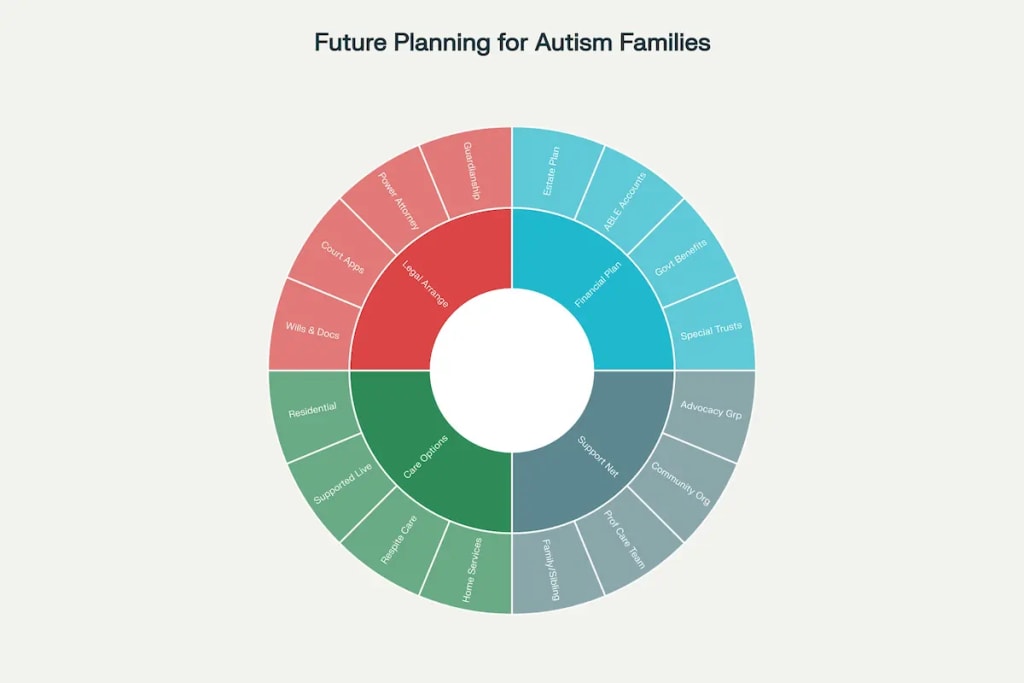
SSI autism adults eligibility and planning
Supplemental Security Income (SSI) provides crucial financial support for autistic adults who meet specific criteria. Current SSI benefits provide up to $914 monthly for individuals, though this amount varies by state and living situation. To qualify, autistic adults must demonstrate:
- Limited income: Generally less than $1,971 monthly from work
- Limited resources: Assets under $2,000 for individuals
- Qualifying disability: Documentation of autism’s impact on daily functioning
Many families don’t realize that careful financial planning can help preserve SSI eligibility while still providing additional support through special needs trusts and ABLE accounts. The key is understanding how different income sources are calculated and ensuring that family assets don’t inadvertently disqualify their loved one.
Comprehensive financial planning timeline
Successful autism financial planning follows a structured approach:
Years 1-2: Foundation building
- Establish special needs trust with experienced attorney
- Open ABLE account and begin regular contributions
- Document all current expenses and project future needs
- Review and update all insurance policies
Years 3-4: System optimization
- Maximize ABLE account contributions
- Coordinate with siblings and extended family on contribution strategies
- Establish relationships with autism-experienced financial advisors
- Begin transitioning financial responsibilities to backup caregivers
Years 5-7: Implementation and refinement
- Complete all legal documentation
- Train family members on trust and ABLE account management
- Establish regular review schedule with professionals
- Create comprehensive financial instruction manual for future caregivers
Legal guardianship and advocacy: Protecting rights and autonomy
Autism guardianship processes vary significantly depending on your location and your adult child’s specific needs. In the UK, the Court of Protection handles these matters, making decisions for adults who lack capacity to make their own choices. However, guardianship shouldn’t be viewed as an automatic necessity, many autistic adults can make their own decisions with appropriate support.
Recent research shows that 43% of autistic adults have some form of legal guardianship or deputyship arrangement, though advocates increasingly emphasize that these should be the least restrictive option necessary to ensure safety and wellbeing.
Understanding deputyship and guardianship options
UK parents have several legal pathways available:
Financial deputyship: Covers managing bank accounts, benefits, property, and investments. This might be appropriate for autistic adults who can make personal care decisions but struggle with financial management.
Health and welfare deputyship: Includes decisions about living arrangements, medical care, and daily activities. This is typically reserved for cases where the person lacks capacity in these areas.
Limited vs. full guardianship: Rather than seeking complete control, consider whether limited arrangements might preserve more of your adult child’s autonomy while providing necessary support.
The application process requires medical evidence of incapacity and assessment of the proposed guardian’s suitability. Legal experts stress that guardianship should be the least restrictive option necessary to ensure safety and wellbeing.
Power of attorney alternatives
For autistic adults with capacity who simply need support with complex decisions, Lasting Power of Attorney might provide a less restrictive alternative to guardianship. These arrangements can be established while the person still has capacity and can be more limited in scope.
Court of Protection autism guardianship process
The Court of Protection autism guardianship process involves several key steps:
- Assessment of capacity: Medical professionals evaluate the person’s ability to make specific decisions
- Application preparation: Detailed forms documenting the need for deputyship
- Court review: Judges examine evidence and may request additional information
- Ongoing supervision: Regular reporting requirements to ensure proper management
Current processing times average 4-6 months, though complex cases may take longer. Costs typically range from £1,000-£3,000 depending on complexity and legal representation needs.
Housing and care options: Mapping the residential landscape
Residential options for adults with autism have evolved significantly beyond the institutional models of previous generations. Modern approaches emphasise choice, independence, and community integration while providing necessary support levels.
Current statistics show that 38% of autistic adults live in some form of supported housing, while 29% remain in family homes past age 25. The variety of available options has expanded significantly, offering families more choices than ever before.
Supported living models
The supported living approach gives autistic adults tenancy rights in their own homes while providing whatever level of support they need. This might involve:
- Independent flats with visiting support: For those needing help with specific tasks like budgeting or healthcare appointments
- Shared housing with live-in support: Combining social interaction with 24/7 assistance availability
- Purpose-built supported housing: Specially designed environments that accommodate sensory and communication needs
Praxis Care, which operates supported living services across Ireland and the UK, reports that this model allows residents to have more control over their daily lives compared to traditional residential care. Tenants can choose their housemates, participate in selecting support staff, and maintain their homes according to personal preferences.
Recent outcome studies show that autistic adults in supported living arrangements report 35% higher satisfaction rates with their living situations compared to those in traditional residential care settings.
Residential care services
For autistic adults requiring more intensive support, residential care provides comprehensive services including accommodation, meals, activities, and round-the-clock staffing. The National Autistic Society operates residential services across the UK, all registered with relevant care inspectorates and designed specifically for autistic adults.
Quality residential services now emphasise:
- Person-centred planning: Individual assessments determine support levels and life goals
- Autism-specific environments: Reduced sensory triggers, visual supports, and predictable routines
- Community integration: Regular outings, volunteer opportunities, and maintaining family connections
- Skill development: Ongoing work to increase independence and self-advocacy abilities
Respite and temporary care
Autism family support planning should include provisions for respite care, both for aging parents and as potential stepping stones toward more independent living arrangements. Many organisations offer short breaks services, allowing families to experience alternative care arrangements gradually rather than in crisis situations.
Research shows that families using regular respite services report 28% lower stress levels and are more likely to successfully transition to permanent alternative care arrangements when needed.
Housing costs and funding
Understanding the financial implications of different housing options is crucial for comprehensive planning:
- Supported living: Costs range from £400-£800 weekly depending on support levels
- Residential care: Typically £800-£1,500 weekly for specialist autism services
- Respite care: Usually £150-£300 per day for temporary placements
Many of these costs can be covered through local authority funding, though families often face lengthy assessment processes and may need to contribute based on their assets and income.
Employment support and transition services
One of the most significant factors in long-term financial security for autistic adults is employment. Recent initiatives have focused on improving employment outcomes, recognizing that work provides not just income, but also purpose, social connection, and increased independence.
Autism transition planning for employment
Effective autism transition planning begins early, ideally during the teenage years. Key components include:
Skills assessment: Identifying strengths, interests, and support needs in work environments Job training programs: Specialized programs that teach both job skills and workplace social skills Supported employment: Services that provide ongoing support once employment begins Employer education: Programs that help businesses understand how to effectively support autistic employees
Current employment support programs
Several organizations now specialize in autism employment support:
Autism Speaks Employment Tool Kit: Provides resources for job seekers, families, and employers Specialisterne: Global organization focused on autism employment in technology fields
National Autistic Society employment services: Offers job coaching and employer support across the UK
Statistics show that autistic adults in supported employment programs have job retention rates of 85%, compared to just 45% for those seeking employment independently.
Benefits of employment for long-term planning
Employment provides multiple benefits beyond just income:
- Reduced family financial burden: Even part-time work significantly reduces long-term care costs
- Increased independence: Work skills often transfer to other life areas
- Social connections: Workplace relationships reduce isolation
- Sense of purpose: Employment contributes to mental health and wellbeing
Families should factor potential employment income into their long-term financial planning, while ensuring that work doesn’t jeopardize benefit eligibility.
The sibling factor: Including brothers and sisters in future plans
Who will care for my autistic son/daughter often becomes a question directed toward siblings, creating complex family dynamics. While many siblings willingly accept future caregiving responsibilities, research suggests this shouldn’t be assumed or imposed without careful consideration.
Current research shows that 67% of siblings of autistic adults expect to take on some caregiving responsibilities in the future, though many feel unprepared for this role. This highlights the importance of early planning and sibling education.
Preparing siblings for potential roles
Effective sibling preparation involves:
- Open communication: Regular family discussions about autism, future needs, and everyone’s feelings about potential responsibilities
- Skills development: Teaching siblings about autism support techniques, emergency procedures, and advocacy skills
- Boundary setting: Making clear that siblings have choices about their level of involvement
- Financial education: Ensuring siblings understand trust structures, benefits, and legal arrangements
The Organisation for Autism Research provides resources specifically designed for siblings, including the “Kit for Kids” series and guides like “Autism, my sibling, and me”. These materials help siblings understand their brother or sister’s needs while validating their own feelings and concerns.
Building extended support networks
Rather than relying solely on siblings, successful autism caregiver burden reduction involves building broader support networks. This might include:
- Professional care coordinators: Individuals trained in autism support who can oversee care arrangements
- Extended family involvement: Grandparents, aunts, uncles, and cousins who can provide backup support
- Community connections: Religious organisations, autism charities, and volunteer networks
- Peer family partnerships: Arrangements with other autism families for mutual support
Research from Ireland’s AsIAm organisation demonstrates the effectiveness of peer support networks, showing that autistic adults and their families benefit significantly from connecting with others who share similar experiences.
Sibling support resources
Recognizing that siblings need their own support, several resources now exist:
Sibling Support Project: International organization providing resources and connecting siblings Autism family support services: Many local autism organizations now offer sibling-specific programming Online communities: Facebook groups and forums specifically for siblings of autistic individuals
Studies show that siblings who receive adequate preparation and support report feeling more confident about their future roles and experience less anxiety about family responsibilities.
Crisis planning: Preparing for emergencies
Autism care crisis planning becomes crucial as parents age and face their own health challenges. Autism Speaks recommends comprehensive crisis planning that includes:
Immediate response protocols
- Emergency contacts: Updated lists including family, professionals, and services providers
- Medication information: Current prescriptions, dosages, and prescribing physicians
- Behaviour support strategies: Specific techniques that help during distress or meltdowns
- Communication aids: Methods for helping the autistic person express needs during crises
Institutional arrangements
- Hospital protocols: Advance planning for medical emergencies, including autism-specific needs
- Temporary care arrangements: Pre-arranged respite services for emergency situations
- Professional contacts: Relationships with autism-experienced healthcare providers
Legal documentation
- Medical decision-making authority: Clear designation of who can make healthcare decisions
- Financial access: Arrangements for accessing funds during emergencies
- Care instructions: Detailed guidance about daily routines, preferences, and support needs
Emergency planning checklist
Recent updates to crisis planning recommendations include:
Digital documentation: Cloud-based storage of all important documents Emergency care boxes: Physical kits with essential items for temporary placement Professional notification systems: Automated systems to alert key professionals during crises Backup location planning: Alternative housing arrangements for emergency situations
Research shows that families with comprehensive crisis plans experience 60% shorter resolution times during emergencies and report feeling significantly more confident about handling unexpected situations.
Support networks and professional resources
Autism family support extends far beyond immediate family circles. The UK boasts numerous organisations specifically designed to assist families navigating long-term planning challenges.
National support organisations
The National Autistic Society offers comprehensive support services including parent-to-parent emotional support helplines, educational programmes (EarlyBird, Teen Life), and specialist residential services. Their Parent to Parent service provides understanding from trained volunteers who are themselves parents of autistic children.
Recent expansion of National Autistic Society support services includes:
- Online support groups: Virtual meetings for parents in remote areas
- Financial planning workshops: Quarterly sessions on special needs financial planning
- Legal clinic referrals: Connections to autism-experienced solicitors and legal aid
- Transition planning support: Specialized help for families planning adult services
Autism Central provides guidance for parents and carers, including information about local support groups and autism-friendly activities. Many areas have locally-run parent support groups that combine emotional support with practical information sharing.
As I Am (Ireland’s autism charity) demonstrates the value of peer-led support, offering adult support programmes, family services, and legal clinics. Their approach emphasises community building and practical assistance with navigating services.
Professional support teams
Effective planning typically requires coordination between multiple professionals:
- Special needs financial planners: Specialists in disability benefit rules and trust structures
- Autism-experienced solicitors: Legal experts familiar with guardianship and capacity assessments
- Care coordinators: Professionals who help navigate service options and applications
- Autism advocates: Independent supporters who can help with disputes and service access
The key is assembling a team that understands autism-specific needs rather than trying to fit autism families into generic service models.
Autism Speaks financial toolkit and resources
The Autism Speaks financial toolkit provides comprehensive guidance covering:
Basic financial planning: Understanding special needs trusts, ABLE accounts, and government benefits Estate planning: Will preparation, guardianship decisions, and inheritance planning Insurance strategies: Life insurance, disability insurance, and healthcare coverage Employment planning: Vocational rehabilitation services and supported employment options
Recent additions to the toolkit include interactive calculators for estimating lifetime care costs and decision trees to help families choose appropriate legal structures.
Finding an autism financial advisor
Locating professionals with autism expertise requires specific strategies:
Credentials to look for: Chartered Special Needs Consultant (ChSNC) or Special Needs Planning certification Experience requirements: Minimum 3-5 years working specifically with autism families Knowledge areas: Should understand SSI, Medicaid, special needs trusts, and ABLE accounts References: Should be able to provide contacts from other autism families they’ve served
Professional organizations like the Academy of Special Needs Planners maintain directories of qualified advisors by geographic region.
Empowering the individual: Self-advocacy and independence
Successful future planning for autistic child arrangements must balance protection with empowerment. Research increasingly emphasises the importance of involving autistic adults in their own planning processes, recognising their rights to self-determination and choice.
Developing self-advocacy skills
Many autistic adults can participate meaningfully in planning their own futures when given appropriate support and information. This might involve:
- Accessible planning documents: Using visual aids, simple language, and familiar formats
- Gradual preparation: Introducing concepts over time rather than in overwhelming amounts
- Choice-making practice: Regular opportunities to make decisions about daily life and preferences
- Rights education: Understanding legal protections and entitlements
Maximising independence
Even autistic adults requiring significant support can often develop greater independence in some life areas. Occupational therapy research demonstrates that skill-building in daily living tasks, communication, and self-care can continue throughout adulthood.
Life skills development priorities often include:
- Financial literacy: Understanding money, budgeting basics, and recognising scams
- Healthcare self-advocacy: Communicating symptoms, understanding treatments, and maintaining health
- Social navigation: Building relationships, recognising social cues, and accessing community resources
- Technology skills: Using phones, computers, and apps for communication and independence
Self-directed support planning
Recent developments in self-directed support allow autistic adults to have greater control over their services:
Personal budgets: Direct payments that individuals can use to purchase their own support services Individual service funds: Pooled arrangements that give more choice while maintaining some professional oversight Supported decision-making: Alternatives to guardianship that provide assistance while preserving autonomy
Research shows that autistic adults using self-directed services report 42% higher satisfaction with their support arrangements compared to traditional service models.
Current challenges: The 2024 crisis in autism services
The landscape for autism and older parents future care planning has become increasingly challenging. NHS data from September 2024 reveals that over 204,000 people are waiting for autism assessments, a staggering 25% increase in just one year. With 89% waiting longer than the recommended 13 weeks, families are facing unprecedented delays in accessing basic support.
This crisis has particular implications for older parents. The Children’s Commissioner reports that some families are waiting over four years for assessments, with children “in limbo” unable to access appropriate education or support services. For aging parents, these delays represent lost opportunities to establish support systems while they’re still able to advocate effectively.
Recent trends affecting family planning include:
- Service closures: Specialist autism units closing, forcing families into generic services
- Workforce shortages: Reduced availability of autism-experienced professionals
- Funding pressures: Increased competition for limited resources
- Bureaucratic complexity: More forms, assessments, and eligibility criteria
Impact on financial planning
The service crisis has direct implications for autism benefits eligibility and planning:
Longer assessment times: Delays in diagnosis mean delays in accessing financial support Increased costs: Families paying privately for services while waiting for public support Planning uncertainty: Difficulty projecting future costs when service availability keeps changing Professional shortages: Fewer autism-experienced financial planners and legal advisors available
Autism benefits advisory services response
In response to these challenges, autism benefits advisory services have expanded their offerings:
Emergency support funds: Short-term financial assistance while waiting for formal assessments Legal advocacy: Help appealing decisions and navigating bureaucratic delays
Care coordination: Professional help managing multiple agencies and applications Financial emergency planning: Strategies for managing unexpected costs during waiting periods
Despite these challenges, families cannot afford to delay planning. The research consistently shows that proactive preparation leads to better outcomes than crisis-driven arrangements.
Taking action: Your next steps forward
Autism and older parents future care planning may feel daunting, but breaking it into manageable steps makes progress possible. Research shows that parents who begin planning early, even in small ways, report reduced anxiety and greater confidence about their family’s future.
Immediate actions (this month)
- Gather documents: Collect diagnoses, assessments, and current support plans
- List current support: Identify everyone currently involved in your child’s care
- Research local resources: Contact your local autism organisations for information
- Begin conversations: Talk with family members about future considerations
- Create emergency contact list: Compile essential information for crisis situations
Short-term goals (next 3-6 months)
- Legal consultation: Meet with a special needs planning solicitor
- Financial review: Assess current resources and future needs with a financial advisor
- Care exploration: Visit potential residential or supported living services
- Network building: Connect with other families and support organisations
- Open ABLE account: Begin tax-advantaged savings for future needs
- Benefits review: Understand current and future benefit eligibility
Medium-term planning (6 months to 1 year)
- Special needs trust: Establish proper legal structures with experienced attorney
- Insurance review: Ensure adequate life and disability coverage for parents
- Sibling preparation: Begin educating family members about future roles
- Service relationships: Build connections with potential future care providers
- Employment exploration: Investigate vocational services and job training programs
- Crisis plan development: Create comprehensive emergency response procedures
Long-term planning (next 1-2 years)
- Legal arrangements: Complete guardianship applications if necessary
- Financial structures: Fully fund trusts and ABLE accounts
- Care arrangements: Develop relationships with potential future care providers
- Family preparation: Train family members and finalise support networks
- Transition planning: Begin gradual introduction of new support systems
- Regular reviews: Establish ongoing monitoring and updating processes
Essential resources for getting started
- Autism Speaks Financial Planning Toolkit: Comprehensive guidance on special needs financial planning
- Court of Protection Information: Official guidance on guardianship processes
- National Autistic Society Family Support: Parent programmes and emotional support services
- Local Authority Social Services: Assessment of care needs and eligibility for support
- Benefits Advisory Services: Expert guidance on maintaining benefit eligibility
- ABLE Account Information: Details on tax-advantaged savings for disability expenses
- Autism employment services: Vocational rehabilitation and job placement assistance
Financial planning milestones checklist
Year 1 accomplishments:
- Special needs trust established
- ABLE account opened and funded
- Basic legal documents completed
- Professional support team assembled
Year 2 accomplishments:
- Full funding strategy implemented
- Care options thoroughly researched
- Family members educated and prepared
- Crisis plans tested and refined
Ongoing responsibilities:
- Annual financial reviews
- Regular benefit eligibility checks
- Care plan updates as needs change
- Professional relationship maintenance
The families successfully navigating these challenges share one common trait: they started somewhere, took one step at a time, and built their support systems gradually. Your autistic adult child’s future doesn’t have to be left to chance, with thoughtful planning and appropriate professional support, you can create security and peace of mind for your entire family.
Remember, seeking help isn’t an admission of failure; it’s an act of love. Every conversation you have, every document you complete, and every relationship you build contributes to a future where your child can thrive with dignity and appropriate support. The journey may be complex, but you don’t have to walk it alone.
Success stories: Learning from other families
Names have been changed to protect privacy, but these represent real family experiences shared through autism support networks.
The Johnson family: Starting late but finishing strong
Sarah and Michael Johnson began serious planning when their autistic son David was 28 and they were both approaching 65. Initially overwhelmed by the complexity, they started with small steps:
Year 1: Contacted the National Autistic Society for guidance, met with a special needs attorney, opened an ABLE account Year 2: Established a special needs trust, enrolled David in a supported employment program, connected with three potential residential services Year 3: David began part-time work and started staying overnight at respite services occasionally
“We thought we’d started too late,” Sarah reflects, “but taking it step by step made everything manageable. David now has a job he loves, we have financial security in place, and he’s excited about eventually moving into his own flat with support.”
The Williams family: Sibling collaboration success
When Margaret Williams was diagnosed with early-onset dementia at 58, her family had to accelerate their planning for her 31-year-old autistic son Marcus. Her daughter Emma took the lead:
Immediate actions: Emma took extended leave to coordinate services, applied for emergency deputyship, arranged temporary care support Six-month plan: Established special needs trust with input from Marcus, found suitable supported living placement, arranged gradual transition Long-term success: Marcus moved into supported living with a carefully planned transition, maintains strong family relationships, and has developed new friendships
“The crisis forced us to plan quickly, but involving Marcus in every decision made all the difference,” Emma explains. “He’s more independent now than we ever imagined possible.”
The O’Brien family: Employment-focused approach
Patrick and Sinead O’Brien focused their planning on maximizing their autistic daughter Aoife’s employment potential:
Starting point: Aoife, 25, living at home with no job experience and significant social anxiety Strategy: Enrolled in autism-specific employment training, worked with job coach, started volunteer work Outcome: Full-time employment in data entry, contributing to her own ABLE account, planning to move to supported living
“We realized that the best security we could give Aoife was meaningful work,” Patrick notes. “Her job gives her confidence and financial independence we never expected.”
These stories demonstrate that successful planning looks different for every family, but common elements include starting with small steps, involving the autistic person in decisions, and building support gradually over time.
Looking toward the future: Emerging trends and opportunities
The landscape of autism support continues evolving, with several promising developments on the horizon:
Technology innovations
Smart home technology: Automated systems that can assist with daily routines and provide safety monitoring Communication apps: Advancing technology making communication easier for non-speaking autistic adults Virtual reality training: Job training and social skills development through immersive technology Health monitoring: Wearable devices that can alert caregivers to health or stress concerns
Policy developments
Employment incentives: Growing government and corporate programs to increase autism employment Housing innovation: New models combining accessibility with community integration Benefit modernization: Reforms to reduce bureaucracy and increase support flexibility Family support expansion: Recognition of the need for comprehensive family planning assistance
Community awareness
Autism acceptance: Increasing understanding leading to more inclusive communities Employer education: More businesses learning to effectively support autistic workers Educational improvements: Better school-to-adult transition planning Healthcare advancement: Improved autism-specific healthcare services for adults
These developments offer hope for families planning for the future, suggesting that tomorrow’s support landscape may be more comprehensive and accessible than today’s.
If you’re feeling overwhelmed by these decisions, start with just one small step. Contact your local autism organisation, schedule a consultation with a special needs financial planner, or simply begin a conversation with family members. Your future self and your autistic adult child will thank you for taking action today.


