Let’s be honest: we’ve all been there. You’re minding your own business, perhaps making a coffee or pretending to work from home, when Spotify’s top 10 playlist starts playing and suddenly you’re questioning everything you thought you knew about music. What once served as a reliable barometer of popular taste has somehow devolved into a sonic wasteland where creativity goes to die, and your ears go to suffer.
The Spotify algorithm 2025 has fundamentally changed how we discover music, and not for the better. TikTok music influence has reached unprecedented levels, with streaming charts broken by viral gimmicks rather than genuine artistic merit. I genuinely never thought it could get worse. But here we are in 2025, and Spotify’s top 10 has managed to surprise us all by plumbing new depths of musical mediocrity. It’s like watching a car crash in slow motion, except the car is your faith in humanity’s taste, and the crash site is littered with auto-tuned vocals and beats that sound like they were programmed by someone’s little cousin who just discovered GarageBand.
The perfect storm: How we got here
The rise of TikTok and viral gimmicks
The most obvious culprit behind this musical apocalypse is TikTok, that algorithmic black hole where 30-second clips determine the fate of entire careers. According to TikTok and Luminate’s latest Music Impact Report, a staggering 84% of all songs that entered the Billboard Global 200 in 2025 went viral on TikTok first. Let that sink in for a moment: we’re essentially letting teenagers with short attention spans decide what constitutes good music.
This statistic represents a seismic shift in how music reaches mainstream audiences. The traditional gatekeepers, radio programmers, music journalists, and industry A&R representatives, have been largely replaced by an algorithm that prioritizes engagement metrics over musical substance. The result is a feedback loop where songs are crafted specifically to capture those crucial first 15 seconds of listener attention, often at the expense of everything else that makes music memorable.
The ripple effects of this TikTok music influence extend far beyond just hit singles. Independent artists report feeling pressured to create “TikTok-ready” content, chopping up their songs into bite-sized hooks and abandoning traditional song structures entirely. Music discovery problems have multiplied as listeners become conditioned to expect instant gratification from their audio experiences.

This isn’t necessarily TikTok’s fault, the platform is simply doing what it was designed to do. But the consequences are devastating for musical artistry. Songs are now crafted not as complete artistic statements but as potential viral moments. Artists are writing hooks that hit within the first 15 seconds, abandoning bridges, skipping intros, and treating outros like an extinct species. The result? A generation of musical attention deficit disorder that makes elevator music seem sophisticated by comparison.
The BBC’s recent research shows that while song lengths briefly recovered to three and a half minutes in early 2025, this was more exception than rule. Most trending tracks still hover around the three-minute mark, with some viral sensations clocking in at barely two minutes. When did we decide that musical experiences should have the same duration as a toddler’s attention span?
Music streaming economics have created additional pressure for brevity. Artists and labels have discovered that shorter songs can be played more frequently, generating more streams and therefore more revenue. This has led to what industry insiders call “stream farming,” where songs are deliberately kept short to maximize play counts rather than artistic impact.
Algorithmic manipulation: When machines make music choices
Spotify’s algorithm, once heralded as a revolutionary tool for music discovery, has become part of the problem. Former Spotify employees have revealed that the platform’s pursuit of profitability has fundamentally compromised its recommendation systems. What was once a sophisticated blend of human curation and machine learning has devolved into an echo chamber that prioritizes familiarity over exploration.
The evidence of these Spotify recommendation issues is everywhere. Users across Reddit and other forums report that Discover Weekly, Daily Mix, and Song Radio features are recycling the same 100-200 tracks ad nauseam. One user described their Release Radar playlist as consisting of “85% noise,” literally rain sounds and brown noise instead of actual music. This isn’t a bug; it’s a feature of an algorithm that has learned to game the system rather than serve its users.
Glenn McDonald, a former Spotify engineer who helped develop the platform’s genre categorization system, explains that the algorithm now keeps users within increasingly narrow musical bubbles. Instead of encouraging musical exploration, it reinforces existing preferences to the point of stagnation. It’s like having a friend who only ever recommends restaurants you’ve already been to, technically safe, but utterly pointless.
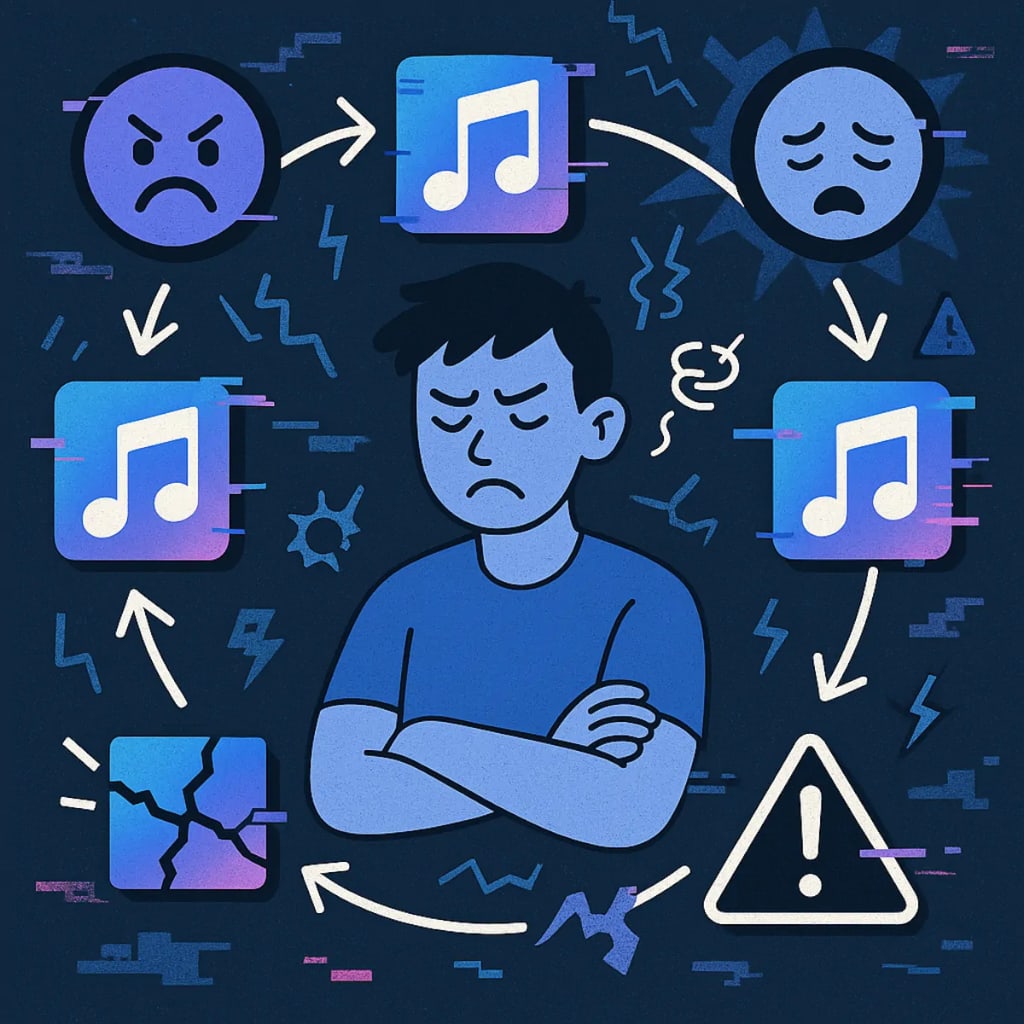
The algorithmic music curation system has become so predictable that many users report knowing exactly which songs will appear in their personalized playlists. This predictability extends to the artificial playlist controversy, where Spotify has been caught seeding its curated playlists with AI-generated content designed to reduce royalty payments to real artists.
Machine learning models trained on user behavior have inadvertently created a feedback loop that reinforces mediocrity. When algorithms detect that users don’t immediately skip certain types of songs, they interpret this as positive engagement, even if the user is simply too passive or distracted to actively curate their listening experience. This has led to what researchers call “algorithmic complacency,” where recommendation systems optimize for the absence of negative feedback rather than the presence of genuine enthusiasm.
The streaming economy’s race to the bottom
The economics of streaming have created perverse incentives that reward quantity over quality. With artists earning roughly $0.003 per stream, the focus has shifted from creating lasting artistic statements to generating as many trackable “plays” as possible. This has led to the proliferation of what industry insiders call “streambait,” generic, mood-driven music designed specifically for algorithmic playlist inclusion rather than human enjoyment.
The Business Insider investigation revealed that Spotify has been seeding its curated playlists with AI-generated music and tracks from “fake artists,” essentially muzak created by clearing houses to avoid paying royalties to real musicians. These phantom artists, with names like “Jonci” (a barely disguised rip-off of Jónsi from Sigur Rós), rack up millions of plays while contributing nothing to musical culture except corporate profits.
This streaming platform problems 2025 scenario has created what economists call a “race to the bottom,” where platforms compete on cost-cutting rather than quality improvement. The result is a system that systematically undervalues musical creativity while overvaluing algorithmic efficiency.

The financial pressure on artists has intensified the viral music trends phenomenon. Independent musicians, who once had the luxury of developing their sound over multiple releases, now feel compelled to chase viral moments with each single. This has led to a homogenization of sound as artists attempt to reverse-engineer successful formulas rather than explore new creative territories.
Social media music trends have become so dominant that many artists now hire specialized TikTok consultants to help craft songs with viral potential. These consultants analyze successful clips, identify common elements, and advise artists on everything from lyrical content to visual aesthetics. The result is music created by committee, designed to perform well in 30-second increments rather than as complete artistic statements.
The worst offenders: A rogues’ gallery of chart mediocrity
Looking at the current Spotify top 10, it’s hard to know where to begin the criticism. The chart is dominated by tracks that feel less like songs and more like algorithmic experiments gone wrong. We have HUNTR/X’s “Golden” sitting at number one, a track that sounds like it was assembled in a committee meeting where the brief was “make something that doesn’t offend anyone but also doesn’t excite anyone.”
The song exemplifies everything wrong with current popular music. It features a generic trap-influenced beat, auto-tuned vocals that could belong to literally any contemporary pop artist, and lyrics that seem generated by an AI trained on the most common phrases from successful pop songs. The track clocks in at exactly 3 minutes and 2 seconds, the perfect length for algorithmic optimization, neither too short to seem incomplete nor too long to risk listener fatigue.
Then there’s the inexplicable presence of multiple K-pop collaboration tracks that seem designed more for merchandising opportunities than musical merit. Don’t misunderstand, K-pop as a genre has produced genuinely innovative and exciting music. But when Western labels try to manufacture that magic through focus-grouped collaborations, the results are about as authentic as a three-dollar bill.
These manufactured collaborations represent the worst aspects of music industry globalization. Rather than fostering genuine cultural exchange between artists from different backgrounds, they create sanitized products designed to appeal to the lowest common denominator across multiple markets. The songs typically feature English-language hooks paired with Korean verses, creating a jarring linguistic patchwork that serves marketing departments better than it serves artistic expression.
Perhaps most frustrating is the dominance of Sabrina Carpenter tracks. While Carpenter is undeniably talented, having six of your songs simultaneously chart in the top 30 suggests something more cynical than organic popularity. It speaks to a music industry that has learned to game streaming algorithms through coordinated release strategies and playlist manipulation rather than trusting audiences to discover music naturally.
The Sabrina Carpenter phenomenon illustrates how music algorithm manipulation can create artificial scarcity and demand. By releasing multiple versions of the same song, alternate mixes, acoustic versions, and featured collaborations, labels can flood streaming platforms with content that appears diverse while actually representing minimal creative output. This strategy, known as “version inflation,” allows artists to dominate charts through sheer volume rather than genuine popularity.
The rise of songs like Alex Warren’s “Ordinary” and sombr’s “back to friends” represents everything wrong with current popular music. These tracks aren’t bad because they’re offensive or controversial, they’re bad because they’re aggressively mediocre. They exist in a sonic middle ground designed to be inoffensive background noise, the musical equivalent of beige paint.
“Ordinary” is particularly emblematic of the streaming era’s creative bankruptcy. The song features predictable chord progressions, utterly generic production, and lyrics that could have been written by a computer program analyzing successful pop ballads. It’s the kind of song that exists purely to fill space in playlists, designed to be pleasant enough not to inspire skips but forgettable enough not to inspire actual engagement.
Digital platform monopolies have exacerbated these problems by concentrating power in the hands of a few major streaming services. When Spotify, Apple Music, and Amazon Music control the vast majority of music consumption, their algorithmic preferences become industry-wide mandates. Artists adapt their creative processes to match these platforms’ optimization requirements, leading to an increasingly homogenized musical landscape.
When charts actually meant something: A brief history lesson
Cast your mind back to 2015, when Spotify first launched Discover Weekly and the platform still felt like a democratizing force in music discovery. The top 10 featured a genuine mix of established artists, breakthrough hits, and unexpected crossover successes. Songs earned their positions through a combination of radio play, genuine fan enthusiasm, and word-of-mouth recommendations that existed beyond algorithmic manipulation.
The music industry of that era, while far from perfect, still maintained some separation between commercial success and algorithmic optimization. Artists could achieve mainstream popularity through diverse pathways: traditional radio play, music television, critical acclaim, or grassroots fan communities. This diversity of routes to success encouraged musical experimentation and risk-taking.
Compare that to today’s chart, where a song’s success is often predetermined by its TikTok virality coefficient rather than its musical merit. The 2018 hit “Old Town Road” by Lil Nas X is often cited as TikTok’s first major mainstream success story, but at least that track had genuine novelty and personality. It broke rules rather than following the algorithmic playbook that has since calcified into industry doctrine.

“Old Town Road” succeeded because it was genuinely unusual, combining country and hip-hop elements in ways that had never been attempted on such a scale. The song sparked genuine cultural conversation about genre boundaries, racial representation in country music, and the nature of musical authenticity. These deeper cultural conversations are largely absent from today’s algorithmically optimized hits, which are designed to generate engagement rather than meaningful discourse.
The Spanish National Research Council’s comprehensive analysis of popular music from 1955 to 2010 provides sobering context for our current predicament. Their study of 500,000 recordings found that timbral diversity peaked in the 1960s and has been steadily declining ever since. Harmonic complexity has similarly decreased, while overall loudness has increased, the sonic equivalent of someone gradually turning down the complexity dial while turning up the volume knob.
This isn’t just nostalgic pining for a golden age that never existed. The data shows that popular music has measurably become more homogeneous, more predictable, and less adventurous over the past several decades. The streaming era has merely accelerated these trends by removing the friction that once separated casual listeners from music discovery.
The pre-streaming era featured natural gatekeepers who, while sometimes problematic, at least brought human judgment and cultural knowledge to the curation process. Radio DJs developed reputations based on their ability to introduce listeners to new and interesting music. Music journalists served as cultural intermediaries, helping audiences understand and appreciate challenging or innovative artists. Record store employees became trusted advisors for customers seeking musical exploration.
These human touchpoints have been largely replaced by algorithmic systems that, while more efficient at scale, lack the cultural context and intuitive understanding that made human curation valuable. The result is a system that can predict what you might want to hear based on your past behavior but cannot introduce you to something genuinely surprising or challenging.
The psychological trap: Why we keep listening
The cruel irony is that we’re complicit in our own musical imprisonment. The “Mere-Exposure Effect,” a psychological phenomenon where people develop preferences for familiar stimuli, means that the more we hear these mediocre songs, the more tolerable they become. Spotify’s algorithm exploits this cognitive bias, gradually conditioning us to accept increasingly homogeneous musical experiences.
This psychological manipulation extends beyond simple familiarity. Streaming platforms have become sophisticated at exploiting what behavioral economists call “choice architecture,” the way in which options are presented to influence decision-making. When Spotify automatically starts playing recommended songs after your chosen playlist ends, it’s leveraging our tendency toward passive consumption to introduce new content that fits within established patterns.
The platform’s interface design reinforces these behavioral patterns. The prominent placement of algorithmic playlists like “Made for You” and “Discover Weekly” encourages users to rely on automated curation rather than actively seeking out new music. The ease of accessing these pre-made playlists contrasts sharply with the effort required to search for unfamiliar artists or explore different genres.
It’s a form of learned helplessness. Users report feeling frustrated with their recommendations but continue using the same playlists and features that frustrate them. We’ve become musical Stockholm syndrome sufferers, developing Stockholm-like attachments to the very algorithmic systems that have impoverished our listening experiences.
The rise of “functional music,” tracks designed to serve specific moods or activities rather than stand as artistic statements, has further eroded our expectations of what popular music can be. When songs are optimized for “studying,” “working out,” or “relaxing,” they inevitably become more generic and less memorable. We’ve traded musical personality for utilitarian efficiency.
This functional approach to music consumption reflects broader cultural shifts toward optimization and efficiency. Just as we’ve gamified fitness, productivity, and social interaction, we’ve begun to treat music as another input to be optimized for specific outcomes rather than experienced for its own sake. The result is music that serves functional purposes but fails to provide the emotional, intellectual, or spiritual nourishment that great art can offer.
Neuroscientific research has shown that repeated exposure to similar musical patterns can actually reshape our neural pathways, making us more receptive to familiar sounds while becoming less sensitive to novelty. This means that algorithmic recommendation systems aren’t just reflecting our preferences, they’re actively shaping them in ways that make us less adventurous and more predictable consumers.
The cultural cost: What we’re really losing
The degradation of Spotify’s top 10 represents more than just bad taste, it’s a symptom of broader cultural homogenization. When algorithms increasingly determine what music gets heard, we lose the happy accidents and unexpected discoveries that have historically driven musical evolution.
Independent artists face unprecedented challenges breaking through algorithmic gatekeepers that favor major label marketing budgets over genuine creativity. The cost of promoting new music on streaming platforms has increased dramatically as organic reach has declined, creating a system that rewards established players while shutting out fresh voices.
This has led to what cultural critics call “the flattening of taste.” When algorithmic systems optimize for broad appeal and minimal offense, they inevitably gravitate toward the middle of the cultural spectrum. The result is music that offends no one but also excites no one, a beige backdrop to modern life rather than a source of genuine emotional or intellectual stimulation.
Perhaps most concerning is the impact on musical literacy itself. When listeners are conditioned to expect instant gratification and sonic familiarity, they become less equipped to appreciate complex or challenging music. We’re creating generations of listeners who have been algorithmically trained to prefer musical fast food over more nutritious fare.
The decline of music criticism and journalism has compounded these problems. As traditional media outlets have cut their arts coverage, fewer professional critics are available to provide context, analysis, and advocacy for challenging or innovative music. This has created a vacuum that algorithmic systems have filled, but algorithms cannot provide the cultural and historical context that helps listeners appreciate and understand new forms of artistic expression.
Educational institutions have also struggled to adapt to the streaming era. Music education programs often focus on traditional instruments and composition techniques while giving little attention to the digital tools and platforms that now dominate popular music creation and distribution. This disconnect between formal music education and contemporary music culture has widened the gap between artistic training and commercial success.
The globalization of music through streaming platforms has had paradoxical effects. While listeners theoretically have access to music from around the world, algorithmic curation tends to homogenize these diverse influences into digestible, Western-friendly formats. This has led to what ethnomusicologists call “cultural flattening,” where distinctive regional musical traditions are stripped of their complexity and context to create globally palatable products.
Fighting back: Reclaiming your musical agency
The good news is that resistance is possible. Music lovers are finding ways to circumvent algorithmic recommendations through manual playlist creation, music blogs, and alternative platforms that prioritize discovery over engagement metrics. Some users have reported success by deliberately training their algorithms, actively seeking out diverse music and using the “dislike” function more aggressively to break free from recommendation loops.
One effective strategy involves what digital music enthusiasts call “algorithm poisoning,” deliberately introducing random elements into your listening patterns to confuse recommendation systems. This might involve occasionally playing music from completely different genres, skipping songs you actually enjoy, or creating playlists that combine disparate styles. While this requires more effort than passive consumption, it can help break users out of algorithmic bubbles.
The resurgence of music blogs and independent criticism provides another avenue for musical discovery. Websites like Pitchfork, The Needle Drop, and countless smaller blogs continue to provide human-curated recommendations that prioritize artistic merit over algorithmic compatibility. These platforms serve as cultural intermediaries, helping listeners discover music that streaming algorithms might never surface.
Vinyl record sales have reached their highest levels since the 1980s, suggesting that some listeners are actively seeking more intentional music consumption experiences. Record stores have reported increased foot traffic from younger customers who appreciate the tactile experience of browsing physical music collections and receiving recommendations from knowledgeable staff members.
The recent backlash against Spotify’s declining recommendation quality has prompted the company to introduce new features that give users more control over their algorithmic experience. The updated Discover Weekly now allows Premium subscribers to target specific genres, potentially breaking users out of their established listening bubbles.
Alternative streaming platforms like Tidal, Bandcamp, and Apple Music are gaining ground by emphasizing human curation over algorithmic recommendation. These platforms still use algorithms, but they balance machine learning with human expertise in ways that Spotify seems to have abandoned in its quest for profitability.
Some listeners have returned to more traditional music discovery methods: asking friends for recommendations, attending live concerts, listening to terrestrial or internet radio stations with human DJs, and exploring music through film soundtracks, television shows, and other media. These approaches require more active engagement but often yield more satisfying and surprising results than algorithmic curation.
Community-driven platforms like Discord servers, Reddit communities, and Facebook groups have emerged as spaces for genuine music discussion and recommendation. These platforms allow music enthusiasts to share discoveries, discuss their listening experiences, and build relationships around shared musical interests in ways that algorithmic systems cannot replicate.
The road ahead: Can we save popular music?
The future of popular music depends largely on whether streaming platforms can find sustainable business models that don’t require sacrificing musical diversity for algorithmic efficiency. Some industry observers are cautiously optimistic about emerging trends that suggest listener fatigue with algorithmic homogenization.
The slight recovery in average song lengths observed in early 2025 suggests that some artists are beginning to push back against TikTok-driven brevity. Songs like Chappell Roan’s “Pink Pony Club” (4:18) and Lola Young’s “Messy” (4:44) demonstrate that audiences will embrace longer, more complex tracks when they offer genuine emotional resonance.
Emerging technologies like spatial audio, interactive music experiences, and AI-assisted composition tools offer new possibilities for musical creativity. However, these technologies will only improve popular music if they’re used to enhance artistic expression rather than optimize algorithmic performance.
The key may lie in rebuilding the cultural infrastructure that once supported musical risk-taking and discovery. This means supporting independent venues, music journalism, and alternative platforms that prioritize artistic merit over engagement metrics. It means being more intentional about our own listening habits and refusing to accept algorithmic mediocrity as inevitable.
Some music industry executives are beginning to recognize the long-term costs of algorithmic optimization. A homogenized musical landscape may generate short-term profits, but it ultimately diminishes the cultural value and emotional significance of music itself. This recognition has led to increased investment in artist development programs, independent label partnerships, and alternative curation methods.
Educational initiatives aimed at improving musical literacy could help create more discerning audiences capable of appreciating complex and challenging music. These programs would need to bridge the gap between traditional music education and contemporary digital music culture, helping listeners develop both technical understanding and critical thinking skills.
Regulatory intervention may eventually be necessary to address the monopolistic aspects of streaming platform dominance. Antitrust investigations into major tech companies could extend to their music streaming services, potentially creating opportunities for more diverse and competitive platforms to emerge.
The human element: What algorithms can’t replace
Despite the sophistication of modern recommendation systems, there are fundamental aspects of musical experience that algorithms cannot replicate or replace. Human curation brings cultural context, emotional intelligence, and intuitive understanding that purely data-driven systems lack.
The serendipitous nature of human-mediated music discovery, whether through friends, radio DJs, or record store employees, often leads to more meaningful and lasting musical relationships. These human touchpoints provide not just recommendations but stories, context, and personal connection that enhance the listening experience.
Live music performance remains largely immune to algorithmic mediation, offering audiences direct connection with artists and spontaneous musical moments that cannot be predicted or optimized. The resurgence of interest in live music, festivals, and intimate venue performances suggests that listeners are actively seeking these irreplaceable human experiences.
The role of emotional and cultural intelligence in music curation cannot be understated. Human curators understand not just what sounds similar to previous successful tracks, but what feels appropriate for specific cultural moments, what challenges listeners in productive ways, and what provides comfort or inspiration during difficult times.
Conclusion: The choice is ours
Spotify’s top 10 hitting rock bottom isn’t just a symptom of technological change, it’s a reflection of our collective choices as music consumers. Every stream we contribute to algorithmically generated playlists, every passive acceptance of recommended mediocrity, and every decision to prioritize convenience over discovery shapes the musical landscape for future generations.
The platform that once promised to democratize music access has instead created new forms of gatekeeping that are arguably more insidious than the old industry structures they replaced. At least when radio DJs and A&R executives controlled what we heard, they were human beings with personal tastes and cultural investments. Algorithms have no such stakes, they optimize for engagement metrics rather than artistic value.
But perhaps that’s the point. Maybe Spotify’s top 10 becoming unwatchably bad is exactly the wake-up call we needed. Maybe it’s time to remember that great music has never been about following algorithms or chasing viral moments, it’s about human creativity, risk-taking, and the beautiful unpredictability of artistic expression.
The choice is ours: we can continue sleepwalking through our playlists, accepting whatever the algorithm serves us, or we can reclaim our agency as music lovers. We can seek out the weird, the challenging, and the genuinely surprising. We can support artists who prioritize creativity over virality, and platforms that value discovery over engagement.
We can also recognize that fixing the current system requires more than individual action. It demands collective resistance to algorithmic mediocrity, support for alternative platforms and curation methods, and advocacy for policies that promote musical diversity rather than corporate efficiency.
The stakes extend beyond personal listening preferences. Music shapes cultural values, emotional development, and social cohesion in ways that extend far beyond entertainment. When we allow algorithmic systems to homogenize our musical landscape, we risk diminishing these broader cultural benefits.
Young musicians and composers are watching these developments closely. The creative choices they make will be influenced by the musical environment we create through our consumption patterns and platform preferences. By demanding better from streaming services and actively supporting musical diversity, we can help ensure that future generations inherit a richer and more varied musical culture.
Because at the end of the day, the real tragedy isn’t that Spotify’s top 10 is terrible, it’s that we’ve somehow convinced ourselves this is good enough. And trust me, we can do so much better than that.
The road back to musical excellence starts with a single skip button. Use it wisely.