In the annals of 1990s pop culture, few phenomena burned as brightly or as bizarrely as the Tamagotchi. This peculiar egg-shaped gadget, housing a pixelated creature that demanded constant care, sparked a global obsession that transcended mere toy fad to become something altogether more significant: a cultural revolution that fundamentally altered our relationship with technology. As Tamagotchi Paradise launches globally in 2025 alongside renewed Tamagotchi Uni features, this digital pet revolution enters its fourth decade stronger than ever. The Tamagotchi history isn’t just a story about a successful product; it’s the origin tale of our modern always-on, notification-driven, digitally dependent existence. This tiny device, born in Japan in 1996, effectively trained an entire generation for life in the algorithm age, pioneering concepts that now dominate our smartphone-saturated world, from Snapchat streaks to Duolingo’s persistent owl reminders. Yet remarkably, whilst many ’90s crazes faded into nostalgic obscurity, the Tamagotchi never truly died. With global sales surpassing 100 million units by 2025 and new iterations still launching worldwide, this digital fossil remains very much alive, evolving alongside the technology it helped shape.
The flickering fuse: origins of a revolution
Who invented Tamagotchi? The turtle that started it all
The original Tamagotchi emerged from an unexpected collision of empathy and innovation. Akihiro Yokoi, a toy manufacturing executive at a small Japanese company called WiZ Co., supposedly encountered an advertisement featuring a boy distraught because he couldn’t bring his pet turtle on holiday. The image resonated deeply with Yokoi, himself a pet owner who understood the painful bind between wanderlust and animal responsibility. His solution was elegantly simple yet profoundly radical: what if you could create a pet that travelled everywhere with you, one that existed entirely in the digital realm?
But brilliant ideas require masterful execution. Yokoi faced formidable challenges: how could he create a device affordable enough for mass adoption yet engaging enough to sustain interest? The Game Boy, released in 1989, had proven portable gaming’s viability, but its $90 price tag (with later revisions still costing $50) positioned it as a premium product. Yokoi needed something far cheaper, a device so inexpensive that practically anyone could purchase one, yet sophisticated enough to foster genuine emotional attachment.
His solution echoed an earlier innovation from an unrelated Yokoi. Gunpei Yokoi, Nintendo’s legendary designer who had pioneered the “lateral thinking with withered technology” philosophy behind the Game & Watch devices. Despite sharing surnames and similar approaches, the two Yokois weren’t related, though both understood that dated components, repurposed cleverly, could create revolutionary products. Akihiro Yokoi opted for extremely cheap, outdated technology: basic black-and-white LCD screens, minimal batteries, and a stark three-button interface.
The Bandai partnership and birth of an icon
Yokoi’s vision required a partner with manufacturing muscle and marketing reach. He found it in Aki Maita, a marketing specialist at Bandai, one of Japan’s leading toy manufacturers. Contrary to popular mythology, Maita wasn’t a lonely teacher dreaming of fluffy companionship. She was a savvy businesswoman tasked with bringing Yokoi’s virtual pet concept to market. The collaboration proved transformative. Maita conducted extensive market research targeting teenage girls, discovering that the demographic adored the name “Tamagotchi,” a portmanteau of tamago (egg) and uotchi, the Japanese pronunciation of “watch”.
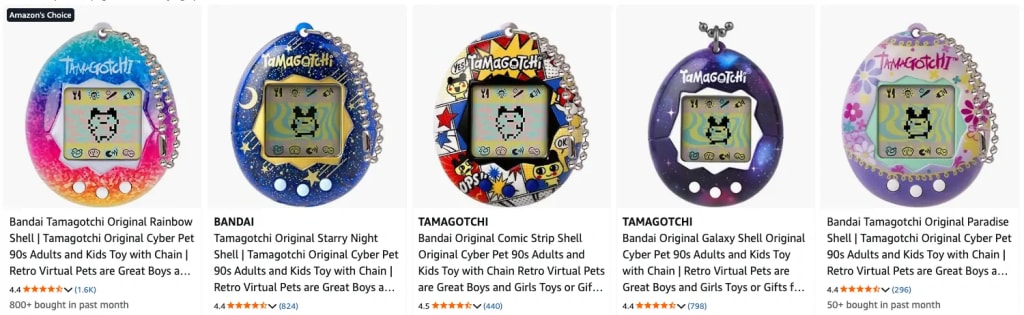
The name reflected Yokoi’s original vision: a watch-integrated pet you could wear on your wrist. The final design, however, emerged as an egg-shaped pendant that could chain to pockets or backpacks. The egg form might have been inspired by reptiles like snakes, which enjoyed popularity as pets in mid-1990s Japan. Inside this unassuming shell lived creatures designed in heta-uma, a popular artistic style found in Japanese teen magazines that celebrated a deliberate “bad-good” aesthetic, intentionally crude drawings that possessed unexpected charm. Converted to pixel art, these characters would become iconic: simple, endearing blobs that somehow inspired genuine love.
On 23 November 1996, Bandai launched the first Tamagotchi in Japan. Nobody, not even the optimistic Maita, anticipated what happened next. This wasn’t merely a successful product launch; it was the detonation of a cultural phenomenon.

The original Tamagotchi 1996: global fever dream
When pixels conquered playgrounds
The original Tamagotchi 1996 became an instant sensation with alarming velocity. Within less than one year, 10 million units sold globally. Parents camped outside toy shops awaiting shipments. Scammers sold fake redemption coupons to desperate buyers. Bandai, caught utterly unprepared, frantically ramped production to 3 million units monthly just to meet demand. When the company offered free Tamagotchis to shareholders owning at least 1,000 shares, stock prices surged 60 yen the following day, with trading volume quadrupling.
The frenzy crossed cultures with remarkable ease. When Tamagotchis launched in the United States on 1 May 1997, San Francisco’s FAO Schwarz sold its entire 3,000-unit stock by 3:00 PM on day one. By noon the next day, the New York flagship had moved 10,000 units. Fifteen Tamagotchis sold every minute in the US and Canada during peak mania. By 1998, the original Tamagotchi had sold approximately 40 million units worldwide, including 12 million in North America alone.
This wasn’t typical toy success. The Tamagotchi inspired behaviours that bordered on the obsessive. Japanese businesswomen reportedly cancelled meetings to care for their digital charges. Reports emerged of adults hiring “Tamagotchi daycare” services, individuals who would babysit virtual pets whilst owners attended school or work. One woman caused a car accident when her Tamagotchi’s beeping distracted her whilst driving. Another refused to turn off her device before aeroplane takeoff, ultimately deplaning rather than comply.

Banned, beloved, and buried
Schools worldwide responded with swift, decisive action: they banned Tamagotchis entirely. Teachers found classrooms disrupted by incessant beeping and students disappearing under desks to feed pixelated creatures. The bans accelerated the virtual pet’s decline from ubiquity but couldn’t erase the profound impression it left on an entire generation.
Perhaps nothing illustrated the Tamagotchi’s emotional impact more poignantly than the cemeteries. In the UK, actual pet cemeteries designated sections specifically for deceased Tamagotchis, where children conducted funerals for neglected digital companions. Online memorial sites proliferated, offering bereaved owners space to share obituaries, causes of death, and eulogies for Jimmy (“dropped it and it made a weird beep sound”) and Toe-Tam (“I left him in my room and when I came back he was dead”). These virtual graveyards, preserved in the forgotten corners of early internet archives, stand as testament to genuine grief over what were, objectively, arrangements of pixels.
The emotional authenticity of this grief was no accident. It was, in fact, entirely by design.
The Tamagotchi effect: psychology of digital attachment

Consequences by design
The Tamagotchi represented a fundamental inversion of the traditional toy-child relationship. Every video game console from the Atari to the Game Boy existed to entertain on demand, passive servants awaiting human pleasure. The Tamagotchi reversed this dynamic entirely. It made demands. It operated on internal schedules utterly indifferent to human convenience. It required care at irregular intervals throughout the day, and these needs couldn’t be paused, scheduled, or postponed.
This reversal created what developmental psychologists now recognise as a novel form of childhood responsibility. Unlike consequence-free traditional play, neglecting a Tamagotchi produced tangible outcomes: the creature would sicken and eventually die. This death mechanic wasn’t punishment but authentic consequence within a relationship. When Western marketers initially attempted to soften this feature for American audiences, focus groups revealed something unexpected: children wanted their digital care to matter. The anxiety of potential failure created the emotional stakes that made the relationship meaningful.
The digital attachment psychology at work here proved surprisingly sophisticated. Tamagotchi gameplay relied on continuous play mechanics rather than discrete gaming sessions, a radical departure from traditional video games that had clear beginnings and endings. You couldn’t simply turn off a Tamagotchi and resume later without consequence. The device continued its internal clock, aging and developing needs whether you attended to it or not. This persistence created genuine responsibility, mimicking real pet ownership in ways no toy had previously attempted.
Psychologists studying this phenomenon identified what became known as the “Tamagotchi effect,” a form of digital attachment where users developed genuine emotional bonds with virtual entities. This wasn’t simply imaginative play or suspended disbelief; fMRI studies conducted years later revealed that human brains could activate similar nurturing circuits when caring for digital creatures as they did for living beings. The Tamagotchi had discovered, perhaps accidentally, how to hack human attachment mechanisms through simple but persistent interaction patterns.
Training wheels for the notification age
Looking back with the clarity of hindsight, the Tamagotchi’s most significant legacy may be its role in acclimatising humans to constant digital interruption. Before smartphones existed, before push notifications became ubiquitous, before “checking your phone” became an hourly ritual, the Tamagotchi normalised the concept that digital devices could legitimately demand your attention throughout the day.
The parallels to modern notification culture origins are striking. Both Tamagotchi alerts and smartphone notifications trigger similar psychological responses: anticipation, anxiety, the nagging feeling that something requires your immediate attention. Both create what behavioural psychologists call “variable interval reinforcement schedules,” where rewards (a healthy pet, a new message) arrive at unpredictable times, creating powerful compulsive checking behaviours. Both train users to prioritise digital demands over immediate physical surroundings.
The Snapchat streak, perhaps the most direct modern descendant of Tamagotchi mechanics, operates on identical principles: daily maintenance of a digital relationship, anxiety about breaking the chain, social pressure to sustain the connection. Instagram’s “Stories” feature creates similar urgency. Duolingo’s increasingly aggressive owl mascot employs guilt-based persistence messaging that would feel familiar to any 1990s Tamagotchi owner who let their digital pet expire.
These aren’t coincidences or parallel evolution. They’re direct applications of the Tamagotchi blueprint: create a digital entity that users care about, make its wellbeing dependent on regular attention, leverage guilt and anxiety to sustain engagement, reward consistency with progression. The Tamagotchi proved this formula could work at massive scale, generating both passionate engagement and, crucially, sustained revenue.
In October 2025, as Tamagotchi Paradise reaches international markets and new Tamaverse events launch for Uni owners, the brand demonstrates remarkable staying power in an era of rapidly cycling trends. The device that pioneered our always-on digital culture continues adapting to it, now incorporating WiFi connectivity, social features, and cloud-based pet storage. The student has become the teacher, learning from the notification-saturated ecosystem it helped create.
The Tamagotchi cultural phenomenon: why it endured
The resurrection: versions after version 1
Following the initial fever, Tamagotchi sales predictably declined. By 2000, the original wave had largely passed, with the devices relegated to nostalgic memory alongside pogs, slap bracelets, and other ’90s ephemera. But unlike those fleeting fads, Tamagotchi staged multiple comebacks, each iteration adding features whilst preserving core gameplay.
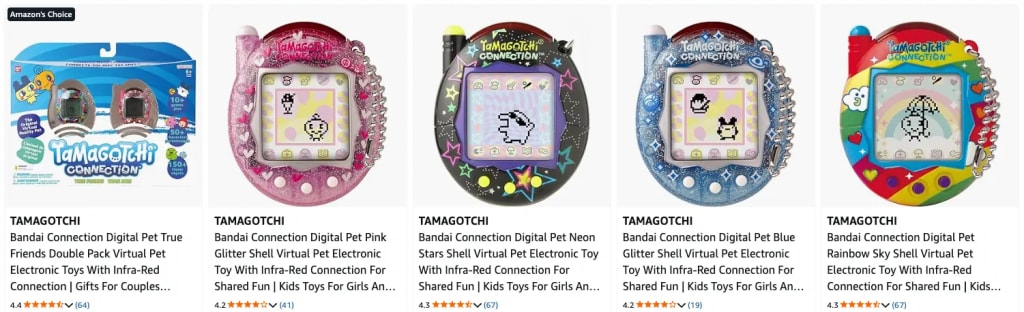
Tamagotchi Connection (2004) introduced infrared connectivity, allowing devices to communicate, enabling pets to “visit” friends, play together, or even marry and produce offspring. This social dimension added multiplicative engagement, as caring for your pet now affected your real-world social relationships. The Connection series sold over 17 million units in Japan alone during its first year.
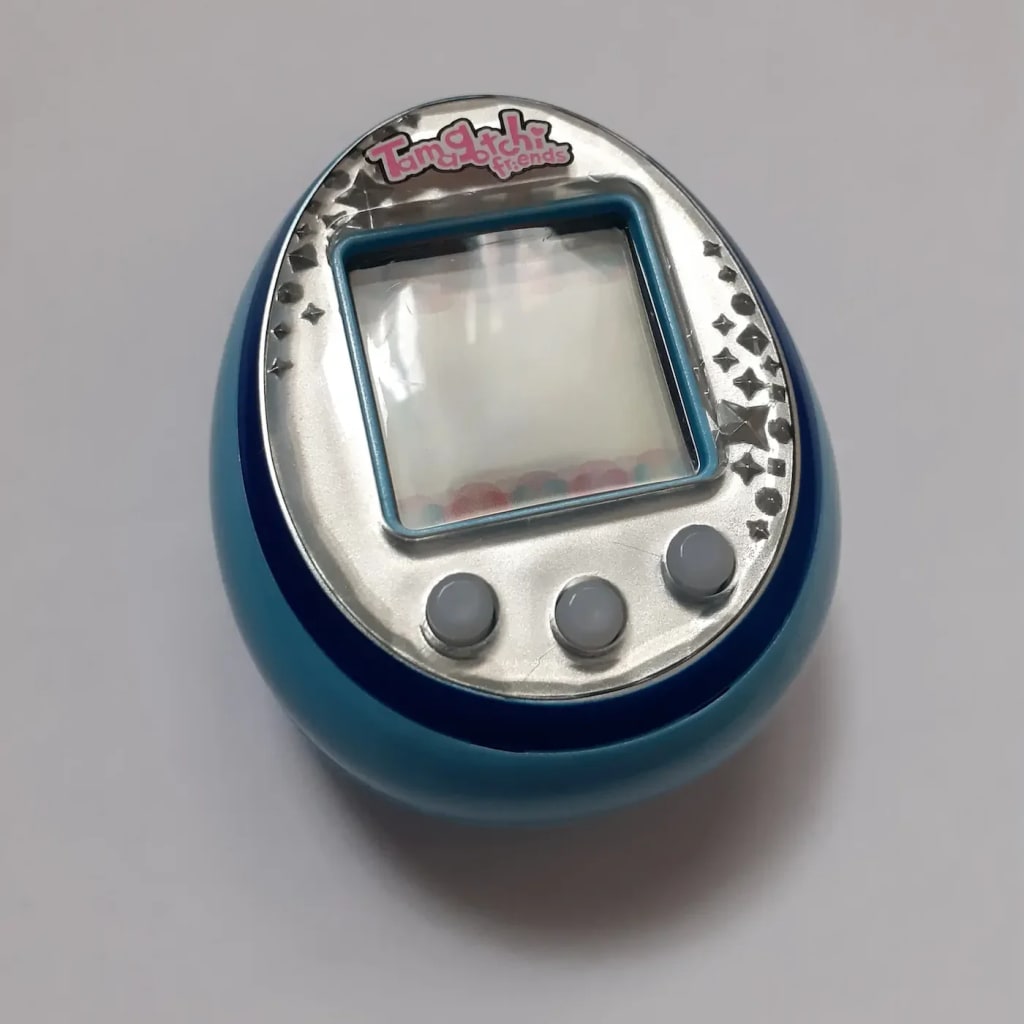
Tamagotchi iD (2009) brought 2D sprites and downloadable content via infrared connections with special stations in Japanese stores. Later models integrated NFC technology for item downloading and WiFi for internet connectivity, steadily moving toward the connected toy ecosystem that dominates contemporary children’s products.
The Tamagotchi Uni (2023) represented Bandai’s most ambitious evolution, featuring full WiFi connectivity to the “Tamaverse,” an online platform where users could access exclusive content, participate in global events, and interact with a worldwide community of digital pet collectors. The Uni demonstrated how thoroughly Tamagotchi had absorbed lessons from the social media era it helped pioneer, integrating community features, regular content updates, and event-based engagement strategies directly into the hardware.
Tamagotchi Paradise 2025: the analogue revival
Most recently, Tamagotchi Paradise (launched July 2025) takes an unexpected direction, incorporating a “zoom dial” for more tactile, analogue interaction with digital creatures. In an era of touchscreens and voice commands, Paradise’s physical dial offers deliberately retro engagement, tapping into broader vintage toy revival trends whilst offering unprecedented customisation with over 50,000 possible character variations.
This design philosophy reflects astute market awareness. The primary Tamagotchi demographic in 2025 isn’t children but adults aged 25 to 45, members of the “kidult market” who grew up with original Tamagotchis and now have disposable income to indulge nostalgic purchases. These consumers value both digital nostalgia and premium build quality, willing to pay higher prices for devices that combine childhood memories with adult aesthetics.
The kidult market represents one of the fastest-growing segments in the toy industry, with adults now accounting for approximately 25% of toy purchases globally. This demographic doesn’t simply buy toys for children; they purchase collectibles, limited editions, and premium versions for themselves. Bandai has responded strategically, releasing special edition Tamagotchis featuring licensed properties (Sanrio characters, Pokémon crossovers, anime collaborations) and designer partnerships that appeal specifically to adult collectors.

The 90s nostalgia gaming trend has particularly benefited Tamagotchi, as millennials and elder Gen Z consumers seek connections to their childhood amid contemporary uncertainty. “Retro gaming 2025” encompasses not only vintage consoles and remastered classics but also continued support for franchises like Tamagotchi that successfully bridge past and present. The appeal isn’t purely nostalgic; it combines fond memories with contemporary conveniences, offering simplified, bounded digital experiences as an anti-scroll alternative to algorithmically infinite social media feeds.
The Tamagotchi succeeded where countless ’90s fads failed because it tapped into fundamental human needs: the desire to nurture, to matter to something, to see consequences from our actions. “Tamagotchi not only fostered nostalgia, but offered a unique way to play that was different from popular video games of the time. It gave players a sense of connection, compassion and customisation, and offered a welcome respite from the competitive and wall-to-wall gaming,” explains Kristy Hisert, Collections Manager at The Strong National Museum of Play, which inducted Tamagotchi into the World Video Game Hall of Fame.
This unique positioning (part toy, part responsibility simulator, part emotional companion) granted Tamagotchi surprising versatility. It could be marketed to children learning responsibility, nostalgic adults seeking simpler times, or digital wellness advocates wanting bounded technology experiences. Few products achieve such cross-generational, multi-purpose appeal.
Influence on virtual pet genre
The Tamagotchi’s legacy extends through countless spiritual successors and inspired creations. Digimon, released in 1997 as a “masculine” counterpart targeting boys, launched an entire franchise spanning anime, manga, video games, and action figures. Monster Rancher, Nintendogs, Neopets, and numerous social media games all draw direct inspiration from Tamagotchi’s care-based gameplay.
The virtual pet evolution continues adapting to contemporary platforms and technologies. Modern iterations of interactive virtual pets extend well beyond dedicated hardware into software ecosystems that integrate across multiple devices. Apps like Mochi Pets bring Tamagotchi-style widget experiences to iOS devices, incorporating interactive features allowing users to feed, pet, and play with virtual creatures without leaving their home screen. Academic researchers have proposed serious game applications based on Tamagotchi mechanics for encouraging physical activity and healthy ageing, with virtual characters reflecting users’ real-world behaviours.
Even cryptocurrency and blockchain gaming have embraced the Tamagotchi blueprint. Projects like Axie Infinity and various NFT-based creature collectors directly apply the care-and-growth mechanics pioneered in 1996, proving the formula’s adaptability to emerging technologies and business models. The fundamental appeal of nurturing a digital dependent proves remarkably adaptable across contexts and technologies.
The comparison between Tamagotchi vs modern apps reveals interesting parallels and divergences. Tamagotchi offered finite demands within a physically bounded device; contemporary applications leverage cloud connectivity and algorithmic content generation for theoretically infinite engagement. Tamagotchi created anxiety through potential pet death; modern apps deploy more sophisticated psychological techniques including social comparison, variable reward schedules, and carefully calibrated difficulty curves. Yet both fundamentally rely on the same insight: humans will invest emotional energy in digital entities if the relationship feels meaningful and consequences feel authentic.
Lessons from the egg: what Tamagotchi teaches us
The ethics of emotional design
The Tamagotchi story raises profound questions about technology design ethics. Is it responsible to engineer emotional attachment to digital entities? Should products make users feel anxiety, guilt, or grief? These questions, barely considered in 1996, now dominate conversations about persuasive design, attention economics, and digital wellbeing.
The Tamagotchi’s death mechanic, initially controversial, proved pedagogically valuable. It taught children that care requires consistency, that neglect produces consequences, and that relationships demand ongoing investment. These lessons, however uncomfortable, prepared young users for both pet ownership and, arguably, adult responsibilities. Yet the same mechanics, when deployed by social media platforms and mobile games at global scale, contribute to anxiety, compulsion, and unhealthy relationships with technology.
Perhaps the crucial distinction lies in bounded versus unbounded design. The Tamagotchi had finite demands: feed it, clean it, play with it, repeat. Modern algorithmic platforms, by contrast, offer infinite content designed to maximise engagement indefinitely. The former teaches responsibility within constraints; the latter exploits psychological vulnerabilities for profit maximisation.
The power of simplicity
In an era of photorealistic graphics, complex mechanics, and overwhelming content libraries, the Tamagotchi’s endurance through deliberate simplicity offers instructive contrast. Three buttons. Pixelated characters. Basic needs. Clear consequences. This minimalism, far from limiting engagement, enhanced it by making the experience accessible, unintimidating, and mentally manageable.
“Despite its emotional depth, Tamagotchi had a simple three-button interface. This simplicity made it accessible to a wide audience whilst still offering depth of gameplay,” notes product design analysis. The best modern apps, regardless of underlying complexity, strive for similarly intuitive interfaces: the Tinder swipe, the Instagram scroll, the Duolingo lesson structure. Complexity can be the enemy of connection; sometimes the most profound interactions emerge from the simplest systems.
This design philosophy extends beyond user interfaces to business models. Digital pet toys 2025 succeed not through technological sophistication but through emotional engagement within accessible frameworks. The most successful interactive digital pets balance simplicity with depth, offering immediate accessibility alongside long-term complexity for dedicated users. This balance, pioneered by Tamagotchi, remains the gold standard for creating mass-market products with devoted niche communities.
Cultural persistence in digital age
The Tamagotchi demonstrates how certain cultural phenomena achieve longevity by evolving whilst maintaining core identity. From infrared connectivity to WiFi Tamaverse integration, from monochrome screens to colour displays, from keychain pendants to smartwatch forms, each iteration adapted to contemporary technology whilst preserving essential gameplay: nurture a creature, watch it grow, experience consequences from your care quality.
This balance between evolution and preservation proves remarkably difficult. Too much change alienates original fans; too little fails to attract new audiences. Bandai’s approach (maintaining the egg shape, three-button interface, and care-based mechanics whilst steadily adding features) threads this needle effectively.
The Tamagotchi’s sustained relevance also reflects strategic brand management. Rather than attempting constant market presence, Bandai has allowed the brand to cycle through periods of dormancy and resurgence, creating anticipation for new releases whilst preventing market saturation. This rhythm mirrors natural cultural cycles, allowing new generations to discover Tamagotchi whilst giving nostalgic adults reason to revisit beloved childhood experiences.
Conclusion: the fossil lives on
As the Tamagotchi approaches its 30th anniversary in 2026, its transformation from ’90s fad to enduring cultural phenomenon stands complete. With over 100 million units sold globally, sustained innovation across dozens of models, and influence permeating modern digital design, the “digital fossil” proves remarkably alive.
Yet the Tamagotchi’s greatest legacy may be less tangible than sales figures or product iterations. It fundamentally altered how humans relate to digital entities, pioneering mechanics and emotional frameworks that now structure our daily technological interactions. Every notification demanding attention, every streak anxiety-producing, every algorithmic relationship requiring “feeding” through engagement, these descend from lessons learned when millions worldwide first cared for pixelated eggs.
The Tamagotchi trained us for the algorithm age, for better and worse. It demonstrated that digital entities could inspire genuine emotion, that virtual relationships could feel meaningful, and that technology could make legitimate demands on human attention and care. Whether this training ultimately benefits or harms us remains an open question, but its profound impact proves undeniable.
As new Tamagotchi models continue launching (the Paradise’s return to analogue interaction, future innovations yet unknown) the franchise shows no signs of mortality. The digital fossil that taught a generation about death, care, and responsibility persists, evolving alongside the technology it helped shape. In this persistence lies both comfort and caution: a reminder that the technologies training our children today will echo through decades, shaping how future generations relate to increasingly sophisticated digital entities demanding ever more of our finite attention.
The Tamagotchi never died. Perhaps it never will. And in that immortality lies its most profound lesson: once you train humans to care for digital creations, that care (and the business models built upon it) become extraordinarily difficult to extinguish.
FAQ: Frequently Asked Questions about Tamagotchi history
Q: When was Tamagotchi invented?
A: The Tamagotchi was invented by Akihiro Yokoi of WiZ Co. and brought to market through partnership with Aki Maita of Bandai. The first Tamagotchi launched in Japan on November 23, 1996, quickly becoming a global phenomenon.
Q: How many Tamagotchi have been sold?
A: Over 100 million Tamagotchi units have been sold globally since 1996. The original version alone sold approximately 40 million units worldwide by 1998, including 12 million in North America.
Q: What is Tamagotchi Paradise?
A: Tamagotchi Paradise, launched in July 2025, is the newest iteration featuring a unique “zoom dial” for more tactile interaction and over 50,000 possible character variations. It represents a blend of nostalgic design with modern customisation options, specifically targeting the adult kidult market whilst remaining accessible to new generations.
Q: Are Tamagotchi still made in 2025?
A: Yes, Tamagotchi devices are actively manufactured and sold in 2025. Current models include the WiFi-enabled Tamagotchi Uni with access to the Tamaverse online platform and the newly released Tamagotchi Paradise. Bandai continues developing new iterations and special editions, demonstrating the brand’s ongoing commercial viability nearly three decades after its original launch.