As we cross 80 years since the dawn of commercial television, the global entertainment industry finds itself in a paradox: the digital revolution, once heralded as the ultimate fix for pirated content, now appears to have come full circle. The optimism that streaming would spell the end of piracy has faded. Instead, streaming fragmentation drives piracy and has become the main culprit behind the persistent and even resurging levels of content piracy 2025. Our latest evergreen analysis, fit for every curious mind and SEO-optimised for both the present and the next Google algorithmic whim, dives into the data, dissects industry blunders, and offers a forward-looking blueprint for how to combat this growing challenge.
The broken promise of streaming
Remember when we all believed that streaming would ‘kill piracy’ once and for all? Netflix, Hulu, and their ilk swept in and gave us more entertainment for less money than a trip to Blockbuster or the cable company ever could. We thought the war was finally over. But that optimism, slicker than a Marvel movie’s VFX budget, was fleeting. By the time your Wi-Fi lamp was blinking ‘buffering’ in late 2020, piracy was already plotting a comeback.

Streaming fragmentation drives piracy. This isn’t just an edgy thesis; it’s the central reality of today’s entertainment ecosystem. As content fragments across a dizzying array of services, each cultivating its own little walled garden, users are frustrated not just by price, but by the sheer inconvenience. The ‘return of content piracy’ isn’t a historical accident or a price protest. It’s a rational consumer response to an ecosystem riddled with streaming subscription fatigue and the inability to find the content you want, when you want it, in one reliable place.
+ Read more: The Netflix empire: How a simple late fee sparked the streaming revolution that changed entertainment forever
The streaming service fragmentation problem has created what many now call “the subscription labyrinth,” where consumers feel trapped between paying for multiple services or turning to alternative methods. Recent studies show that 62% of streaming users now experience subscription fatigue, with many feeling overwhelmed by the sheer number of choices and the rising costs associated with maintaining access to their favorite content. This frustration has led to a phenomenon industry analysts describe as “unwilling pirates”: consumers who would prefer to pay for content legally but find themselves unable to access what they want through legitimate channels.
The data-driven resurgence of piracy
Before you chalk up piracy’s return to nostalgia, let’s dive into the numbers. According to research from MUSO, piracy hit its all-time low in 2020, with just 130 billion global visits to piracy sites. Fast forward to 2024, and the MUSO 2024 data shows visits had surged to 216.3 billion, representing 216 billion piracy visits and a jump worthy of a Hollywood plot twist. If you think downloads and torrents are to blame, think again: a staggering 96% of TV and film piracy in 2023 came from unlicensed streaming sites. Pirate aggregator apps and sites that unify everything Netflix, Disney+, and HBO Max fragment became the go-to solution for frustrated viewers. By 2024, streaming and download methods reached parity; streaming made up just over half (50.4%) of piracy delivery, with downloads trailing close behind at 49.6%.
These piracy statistics 2025 reveal a troubling trend for content creators and distributors. The resurgence isn’t limited to one geographic region or demographic. It’s a global phenomenon that spans continents and age groups, suggesting that the underlying causes run deeper than simple economic factors. What we’re seeing is a fundamental mismatch between how content is distributed and how consumers want to access it.
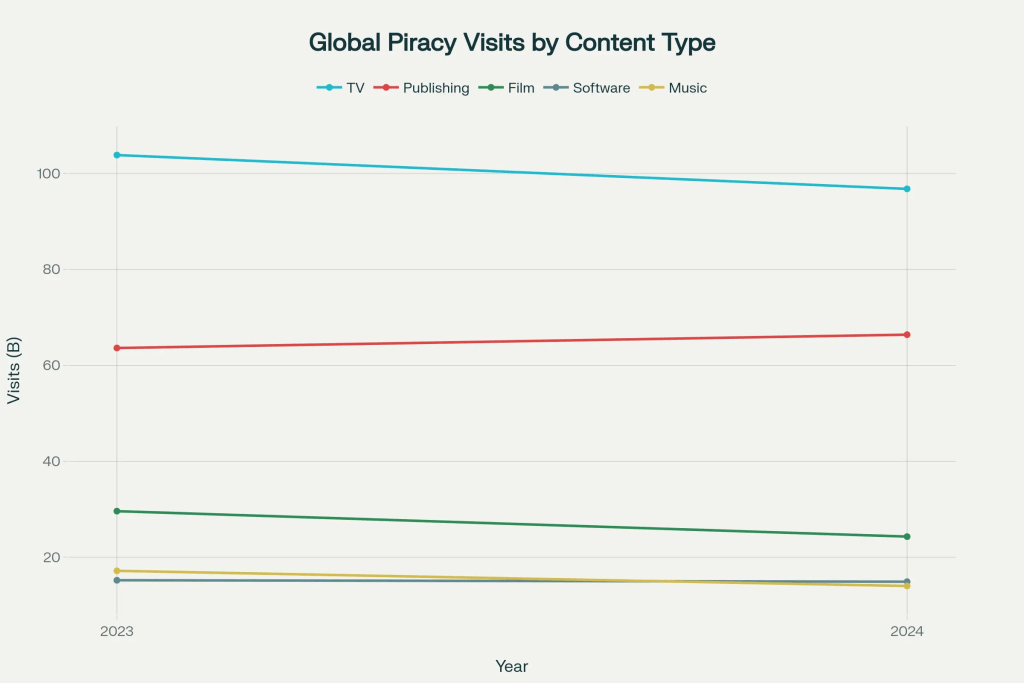
Here’s a visual breakdown for those who like their data with a side of eye candy:
Global piracy visits by content category (2024, in billions)

Year-on-year change in piracy visits by content category (2023-2024)
Piracy delivery methods: streaming vs. download (2024)

Let’s not skim past the historical value. These numbers aren’t just a blip but evidence of a deep-rooted shift in consumer behavior and content access problems. In fact, TV continues to hold the dubious honour as the #1 piracy category, accounting for nearly 45% of all illegal visits. However, the most dramatic story in recent streaming piracy trends involves publishing, particularly manga.
The anime and manga piracy explosion
While TV and film piracy grab headlines, there’s an even more dramatic story unfolding in the publishing sector. Manga piracy and broader anime piracy have surged to unprecedented levels, with manga now accounting for approximately 70% of all publishing piracy globally. This anime manga piracy surge represents one of the fastest-growing segments of digital piracy, and understanding why reveals important lessons about content access and consumer behavior.
The explosion in anime piracy isn’t happening in a vacuum. Japanese animation and manga have experienced massive growth in global popularity over the past five years, yet legal access remains frustratingly limited for international audiences. While platforms like Crunchyroll, Funimation (now merged with Crunchyroll), and Netflix have made strides in bringing anime to Western audiences, significant gaps remain. New series often face months-long delays for international release, if they’re licensed at all. Manga presents an even bigger challenge, with many popular titles never receiving official English translations or facing years of delay.
This creates the perfect storm for piracy. Passionate fans who want to stay current with Japanese releases find themselves with no legal option to access the content they crave. Fan translation groups have filled this void for decades, but the recent surge in piracy visits to manga sites suggests that what was once a niche community activity has become mainstream behavior. Sites offering free access to thousands of manga titles see billions of visits annually, dwarfing the traffic to legitimate platforms.
The publishing piracy increase of 4.3% in 2024, driven almost entirely by manga, stands in stark contrast to other content categories that saw declines. This isn’t about price. Many manga piracy sites are ad-supported and free, but fans would often prefer to support creators if convenient legal options existed. The problem is availability: you can’t pay for what isn’t offered in your region.
Industry responses have been slow and piecemeal. While some publishers have launched digital platforms like VIZ Media’s Shonen Jump app and Kodansha’s K Manga, these services cover only a fraction of available titles and often restrict access by region. The gap between what fans want and what’s legally available continues to widen, pushing more users toward piracy.
This pattern mirrors the broader streaming fragmentation problem but with even higher stakes. Manga and anime fans are among the most dedicated and passionate consumer groups, willing to pay premium prices for merchandise, attend conventions, and support creators. Yet they’re systematically pushed toward piracy by an industry that hasn’t adapted its distribution model to meet global demand.
The implications extend beyond just manga and anime. The publishing sector’s struggles demonstrate that content availability matters more than price point for many consumers. It’s a lesson the film and TV industries should heed as they navigate their own fragmentation challenges.
Fragmentation: the root cause of user frustration
Ah, the “subscription labyrinth.” It’s the modern digital maze, one where your favourite series disappears from Netflix, reappears on Paramount+, and maybe, just maybe, pops up on Peacock with fewer episodes. Sound familiar? If you wanted to keep up with “Westworld,” “Yellowstone,” or “The Office,” you needed more than a spreadsheet. You practically needed investment capital.
But here’s the rub: the ultimate consumer desire is convenience and unification. Pirate aggregator apps, while technically illegal, address this directly. They gather every show, movie, and live channel into a single interface, delivering on the promise mainstream streaming quietly abandoned. It’s no wonder that half of all piracy traffic still comes from these aggregators in 2024, functioning as unified streaming platforms that consumers desperately want but can’t access legally.
The too many streaming services problem has reached a breaking point. The average household now subscribes to four or five different platforms, each with its own app, user interface, search function, and billing system. Want to watch a movie? First, you have to remember which service has it. Then you have to check if it’s still there or if it migrated to another platform. Then you hope your subscription tier includes it and doesn’t require an additional rental fee.
This fragmentation extends beyond just having multiple subscriptions. Content libraries are constantly shifting as licensing deals expire and renew. A show available on Netflix this month might move to Amazon Prime next quarter, then to a network-owned platform the following year. Consumers can’t build reliable viewing habits when content locations change unpredictably.
Regional restrictions add another layer of complexity. A title available on Netflix in the United States might not exist on Netflix UK, or it might be exclusive to an entirely different platform depending on local licensing agreements. This geographic fragmentation explains why VPN services have become essential tools for many streaming consumers, allowing them to access content available in other regions.
For legitimate players, there have been some attempts at streamlining. Amazon’s “Prime Channels” lets users bolt on other subscriptions within their Prime interface, offering a taste of unity. Paramount Plus and others are participating, but they’re not the industry norm. Until true content aggregation is possible, pirates will keep winning on “frictionless” user experience.
Streaming bundles as a potential solution
There’s a glimmer of hope on the horizon that might address streaming service fragmentation: the rise of streaming bundles 2025. After years of aggressive competition and market fragmentation, major streaming players have begun experimenting with bundle offerings that combine multiple services under a single subscription. This represents a significant shift in strategy and could provide the unified streaming platform experience that consumers have been demanding.
The most prominent example is the Disney+, Hulu, and Max bundle, which packages three major streaming services for a combined price lower than subscribing to each individually. Disney’s ownership of both Disney+ and Hulu made this partnership natural, while Warner Bros. Discovery’s Max joining the bundle creates a compelling offer that includes content from Disney, Pixar, Marvel, Star Wars, National Geographic, plus Hulu’s extensive library and HBO’s premium programming.
Verizon has also entered the streaming bundle space, offering packages that combine Netflix with Disney+ at discounted rates for their wireless customers. This telecommunications-meets-streaming approach could become more common as companies look for ways to add value and reduce customer churn. T-Mobile and AT&T have similar offerings, suggesting that bundling might become standard practice for wireless carriers looking to differentiate their services.
Amazon Prime’s approach deserves special mention. While not a traditional bundle, Amazon’s strategy of making Prime Video part of their broader Amazon Prime membership (which includes free shipping, music streaming, and other benefits) creates a natural content aggregation point. Their Prime Channels feature goes further by allowing subscribers to add additional streaming services like Paramount+, Showtime, and Starz directly through the Prime Video interface. This creates a single app experience where users can access content from multiple sources without switching between different platforms.
Apple has taken a similar approach with Apple TV Channels, allowing users to subscribe to services like Paramount+, Showtime, and others through the Apple TV app. While these aren’t traditional bundles with discounted pricing, they do address the user experience problem by providing a unified interface.
These streaming consolidation efforts represent industry acknowledgment that fragmentation has gone too far. The question is whether these solutions go far enough. Current bundles typically cover only two to three services, while many households subscribe to five or more. The savings, while welcome, often aren’t dramatic enough to fundamentally change the value proposition compared to piracy alternatives that offer everything for free.
There’s also the problem of content gaps. Even the most comprehensive bundles don’t include everything. Sports content remains particularly fragmented, with major leagues and events spread across network TV, cable channels, and multiple streaming platforms. Live television and news present similar challenges, with no single bundle offering comprehensive access.
The streaming bundle concept does point toward a possible future where content unification becomes the norm rather than the exception. If bundles continue to expand and cover more services, if pricing becomes genuinely competitive, and if the user experience truly delivers on the promise of convenience, they could represent a viable path forward. The music industry’s success with comprehensive catalog access through Spotify and Apple Music proves that this model can work.
However, bundles must become more ambitious and inclusive to truly combat piracy. A streaming landscape where consumers need two comprehensive bundles instead of six individual subscriptions would be an improvement, but pirates would still maintain an advantage with their single-interface, everything-included approach. The real solution requires industry-wide cooperation on a scale that seems unlikely given current competitive dynamics and content ownership patterns.
The music industry as a contrast (the ‘unified’ model)
If there’s a silver lining, it is this: music streaming got it right. Spotify, Apple Music, and YouTube Music aren’t flawless, but they offer the broadest catalogues for a single subscription, making switching services mostly a matter of taste, not necessity. The effect? Music piracy has plummeted, and most users don’t even consider pirating tracks anymore.
The music streaming vs film piracy comparison reveals important lessons. Spotify doesn’t require you to subscribe to three different services to access Universal, Sony, and Warner music catalogs. You don’t need a separate app for independent labels. Regional restrictions exist but are far less severe than in film and television. The music industry achieved what film and TV haven’t: they created a truly unified access model where licensing complexity happens behind the scenes, invisible to consumers.
This success didn’t happen by accident or goodwill. The music industry arrived at this model after being devastated by piracy in the early 2000s. Napster, LimeWire, and BitTorrent nearly destroyed traditional music sales, forcing labels to reconsider their distribution models. Spotify emerged from this chaos with a compelling value proposition: legal access to virtually all music for a reasonable monthly fee, with a free ad-supported tier as an entry point. Apple Music, Amazon Music, and YouTube Music followed similar models, and while they compete for subscribers, they all offer comparable catalog breadth.
The key insight is that the music industry recognized that convenience beats free when the legal option is genuinely convenient. Spotify made discovering new music easier than piracy ever did, with curated playlists, algorithmic recommendations, and social sharing features. The apps work seamlessly across devices. Everything is searchable and accessible instantly. The user experience became so superior to piracy that most consumers abandoned illegal downloading.
Contrast that with TV and film, where you need multiple subscriptions, shifting geographic rights, and often, a VPN (and a therapist) just to find a film you want. The fragmented landscape means that even paying customers often can’t access content legally. A subscriber to five different streaming services might still encounter a situation where the movie they want to watch isn’t available on any of them due to licensing restrictions.
It’s no accident music piracy is down nearly 19% in 2024, and streaming is credited for the turnaround. The music industry’s approach offers a proven blueprint for combating piracy: make legal access so convenient and comprehensive that piracy becomes more trouble than it’s worth. Film and television could achieve similar results, but it would require unprecedented cooperation among competitors and a willingness to prioritize consumer experience over short-term competitive advantages.
The streaming industry often argues that film and television content is more expensive to produce than music, justifying higher prices and more restrictive licensing. This argument misses the point. Consumers aren’t comparing the production costs of a Marvel movie versus a pop song. They’re comparing user experiences: the hassle of managing multiple streaming subscriptions versus the simplicity of Spotify. Until streaming services can match the unified music model’s convenience, they’ll continue losing users to piracy.
Piracy as a “service problem” (the MUSO pillars)
Crunch the MUSO data further and you see the core pillars fuelling this modern content piracy paradigm. These streaming piracy trends reveal that piracy isn’t primarily about criminality or even about saving money. It’s fundamentally a service problem, a response to industry failures to meet basic consumer expectations.
Fragmented access tops the list. Too many services, too many logins, no guarantee your show will be there tomorrow. This goes beyond mere inconvenience. The cognitive load of managing multiple subscriptions, tracking which content lives where, and adapting to constant library changes creates genuine friction. Pirate services eliminate this friction entirely with centralized, searchable libraries that don’t shift unpredictably.
Demand for digital formats presents another challenge. Original, digital-only content like TV series, manga, and web fiction is most pirate-prone because there’s simply no alternative legal avenue for high-frequency, episodic content. When a manga series releases new chapters weekly in Japan, international fans face a choice: wait months for official translations that may never come, or read fan translations online immediately. The legal option doesn’t exist, making piracy the only option for staying current.
Economic disparities, while crucial, deserve their own dissertation and are outside today’s core analysis. However, it’s worth noting that piracy rates vary dramatically by region, often correlating more with content availability than with average income levels. Wealthy markets with poor content selection see high piracy rates, while some developing markets with excellent local content offerings see lower rates than expected.
Notably, exclusivity is a double-edged sword. Films released simultaneously in theatres and online see less piracy than straight-to-digital blockbusters. This seems counterintuitive, but the explanation is simple: simultaneous releases in multiple formats give consumers choices about how to watch, reducing the incentive to seek illegal alternatives. When a film goes straight to streaming on a single platform, viewers who don’t subscribe to that platform have only two choices: subscribe or pirate. There’s no theatrical option, no rental window, no alternative access point.
Series with no alternative release platforms nudge audiences back toward pirate aggregators. They’re looking for service, not anarchy. This is the “unwilling pirate” phenomenon: consumers who would prefer to pay for content legally but find themselves with no reasonable legal option. These users often feel guilty about piracy and would switch to legal services if those services actually provided access to the content they want.
Industry anti-piracy efforts have traditionally focused on enforcement: blocking sites, prosecuting operators, and implementing digital rights management technologies. While these measures have their place, they address symptoms rather than causes. You can shut down a piracy site, but users will simply migrate to another unless you address why they turned to piracy in the first place.
The most effective anti-piracy strategy is to out-compete pirates on convenience and value. This means offering comprehensive catalogs, reasonable pricing, excellent user experiences, and reliable content availability. The music industry proved this approach works. The film and television industry continues to resist it, preferring to maintain exclusivity and fragmentation while wondering why piracy persists.
The price factor: important but secondary
Now, let’s tackle the elephant in the wallet. Yes, streaming prices have soared globally. In the United States, the average household spends between $42 and $90 monthly on streaming services. Recent surveys peg the average at $69, with a quarter of consumers now shelling out more than $100 per month. Brazilian ‘premium’ all-access streaming tops R$340 monthly (about $65), and Netflix’s standard plan in the US is nearly $18. Subscription fatigue is as real as your dwindling bank balance, with over 62% of users reporting they feel overwhelmed and a third cancelling services as a result.
These subscription fatigue statistics paint a picture of an industry pushing consumers to their breaking point. The steady price increases across all major platforms have outpaced inflation and wage growth in many markets. What started as an affordable alternative to cable has gradually crept toward cable-level pricing when you add up multiple subscriptions needed for comprehensive content access.
+ Read more: The subscription economy impact: How monthly fees are silently draining your wallet
Price sensitivity varies significantly by content type and consumer demographic. Younger viewers, who grew up with free or inexpensive digital content, show higher price resistance than older viewers accustomed to cable bills. Premium content like live sports commands higher willingness to pay, while generic movie catalogs do not. Original series that viewers can’t access elsewhere justify higher prices better than licensed content available on multiple platforms.
But here’s the kicker: even as prices climb, user numbers and revenues (Netflix, for example) continue to grow. Netflix added millions of subscribers in 2024 despite raising prices and cracking down on password sharing. Disney+ remains profitable despite the costs of producing expensive original content. The financial pain makes piracy more appealing, but the root driver remains fragmentation, not just sticker shock.
This reveals an important truth about content piracy 2025: convenience and content availability top the hierarchy of needs; price accelerates the exodus when those are missing. Consumers will pay premium prices for content they want if the service delivers value. Netflix’s continued growth despite higher prices proves this. However, when users must maintain four or five subscriptions to access the content they want, price becomes a breaking point.
The relationship between price and piracy isn’t linear. A single $15 subscription might seem reasonable; five of them totaling $75 monthly feels excessive, especially when content keeps migrating between platforms. The value proposition breaks down not because any individual service is too expensive, but because the cumulative cost combined with the fragmentation hassle makes piracy’s zero-dollar price point increasingly attractive.
Ad-supported tiers have emerged as one response to price concerns. Netflix, Disney+, Hulu, and others now offer lower-priced options with advertisements. These tiers provide a compromise: consumers pay less but sacrifice the ad-free experience. Early data suggests modest adoption, with many users preferring to pay more for ad-free viewing. However, ad-supported tiers do provide an entry point for price-sensitive consumers who might otherwise turn to piracy.
The pricing challenge is real and growing. Streaming services face pressure from all sides: production costs keep rising, investors demand profitability, licensing fees for content increase, and consumers resist price hikes. Something has to give. Either services will consolidate and share costs through bundling, or they’ll continue raising prices and losing users to piracy and subscription fatigue.
What’s clear is that price alone doesn’t explain piracy rates. If it did, we’d see uniform piracy rates across all content types, but we don’t. Music piracy has collapsed despite music streaming costing about the same as a single video streaming subscription. The difference isn’t price; it’s convenience and comprehensive access. Film and television services could learn from this, but it would require fundamental changes to how they license and distribute content.
Current anti-piracy trends and technological solutions
The entertainment industry hasn’t been idle in combating piracy. Recent anti-piracy trends for 2025 showcase increasingly sophisticated technological and legal approaches, though their effectiveness varies considerably. Understanding these efforts provides context for why piracy persists despite significant resources devoted to stopping it.
Artificial intelligence and machine learning now play central roles in anti-piracy detection. Content recognition algorithms can scan millions of websites and video platforms daily, identifying unauthorized copies of copyrighted material within hours of upload. These systems analyze video fingerprints, audio signatures, and even subtle metadata to match pirated content with original sources. Major studios and streaming platforms employ AI-powered monitoring services that generate takedown requests automatically.
Blockchain technology has been proposed as a solution for tracking content ownership and licensing rights. The theory suggests that immutable blockchain records could make it easier to verify legitimate content sources and harder for pirates to obscure their operations. However, practical implementation has been limited, and pirates have shown remarkable adaptability in circumventing new technologies.
The ERAS protocol (Enhanced Rights Authentication System) represents another technological approach, using advanced encryption and authentication methods to verify legitimate streaming sources. Content protected by ERAS includes watermarks and digital signatures that are extremely difficult to strip without degrading quality. Some streaming services now implement similar systems to protect their highest-value content.
Legal and regulatory efforts have intensified as well. The European Union added several major piracy sites, including anime streaming platform HiAnime, to its 2025 piracy watchlist, increasing pressure on internet service providers to block access. Similar efforts in other jurisdictions use court orders to force ISPs to block known piracy domains, though these measures often prove temporary as sites quickly establish new domains.
Industry cooperation has improved, with studios, streaming platforms, and technology companies sharing intelligence about piracy operations. Organizations like the Alliance for Creativity and Entertainment (ACE) coordinate legal actions across borders, targeting the most prolific piracy operations with civil and criminal prosecution.
Yet despite these efforts, piracy continues growing. The reason is simple: technology and enforcement alone can’t solve a service problem. You can make piracy harder, more inconvenient, and riskier, but if legal alternatives remain fragmented and expensive, determined users will find workarounds. Pirates adapt quickly to new countermeasures, and shutting down one site typically just redistributes its users to others.
The most effective anti-piracy solution remains the same one that worked for music: make legal access so convenient and comprehensive that piracy becomes the harder option. Technology should enhance user experience, not just block unauthorized access. Enforcement should target the worst commercial piracy operations while addressing the root causes that drive casual users to piracy in the first place.
Conclusion and long-term outlook (the warning light)
So, what’s the verdict after a data-drenched odyssey through the streaming jungle? The streaming industry, in its zeal to “innovate,” has replicated the worst sins of cable TV: gatekeeping, streaming service fragmentation, and exclusivity, multiplied by slick UIs and the illusion of choice. In this new era, piracy hasn’t “defeated” streaming, nor is streaming vanquished. Both now occupy a tense, mutually sustaining plateau, especially in niche segments.
The streaming piracy trends of 2024 and early 2025 suggest we’ve reached an inflection point. The 216 billion piracy visits recorded by MUSO represent more than just a number. They represent millions of consumers who’ve decided that the current streaming landscape doesn’t meet their needs. These aren’t hardened criminals or ideology-driven activists. They’re ordinary people frustrated by content access problems, overwhelmed by subscription fatigue, and tired of the subscription labyrinth that makes finding and watching content feel like a full-time job.
Piracy is now less about ideology or “sticking it to the man.” It’s a practical response to broken promises: scarcity in an age that claimed it would deliver abundance. The digital revolution was supposed to make content more accessible, not less. Streaming was supposed to be convenient, not complicated. The reality has fallen far short of these promises, and consumers have responded predictably.
The anime manga piracy surge illustrates this perfectly. Manga fans aren’t pirating because they’re cheap or anti-creator. They’re pirating because legal options often don’t exist for the content they want. When the industry finally provides convenient, comprehensive legal access, as demonstrated by music streaming services, piracy plummets. The formula isn’t complicated; it just requires cooperation and consumer-centric thinking that the current industry structure doesn’t incentivize.
Streaming bundles 2025 offer a glimmer of hope. The Disney+, Hulu, and Max bundle, along with similar offerings from other companies, acknowledge that content fragmentation has gone too far. These represent first steps toward the unified streaming platform that consumers want. However, current bundles remain limited in scope and don’t fully address the underlying problems. Real solutions require more ambitious consolidation and a fundamental rethinking of how content licensing works.
The comparison to music streaming vs film piracy remains instructive. Spotify and Apple Music didn’t end music piracy through legal threats or technological barriers. They ended it by being better than piracy: easier to use, more reliable, with better discovery tools and seamless cross-device functionality. Film and television streaming could achieve similar results, but only if major players prioritize consumer experience over competitive advantage.
Looking forward, the industry faces a choice. Continue down the current path of increasing fragmentation, rising prices, and content access problems, which will inevitably drive more consumers to piracy and potentially undermine the entire streaming business model. Or embrace consolidation and cooperation, creating the unified, convenient, comprehensive access that consumers clearly want and are willing to pay for.
The warning light is flashing. Current trends are unsustainable. Subscription fatigue is real and growing. Consumer patience is wearing thin. The success of pirate aggregator apps demonstrates what’s possible when user experience takes priority. Unless the industry rectifies its core service problem by delivering unified, convenient, and broad access to content, piracy will remain a fixture, ready to fill every gap left by legal platforms.
The technology exists to create better legal alternatives. The business models have been proven in the music industry. What’s missing is the will to cooperate and prioritize long-term sustainability over short-term competitive positioning. Until that changes, the piracy surge 2024 will likely continue into 2025 and beyond, representing not the failure of technology but the failure of business strategy and industry cooperation.
Key takeaways and “further reading”:
Fragmentation is the biggest trigger for the rise of digital piracy in the streaming era. Content access problems matter more than price for most consumers. The subscription labyrinth has pushed even willing payers toward alternative solutions.
Price matters, but ease and unified access are paramount. Subscription fatigue statistics show 62% of users feel overwhelmed, but even these users would pay if services delivered real value and convenience.
Music streaming’s unified model is the blueprint to beat. Spotify and Apple Music proved that comprehensive catalog access with excellent user experience can essentially eliminate piracy. Film and television need to learn this lesson.
The anime and manga piracy explosion demonstrates what happens when content availability lags demand. Publishers are losing billions in potential revenue because they haven’t adapted distribution to meet global demand.
Streaming bundles offer promise but need to go further. Current offerings are steps in the right direction but don’t fully address fragmentation. More ambitious consolidation is necessary.
Piracy will persist as long as access models lag behind user expectations. All the anti-piracy technology and legal enforcement in the world won’t solve a service problem. The industry must compete with pirates on convenience and value, not just try to shut them down.
Feeling a little “stream-fatigued” or ready to dive into the full MUSO report? Bring your opinions, experiences, and counter-theories to the discussion. The comments section is your streaming unifier, a space for every voice to share their perspective on how streaming fragmentation drives piracy and what solutions might actually work.