

Ireland stands as one of the wealthiest nations on Earth, boasting the fourth-highest GDP per capita globally and hosting some of the world’s most powerful multinational corporations. Yet beneath this veneer of prosperity lies a devastating reality: thousands of its own citizens have nowhere to call home. The Irish housing crisis has reached alarming proportions. In August 2025, official figures recorded 16,353 people in emergency accommodation, including 5,145 children, representing yet another record high in a crisis that shows no signs of abating. But this represents merely the visible tip of a far larger crisis. The Simon Community estimates that approximately 290,000 people experience what they term “invisible homelessness,” sleeping on couches, in cars, or packed into overcrowded homes with relatives.
This is not merely a housing shortage. This is the story of how a wealthy nation, flush with corporate tax revenues and economic growth, systematically dismantled its housing system through a toxic combination of colonial legacy, speculative excess, policy failures, and regulatory capture. In October 2025, as the government announced Budget 2026 with promises of VAT reductions and new construction incentives, property asking prices showed their first signs of softening after years of relentless increases. Yet with 113,000 mortgages now controlled by vulture funds and housing construction still falling dramatically short of the 50,000 to 60,000 annual units needed, the question remains: can Ireland escape the trap it has created for itself?
This is the story of Ireland’s unprecedented housing crisis, and how living in one of Europe’s richest countries became a luxury its own people can no longer afford.
The colonial roots: land, famine and displacement
To understand Ireland’s contemporary housing crisis, one must first grasp the deep historical trauma embedded in Irish consciousness around land ownership and displacement. The seeds of today’s crisis were planted centuries ago, during the British colonisation of Ireland when the island’s land was systematically transferred from Catholic Irish farmers to Protestant English lords.
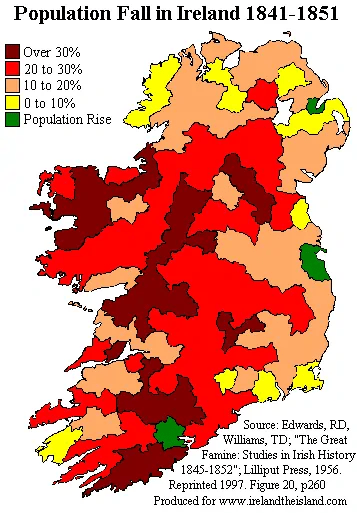
By the mid-19th century, the vast majority of Ireland’s Catholic population had been reduced to tenants on what had once been their own land, paying exorbitant rents to absentee landlords. This exploitative system reached its catastrophic climax during the Great Famine of 1845-1852, when a potato blight decimated the staple crop for millions of impoverished Irish, triggering mass starvation. Between 1845 and 1852, approximately one million people died whilst another million fled overseas to Canada, America, Australia and Britain.
The horror was compounded by mass evictions. Landlords, facing increased taxation for supporting impoverished tenants and seeing greater profit in cattle farming than crop cultivation, forcibly removed families from their homes. Historical records suggest that at least 250,000 families, potentially half a million to three-quarters of a million people, lost their homes during the Famine years through evictions, forced surrenders, and “clearances”. The most brutal evictions occurred in counties like Tipperary, earning the sobriquet “Bloody Tipperary,” along with Cork, Mayo, Galway, Clare, Kerry and Limerick.

This traumatic legacy forged an indelible connection in the Irish psyche between land ownership, security, and survival. The struggle for “land for the people” became a defining political movement. In 1881, the British government finally established the Irish Land Commission through the Land Law (Ireland) Act, which allowed tenants to gradually purchase the land they cultivated using their rent payments. This marked a watershed moment, the beginning of the end of landlordism in Ireland. By 1929, over 97% of tenant farmers had become freeholders, as the Land Commission facilitated the transfer of approximately 13.5 million acres by 1920.
Yet the trauma of displacement was far from over. The 1921 partition of Ireland, dividing the island into the Republic of Ireland and Northern Ireland, reignited sectarian tensions and led to civil war, causing further displacement and housing insecurity. Between 1969 and 1998, during the period known as “the Troubles,” an estimated 60,000 people were forcibly displaced in Northern Ireland due to sectarian violence.
This historical backdrop is crucial. Ireland’s housing crisis is not merely an economic or policy failure, it is layered upon centuries of dispossession, famine-driven migration, and the collective memory of home as a precarious, contested space. The current crisis, where thousands sleep in cars and emergency shelters whilst properties sit vacant as investment vehicles, carries echoes of a past where Irish people were systematically denied the security of a place to call their own.
The Celtic Tiger: boom, bubble and spectacular bust
Ireland’s transformation from one of Europe’s poorest nations to one of its wealthiest occurred with breathtaking speed. In the two decades ending in 2007, the country experienced what became known as the “Celtic Tiger” era, a period of unprecedented economic growth averaging over 6% annually. The catalyst was Ireland’s strategic decision to pursue an open, export-led economy underpinned by an extraordinarily low corporate tax rate.
From the 1990s onwards, Ireland standardised its corporate tax rate at 12.5%, less than half the European Union average of 20-25%, making it an irresistible destination for American multinationals seeking a European base. Technology giants like Apple, Google, Facebook, Microsoft and pharmaceutical companies like Pfizer established substantial operations in Ireland, not primarily for manufacturing, but to exploit what became known as the “Double Irish” tax avoidance strategy.
The Double Irish arrangement allowed US corporations to establish two Irish-registered companies, one managed from Ireland, the other managed from a tax haven like Bermuda, and funnel profits through the Netherlands (the “Dutch Sandwich”) to avoid both Irish and US taxes. This scheme, described as “one of the world’s most successful tax avoidance tools,” shielded up to $100 billion annually in US multinational foreign profits from taxation and helped US corporations accumulate $1 trillion in untaxed offshore reserves between 2004 and 2018.

The economic boom generated extraordinary wealth, at least on paper. Ireland’s GDP soared by 229% during the Celtic Tiger years. Rising incomes and cheap credit fuelled an unprecedented real estate bubble. Between 1996 and 2006, house prices quadrupled, and in 2006 alone, over 90,000 dwellings were constructed, a staggering figure for a nation of just over four million people.
But this boom contained the seeds of its own destruction. Banks, operating with minimal regulatory oversight, extended vast loans for commercial and residential property, expanding their assets to five times Ireland’s GDP. The government, intoxicated by the influx of tax revenues and construction-related economic activity, made a fateful decision: it ceased building social housing. Why bother with state provision when the private market appeared to be delivering homes at such unprecedented rates?
Then came 2008. The Global Financial Crisis exposed Ireland’s economy as a house of cards. As liquidity from overseas investors dried up, bank losses on property loans mounted catastrophically. The Irish government guaranteed the liabilities of the country’s six major banks and pumped the equivalent of 30% of GDP into the financial sector. The property bubble burst with devastating force: house prices in Dublin fell 56% from their peak, apartment prices dropped over 62%, and mortgage approvals plummeted to 1971 levels.
By the second quarter of 2010, house prices nationally had fallen 35% compared to 2007, and the number of housing loans approved fell by 73%. By 2012, more than 28% of Irish mortgages were in arrears or had been restructured. Unemployment soared to 15%. In November 2010, Ireland was forced to seek a €67.5 billion bailout from the IMF and European Union, equal to 40% of the country’s economy.
The construction industry collapsed. Having built 90,000 homes in 2006, by 2014 Ireland completed just 10,000 units. Ghost estates, partially completed housing developments abandoned mid-construction, scarred the landscape. Over 200,000 homes stood empty in 2012.

The vultures circle: financialisation and the second housing crisis
The post-crash period created a perfect storm for what would become Ireland’s current housing crisis. As the economy lay in ruins, international “vulture funds,” private equity firms and hedge funds with enormous financial firepower, swooped in to acquire distressed property assets at heavily discounted prices.
Between 2013 and 2021, the Irish government (through the National Asset Management Agency, or NAMA) and private banks conducted one of the world’s largest debt fire-sales, offloading tens of billions of euros worth of assets, including thousands upon thousands of homes and development land. These loans were discounted by up to 90% in some cases, drawing vulture funds from the United States, Britain, Germany, Holland, Israel and Canada.
This “financialisation of housing,” the transformation of homes from places to live into global financial assets, fundamentally altered Ireland’s housing market. By October 2025, the scale of vulture fund control had expanded dramatically. Current data shows that 113,000 mortgages are now controlled by these funds, a substantial increase from earlier estimates. In one notorious 2021 case, a vulture fund purchased 46 of 54 homes in a new Dublin housing estate, putting them up for rent at €3,175 per month, requiring an annual salary of €127,000 to be affordable under the “30% of income on rent” rule.
The vulture funds’ strategy was brutally simple: acquire properties cheaply, keep many deliberately vacant to artificially constrain supply and drive up rents, then extract maximum returns. Because private equity funds and hedge funds have access to huge financial firepower, they can enter when others cannot. Because they do not have a retail presence in Ireland or need to maintain client relationships, they can squeeze debtors and control markets as hard as they like.
The consequences were predictable. Rents, which had fallen during the crash, began rising relentlessly from 2012 onwards. The average national rent, which stood at just under €760 per month in early 2010, had nearly doubled to €1,402 by the end of 2019. By the second quarter of 2025, the average national rent had reached €2,055 per month, an increase of 106% from 2011. In Dublin, average rents exceeded €2,400 monthly, placing enormous strain on working families and young professionals.
House prices followed a similar trajectory. After bottoming out at an average of €205,476 in 2012, prices climbed steadily, reaching €366,653 by June 2023 and €370,000 by May 2025, representing an 8% year-on-year increase. However, October 2025 data showed the first signs of asking price softening in years, with some analysts suggesting the market may finally be approaching a turning point, though whether this represents genuine affordability improvement or simply a temporary pause remains unclear.
Policy failures: how government made the crisis worse
Perhaps the most damning aspect of Ireland’s housing crisis is that it was not inevitable. It was, to a significant extent, created and exacerbated by government policy choices. Multiple interventions, often well-intentioned, produced outcomes ranging from ineffective to actively counterproductive.
The prohibition of affordable housing models
In 2013, the Irish government banned “pensionatos,” traditional boarding houses with shared bathrooms, under the argument that “no one should live in accommodation without a private bathroom”. While intended to improve housing standards, the measure eliminated affordable options for students and low-income workers without replacing them with alternatives.
In 2020, the government banned “co-living” schemes, modern developments offering small private rooms with shared kitchens, popular with young professionals and digital nomads. The ban followed public outcry over proposed minimum room sizes of just 12 square metres. Again, the policy eliminated supply without addressing the underlying shortage, and ironically, government-provided emergency accommodation operates under the very standards the government deemed unacceptable for the private market.
The Help to Buy scheme: subsidising the wealthy
Introduced in Budget 2017 and originally expected to cost €40 million annually, the Help to Buy (HTB) scheme provides first-time buyers with a rebate of up to €30,000 on taxes paid, ostensibly to assist with deposits. By 2022, the scheme had cost the exchequer approximately €740.8 million, almost 19 times the original projection, with an average annual cost exceeding €105 million.
Multiple analyses have concluded the scheme is “poorly targeted with respect to incomes, location, house prices and other socioeconomic factors”. The data reveals that over one-third of HTB claims (34.47%) were for properties valued between €301,000 and €375,000, with only 2% for properties under €150,000. Research by Social Justice Ireland demonstrated that HTB disproportionately benefits purchasers buying higher-value properties, whilst a Department of Finance review concluded the scheme “probably contributed to house price increases,” precisely the opposite of its stated intent.
Critics argue HTB functions essentially as a “bonanza giveaway to private developers,” artificially inflating demand and prices whilst doing nothing to address the fundamental supply shortage. The Labour Party has called it a policy that “will make housing more unaffordable”.
Rent Pressure Zones: the law of unintended consequences
In 2016, facing spiralling rents, the government introduced Rent Pressure Zones (RPZs), designated areas where rent increases were capped at 4% annually (later reduced to the lower of 2% or inflation). The intention was to protect existing tenants from sharp rent rises whilst supply caught up with demand.
The reality proved more complex. Research by the Economic and Social Research Institute (ESRI) found that RPZ controls did moderate rents for existing tenants, but created a “two-tier rental market”. Whilst sitting tenants enjoyed lower rents, those seeking new accommodation faced higher rents as landlords compensated for restricted increases by setting new tenancies at maximum rates. The IMF argued that RPZs led to “lower supply of rented accommodation”.
Property developers claimed that rent controls, combined with rising interest rates, “asfixiated the construction of new rental properties”. Apartment construction for the rental market fell 24% in 2024 compared to the previous year.
However, in a major reform announced in October 2025, the government extended RPZs to cover the entire country whilst introducing significant changes set to take effect in March 2026. The new system allows landlords to reset rents after six-year tenancies and exempts new apartment developments from the 2% cap, attempting to balance tenant protection with supply incentives. Whether these reforms will prove more successful than previous iterations remains to be seen.
Airbnb and short-term lets: regulatory impotence
The explosive growth of Airbnb transformed thousands of long-term rental properties into short-term tourist accommodation, drastically reducing available housing stock. By early 2025, approximately 20,000 properties were listed as short-term lets on Airbnb in Ireland, compared to just 2,300 homes available for long-term private rental nationwide.
In 2019, Ireland introduced regulations requiring change-of-use planning permission for short-term lets exceeding 90 days in Rent Pressure Zones. The regulations proved “largely ineffective”: in 2023, only 91 applications for change-of-use permission or voluntary registration were received, compared to 9,142 entire-property Airbnb listings in RPZs. Research by the ESRI in April 2025 found that whilst short-term lets are concentrated in tourist hotspots (representing one in three lettings in Westport, one in six in Killarney, one in ten in Dublin’s inner city), enforcement remains minimal.
Threshold, Ireland’s national housing charity, has called for urgent legislation to establish a register of short-term lets to facilitate the return of properties to the long-term market. However, the ESRI report noted that “it cannot be assumed that many of the short-term lets in non-urban areas would be likely to switch to the private rental sector in the absence of Airbnb,” as many correspond to previously recorded holiday homes.
The supply crisis: bureaucracy, infrastructure and unmet targets
Ireland’s housing crisis is fundamentally a supply crisis. Expert consensus holds that Ireland needs to build between 50,000 and 60,000 homes annually to meet demand. In 2024, Ireland completed 32,949 homes, falling significantly short even of the government’s own target of 33,000, let alone the actual need.
Why can’t Ireland build enough homes? The answers are multiple and systemic.
Infrastructure deficits
Perhaps the most critical constraint is the absence of essential infrastructure, particularly water and energy, needed to support new housing developments. Uisce Éireann, Ireland’s water utility, warned in June 2025 that its capacity could hit “critical constraints” within three to four years, resulting in housing delivery coming to “a standstill”. The utility’s CEO, Niall Gleeson, stated that Dublin is “running out of road” and could be “one fine day away from water restrictions”.
To meet the government’s housing targets of 50,500 homes per year (scaling to 60,000 by 2030), Uisce Éireann estimated it would require an additional €2 billion over five years beyond the already planned €10.3 billion capital investment. The Construction Industry Federation has called for ringfencing €500 million per annum specifically for water and wastewater infrastructure to support housing, highlighting critical projects like the Greater Dublin Drainage and Water Supply Project.
Energy infrastructure presents similar challenges. The Construction Industry Federation has emphasised the need for “significantly increasing investment in energy infrastructure, especially to secure electricity supply for FDI-driven projects”. Without adequate electricity grid capacity, new housing developments face connection delays or outright impossibility.
Transport connections, link roads, roundabouts, and public transport, constitute another infrastructural bottleneck. The Irish Fiscal Council noted that “Ireland has significant infrastructure deficits in housing, health, transport, and electricity, and is 25% lower than average for high-income countries”.
Bureaucratic complexity and planning delays
The second major constraint is an extraordinarily complex and slow-moving approval and planning system. Social housing projects by local authorities have traditionally required a four-stage approval process, which critics argue “can add up to two years to the delivery of social housing after planning has been granted and before construction commences”. Sinn Féin housing spokesperson Eoin Ó Broin described this as “excessive red tape and bureaucracy” combined with an “overly complex public spending code”.
In August 2025, Housing Minister James Browne announced reforms to replace the four-stage process with a single-stage approval for all social housing projects up to €200 million. Whether this streamlining will significantly accelerate delivery remains to be seen.
Planning permission delays affect private and public developments alike. Independent TD Matt Shanahan blamed “bureaucracy over the last ten years” for the housing crisis, noting that planning applications that once ran to 8-10 pages now require 80 pages just for the business plan. Multiple stakeholders cited issues with “Irish Water, ESB networks, roads, planning approvals, and the Planning Appeals Board”.
The Construction Industry Federation’s Director General stated that “the main barriers lie outside the industry with persistent planning delays, a lack of zoned land, and slow delivery of enabling infrastructure”. Industry representatives report that “nobody wants to get into building in a significant way because it’s so difficult to make money at it now due to the costs”.
The Quango question: misplaced priorities?
One of the most controversial aspects of Ireland’s housing crisis is the apparent mismatch between government spending priorities and housing outcomes. Between 2015 and 2024, total government expenditure increased from €70 billion to €116 billion, a rise of 66%. Yet housing conditions did not improve proportionally.
In 2024, just €8 billion of the €116 billion budget was allocated to housing initiatives. By contrast, €24 billion went to “Quangos,” quasi-non-governmental organisations including marketing bodies, state television, and various regulatory agencies. Critics point to examples like the Irish Central Bank, which employs 2,100 public servants for regulatory functions despite Ireland using the Euro (regulated by the European Central Bank) and having no independent monetary policy, more than double Denmark’s comparable workforce.
The Housing Commission’s 2024 report concluded that “decades of housing interventions have not resolved fundamentally systemic failures” and that Ireland now has “one of the highest levels of public expenditure for housing in Europe, yet one of the poorest outcomes”. The report called for a “radical strategic reset of housing policy,” identifying “ineffective decision-making, reactive policy-making, and risk aversion” as core problems.
The human cost: lives in limbo
Behind every statistic lies a human story. Consider Jordyn, Jonathan, and their one-year-old daughter Delilah, who spent ten months living in their car and sleeping on friends’ couches. When they finally sought help from authorities, they were told they “were not a priority”. Only through the intervention of a local councillor were they eventually housed in emergency accommodation.
Or Justin, a social worker who had worked in emergency homeless accommodation, who himself became homeless. The bitter irony: the emergency shelters follow the very model, small spaces, shared bathrooms and kitchens, that the government banned in the private sector.
+ Read more: The sharp edge of change: How knife crime in Ireland is testing the limits of unarmed policing
The psychological and social toll is immense. The home ownership rate among those aged 25-39, once considered a prime home-owning age, has dwindled to just 7%, less than one-third of the 22% recorded in 2011. Young professionals are forced to choose between remaining in Ireland with no prospect of stable housing or emigrating, echoing the Famine-era migrations of their ancestors.
The crisis extends beyond individuals to entire communities. Businesses report that 81% struggle to hire workers because there is nowhere for potential employees to live. Tourism and hospitality sectors face similar challenges. The Housing Commission estimated a housing deficit of between 212,500 and 256,000 homes based on the 2022 Census.
The August 2025 homelessness figures of 16,353 people, including 5,145 children, represent not just numbers but families sleeping in hotel rooms, hostels, and emergency shelters, unable to establish stable lives or provide secure environments for their children. The Simon Community’s estimate of 290,000 people experiencing “invisible homelessness,” couch-surfing or living in overcrowded conditions, suggests the true scale of housing insecurity is far greater than official figures acknowledge.
The leprechaun economy: paper wealth, real poverty
The central paradox of Ireland’s housing crisis is this: How can one of the world’s wealthiest nations fail to house its own people?
The answer lies in understanding what economist Paul Krugman dubbed “leprechaun economics”. In July 2016, Ireland’s Central Statistics Office reported that the nation’s GDP had grown by an astonishing 26.3%, later revised to 34.4%, in 2015. This was not real economic growth. It was an accounting trick.
In Q1 2015, Apple executed what academics later identified as the largest base erosion and profit shifting (BEPS) action in history, restructuring $300 billion of intellectual property into Ireland using a new tax avoidance tool called Capital Allowances for Intangible Assets (CAIA). This single transaction artificially inflated Ireland’s GDP by approximately one-third overnight.
The distortion was so severe that in 2017, Ireland’s Central Bank introduced a new metric, Modified Gross National Income (GNI*), to remove some of the distortions caused by multinational tax strategies. Irish GDP stood at 162% of Irish GNI* in 2017. In other words, Ireland’s official GDP overstates the actual domestic economy by more than 60%.
This matters enormously for understanding the housing crisis. Ireland’s celebrated “wealth” exists primarily on corporate balance sheets and in tax filings, not in the pockets of ordinary Irish citizens or in public infrastructure. Ireland’s GDP is artificially inflated by BEPS accounting flows, creating a statistical illusion.
The International Monetary Fund estimated in 2019 that 60% of Irish foreign direct investment was “phantom,” existing only on paper for tax purposes. Ireland is ranked by academics as the world’s largest tax haven, larger even than the Caribbean tax haven system.
This explains the paradox: Ireland can simultaneously have one of the highest GDPs per capita in the world whilst its citizens cannot afford homes, its public services are underfunded relative to need, and its infrastructure lags 25% behind the average for high-income countries. The wealth simply isn’t where the statistics suggest it should be.
The term “leprechaun economics” has become synonymous with Ireland’s peculiar situation, a feature of tax havens where paper prosperity masks real economic challenges. As Krugman observed, when a billionaire walks into a pub, the average wealth of everyone in the room skyrockets, but nobody else’s actual wealth has changed. Ireland’s GDP reflects the billionaire, but most Irish people are still struggling to afford a pint.
Housing for All: ambitious plans, insufficient delivery
In September 2021, the Irish government launched “Housing for All,” described as “the single largest investment in housing since the 1960s”. The plan committed to spending €20 billion over five years to deliver an average of 33,000 homes annually through 2030, comprising 90,000 social housing units, 36,000 affordable homes, 18,000 cost-rental properties, and 170,000 private homes, a total of 300,000 new dwellings.
The plan contained 213 specific actions across four pathways: supporting homeownership and increasing affordability; eradicating homelessness and increasing social housing; increasing new housing supply; and addressing vacancy and efficient use of existing stock.
Initial progress reports showed mixed results. The Q4 2021 report indicated that 44 of 65 measures due for delivery (68%) were completed on schedule, with an overall delivery rate of 72% for measures due to date. In 2022, Ireland exceeded its annual target, completing just under 30,000 homes, 21% above the Housing for All target and representing a 46% increase over 2021.
However, subsequent years have proven more challenging. In 2024, while total housing completions reached 32,949, this fell short of the 33,000 target and far below the revised expert consensus of 50,000-60,000 needed. More troublingly, the social housing new-build target was missed by 17%, and the affordable housing target was missed by a staggering 60%.
By November 2024, recognising the insufficiency of the original targets, the government revised its ambitions upward: 303,000 new homes between 2025 and 2030, averaging 50,500 per year and scaling to 60,000 annually by 2030. This represents a substantial increase, 17,000 additional units per year, but also requires nearly doubling current delivery rates.
Budget 2026, announced on October 7-8, 2025, included new measures aimed at stimulating construction: a reduction in VAT on apartment construction from 13.5% to 9%, and enhanced corporation tax deductions for apartment developers. The government framed these measures as removing financial barriers to development, though critics questioned whether tax breaks would prove more effective than previous failed interventions.
Social Justice Ireland’s preliminary review of Housing for All noted critical concerns: the targets extend to 2030 whilst funding is guaranteed for only five years, and “there is no reference to the backlog built over more than a decade of under-provision”. The organisation questioned whether the plan truly addressed systemic failures or merely offered another iteration of ineffective interventions.
The Housing Commission’s 2024 report was more damning, concluding that despite being “in the midst of a housing crisis for almost a decade,” with government spending amongst the highest in Europe, Ireland has achieved “one of the poorest outcomes”. The report called for treating housing as a “unique national priority” and implementing a “radical strategic reset”.
Potential solutions: learning from failure
What would it actually take to resolve Ireland’s housing crisis? The accumulated evidence from policy failures and international comparisons suggests several key interventions.
Massive public housing construction
Ireland’s retreat from social housing construction in the 1980s-2000s created a dependency on private market delivery that has manifestly failed. Vienna, Austria, often cited as having the best housing system in Europe, has maintained approximately 60% social and cost-rental housing through continuous state investment over more than a century, resulting in rents 40-60% lower than comparable European cities.
Ireland’s commitment to build 90,000 social housing units by 2030 represents progress, but the delivery rate remains inadequate. Accelerating construction requires not just funding, but addressing the bureaucratic and infrastructure bottlenecks that constrain delivery. The August 2025 reforms introducing single-stage approval for social housing projects represent a positive step, but implementation and results remain to be seen.
Infrastructure investment as priority
Housing cannot be built without water, energy, and transport infrastructure. The government’s proposed allocation of €3 billion for infrastructure (€1 billion for water, €1.25 billion for housing infrastructure, €750 million for electricity grid) represents a start. However, Uisce Éireann alone states it needs an additional €2 billion over five years specifically for water and wastewater to support housing.
The Construction Industry Federation’s call to ringfence €500 million annually for water infrastructure and prioritise enabling infrastructure with multi-annual budgets recognises that infrastructure must lead, not follow, housing development. Ireland’s infrastructure deficit, 25% below the average for high-income countries, will not be resolved with incremental investment.
Planning reform: speed without sacrificing standards
The four-stage approval process for social housing that could add two years to projects after planning permission was already granted represented an indefensible inefficiency. The August 2025 reforms introducing single-stage approval for projects up to €200 million should be monitored closely for effectiveness.
More broadly, streamlining planning processes, reducing unnecessary bureaucracy, and providing clear timelines for decisions could unlock significant supply. However, this must be balanced against legitimate environmental, heritage, and community concerns. The solution is efficiency, not abandonment of standards.
Rethinking rent controls
The evidence from Ireland and internationally suggests that blanket rent controls, whilst protecting existing tenants, can reduce new supply and create perverse incentives. The reforms taking effect in March 2026, extending RPZs nationally but allowing rent resets after six years and exempting new developments, represent an attempt to balance tenant protection with supply incentives.
An alternative approach, practised in Vienna and elsewhere, is massive public provision of cost-rental housing that competes directly with the private market, constraining prices through supply rather than regulation. This addresses the fundamental problem (insufficient supply) rather than attempting to manage its symptoms (high rents).
Addressing short-term lets: enforcement over legislation
Ireland has regulations requiring planning permission for short-term lets exceeding 90 days, but enforcement has been virtually non-existent, 91 applications received against 9,142 Airbnb listings in RPZs. Threshold’s call for a mandatory register of short-term lets, coupled with genuine enforcement, could return significant housing stock to the long-term market.
However, the ESRI research cautioning that many short-term lets (particularly in rural tourist areas) would not convert to long-term rentals suggests enforcement alone will not solve the crisis. It must be part of a broader supply strategy.
Abolishing counterproductive schemes
The Help to Buy scheme, costing over €1.2 billion to date and demonstrably inflating prices whilst disproportionately benefiting wealthier buyers, should be abolished or radically reformed to target only those genuinely unable to access homeownership. Using limited public resources to subsidise developers rather than build public housing represents a fundamental misallocation.
Budget 2026’s decision to maintain and even expand HTB, despite overwhelming evidence of its counterproductive effects, suggests political considerations continue to trump evidence-based policy. The scheme remains popular with middle-class voters who benefit from it, even as it worsens affordability for everyone else.
Tackling financialisation: homes for people, not profit
The transformation of housing from places to live into financial assets for international investors lies at the heart of the modern crisis. With 113,000 mortgages now controlled by vulture funds, policies to restrict bulk purchasing by investment funds, impose vacancy taxes on deliberately empty properties, and provide preferential treatment to owner-occupiers over investors could help shift the balance.

Some European countries have successfully implemented restrictions on non-resident property ownership or requirements that properties be occupied rather than left vacant. Ireland’s reluctance to adopt similar measures reflects the same pro-investor orientation that created the crisis in the first place.
Confronting the Quango system
If Ireland genuinely spends €24 billion on quasi-governmental organisations whilst allocating only €8 billion to housing, a fundamental reallocation of priorities is overdue. A comprehensive audit of Quangos to identify duplication, inefficiency, and low-value activities could free significant resources for housing and infrastructure.
The Central Bank of Ireland employing 2,100 people for functions largely handled by the European Central Bank represents just one example of the bloated public sector that absorbs resources whilst failing to deliver on core needs like housing. Rationalising these organisations could release billions for more productive uses.
Realistic targets and accountability
Setting targets of 33,000 homes annually when expert consensus holds that 50,000-60,000 are needed guarantees failure. The November 2024 revision to 50,500 (scaling to 60,000) represents a necessary alignment with reality. However, targets without consequences for non-delivery are meaningless.
The establishment of a Housing Delivery Oversight Executive to identify and address delivery blockages, as recommended by the Housing Commission, could provide necessary accountability. Politicians must face electoral consequences for continued failure to meet housing targets, just as they would for failures in other critical areas of governance.
A crisis of choice, not inevitability
Ireland’s housing crisis is not a natural disaster or an unavoidable consequence of global economic forces. It is the predictable outcome of specific policy choices made over decades: the abandonment of social housing construction, the facilitation of vulture fund acquisition of property assets, the failure to invest in essential infrastructure, the creation of a tax system that generates phantom wealth rather than domestic prosperity, and the prioritisation of bureaucratic expansion over housing delivery.
The historical trauma of the Famine and centuries of dispossession adds a particularly bitter dimension to the contemporary crisis. The descendants of those who fought for “land for the people” in the 1880s now find themselves priced out of their own cities, living in cars or on couches, told they are “not a priority” when they seek help. The October 2025 homelessness figure of 16,353 people, including 5,145 children, represents not just a policy failure but a moral one.
The leprechaun economics that make Ireland appear fabulously wealthy on paper whilst its infrastructure crumbles and its people cannot afford homes represents a profound failure of economic policy and political will. As Krugman observed, the term has become a feature of all tax havens, jurisdictions that prioritise serving multinational corporate interests over meeting domestic needs.
+ Read more: Dublin bike theft: When ordinary citizens outperform armed police in property recovery
The solutions exist. Vienna demonstrates that continuous public investment in housing over decades creates affordability and security. Finland has virtually eliminated rough sleeping through a “Housing First” approach prioritising permanent housing over temporary shelters. Other European nations maintain infrastructure investment rates 25% higher than Ireland despite lacking Ireland’s corporate tax windfalls.
What Ireland lacks is not resources. The country runs budget surpluses, accumulating €23 billion in reserves in 2024 alone. What it lacks is political will to fundamentally restructure priorities, confront vested interests, and treat housing as the national emergency it has become.
Budget 2026’s measures, VAT reductions and tax deductions for developers, represent the same approach that has consistently failed: using public resources to subsidise private interests rather than directly providing public housing. The October 2025 softening of property asking prices offers a glimmer of hope that market dynamics may be shifting, but without fundamental policy changes, any price moderation will likely prove temporary.
The March 2026 Rent Pressure Zone reforms, allowing rent resets after six years whilst extending controls nationwide, attempt to thread an impossible needle: protecting tenants whilst incentivising supply. Yet the evidence suggests that no amount of tinkering with rent controls will solve a crisis rooted in fundamental undersupply. Only massive public housing construction, on the scale of Vienna’s century-long commitment, can break the cycle of speculation and scarcity that has made Ireland one of the most expensive places to live in Europe.
Until Ireland’s leaders recognise that a nation cannot call itself prosperous when tens of thousands of its citizens have nowhere to call home, the Irish housing crisis will continue. Until housing policy prioritises people over profit, Irish citizens over international investors, and long-term sustainability over short-term political expediency, the waiting lists will grow longer, the homeless numbers will rise higher, and the paradox of poverty amidst paper prosperity will deepen.
The path forward: choices Ireland must make
Ireland stands at a crossroads. One path leads toward continued dysfunction, deepening inequality, and the hollowing out of communities as young people emigrate and families fracture under the strain of housing insecurity. The other path requires confronting hard truths, making difficult choices, and committing to a multi-decade programme of public investment and structural reform.
The question is not whether Ireland can afford to fix its housing crisis. With budget surpluses, corporate tax revenues (however artificially inflated), and EU support, Ireland is one of the few nations in Europe with the fiscal capacity to address its housing shortage comprehensively. The question is whether Irish politicians will finally prioritise housing their own people over maintaining a system that serves international capital at the expense of domestic need.
Several immediate actions could begin to turn the tide. First, Ireland must treat housing construction with the same urgency it treated the bank bailout in 2008. When the financial system faced collapse, the government moved with unprecedented speed to inject billions into failing banks. Housing deserves no less urgency. Declaring a national housing emergency with extraordinary powers to fast-track construction, streamline approvals, and override local objections would signal that the government finally grasps the severity of the crisis.
Second, infrastructure investment must precede, not follow, housing development. Uisce Éireann’s warning that water capacity will reach critical constraints within three to four years represents a red line that cannot be crossed. The additional €2 billion the utility requires over five years is a fraction of the budget surplus Ireland accumulates annually. Ringfencing this funding immediately, along with comparable investments in electricity grid capacity and transport infrastructure, would remove the most fundamental barriers to construction.
Third, Ireland must break its addiction to failed subsidy schemes like Help to Buy. Every euro spent inflating house prices through demand-side subsidies is a euro not spent building actual homes. Redirecting the €150+ million spent annually on HTB toward direct public housing construction would deliver thousands of additional social and affordable units. The political courage required to end a popular middle-class subsidy would be repaid many times over in increased housing delivery.
Fourth, the vulture fund problem requires direct intervention. While the number of mortgages under vulture fund control has grown to 113,000, other European countries have demonstrated that political will can constrain financial predation. Vacancy taxes punitive enough to make property hoarding uneconomic, restrictions on bulk purchasing by investment funds, and preferential treatment for owner-occupiers in property sales could begin to shift the balance from housing as financial asset to housing as human necessity.
Fifth, enforcement of existing regulations, particularly around short-term lets, must become genuine rather than performative. A mandatory register of all Airbnb properties, coupled with automatic planning enforcement for non-compliant properties, would return thousands of homes to the long-term rental market. The technology to track and enforce these regulations exists. What lacks is political will to confront the tourist industry and property owners profiting from the current system.
Sixth, the Quango system requires fundamental reform. In any organisation, when spending increases 66% over a decade whilst core outcomes deteriorate, management would face consequences. Ireland’s public sector must undergo the same scrutiny. A zero-based budgeting exercise, requiring every Quango to justify its existence and funding level from scratch, could release billions for housing and infrastructure. The Central Bank’s 2,100 employees represent just one obvious target for rationalisation.
Finally, Ireland must abandon the leprechaun economics that prioritise corporate tax revenues over domestic prosperity. While the 12.5% (now 15% for large corporations under global minimum tax agreements) corporate rate has generated substantial revenues, those revenues have not translated into quality of life improvements for ordinary Irish people. A tax system that produces phantom GDP growth whilst citizens sleep in cars is not a success, it is a failure masquerading as prosperity.
Learning from success: the Vienna model revisited
Vienna’s housing system, repeatedly ranked the world’s best, offers a roadmap Ireland could follow. The Austrian capital has maintained approximately 60% social and cost-rental housing through continuous public investment since the 1920s. The result: rents in Vienna average 40-60% lower than comparable European cities, homelessness rates are minimal, and housing security is treated as a right rather than a luxury.
The Vienna model rests on several principles directly applicable to Ireland. First, the city treats housing as a public good requiring perpetual public investment, not a market commodity to be left to private developers. The city builds thousands of social housing units annually and has done so for over a century. This sustained commitment creates stable supply that moderates market prices.
Second, Vienna’s social housing serves all income levels, not just the poorest. Middle-class Viennese live in social housing alongside working-class residents, creating mixed-income communities and ensuring political support for continued investment. When the middle class benefits from social housing, politicians cannot cut funding without electoral consequences.
Third, the city uses cost-rental housing, units rented at cost recovery rather than market rates, to provide affordable options for those above social housing income limits but unable to afford market rents. This fills the gap that leaves so many Irish people trapped between ineligibility for social housing and inability to afford private rent.
Fourth, Vienna invests heavily in quality. Social housing developments feature gardens, community facilities, and architectural distinction. Residents take pride in their housing, and social housing carries no stigma. This contrasts sharply with Ireland’s emergency accommodation and neglected social housing estates.
Fifth, the city maintains long-term thinking. Vienna’s housing strategy spans decades, not electoral cycles. Politicians plant trees knowing they will not sit in their shade, but that future generations will. Ireland’s short-term thinking, where housing plans rarely survive beyond a single government, guarantees continued crisis.
Could Ireland adopt the Vienna model? The fiscal capacity exists. Ireland’s budget surplus of €23 billion in 2024 dwarfs Vienna’s annual social housing investment. The political will, however, remains absent. Adopting Vienna’s approach would require acknowledging that decades of Irish housing policy have failed, that the private market cannot and will not solve the crisis, and that massive sustained public investment represents the only viable solution.
It would require politicians to think beyond the next election, to prioritise long-term housing security over short-term political gains. It would require confronting developers, landlords, and investment funds who profit from scarcity. It would require the Irish state to reassert that housing is too important to be left to market forces, that some things are fundamental rights rather than commodities.
The cost of inaction: Ireland’s lost generation
While politicians debate policy tweaks and developers lobby for tax breaks, an entire generation of young Irish people faces a future without housing security. The 7% home ownership rate among those aged 25-39 represents not just a statistic but a fundamental break in the social contract. Previous generations could reasonably expect that work, savings, and patience would eventually yield a home. Current young adults harbour no such illusions.
The consequences extend far beyond housing. Young professionals delay or forego having children because they lack stable housing. Families stay trapped in unsuitable accommodation because nothing better exists within their means. Talented graduates emigrate not because Ireland lacks opportunities, but because those opportunities come without anywhere to live.
Businesses report that 81% struggle to hire workers due to housing shortages. This constraint on labour supply limits economic growth, reduces productivity, and forces companies to locate elsewhere. The housing crisis has become an economic crisis, constraining Ireland’s future prosperity. When nurses, teachers, and other essential workers cannot afford to live near their workplaces, the entire society suffers.
The social fabric frays when young people cannot establish independent households, when families double up in overcrowded accommodation, when homelessness becomes normalised. The psychological toll of housing insecurity, the constant stress of unaffordable rent, the humiliation of living in emergency accommodation, the despair of saving for deposits that recede faster than incomes rise, creates a generation marked by anxiety and precarity.
October 2025 marked another record: 16,353 people in emergency accommodation, including 5,145 children. Each of those children grows up without stability, moving between hotels and hostels, changing schools repeatedly, lacking space for homework or play. The developmental impact of childhood housing insecurity echoes through entire lives. Ireland is creating trauma that will reverberate for decades.
The bitter irony is that solutions exist and resources are available. Ireland is not a poor country forced to choose between housing and other necessities. It is a wealthy country choosing to tolerate mass housing insecurity whilst accumulating budget surpluses. This is not an economic problem. It is a political choice.
Conclusion: prosperity without homes is not prosperity
The Irish housing crisis represents the clearest possible illustration that GDP growth, corporate tax revenues, and paper wealth mean nothing when ordinary people lack the most basic security of a place to call home. The Irish housing crisis demonstrates how Ireland’s “economic miracle” has produced world-leading GDP per capita whilst failing spectacularly at the fundamental task of housing its population.
The leprechaun economics that inflate Ireland’s statistics whilst its people sleep in cars expose the hollowness of conventional economic measures. When economists celebrate Ireland’s growth rates whilst 290,000 people experience housing insecurity, something is profoundly wrong with how we define success.
The solutions are neither mysterious nor unaffordable. Other countries house their populations successfully. Vienna proves that sustained public investment creates lasting affordability. Finland shows that political will can virtually eliminate homelessness. The Nordic countries demonstrate that high taxes and generous social provision create better quality of life than low-tax, market-driven systems.
What Ireland lacks is not resources or knowledge, but political courage. The courage to tell developers that public need trumps private profit. The courage to tell international investors that homes are for living in, not financial speculation. The courage to tell middle-class voters that programmes like Help to Buy that benefit them personally harm society collectively.
Until Ireland’s leaders find that courage, the crisis will worsen. The October 2025 softening of asking prices offers false hope unless accompanied by structural change. Market corrections without supply increases simply make housing fractionally less unaffordable rather than actually affordable. And the moment prices stabilise, speculation will resume unless the underlying incentives change.
The answer will determine whether Ireland’s housing crisis becomes a temporary aberration in an otherwise successful modern history, or the defining failure of a generation. A leprechaun economy that promised prosperity but delivered precarity. That celebrated wealth on balance sheets whilst its people slept in cars. That ultimately proved that GDP growth means nothing when your own citizens have nowhere to call home.
The children sleeping in hotels tonight, the families living in cars, the young professionals emigrating for want of housing, they are not statistics. They are Ireland’s present and future. How Ireland treats them will define what kind of country it becomes. A wealthy nation that houses its people, or a tax haven with a homelessness crisis. A society that provides security and dignity, or an economy that optimises spreadsheets whilst abandoning citizens.
Ireland has the resources, the knowledge, and the capability to solve the Irish housing crisis. What it needs now is the will. The question facing Irish voters and politicians is simple: will you choose housing for people, or profits for investors? Will you build a society, or maintain a tax haven? The answer cannot wait another budget cycle whilst thousands more lose their homes.


